MCQ
Mark the correct options:
  • A
    A system $X$ is in thermal equilibrium with $Y$ but not with $Z.$ System $Y$ and $Z$ may be in thermal equilibrium with each other.
  • B
    A system $X$ is in thermal equilibrium with $Y$ but not with $Z$. Systems $Y$ and $Z$ are not in thermal equilibrium with each other.
  • C
    A system $X$ is neither in thermal equilibrium with $Y$ nor with $Z$. The system $Y$ and $Z$ may be in thermal equilibrium with each other.
  • Both $B$ and $C$

Answer

Correct option: D.
Both $B$ and $C$
Key concept: Two bodies are said to be in thermal equilibrium with each other, when no heat flows from one body to the other. That is when both the bodies are at the same temperature.
According to the problem,
$b.$ If two systems $X$ and $Y$ are in thermal equilibrium, i.e., $\mathrm{T}_{\mathrm{X}}=\mathrm{T}_{\mathrm{y}}$ and $x$ is not in thermal equilibrium with $z$ , i.e., $T_X \neq T_z$ then clearly, $T_y \neq T_Z$ Hence, $y$ and $z$ are not in thermal equilibrium.
$c.$ If $X$ ais not in thermal equilibrium with $Y$, i.e., $T_X \neq T_y$ and also $X$ is not thermal equilibrium with $Y$, i.e., $T_X$ $\neq T_Z$. Then we cannot say about equilibrium of $Y$ and $Z$, they may or may not be in equilibrium.

Need a full question paper?

Generate a complete, print-ready paper with questions like this in minutes — across 16+ boards, with answer keys.

Start Generating Free

Similar questions

Two bodies of masses $m$ and $4m$ are moving with equal linear momentum. The ratio of their kinetic energies is:
A projectile moving vertically upwards with a velocity of $200\, ms^{-1}$ breaks into two equal parts at a height of $490\, m$. One part starts moving vertically upwards with a velocity of $400\, ms^{-1}$. How much time it will take, after the break up with the other part to hit the ground? .............. $\mathrm{s}$
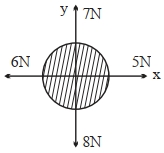
For a free body diagram shown in the figure, the four forces are applied in the ' $x$ ' and ' $y$ ' directions. What additional force must be applied and at what angle with positive $x$-axis so that the net acceleration of body is zero?
The 'Kangri' is an earthen pot used to stay warm in Kashmir during the winter months. Assume that the 'Kangri' is spherical and of surface area $7 \times 10^{-2} \,m ^{2}$. It contains $300 g$ of a mixture of coal, wood and leaves with calorific value of $30 \,kJ / g$ (and provides heat with $10 \%$ efficiency). The surface temperature of the 'Kangri' is $60^{\circ} C$ and the room temperature is $0^{\circ} C$. Then, a reasonable estimate for the duration $t$ (in h) that the 'Kangri' heat will last is (take the 'Kangri' to be a black body)
The engine of a train sounds a whistle at frequency v. The frequency heard by a passenger is:
When two tuning forks (fork $1$ and fork $2$) are sounded simultaneously, $4$ beats per second are heard. Now, some tape is attached on the prong of the fork $2$. When the tuning forks are sounded again, $6$ beats per second are heard. If the frequency of fork $1$ is $200\, Hz$, then what was the original frequency of fork $2$? .... $Hz$
A block of ice floats in an oil in a vessel when the ice melts, the level of oil will ..............
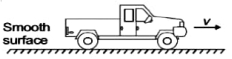
A cart loaded with sand moving with velocity $v$. Sand is falling through the hole as shown in diagram then after falling on the ground sand is
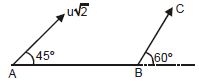
A particle is projected from a point $A$ with velocity $u\sqrt 2$ at an angle of $45^o$ with horizontal as shown in fig. It strikes the plane $BC$ at right angles. The velocity of the particle at the time of collision is
Which of the following sets of concurrent forces may be in equilibrium