Question
Mark the correct options:
  1. An atom with a vacancy has smaller energy that a neutral atom.
  2. K X-ray is emitted when a hole makes a jump from the K shell to some other shell.
  3. The wavelength of K X-ray is smaller than the wavelength of L X-ray of the same material.
  4. The wavelength of $\text{K}_\alpha$ X-ray is smaller than the wavelength of $\text{K}_\beta$ X-ray of the same material.

Answer

  1. K X-ray is emitted when a hole makes a jump from the K shell to some other shell.
  2. The wavelength of K X-ray is smaller than the wavelength of L X-ray of the same material.

Explanation:

Energy of a vacant atom is higher than that of a neutral atom.

Hence, option (a) is incorrect.

K X-ray is emitted when an electron makes a jump to the K shell from some other shell. As a result, a positive charge hole is created in the outer shell. As the electron continuously moves to the K shell, the hole moves from the K shell to some other shell.

Hence, option (b) is correct.

K X-ray is emitted due to the transition of an electron from the L or M shell to the K shell and L X-ray is emitted due to the transition of an electron from the M or N shell to the L shell. The energy involved in the transition from the L or M shell to the K shell is higher than the energy involved in the transition from the M or N shell to the L shell. Since the energy is inversely proportional to the wavelength, the wavelength of the K X-ray is smaller than the wavelength of the L X-ray of the same material. Hence, option (c) is correct.

If EK, EL and EM are the energies of K, L and M shells, respectively, then the wavelength of $\text{K}_\alpha$ X-ray $(\lambda_1)$ is given by

$\lambda_1=\frac{\text{hc}}{\text{E}_\text{K}-\text{E}_\text{L}}$

Here,

h = Planck's constant

c = Speed of light

Wavelength of the $\text{K}_\beta$ x-ray $(\lambda_2)$ is given by

$\lambda_2=\frac{\text{hc}}{\text{E}_\text{K}-\text{E}_\text{M}}$

As the difference of energies (EK - EM) is more than (E- EL), $\lambda_2$ is less than $\lambda_1$.

Hence, option (d) is not correct.

Need a full question paper?

Generate a complete, print-ready paper with questions like this in minutes — across 16+ boards, with answer keys.

Start Generating Free

Similar questions

A transistor has three impurity regions. All the three regions have different doping levels. In order of increasing doping level, the regions are:
The materials having high resistance to the passage of electricity are called as:

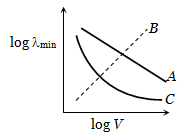
The dependence of the short wavelength limit   on the accelerating potential V is represented by the curve of figure

(a) A 

(b) B 

(c) C 

(d) None of these

In order to pass 10% of main current through a moving coil galvanometer of 99 ohm, the resistance of the required shunt is

(a) 9.9 Ω

(b) 10 Ω

(c) 11 Ω

(d) 9 Ω

There is a uniform electric field of strength   along y-axis. A body of mass 1g and charge is projected into the field from origin along the positive x-axis with a velocity 10m/s. Its speed in m/s after 10s is (Neglect gravitation)

(a) 10

(b) 5 

(c) 10 

(d) 20

Assertion  :  In Young’s experiment, the fringe width for dark fringes is different from that for white fringes.

Reason      : In Young’s double slit experiment the fringes are performed with a source of white light, then only black and bright fringes are observed.

(a) If both assertion and reason are true and the reason is the correct explanation of the assertion.

(b) If both assertion and reason are true but reason is not the correct explanation of the assertion.

(c) If assertion is true but reason is false.

(d) If the assertion and reason both are false.

Which of the following about potential difference between any two points is true?
  1. It depends only on the initial and final position.
  2. It is the work done per unit positive charge in moving from one point to other.
  3. It is more for a positive charge of two units as compared to a positive charge of one unit.

    Assertion   :   Charge is invariant.

    Reason      : Charge does not depends on speed of frame of reference.

    (a) If both assertion and reason are true and the reason is the correct explanation of the assertion.

    (b) If both assertion and reason are true but reason is not the correct explanation of the assertion.

    (c) If assertion is true but reason is false.

    (d) If the assertion and reason both are false.

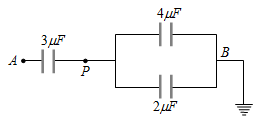
    In the figure a potential of + 1200 V is given to point A and point B is earthed, what is the potential at the point P

    (a) 100 V 

    (b) 200 V

    (c) 400 V 

    (d) 600 V