Questions

M.C.Q (1 Marks)

Take a timed test

21 questions · self-marked practice — reveal the answer and mark yourself.

Question 11 Mark
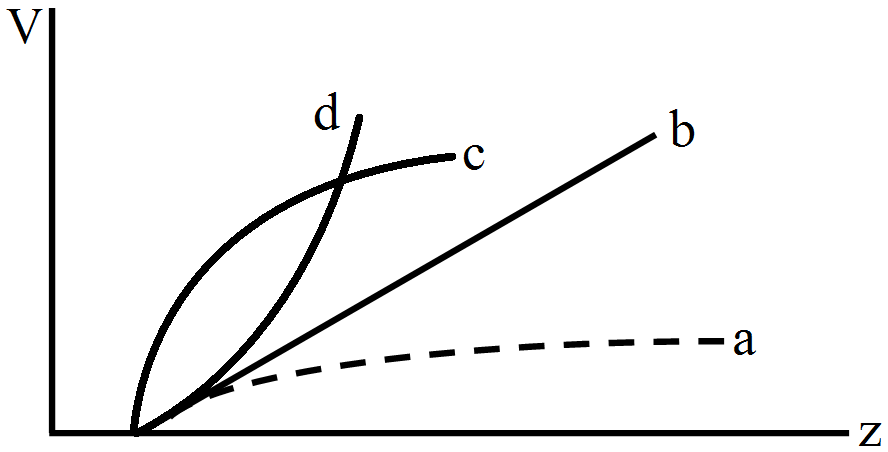
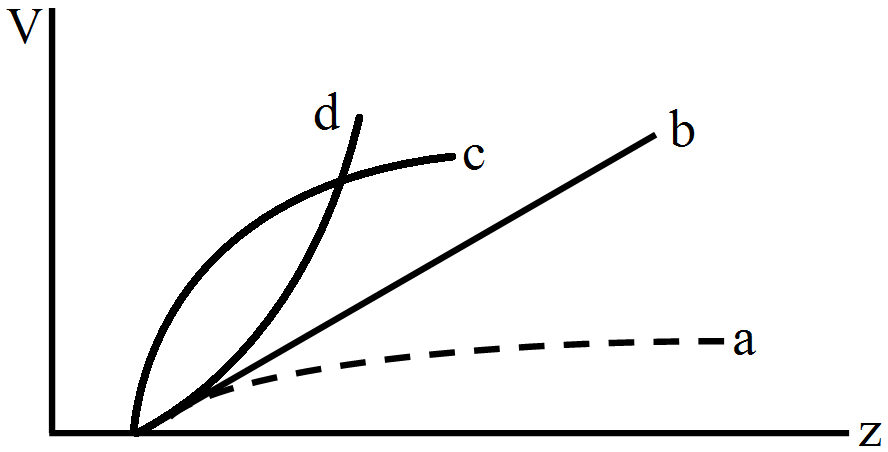
Frequencies of $\text{K}_\alpha$ X-rays of different materials are measured. Which one of the graphs in the figure may represent the relation between the frequency v and the atomic number Z?

Answer
Using Moseley's Law,

$\sqrt{\text{v}}$ = a(Z−b)

where, v = frequency of Kα X-ray

Z = atomic number

$\therefore \text{v}=\text{a}^2(\text{Z}-\text{b})^2$

$\Rightarrow(\text{Z}-\text{b})^2=\frac{\text{v}}{\text{a}^2}$

This is  the equation of a parabola with some intercept on the axis, representing atomic number (Z). Hence, curve d represent this relation correctly.

View full question & answer
Question 21 Mark
The X-ray beam emerging from an X-ray tube:
  1. Is monochromatic.
  2. Has all wavelengths smaller than a certain maximum wavelength.
  3. Has all wavelengths greater than a certain minimum wavelength.
  4. Has all wavelengths lying between a minimum and a maximum wavelength.
Answer
  1. Has all wavelengths greater than a certain minimum wavelength.

Explanation:

The X-ray beam emerging from an X-ray tube consists of wavelengths greater than a certain minimum wavelength called cutoff wavelength.

View full question & answer
Question 31 Mark
50% of the X-ray coming from a Coolidge tube is able to pass through a 0.1mm thick aluminium foil. The potential difference between the target and the filament is increased. The thickness of the aluminium foil that will allow 50% of the X-ray to pass through will be:
  1. zero
  2. < 0.1mm
  3. 0.1mm
  4. > 0.1mm
Answer
  1. > 0.1mm

Explanation:

As we increase the accelerating potential between the filament and the target, the penetrating power of the X-ray will increase. As a result, the fraction of the X-ray passing through the foil will increase. But it is given that the same fraction of the X-ray is passing. Therefore, the thickness of the aluminium foil should be increased to maintain the same fraction of the X-ray that will pass through the foil.

View full question & answer
Question 41 Mark
Visible light passing through a circular hole forms a diffraction disc of radius 0.1mm on a screen. If an X-ray is passed through the same setup, the radius of the diffraction disc will be:
  1. zero
  2. < 0.1mm
  3. 0.1mm
  4. > 0.1m
Answer
  1. < 0.1mm

Explanation:

Radius of the diffraction disc is directly proportional to the wavelength of the light used for the given hole. We know that the wavelength of an X-ray is less than the wavelength of visible light. If an X-ray is passed through the same setup, the radius of the diffraction disc will be less than 0.1m.

View full question & answer
Question 51 Mark
One of the following wavelengths is absent and the rest are present in the X-rays coming from a Coolidge tube. Which one is the absent wavelength?
  1. 25pm
  2. 50pm
  3. 75pm
  4. 100pm
Answer
  1. 25pm

Explanation:

Cutoff wavelength (minimum) is absent in the X-rays coming from a Coolidge tube. Hence, the 25 pm wavelength is absent.

View full question & answer
Question 61 Mark
Cutoff wavelength of X-rays coming from a Coolidge tube depends on the:
  1. Target material.
  2. Acelerating voltage.
  3. Separation between the target and the filament.
  4. Temperature of the filament.
Answer
  1. Acelerating voltage.

Explanation:

Cutoff wavelength (λmin) is given by

$\lambda_{\text{min}}=\frac{\text{hc}}{\text{eV}}$

Here,

h = Planck's constant

c = Speed of light

V = Accelerating voltage

e = Charge of electron

Clearly, a cutoff wavelength depends on accelerating voltage. It does not depend on the target material, separation between the target and the temperature of the filament.

View full question & answer
Question 71 Mark
X-ray incident on a material:
  1. Exerts a force on it.
  2. Transfers energy to it.
  3. Transfers momentum to it.
  4. Transfers impulse to it.
Answer
  1. Exerts a force on it.
  2. Transfers energy to it.
  3. Transfers momentum to it.
  4. Transfers impulse to it.

Explanation:

An X-ray exerts force on the material on which it is incident. For example, it can penetrate into metals. An X-ray also transfers energy, momentum and impulse to the material on which it incident. Therefore, all options are correct.

View full question & answer
Question 81 Mark
​​​​50% of the X-rays coming from a Coolidge tube are able to pass through a 0.1mm thick aluminium foil. If the potential difference between the target and the filament is increased, the fraction of the X-rays passing through the same foil will be:
  1. 0%
  2. < 50%
  3. 50%
  4. > 50%
Answer
  1. > 50%

Explanation:

The penetrating power of X-rays varies directly with the accelerating potential of the electrons (V) or the energy of the X-rays. So, if the potential difference between the target and the filament is increased, the fraction of the X-rays passing through the foil will also increase.

View full question & answer
Question 91 Mark
Consider a photon of continuous X-ray and a photon of characteristic X-ray of the same wavelength. Which of the following is/are different for the two photons?
  1. Frequency.
  2. Energy.
  3. Penetrating power.
  4. Method of creation.
Answer
  1. Method of creation.

Explanation:

Let $\lambda_1$ and $\lambda_2$ be the wavelengths of the photons of continuous and characteristic X-rays, respectively.

Given:

$\lambda_1=\lambda_2=\lambda$

Now, frequency $(\nu)$ is given by

$\nu=\frac{\text{c}}{\lambda_1}=\frac{\text{c}}{\lambda_2}$

$\Rightarrow\nu=\frac{\text{c}}{\lambda}$

Hence, the frequency of both the photons is the same.

Energy of a photon (E) is given by

$\text{E}=\text{h}\nu$

As the frequency of both the photons is the same, they will have the same energy.

The photon of the continuous X-ray and the photon of the characteristic X-ray consist of the same penetrating power.

The photon of the characteristic X-ray is created because of the transition of an electron from one shell to another. The photon of the continuous X-ray is created because of the conversion of the kinetic energy of an electron into a photon of electromagnetic radiation.

View full question & answer
Question 101 Mark
X-ray from a Coolidge tube is incident on a thin aluminium foil. The intensity of the X-ray transmitted by the foil is found to be I0. The heating current is increased to increase the temperature of the filament. The intensity of the X-ray transmitted by the foil will be:
  1. zero
  2. < I0
  3. I0
  4. > I0
Answer
  1. > I0

Explantion:

We know that the intensity of an X-ray is directly proportional to the current through the X-ray tube. If the filament current is increased to increase the temperature of the filament, more electrons will be emitted from the filament per unit time. As a result, current in the X-ray tube will increase and consequently, the intensity of the X-ray will also increase.

View full question & answer
Question 111 Mark
The figure shows the intensity-wavelength relations of X-rays coming from two different Coolidge tubes. The solid curve represents the relation for the tube A in which the potential difference between the target and the filament is VA and the atomic number of the target material is ZA. These quantities are VB and ZB for the other tube. Then:
  1. VA > VB, ZA > ZB
  2. VA > VB, ZA < ZB
  3. VA < VB, ZA > ZB
  4. VA > VB, ZA < ZB
​​​​​​​​​​​​​​
Answer
  1. VA > VB, ZA < ZB

Explanation:

It is clear from the figure that the X-ray of tube A has less cutoff wavelength than the X-ray of tube B.

$\therefore\lambda_\text{A}<\lambda_\text{B}$

Using Moseley's Law,

ZA < ZB

$\lambda\propto\frac{1}{\text{V}}$, where V is the voltage applied in the X-ray tube.

$\therefore$ V> VB

View full question & answer
Question 121 Mark
Consider a photon of a continuous X-ray coming from a Coolidge tube. Its energy comes from:
  1. The kinetic energy of the striking electron.
  2. The kinetic energy of the free electrons of the target.
  3. The kinetic energy of the ions of the target.
  4. An atomic transition in the target.
Answer
  1. The kinetic energy of the striking electron.

​​​​​​​Explanation:

In an X-ray tube, electrons are emitted by the filament when it is heated. An electric field generated by a DC battery between the filament and the target makes the electrons hit the target atoms with a very high speed. As a result, the electrons lose their kinetic energy to eject photons, which leads to a continuous emission of X-rays.

View full question & answer
Question 131 Mark
For harder X-rays:
  1. The wavelength is higher.
  2. The intensity is higher.
  3. The frequency is higher.
  4. The photon energy is higher.
Answer
  1. The frequency is higher.
  2. The photon energy is higher.

Explanation:

Harder X-rays are the X-rays having low wavelengths. Since the frequency varies inversely with the wavelength, hard X-rays have high frequency.

Energy of a photon (E) is given by

$\text{E}=\frac{\text{hc}}{\lambda}$

Here,

h = Planck's constant

c = Speed of light

$\lambda$ = Wavelength of light.

Clearly, energy varies inversely with wavelength. Therefore, the energy of the photon will be higher for the hard X-ray.

View full question & answer
Question 141 Mark
X-ray beam can be deflected:
  1. By an electric field.
  2. By a magnetic field.
  3. By an electric field as well aa by a magnetic field.
  4. Neither by an electric field nor by a magnetic field.
Answer
  1. Neither by an electric field nor by a magnetic field.

Explanation:

Since X-rays do not have any charged particles, they are not deflected by an electric field or a magnetic field.

View full question & answer
Question 151 Mark
For a given material, the energy and wavelength of characteristic X-rays satisfy:
  1. $\text{E}(\text{K}_\alpha)>\text{E}(\text{K}_\beta)>\text{E}(\text{K})_\gamma$
  2. $\text{E}(\text{M}_\alpha)>\text{E}(\text{L}_\alpha)>\text{E}(\text{K}_\alpha)$
  3. $\lambda(\text{K}_\alpha)>\lambda(\text{K}_\beta)>\lambda(\text{K}_\gamma)$
  4. $\lambda(\text{M}_\alpha)>\lambda(\text{K}_\beta)>\lambda(\text{K}_\alpha)$
Answer
  1. $\lambda(\text{K}_\alpha)>\lambda(\text{K}_\beta)>\lambda(\text{K}_\gamma)$

  2. $\lambda(\text{M}_\alpha)>\lambda(\text{K}_\beta)>\lambda(\text{K}_\alpha)$

Explanation:

The $\text{K}_\gamma$ transition (from the N shell to the K shell) involves more energy than the $\text{K}_\beta$ transition (from the M shell to the K shell), which has more energy than the $\text{K}_\alpha$ transition (from the L shell to the K shell).

As the energy varies inversely with the wavelength,

$\lambda(\text{K}_\alpha)>\lambda(\text{K}_\beta)>\lambda(\text{K}_\gamma)$

The $\text{M}_\alpha$ transition is due to the jumping of an electron from the N shell to the M shell and involves less energy than the $ \text{L}_\alpha$ transition (from the M shell to the L shell), which involves less energy than the $\text{K}_\alpha$ transition (from the L shell to the K shell).

As the energy varies inversely with the wavelength,

$\lambda(\text{M}_\alpha)>\lambda(\text{L}_\alpha)>\lambda(\text{K}_\alpha)$

View full question & answer
Question 161 Mark
The energy of a photon of a characteristic X-ray from a Coolidge tube comes from:
  1. The kinetic energy of the striking electron.
  2. The kinetic energy of the free electrons of the target.
  3. The kinetic energy of the ions of the target.
  4. An atomic transition in the target.
Answer
  1. An atomic transition in the target.

Explanation:

In an X-ray tube, electrons are emitted by the filament. These electrons are made to strike the filament by applying an electric field between the filament and the target. As a result of it, the kinetic energy of the electrons is lost to the target atoms. This energy is utilised by the target atoms to knock out an electron from the innermost shell. Consequently, the electron makes a transition from the higher energy state to this vacant shell. Due to this transition, the difference of energy of the two states gives photon of characteristic X-ray.

View full question & answer
Question 171 Mark
The potential difference applied to an X-ray tube is increased. As a result, in the emitted radiation:
  1. The intensity increases.
  2. The minimum wavelength increases.
  3. The intensity remains unchanged.
  4. The minimum wavelength decreases.
Answer
  1. The intensity remains unchanged.
  2. The minimum wavelength decreases.

Explanation:

Cutoff wavelength $(\lambda_\text{min})$ is given by

$\lambda_\text{min}=\frac{\text{hc}}{\text{eV}}$

Here,

h = Planck's constant

c = Speed of light

V = Accelerating voltage

e = Charge of electron

If the potential difference applied to an X-ray tube (V) is increased, then the minimum wavelength (cutoff wavelength) gets decreased.

Intensity is not affected by the potential difference applied.

View full question & answer
Question 181 Mark
Mark the correct options:
  1. An atom with a vacancy has smaller energy that a neutral atom.
  2. K X-ray is emitted when a hole makes a jump from the K shell to some other shell.
  3. The wavelength of K X-ray is smaller than the wavelength of L X-ray of the same material.
  4. The wavelength of $\text{K}_\alpha$ X-ray is smaller than the wavelength of $\text{K}_\beta$ X-ray of the same material.
Answer
  1. K X-ray is emitted when a hole makes a jump from the K shell to some other shell.
  2. The wavelength of K X-ray is smaller than the wavelength of L X-ray of the same material.

Explanation:

Energy of a vacant atom is higher than that of a neutral atom.

Hence, option (a) is incorrect.

K X-ray is emitted when an electron makes a jump to the K shell from some other shell. As a result, a positive charge hole is created in the outer shell. As the electron continuously moves to the K shell, the hole moves from the K shell to some other shell.

Hence, option (b) is correct.

K X-ray is emitted due to the transition of an electron from the L or M shell to the K shell and L X-ray is emitted due to the transition of an electron from the M or N shell to the L shell. The energy involved in the transition from the L or M shell to the K shell is higher than the energy involved in the transition from the M or N shell to the L shell. Since the energy is inversely proportional to the wavelength, the wavelength of the K X-ray is smaller than the wavelength of the L X-ray of the same material. Hence, option (c) is correct.

If EK, EL and EM are the energies of K, L and M shells, respectively, then the wavelength of $\text{K}_\alpha$ X-ray $(\lambda_1)$ is given by

$\lambda_1=\frac{\text{hc}}{\text{E}_\text{K}-\text{E}_\text{L}}$

Here,

h = Planck's constant

c = Speed of light

Wavelength of the $\text{K}_\beta$ x-ray $(\lambda_2)$ is given by

$\lambda_2=\frac{\text{hc}}{\text{E}_\text{K}-\text{E}_\text{M}}$

As the difference of energies (EK - EM) is more than (E- EL), $\lambda_2$ is less than $\lambda_1$.

Hence, option (d) is not correct.
View full question & answer
Question 191 Mark
When an electron strikes the target in a Coolidge tube, its entire kinetic energy:
  1. Is converted into a photon.
  2. May be converted into a photon.
  3. Is converted into heat.
  4. May be converted into heat.
Answer
  1. May be converted into a photon.
  1. May be converted into heat.

Explanation:

When an electron strikes the target in a Coolidge tube, the kinetic energy of the electron is used in two ways. Some part of the kinetic energy is converted into a photon, while the remaining part gets converted into heat when the electron makes collisions with the atoms of the target. However, the amount of kinetic energy appearing as the photon vary from collision to collision.

View full question & answer
Question 201 Mark
If the potential difference applied to the tube is doubled and the separation between the filament and the target is also doubled, the cutoff wavelength:
  1. Will remain unchanged.
  2. Will be doubled.
  3. Will be halved.
  4. Will become four times the original.
Answer
  1. Will be halved.

Explanation:

Cut off wavelength is given by

$\lambda_{\text{min}}=\frac{\text{hc}}{\text{eV}'}$

where h = Planck's constan

c = speed of light

e = charge on an electron

V = potential difference applied to the tube

When potential difference (V) applied to the tube is doubled, cutoff wavelength

$\big({\lambda}'_\text{min}\big)$ is given by

${\lambda}'_\text{min}=\frac{\text{hc}}{\text{e}(2\text{V})}$

$\Rightarrow\lambda'_\text{min}=\frac{\lambda_\text{min}}{2}$

Cuttoff wavelength does not depend on the separation between the filament and the target.

Thus, cutoff wavelength will be halved if the the potential difference applied to the tube is doubled.

View full question & answer
Question 211 Mark
If the current in the circuit for heating the filament is increased, the cutoff wavelength:
  1. Will increase.
  2. Will decrease.
  3. Will remain unchanged.
  4. Will change.
Answer
  1. Will remain unchanged.

Explanation:

Cut off wavelength is given by

$\lambda_\text{min}=\frac{\text{hc}}{\text{eV}'}$

where h = Planck's constant

c = speed of light

e = charge on an electron

V = potential difference applied to the tube

Clearly, the cutoff wavelength does not depend on the current in the circuit and temperature of the filament.

View full question & answer