Question
Mark the correct options:
  1. Gauss's law is valid only for symmetrical charge distributions.
  2. Gauss's law is valid only for charges placed in vacuum.
  3. The electric field calculated by Gauss's law is the field due to the charges inside the Gaussian surface.
  4. The flux of the electric field through a closed surface due to all the charges is equal to the flux due to the charges enclosed by the surface.
Answer

  1. The flux of the electric field through a closed surface due to all the charges is equal to the flux due to the charges enclosed by the surface.

Explanation:

The flux of the electric field through a closed surface due to all the charges is equal to the flux due to the charges enclosed by the surface.

Need a full question paper?

Generate a complete, print-ready paper with questions like this in minutes — across 16+ boards, with answer keys.

Start Generating Free

Similar questions

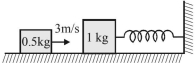
A $1\,kg$ mass is attached to a spring of force constant $600\,N / m$ and rests on a smooth horizontal surface with other end of the spring tied to wall as shown in figure. A second mass of $0.5\,kg$ slides along the surface towards the first at $3\,m / s$. If the masses make a perfectly inelastic collision, then find amplitude and time period of oscillation of combined mass.
A satellite is moving in a circular orbit at a height 100km above the earth's surface. A person inside the satellite feels weightless because:
A metallic wire of length $L$ is fixed between two rigid supports. If the wire is cooled through a temperature difference $\Delta T$ ($Y$ = young’s modulus, $\rho$ = density, $\alpha$ = coefficient of linear expansion) then the frequency of transverse vibration is proportional to : 
A person standing on an open ground hears the sound of a jet aeroplane, coming from north at an angle $60^o$ with ground level. But he finds the aeroplane right vertically above his position. If $\upsilon $ is the speed of sound, speed of the plane is
Unit vector parallel to the resultant of vectors $\vec A = 4\hat i - 3\hat j$and $\vec B = 8\hat i + 8\hat j$ will be
The equation of the progressive wave, where $t$ is the time in second, $x$ is the distance in metre is $y=A \cos 240\left(t-\frac{x}{12}\right)$. The phase difference (in $SI$ units) between two positions $0.5 \,m$ apart is ...........
 A normal eye is not able to see objects closer than 25cm because:
  1. The focal length of the eye is 25cm.
  2. The distance of the retina from the eye-lens is 25cm.
  3. The eye is not able to decrease the distance between the eye-lens and the retina beyond a limit.
  4. The eye is not able to decrease the focal length beyond a limit.
A projectile is fired with velocity $u$ at an angle $\theta$ with horizontal. At the highest point of its trajectory it splits up into three segments of masses $m, m$ and $2 \,m$. First part falls vertically downward with zero initial velocity and second part returns via same path to the point of projection. The velocity of third part of mass $2 \,m$ just after explosion will be
The time period of a particle in simple harmonic motion is equal to the smallest time between the particle acquiring a particular velocity $\overrightarrow{\text{v}}.$ The value of v is
  1. vmax.
  2. 0
  3. between 0 and vmax.
  4. between 0 and - vmax
A solid floats in a liquid in a partially dipped position.
  1. The solid exerts a force equal to its weight on the liquid.
  2. The liquid exerts a force of buoyancy on the solid which is equal to the weight of the solid.
  3. The weight of the displaced liquid equals the weight of the solid.
  4. The weight of the dipped part of the solid is equal to the weight of the displaced liquid.