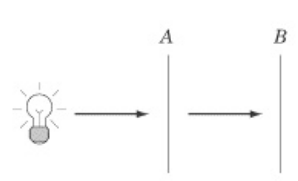
MCQ
Mark the correct options:
- AA diode valve can be used as a rectifier.
- BA triode valve can be used as a rectifier.
- CA diode valve can be used as an amplifier.
- DA triode valve can be used as an amplifier.
A diode valve can be used as a rectifier.
A triode valve can be used as a rectifier.
A triode valve can be used as an amplifier.
Explanation:
A diode valve and a triode valve allow current to flow only in one direction. Since a rectifier is a device that converts alternating current (bi-directional) into direct current (uni-directional), a diode valve and a triode valve can be used as rectifiers. A triode valve can control its output in proportion to the input signal. That is, it can act as an amplifier, whereas a diode valve cannot control its output in proportion to the input signal. So, it cannot be use as an amplifier.
Generate a complete, print-ready paper with questions like this in minutes — across 16+ boards, with answer keys.
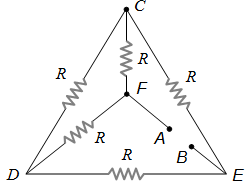
Five equal resistances each of resistance R are connected as shown in the figure. A battery of V volts is connected between A and B. The current flowing in AFCEB will be
|
(a) |
(b) |
(c) |
(d) |
When a compact disc is illuminated by a source of white light. Coloured 'lanes' are observed. This is due to
|
(a) Dispersion |
(b) Diffraction |
(c) Interference |
(d) Refraction |
Which of the following is not the property of a cathode ray
|
(a) It casts shadow |
(b) It produces heating effect |
|
(c) It produces flurosence |
(d) It does not deflect in electric field |
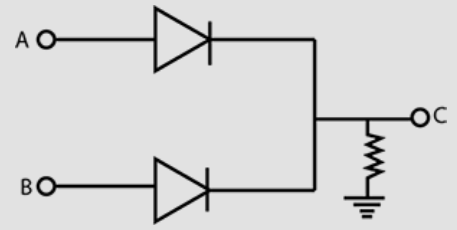
Photo-electric effect can be explained by
|
(a) Corpusular theory of light |
(b) Wave nature of light |
|
(c) Bohr’s theory |
(d) Quantum theory of light |
$\vec{\text{r}}.\vec{\text{F}}=0$ and $\vec{\text{F}}.\vec{\tau}=0$
$\vec{\text{r}}.\vec{\tau}=0$ but $\vec{\text{F}}.\vec{\tau}\neq0$
$\vec{\text{r}}.\vec{\tau}\neq0$ but $\vec{\text{F}}.\vec{\tau}=0$
$\vec{\text{r}}.\vec{\tau}\neq0$ and $\vec{\text{F}}.\vec{\tau}\neq0$