MCQ
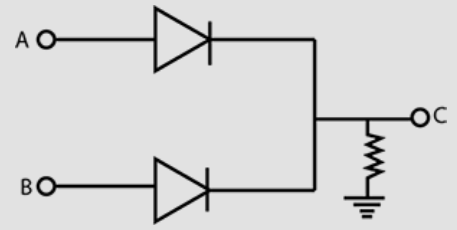
In the given circuit, if A and B represent two inputs and C represents the output, the circuit represents:
- ANOR gate
- BAND gate
- CGate
- DOR gate
Explanation:
The image given shows a diode OR circuit. R is connected from the output to ground to provide bias current for the diodes. Any positive voltage will represent a logic 1 state and the summing of currents through multiple diodes does not change the logic level.
Generate a complete, print-ready paper with questions like this in minutes — across 16+ boards, with answer keys.
A parallel plate capacitor has an electric field of  between the plates. If the charge on the capacitor plate is 1μC, the force on each capacitor plate is
|
(a) 0.5 N |
(b) 0.05 N |
(c) 0.005 N |
(d) None of these |
For the study of the helical structure of nucleic acids, the property of electromagnetic radiation generally used is
|
(a) Reflection |
(b) Interference |
(c) Diffraction |
(d) Polarization |
Two non-ideal identical batteries are connected in parallel. Consider the following statements
(i) The equivalent e.m.f. is smaller than either of the two e.m.f.s
(ii) The equivalent internal resistance is smaller than either of the two internal resistances
|
(a) Both (i) and (ii) are correct |
(b) (i) is correct but (ii) is wrong |
|
(c) (ii) is correct but (i) is wrong |
(d) Both (i) and (ii) are wrong |