MCQ

Mark the correct options:

  • A
    If the far point goes ahead, the power of the divergent lens should be reduced.
  • B
    If the near point goes ahead, the power of the convergent lens should be reduced.
  • C
    If the far point is 1 m away from the eye, divergent lens should be used.
  • D
    If the near point is 1 m away from the eye, divergent lens should be used.

Answer

  1. If the far point goes ahead, the power of the divergent lens should be reduced.

  1. If the far point is 1m away from the eye, the divergent lens should be used.

Explanation:

As the far point (x) is shifited ahead, the focal length (f) will be increased.

thus. we have

$\frac{1}{\text{f}}=\frac{1}{\text{v}}-\frac{1}{\text{u}}$

$\Rightarrow \frac{1}{\text{f}}=\frac{1}{-\text{x}}-\frac{1}{-\infty}$

$\Rightarrow \frac{1}{\text{f}}=\frac{1}{-\text{x}}$

$\Rightarrow\text{f}=-\text{x}$

As power (p) is equal to reciprocal of the focal length, it will be reduced, Also, because the focal length is negative, the lens used will be divergent when the far point is 1m away.

Need a full question paper?

Generate a complete, print-ready paper with questions like this in minutes — across 16+ boards, with answer keys.

Start Generating Free

Similar questions

When charged particle enters-a uniform magnetic field, its K.E:
The force of repulsion between two point charges is F, when these are 1m apart. Now the point charges are replaced by conducting spheres of radii 5cm having the charge same as that of point charges. The distance between their centres is 1m, then the force of repulsion will:

An electron is revolving round a proton, producing a magnetic field of 16 weber/m2 in a circular orbit of radius 1Å. It’s angular velocity will be

(a) 1017 rad/sec

(b) 1/2 π  × 1012 rad/sec

(c) 2π × 1012 rad/sec

(d) 4 π × 1012 rad/sec

Huygen’s principle of secondary wavelets may be used to

(a) Find the velocity of light in vacuum

(b) Explain the particle behaviour of light

(c) Find the new position of the wavefront

(d) Explain photoelectric effect

A radioactive nucleus undergoes a-emission to form a stable element. What will be the recoil velocity of the daughter nucleus if V is the velocity of a-emission and A is the atomic mass of radioactive nucleus

(a)     

(b)  

(c)   

(d)  

To use a transistor as an amplifier, emitter-base junction is kept in ...X... and base-collector junction is kept in ...Y... Here, X and Y refer to:
When a glass rod is rubbed with silk, what kind of charge will be developed on glass?

A combination of two thin lenses of the same material with focal lengths  and , arranged on a common axis minimizes chromatic aberration, if the distance between them is

(a)  

(b)

(c) ( 

(d)  

The dielectric strength of a medium is $2 kV mm ^{-1}$ What is the maximum potential difference that can be established across a $50 \mu m$ sample without binding?

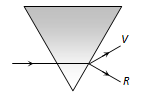
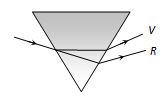
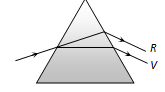
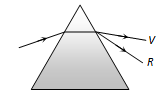
Which of the following diagrams, shows correctly the dispersion of white light by a prism

(a)

(b)

(c)

(d)