MCQ
Mark the correct statement
  • Nuclei of different elements can have the same number of neutrons
  • B
    Every element has only two stable isotopes
  • C
    Only one isotope of each element is stable
  • D
    All isotopes of every element are radioactive

Answer

Correct option: A.
Nuclei of different elements can have the same number of neutrons
a
(a) Nuclei of different elements having the same mass number are called isotones

$e.g.,$  $_4B{e^9}$ and $_5{B^{10}}$

Need a full question paper?

Generate a complete, print-ready paper with questions like this in minutes — across 16+ boards, with answer keys.
Start Generating Free

Similar questions

If a Vander-Waal's gas expands freely, then final temperature is
The de-Broglie wavelength $\lambda $ associated with an electron having kinetic energy $E$ is given by the expression
On increasing the temperature of a substance gradually, which of the following colours will be noticed by you
A star is modeled as a uniform spherical distribution of matter keeping mass of star constant. How gravitational pressure on surface depends on volume of the star?
The current in a conductor is expressed as $I=3 t^2+4 t^3$, where $I$ is in Ampere and $t$ is in second. The amount of electric charge that flows through a section of the conductor during $t=1$ s to $t=2 \mathrm{~s}$ is_______ C.
A weightless thread can support tension upto $30 \,N$. A stone of mass $0.5 \,kg$ is tied to it and is revolved in a circular path of radius $2 \,m$ in a vertical plane. If $g = 10m/{s^2}$, then the maximum angular velocity of the stone will be ........ $rad/s$
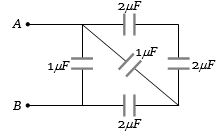
The total capacity of the system of capacitors shown in the adjoining figure between the points $A$ and $B$ is.....$\mu F$
A particle is tied to $20\, cm$ long string. It performs circular motion in vertical plane. What is the angular velocity of string when the tension in the string at the top is zero  ........ $rad/sec$
An electric line of force in the $xy$ plane is given by equation ${x^2} + {y^2} = 1$. A particle with unit positive charge, initially at rest at the point $x = 1,\;y = 0$ in the $xy$ plane
Coefficient of linear expansion of material of resistor is $\alpha$. Its temperature coefficient of resistivity and resistance are $\alpha_\rho$ and $\alpha_R$ respectively, then correct relation is