Coefficient of linear expansion of material of resistor is $\alpha$. Its temperature coefficient of resistivity and resistance are $\alpha_\rho$ and $\alpha_R$ respectively, then correct relation is
Diffcult


Download our appand get started for free
Experience the future of education. Simply download our apps or reach out to us for more information. Let's shape the future of learning together!No signup needed.*
Similar Questions
- 1Two resistances of $400\,\Omega $ and $800\,\Omega $ are connected in series with a $6\,volt $ battery of negligible internal resistance. A voltmeter of resistance $10,000\,\Omega $ is used to measure the potential difference across $400\,\Omega $ . The error in the measurement of potential difference (in volt) approximately isView Solution
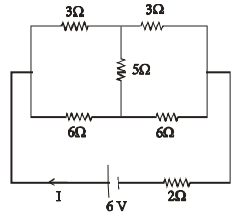
- 2A battery of $6\,V$ is connected to the circuit as shown below. The current I drawn from the battery is:View Solution
- 3$A$ brass disc and a carbon disc of same radius are assembled alternatively to make a cylindrical conductor. The resistance of the cylinder is independent of the temperature. The ratio of thickness of the brass disc to that of the carbon disc is [$\alpha$ is temperature coefficient of resistance and Neglect linear expansion ]View Solution
- 4A uniform wire of resistance $R$ is uniformly compressed along its length, until its radius becomes $n$ times the original radius. Now resistance of the wire becomesView Solution
- 5A resistor dissipates $192\, {J}$ of energy in $1\, {s}$ when a current of $4\, {A}$ is passed through it. Now, when the current is doubled, the amount of thermal energy dissipated in $5 \,{s}$ in $.....\,J.$View Solution
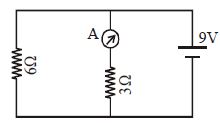
- 6In the figure shown, if the internal resistance of the battery is $1\, ohm$, the reading of the ammeter will be ............... $A$View Solution
- 7Three $60\, W$ light bulbs are mistakenly wired in series and connected to a $120\,V$ power supply. Assume the light bulbs are rated for single connection to $120\,V$. With the mistaken connection, the power dissipated by each bulb is: .................. $W$View Solution
- 8View SolutionSelect the correct statement
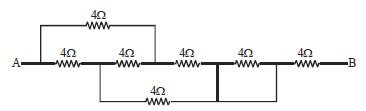
- 9Equivalent resistance between $A$ and $B$ is ............ $\Omega$View Solution
- 10A student in a town in India, where the price per unit ( $1$ unit $=1 \,kWh$ ) of electricity is $₹ 5.00$, purchases a $1 \,kVA$ $UPS$ (uninterrupted power supply) battery. A day before the exam, $10$ friends arrive to the student's home with their laptops and all connect their laptops to the $UPS$. Assume that each laptop has a constant power requirement of $90 \,W$. Consider the following statements.View Solution
$I.$ All the $10$ laptops can be powered by the $UPS$, if connected directly.
$II.$ All the $10$ laptops can be powered, if connected using an extension box with a $3 \,A$ fuse.
$III.$ If all the $10$ friends use the laptop for $5 \,h$, then the cost of the consumed electricity is about $₹ 22.50.$
Select the correct option with the true statements.