MCQ
Mark the correct statements for a particle going on a straight line
  • A
    if the position and velocity have opposite sign, the particle is moving towards the origin
  • B
    if the velocity is zero for a time interval, the acceleration is zero at any instant within the time interval
  • C
    if the velocity and acceleration have opposite sign, the object is slowing down
  • All of the above

Answer

Correct option: D.
All of the above
d
All options are correct except $C$ because, if the velocity is zero at an instant, then acceleration may not necessarily be zero at that instant.

For e.g. when an object is thrown vertically upward, at highest point velocity is zero but acceleration on it due to gravity is non-zero.

Option $D$ is correct as the derivative of velocity will be zero in case velocity is zero for a time interval,

Need a full question paper?

Generate a complete, print-ready paper with questions like this in minutes — across 16+ boards, with answer keys.

Start Generating Free

Similar questions

An electron and proton have the same de-Broglie wavelength. Then the kinetic energy of the electron is
The field of view is maximum for
Two plane mirrors are placed parallel to each other at a distance $L$ apart.$A$ point object $O$ is placed between them, at a distance $L / 3$ from one mirror. Both mirrors form multiple images. The distance between any two images cannot be
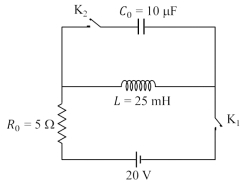
The circuit shown in the figure contains an inductor $L$, a capacitor $C_0$, a resistor $R_0$ and an ideal battery. The circuit also contains two keys $K_1$ and $K_2$. Initially, both the keys are open and there is no charge on the capacitor. At an instant, key $K_1$ is closed and immediately after this the current in $R_0$ is found to be $l_1$. After a long time, the current attains a steady state value $I_2$. Thereafter, $K_2$ is closed and simultaneously $K_1$ is opened and the voltage across $C_0$ oscillates with amplitude $V_0$ and angular frequency $\omega_0$.

Match the quantities mentioned in $List-I$ with their values in $List-II$ and choose the correct option.

$List-I$ $List-II$
($P$) The value of $l_1$ in Ampere is ($1$) $0$
($Q$) The value of $I_2$ in Ampere is ($2$) $2$
($R$) The value of $\omega_0$ in kilo-radians/s is ($3$) $4$
($S$) The value of $V_0$ in Volt is ($4$) $20$
  ($5$) $200$

If $I_1, I_2, I_3$ and $I_4$ are the respective $r.m.s$. values of the time varying currents as shown in the four cases $I, II, III$ and $IV$. Then identify the correct relations.
A point mass of $1 \mathrm{~kg}$ collides elastically with a stationary point mass of $5 \mathrm{~kg}$. After their collision, the $1 \mathrm{~kg}$ mass reverses its direction and moves with a speed of $2 \mathrm{~ms}^{-1}$. Which of the following statement(s) is (are) correct for the system of these two masses?

$(A)$ Total momentum of the system is $3 \mathrm{~kg} \mathrm{~ms}^{-1}$

$(B)$ Momentum of $5 \mathrm{~kg}$ mass after collision is $4 \mathrm{~kg} \mathrm{~ms}^{-1}$

$(C)$ Kinetic energy of the centre of mass is $0.75 \mathrm{~J}$

$(D)$ Total kinetic energy of the system is $4 \mathrm{~J}$

A stone of mass of $16\, kg$ is attached to a string $144 \,m$ long and is whirled in a horizontal circle. The maximum tension the string can withstand is $16$ Newton. The maximum velocity of revolution that can be given to the stone without breaking it, will be ....... $ms^{-1}$
In an amplitude modulator circuit, the carrier wave is given by, $C(t) = 4\, sin\, (2000\,\pi t)$ while modulating signal is given by, $m(t) = 2\, sin\, (2000\, \pi t)$. The values of modulation index and lower side band frequency are
Match the List $I$ with List $II$

LIST $I$ LIST $II$
$A$ Intrinsic Semiconductor $I$ Fermi-level near conduction band
$B$ $n-$type semiconductor $II$ Fermi-level at middle
$C$ $p-$ type semiconductor $III$ Fermi-level near valence band
$D$ Metals $IV$ Fermi-level inside conduction band

Choose the correct answer from the options given below:

A circular coil of $500$ turns of wire has an enclosed area of $0.1\,{m^2}$ per turn. It is kept perpendicular to a magnetic field of induction $0.2\, T$ and rotated by $180^o$ about a diameter perpendicular to the field in $0.1\,sec$. How much charge will pass when the coil is connected to a galvanometer with a combined resistance of $50\, ohms$......$C$