MCQ
Two plane mirrors are placed parallel to each other at a distance $L$ apart.$A$ point object $O$ is placed between them, at a distance $L / 3$ from one mirror. Both mirrors form multiple images. The distance between any two images cannot be
  • $3L / 2$
  • B
    $2L / 3$
  • C
    $2L$
  • D
    None

Answer

Correct option: A.
$3L / 2$
a
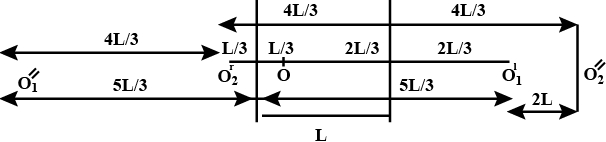
Please refer below image.

On the left side the distance between two images will be $=4 L / 3$ and on

the right side the distance between the two adjacent image is $=2 L$

Hence, the distance cannot be $3 L / 2$

Need a full question paper?

Generate a complete, print-ready paper with questions like this in minutes — across 16+ boards, with answer keys.

Start Generating Free

Similar questions

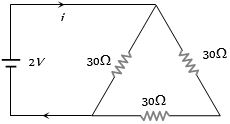
The current in the adjoining circuit will be
The storage battery of a car has an $emf$ of $12\; V$. If the internal resistance of the battery is $0.4\; \Omega,$ what is the maximum current (in $A$) that can be drawn from the battery?
From the following diode circuit. Which diode in forward biased condition
Find the torque of a force $\overrightarrow F = - 3\hat i + \hat j + 5\hat k$ acting at the point $\overrightarrow r = 7\hat i + 3\hat j + \hat k$
A truck travelling due north at $20 \,m/s $ turns west and travels at the same speed. The change in its velocity be
Two coils $A$ and $B$ having turns $300$ and $600$ respectively are placed near each other, on passing a current of $3.0$ ampere in $A$, the flux linked with A is $1.2 \times {10^{ - 4}}\,weber$ and with $B$ it is $9.0 \times {10^{ - 5}}\,weber$. The mutual inductance of the system is
From a circular disc of radius $R$ and mass $9 M$, a small disc of mass $M$ and radius $\frac{R}{3}$ is removed concentrically. The moment of inertia of the remaining disc about an axis perpendicular to the plane of the disc and passing through its centre is
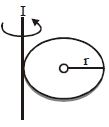
A solid sphere of radius $R$ has moment of inertia $I$ about its geometrical axis. It is melted into a disc of radius $r$ and thickness $t$. If it's moment of inertia about the tangential axis (which is perpendicular to plane of the disc), is also equal to $I,$ then the value of $r$ is equal to
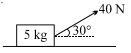
Adjoining figure shows a force of $40\, N$ acting at $30^o$ to the horizontal on a body of mass $5 \,kg$ resting on a smooth horizontal surface. Assuming that the acceleration of free-fall is $10\, ms^{-2}$, which of the following statements is (are) correct?

$[1]$ The horizontal force acting on the body is $20\, N$

$[2]$ The weight of the $5\, kg$ mass acts vertically downwards

$[3]$ The net vertical force acting on the body is $30\, N$

The sun is rotating about its own axis. The spectral lines emitted from the two ends of its equator, for an observer on the earth, will show