MCQ
Mark the correct statements for a particle going on a straight line
  • A
    if the position and velocity have opposite sign, the particle is moving towards the origin
  • B
    if the velocity is zero for a time interval, the acceleration is zero at any instant within the time interval
  • C
    if the velocity and acceleration have opposite sign, the object is slowing down
  • All of the above

Answer

Correct option: D.
All of the above
d
All options are correct except $C$ because, if the velocity is zero at an instant, then acceleration may not necessarily be zero at that instant.

For e.g. when an object is thrown vertically upward, at highest point velocity is zero but acceleration on it due to gravity is non-zero.

Option $D$ is correct as the derivative of velocity will be zero in case velocity is zero for a time interval,

Need a full question paper?

Generate a complete, print-ready paper with questions like this in minutes — across 16+ boards, with answer keys.

Start Generating Free

Similar questions

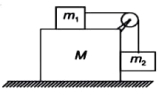
In the given arrangement all surfaces are smooth. What acceleration should be given to the system, for which the block $m_2$ doesn't slide down?
In a water-fall the water falls from a height of $100\,m.$ If the entire $K.E.$ of water is converted into heat, the rise in temperature of water will be........ $^oC$
A body is moved along a straight line by a machine delivering constant power. The distance moved by the body in time $ t$  is proportional to
A block of mass $10\, kg$ is placed on a rough horizontal surface having coefficient of friction $\,\mu  = 0.5$. If a horizontal force of $100\, N$ is acting on it, then acceleration of the block will be ....... $m/s^2$
Choose the correct relationship between Poisson ratio $(\sigma)$. bulk modulus $( K )$ and modulus of rigidity $(\eta)$ of a given solid object:
A metallic sphere cools from $50^{\circ} C$ to $40^{\circ} C$ in $300 \,s.$ If atmospheric temperature around is $20^{\circ} C ,$ then the sphere's temperature after the next $5$ minutes will be close to$.....C$
A composition string is made up by joining two strings of different masses per unit length $\rightarrow \mu$ and $4\mu$ . The composite string is under the same tension. A transverse wave pulse $: Y = (6 mm) \,\,sin\,\,(5t + 40x),$ where $‘t’$ is in seconds and $‘x’$ in meters, is sent along the lighter string towards the joint, the percentage of power transmitted to the heavier string through the joint is approximately ..... $\%$
$A$ small bucket of mass $M\, kg$ is attached to $a$ long inextensible cord of length $L\, m$ . The bucket is released from rest when the cord is in a horizontal position. At its lowest position, the bucket scoops up $m\, kg$ of water and swings up to a height $h$. The height $h$ in meters is 
A particle is found to be at rest when seen from a frame S1 and moving with constant velocity when seen from another frame S2. Mark out the possible options:
  1. Both the frames are inertial.
  2. Both the frames are non-inertial.
  3. S1 is inertial and S2 is non-inertial.
  4. S1 is non-inertial and S2 is inertial.
The sum of all electromagnetic forces between different particles of a system of charged particles is zero:
  1. Only if all the particles are positively charged.
  2. Only if all the particles are negatively charged.
  3. Only if half the particles are positively charged and half are negatively charged.
  4. Irrespective of the signs of the charges.