Question
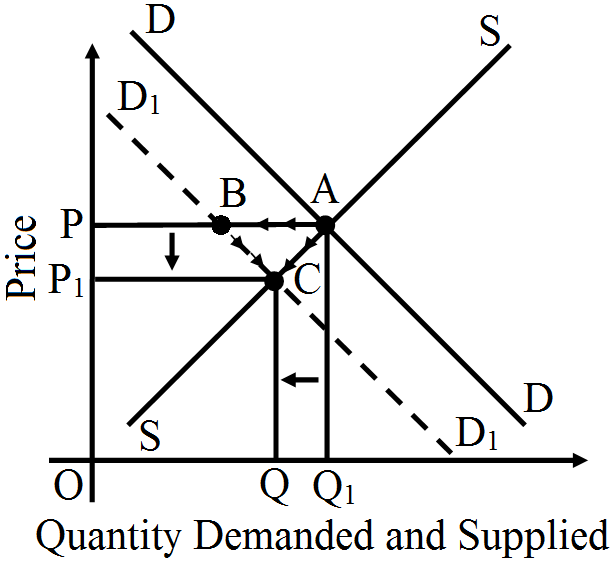
Market for a good is in equilibrium. There is decrease in demand for this good. Explain the chain of effects of this change. Use diagram.### How will equilibrium price and quantity be affected when there is decrease in demand? Explain with diagram.###How will equilibrium price and quantity be affected when there is leftward shift of demand curve?### Explain the chain effects on demand, supply and price caused by leftward shift of demand curve.### Market for a good is in equilibrium. The demand for the good ‘decreases’. Explain the chain of effects of this change.###Good Y is a substitute of good X. The price of Y falls. Explain the chain of effects of this change in the market of X.
Need a full question paper?

Generate a complete, print-ready paper with questions like this in minutes — across 16+ boards, with answer keys.

Start Generating Free

Similar questions

Explain the concept of 'Marginal Rate of Substitution' with the help of a numerical example. Also, explain its behaviour along an Indifference Curve.

OR

Explain the concept of Marginal Rate of Substitution (MRS) by giving an example. What happens to MRS when consumer moves downward along the Indifference Curve?

Define market demand. State the factors that affect it.
A firm's fixed cost is 2000. Compute TVC, AVC, TC and ATC from the following table.
Output (Units)
1
2
3
4
5
6
7
MC (₹)
2000 1500 1200 1500 2000 2700 3500
On the basis of the information given below, determine the level of output at which the producer will be in equilibrium. Use the marginal cost-marginal revenue approach. Give reasons for your answer.
Output (Units) Average Revenue(₹) Total Cost(₹)
1 7 7
2 7 15
3 7 22
4 7 28
5 7 33
6 7 40
7 7 48
Explain national income equilibrium through aggregate demand and aggregate supply. Use diagram. Also explain the changes that take place in an economy when the economy is not in equilibrium.
Write down the three identities of calculating the GDP of a country by three methods.
Discuss briefly the meanings of:
  1. Fixed Exchange Rate.
  2. Flexible Exchange Rate.
  3. Managed Floating Exchange Rate.
Market for a good is in equilibrium. Explain the chain of reactions in the market if the price is (i) higher than equilibrium price and (ii) lower than equilibrium price.
A farmer takes a farm on rent and carries on farming with the help of his family members. Identify explicit and implicit costs from this information. Explain.
Will the following be included in the national income of India? Give reasons for your answer.
  1. Financial assistance to flood victims.
  2. Profits earned by the branches of a foreign bank in India.
  3. Salaries of Indians working in the American Embassy in India.