MCQ
Mass is distributed uniformly over a thin rectangular plate and positions of two vertices are given by $(1, 3)$ and $(2, -4)$. What is the position of $3^{rd}$ vertex if centre of mass of the plate lies at the origin ?
  • A
    $(1, -2)$
  • B
    $(-2, 4)$
  • $(-3, 1)$
  • D
    $(1, 2)$

Answer

Correct option: C.
$(-3, 1)$
c
$\left(\mathrm{x}_{\mathrm{CM}}, \mathrm{y}_{\mathrm{CM}}\right)=\left(\frac{\mathrm{x}_{1}+\mathrm{x}_{2}+\mathrm{x}_{3}}{3}, \frac{\mathrm{y}_{1}+\mathrm{y}_{2}+\mathrm{y}_{3}}{3}\right)$

$(0,0)=\left(\frac{1+2+x_{3}}{3}, \frac{3-4+y_{3}}{3}\right)$

$\left(\mathrm{x}_{3}, \mathrm{y}_{3}\right)=(-3,1)$

Need a full question paper?

Generate a complete, print-ready paper with questions like this in minutes — across 16+ boards, with answer keys.

Start Generating Free

Similar questions

Unit vector does not have any .......
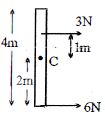
A rod of mass $1\ kg$ is kept on frictionless table and is acted upon by $2$ forces as shown. We want to replace these $2$ forces by a single force so that the effect on the rod is the same. ........ $m$ far from the center $C$ of the rod should we apply the force.
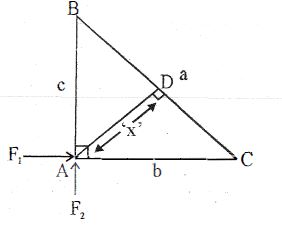
Two forces acting on point $A$ along their side and having magnitude reciprocal to length of side then resultant of these forces will be proportional to
The dimensions of capacitance are (where Q is the dimension of charge):
The escape velocity for a planet is $v_e.$ A tunnel is dug along a diameter of the planet and a small body is dropped into it at the surface. When the body reaches the centre of the planet, its speed will be
Stress required in a wire to produce $0.1\%$ strain is $4 \times10^8\, N/m^2$. Its yound modulus is $Y_1$. If stress required in other wire to produce $0.3\%$ strain is $6 \times 10^8\, N/m^2$. Its young modulus is $Y_2$. Which relation is correct
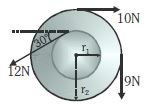
In the following figure $r_1$ and $r_2$ are $5\, cm$ and $30\, cm$ respectively. If the moment of inertia of the wheel is $5100\, kg-m^2$ then its angular acceleration will be
A particle moves for $8\, seconds$. It first accelerates from rest and then retards to rest. If the retardation be $3\, times$ the acceleration, then time for which it accelerates will be 
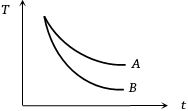
Water and turpentine oil (specific heat less than that of water) are both heated to same temperature. Equal amounts of these placed in identical calorimeters are then left in air
The potential energy of a body is given by, $U =A - B{x^2}$(Where x is the displacement). The magnitude of force acting on the particle is