Question
Mass of atom expressed in atomic mass unit is:

Answer

  1. Atomic mass
Explanation:
The mass of an atom expressed in amu is known as atomic mass. atomic mass unit defined as a unit of mass used to express atomic and molecular weights, equal to one-twelfth of the mass of an atom of carbon-12.

Need a full question paper?

Generate a complete, print-ready paper with questions like this in minutes — across 16+ boards, with answer keys.
Start Generating Free

Similar questions

Assertion :   The tangent galvanometer can be made more sensitive by increasing the number of turns of its coil.
Reason    : Current through galvanometer is proportional to the number of turns of coil.(a) If both assertion and reason are true and the reason is the correct explanation of the assertion.(b) If both assertion and reason are true but reason is not the correct explanation of the assertion.(c) If assertion is true but reason is false.(d) If the assertion and reason both are false.


If the speed of light in vacuum is $C m/\sec,$ then the velocity of light in a medium of refractive index $1.5$
'Albedo' is (a) Reflecting power of a heavenly body(b) Transmitive power of a heavenly body(c) Absorptive power of a heavenly body(d) Refracting power of a heavenly body


Choose the correct statement(a) When we heat a semiconductor its resistance increases (b) When we heat a semiconductor its resistance decreases (c) When we cool a semiconductor to 0 K then it becomes super conductor(d) Resistance of a semiconductor is independent of temperature


If a charged particle moves unaccelerated in a region containing electric and magnetic fields,
  1. $\overrightarrow{\text{E}}$ must be perpendicular to $\overrightarrow{\text{B}}$
  2. $\overrightarrow{\text{V}}$ must be perpendicular to $\overrightarrow{\text{E}}$
  3. $\overrightarrow{\text{V}}$ must be perpendicular to $\overrightarrow{\text{B}}$
  4. E must be equal to vB.
According to Bohr's theory, if angular momentum of electron in excited hydrogen atom is $\left(\frac{2 h}{2 \pi}\right)$, then the energy will be :
Consider the following two statements:
  1. Kirchhoff's junction law follows from conservation of charge.
  2. Kirchhoff's loop law follows from conservative nature of electric field.
  1. Both A and B are correct.
  2. A is correct but B is wrong.
  3. B is correct but A is wrong.
  4. Both A and B are wrong.
Magnetic force required to demagnetize the material:
The correct curve representing the variation of capacitive reactance $Xc$​ with frequency $f$ is.
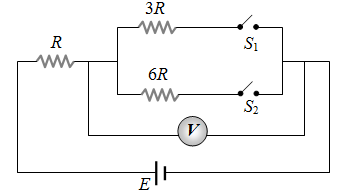
In the circuit shown in figure reading of voltmeter is $V_1$ when only $S_1$ is closed, reading of voltmeter is $V_2$ when only $S_2$ is closed and reading of voltmeter is $V_3$ when both $S_1$ and $S_2$ are closed. Then