Question
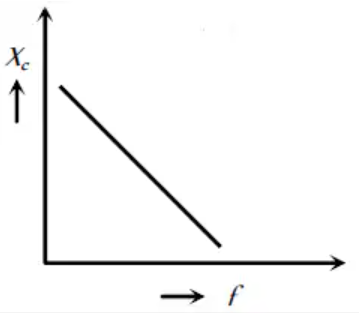
The correct curve representing the variation of capacitive reactance $Xc$​ with frequency $f$ is.

Answer

Image
$\text{X}_\text{C}=\frac{1}{\text{C}2\pi\text{f}}$
$X_{C​}$ and f are inversely proportional.

Need a full question paper?

Generate a complete, print-ready paper with questions like this in minutes — across 16+ boards, with answer keys.

Start Generating Free

Similar questions

When a plane mirror is rotated through an angle θ then the reflected ray turns through the angle 2θ then the size of the image(a) Is doubled(b) Is halved(c) Remains the same(d) Becomes infinite
       
For a series LCR circuit the power loss at resonance is : -
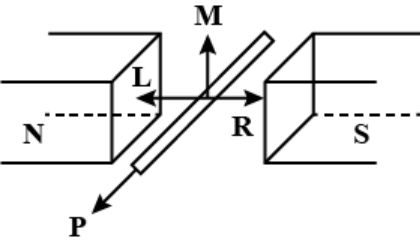
An electric potential difference will be induced between the ends of the conductor shown in the figure, if the conductor moves in the direction shown by:
Image
A glass lens is placed in a medium in which it is found to behave like a glass plate. Refractive index of the medium will be(a) Greater than the refractive index of glass(b) Smaller than the refractive index of glass(c) Equal to refractive index of glass(d) No case will be possible from above 


A particle executes simple harmonic motion under the restoring force provided by a spring. The time period is $T$. If the spring is divided in two equal parts and one part is used to continue the simple harmonic motion, the time period will:
At breakdown voltage, the rate of creation of hole-electron pairs is _____ leading to the _______ in current. 
In a charged capacitor, the energy resides:
A glass convex lens $\left({\mu_{\mathrm{g}}}\right.= 1.5)$ has a focal length of $8 \ cm$ when placed in air. What would be the focal length of the lens when it is immersed in water $\left(\mu_{\mathrm{w}}=1.33\right)$
An achromatic prism is made by combining two prisms
$p_1\left(\mu_v=1.523, \mu_r=1.515\right)$ ana
$ p_2\left(\mu_v=1.666, \mu_r=1.650\right) $
where $\mu$ represents the refractive index. If the angle of the prism $p_1$
is $10^{\circ}$, then the angle of the prism $\mathrm{P}_2$ will be
The capacitance of a parallel plate condenser does not depend on(a) Area of the plates(b) Medium between the plates(c) Distance between the plates(d) Metal of the plates