MCQ
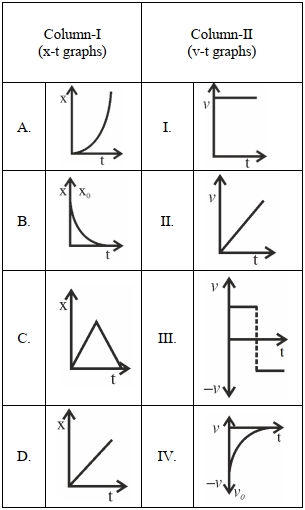
Match Column$-I$ with Column$-II :$

Choose the correct answer from the options given below:
  • $(A)-(II), (B)-(IV), (C)-(III), (D)-(I)$
  • B
    $(A)-( I), (B)-(II), (C)-(III), (D)-(IV)$
  • C
    $(A)-( II), (B)-(III), (C)-(IV), (D)-(I)$
  • D
    $(A)-(I), (B)-(III), (C)-(IV), (D)-(II)$
Answer

Correct option: A.
$(A)-(II), (B)-(IV), (C)-(III), (D)-(I)$
a
$\frac{d x}{d t}=\text { slope } \geq 0 \text { always increasing }$

$\text { (A - II) }$

$\frac{d x}{d t} < 0 \text {; and at } t \rightarrow \infty \frac{ dx }{ dt } \rightarrow 0$

$( B - IV )$

$\frac{ dx }{ dt } > 0 \text { for first half } \frac{ dx }{ dt } < 0 \text { for second half. }$

$\text { (C - III) }$

$\frac{ dx }{ dt }=\text { constant }$

$\text { (D - I) }$

Need a full question paper?

Generate a complete, print-ready paper with questions like this in minutes — across 16+ boards, with answer keys.

Start Generating Free

Similar questions

A polarizer - analyser set is adjusted such that the intensity of light coming out of the analyser is just $10 \%$ of the original intensity. Assuming that the polarizer - analyser set does not absorb any light, the angle by which the analyser need to be rotated further to reduce the output intensity to be zero, is.....$^o$
Two charges, each equal to $q$, are kept at $x = -a$ and $x = a$ on the $x-$axis. A particle of mass $m$ and charge $q_0=\frac{q}{2}$ is placed at the origin. If charge $q_0$ is given a small displacement $(y < < a)$ along the $y-$axis, the net force acting on the particle is proportional to
An electron is moving along positive $x$-axis. To get it moving on an anticlockwise circular path in $x-y$ plane, a magnetic filed is applied
Resistance of a wire at $0^{\circ} \mathrm{C}, 100^{\circ} \mathrm{C}$ and $t^{\circ} \mathrm{C}$ is found to be $10 \Omega, 10.2 \Omega$ and $10.95 \Omega$ respectively. The temperature $t$ in Kelvin scale is $\qquad$
When the speed of a moving body is doubled
A galvanometer can be used as a voltmeter by connecting a
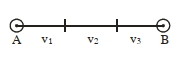
A car covers $A B$ distance with first one-third at velocity $v _{1} ms ^{-1}$, second one-third at $v _{2} ms ^{-1}$ and last one-third at $v _{3} ms ^{-1}$. If $v _{3}=3 v _{1}, v _{2}=2 v _{1}$ and $v _{1}=11\,ms ^{-1}$ then the average velocity of the car is________ $ms ^{-1} .$
$Assertion :$ Air quickly leaking out of a balloon becomes cooler.
$Reason :$ The leaking air undergoes adiabatic expansion.
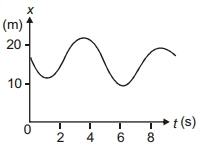
Figure shows the position of a particle moving on the $x$-axis as a function of time
Calculate the amount of heat (in calories) required to convert $5\,gm$ of ice at $0°C$ to steam at $100°C$