MCQ
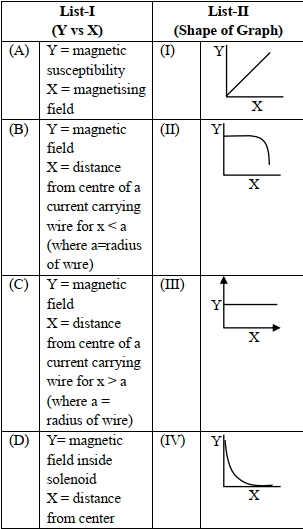
Match List-$I$ with List-$II$

Choose the correct answer from the options given below :
  • A
    $(A)-(III), (B)-(I), (C)-(IV), (D)-(II)$
  • B
    $(A)-(I), (B)-(III), (C)-(II), (D)-(IV)$
  • C
    $(A)-(IV), (B)-(I), (C)-(III), (D)-(II)$
  • $(A)-(III), (B)-(IV), (C)-(I), (D)-(II)$
Answer

Correct option: D.
$(A)-(III), (B)-(IV), (C)-(I), (D)-(II)$
d
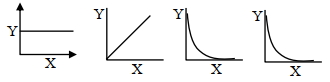
$(A)$ Graph between Magnetic susceptibility and magnetising field is:

(Image)

$(B)$ magnetic field due to a current carrying wire for $\mathrm{x}<\mathrm{a}$ :

$\mathrm{B}=\frac{\mu_0 \mathrm{ir}}{2 \pi \mathrm{a}^2}$

(Image)

$(C)$ magnetic field due to a current carrying wire for $x>a$ :

$B=\frac{\mu_0 i}{2 \pi a}$

(Image)

$(D)$ magnetic field inside solenoid varies as:

Need a full question paper?

Generate a complete, print-ready paper with questions like this in minutes — across 16+ boards, with answer keys.

Start Generating Free

Similar questions

A uniform magnetic field $B$ is acting from south to north and is of magnitude $1.5$ $Wb/{m^2}$. If a proton having mass $ = 1.7 \times {10^{ - 27}}\,kg$ and charge $ = 1.6 \times {10^{ - 19}}\,C$ moves in this field vertically downwards with energy $5\, MeV$, then the force acting on it will be
Find out velocity of image of given object....$cm/sec$
An electron with energy $0.1\,ke\,V$ moves at right angle to the earth's magnetic field of $1 \times 10^{-4}\,Wbm ^{-2}$. The frequency of revolution of the electron will be. (Take mass of electron $=9.0 \times 10^{-31}\,kg$ )
Which of the following are polar molecules:
The capacitance of a parallel plate capacitor is $12\,\mu \,F$. If the distance between the plates is doubled and area is halved, then new capacitance will be.........$\mu \,F$
The specific resistance of manganin is $50 \times {10^{ - 8}}\,ohm \times m$. The resistance of a cube of length $50\,cm$ will be
The ratio of wavelengths of the last line of Balmer series and the last line of Lyman series is
The transformation ratio in the step-up transformer is
An unknown transistor needs to be identified as a $npn$  or  $pnp$ type. A multimeter, with $+ve$ and $-ve$  terminals, is used to measure resistance between different terminals of transistor. If terminal $2$ is the base of the transistor then which of the following is correct for a $pnp$ transistor?
The current through an ideal $PN-$junction shown in the following circuit diagram will be .....$mA$