MCQ
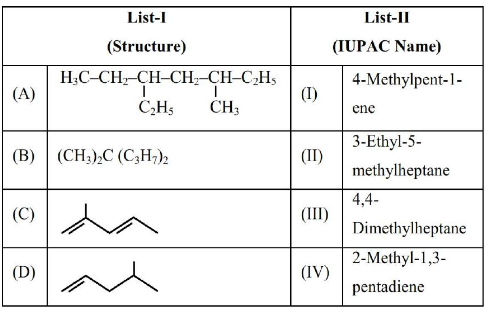
Match List-I with List-II.
Image
Choose the correct answer from the options given below :
  • A
    (A)-(III), (B)-(II), (C)-(IV), (D)-(I)
  • B
    (A)-(III), (B)-(II), (C)-(I), (D)-(IV)
  • (A)-(II), (B)-(III), (C)-(IV), (D)-(I)
  • D
    (A)-(II), (B)-(III), (C)-(I), (D)-(IV)
Answer

Correct option: C.
(A)-(II), (B)-(III), (C)-(IV), (D)-(I)
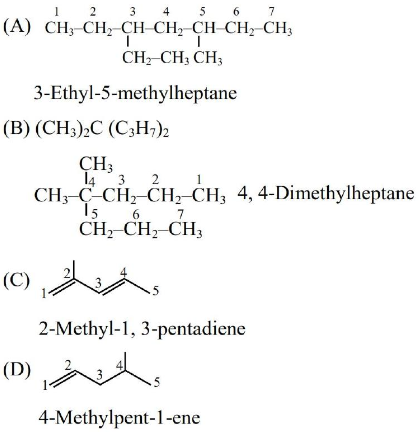
(C)
Sol.
Image

Need a full question paper?

Generate a complete, print-ready paper with questions like this in minutes — across 16+ boards, with answer keys.

Start Generating Free

Similar questions

Product in the given reaction will be

Major Product will be :-

If $A$ is $[Rn]\,6d^2\,7s^2$ then identify block, period, group?
Select the correct statements for quantum numbers.

$(i)$ Magnetic quantum no. $(m_l )$ gives information about the spatial orientation of orbitals with respect to standard set of co-ordinate axis.

$(ii)$ Electron spin quantum no. is represented by '$s$' and have value' $\frac{1}{2}$ '

$(iii)$ Principal quantum no. $(n)$ determine the size of the orbitals and also to a large extent of the energy of the orbitals.

Match List $I$ with List $II $
  $ \ce{LIST - I} ($Complex ion$)$  $\ce{LIST - II} ($Electronic Configuration$)$  
$A.$ $[Cr(H_{2}O)_{6}]^{3+}$ $I.$ $t_{2g}^{2}e_{g}^{0}$
$B.$ $[Fe(H_{2}O)_{6}]^{3+}$ $II.$ $t_{2g}^{3}eg^{0}$
$C.$ $[Ni(H_{2}O)_{6}]^{2+}$ $III.$ $t_{2g}^{3}eg^{2}$
$D.$ $[V(H_{2}O)_{6}]^{3+}$ $IV.$ $t_{2g}^{6}eg^{2}$
Choose the correct answer from the options given below:
Incorrect order of ionic radius is
$K^+, Cl^-, Ca^{2+}$ and  $S^{2-},$  ions are isoelectronic. The decreasing order of their size is
Major product of the reaction is
After understanding the assertion and reason, choose the correct option.
Assertion : In the bonding molecular orbital $(MO)$ of $H_2,$ electron density is increased between the nuclei.
Reason : The bonding $MO$ is ${\psi _A}\, + \,\,{\psi _{B,}}$ which shows destructive interference of the combining electron waves.
The osmotic pressure of a dilute solution of an ionic compound $XY$ in water is four times that of a solution of $0.01\,M\,BaCl_2$ in water. Assuming complete dissociation of the given ionic compounds in water, the concentration of $XY$ (in $mol\,L^{-1}$) in solution is
$100\ ml$ , $1\,M\ H_2SO_4$ solution of density $1.5\ gm/ml$ is mixed with $400\ ml$ of water, resulting in a diluted solution of density $1.25\ gm/ml$ Find molarity of final diluted solution.

(Density of water $= 1\,gm/ml$ )