Sample QuestionsJEE Main 29-Jan-2025 Paper - Shift 1 questions
One sample from each question group in this chapter. Select any group above to see the full set with answer keys.
Let $A=\left[a_{i j}\right]=\left[\begin{array}{cc}\log _{5} 128 & \log _{4} 5 \\ \log _{5} 8 & \log _{4} 25\end{array}\right]$. If $\mathrm{A}_{\mathrm{ij}}$ is the cofactor of $\mathrm{a}_{\mathrm{ij}}, \mathrm{C}_{\mathrm{ij}}=\sum_{\mathrm{k}=1}^{2} \mathrm{a}_{\mathrm{ik}} \mathrm{A}_{\mathrm{jk}}, 1 \leq \mathrm{i}$, $\mathrm{j} \leq 2$, and $\mathrm{C}=\left[\mathrm{C}_{\mathrm{ij}}\right]$, then $8|\mathrm{C}|$ is equal to :
Answer: C.
View full solution →Let $\left|z_{1}-8-2 i\right| \leq 1$ and $\left|z_{2}-2+6 i\right| \leq 2$, $z_{1}, z_{2} \in C$. Then the minimum value of $\left|z_{1}-z_{2}\right|$ is :
Answer: B.
View full solution →View full solution →Let $L_{1}: \frac{x-1}{1}=\frac{y-2}{-1}=\frac{z-1}{2}$ and $L_{2}: \frac{x+1}{-1}=\frac{y-2}{2}=\frac{z}{1}$ be two lines.
Let $L_{3}$ be a line passing through the point $(\alpha, \beta, \gamma)$ and be perpendicular to both $\mathrm{L}_{1}$ and $\mathrm{L}_{2}$. If $\mathrm{L}_{3}$ intersects $L_{1}$, then $|5 \alpha-11 \beta-8 \gamma|$ equals :
Answer: C.
View full solution →The integral $80 \int_{0}^{\frac{\pi}{4}}\left(\frac{\sin \theta+\cos \theta}{9+16 \sin 2 \theta}\right) d \theta$ is equal to :
- A
$3 \log _{\mathrm{e}} 4$
- B
$6 \log _{\mathrm{e}} 4$
- ✓
$4 \log _{\mathrm{e}} 3$
- D
$2 \log _{e} 3$
Answer: C.
View full solution →Let $\mathrm{S}=\mathrm{x}: \cos ^{-1} \mathrm{x}=\pi+\sin ^{-1} \mathrm{x}+\sin ^{-1} 2 \mathrm{x}+1$
Then $\sum_{x \in S}(2 x-1)^{2}$ is equal to $\qquad$ -
View full solution →The number of 6 -letter words, with or without meaning, that can be formed using the letters of the word MATHS such that any letter that appears in the word must appear at least twice, is 4 __________.
Let $S=m \in Z: A^{m^{2}}+A^{m}=3 I-A^{-6}$, where $A=\left[\begin{array}{cc}2 & -1 \\ 1 & 0\end{array}\right]$. Then $n(S)$ is equal to ____________ .
View full solution →Let $\mathrm{f}:(0, \infty) \rightarrow \mathrm{R}$ be a twice differentiable function. If for some $a \neq 0, \int_{0}^{1} \mathrm{f}(\lambda \mathrm{x}) \mathrm{d} \lambda=\operatorname{af}(\mathrm{x})$, $f(1)=1$ and $f(16)=\frac{1}{8}$, then $16-f^{\prime}\left(\frac{1}{16}\right)$ is equal to __________ .
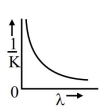
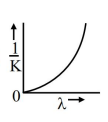
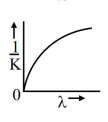
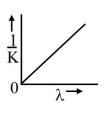
View full solution →If $\lambda$ and K are de Broglie Wavelength and kinetic energy, respectively, of a particle with constant mass. The correct graphical representation for the particle will be :-
Answer: B.
View full solution →Given below are two statements : one is labelled as
Assertion (A) and other is labelled as Reason (R).
Assertion (A) : Electromagnetic waves carry energy but not momentum.
Reason (R): Mass of a photon is zero.
In the light of the above statements, choose the most appropriate answer from the options given below:
- A
(A) is true but (R) is false.
- ✓
(A) is false but (R) is true.
- C
Both (A) and (R) are true but (R) is not the correct explanation of (A).
- D
Both (A) and (R) are true and (R) is the correct explanation of (A).
Answer: B.
View full solution →The workdone in an adiabatic change in an ideal gas depends upon only :
- A
- B
change in its specific heat
- C
- ✓
change in its temperature
Answer: D.
View full solution →Match List-I with List-II.| | List-I | | List-II |
| (A) | Electric field inside (distance r > 0 from center) of a uniformly charged spherical shell with surface charge density $\sigma$, and radius R. | (I) | $\sigma / \varepsilon_0$ |
| (B) | Electric field at distance r > 0 from a uniformly charged infinite plane sheet with surface charge density $\sigma$. | (II) | $\sigma / 2 \varepsilon_0$ |
| (C) | Electric field outside (distance r > 0 from center) of a uniformly charged spherical shell with surface charge density $\sigma$, and radius R | (III) | 0 |
| (D) | oppositely charged infinite plane parallel sheets with uniform surface charge density $\sigma$. | (IV) | $\frac{\sigma}{\varepsilon_0 r^2}$ |
Choose the correct answer from the options given below : - A
(A)-(IV), (B)-(I), (C)-(III), (D)-(II)
- B
(A)-(IV), (B)-(II), (C)-(III), (D)-(I)
- C
(A)-(II), (B)-(I), (C)-(IV), (D)-(III)
- ✓
(A)-(III), (B)-(II), (C)-(IV), (D)-(I)
Answer: D.
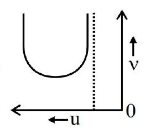
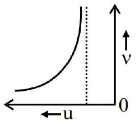
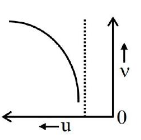
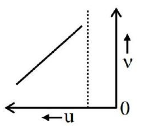
View full solution →Let $u$ and $v$ be the distances of the object and the image from a lens of focal length $f$. The correct graphical representation of $u$ and $v$ for a convex lens when $|\mathbf{u}|>f$, is
Answer: B.
View full solution →The maximum speed of a boat in still water is $27 \mathrm{~km} / \mathrm{h}$. Now this boat is moving downstream in a river flowing at $9 \mathrm{~km} / \mathrm{h}$. A man in the boat throws a ball vertically upwards with speed of $10 \mathrm{~m} / \mathrm{s}$. Range of the ball as observed by an observer at rest on the river bank, is ____________ cm .
(Take $\mathrm{g}=10 \mathrm{~m} / \mathrm{s}^{2}$ )
View full solution →In a hydraulic lift, the surface area of the input piston is $6 \mathrm{~cm}^{2}$ and that of the output piston is $1500 \mathrm{~cm}^{2}$. If 100 N force is applied to the input piston to raise the output piston by 20 cm , then the work done is____________ kJ.
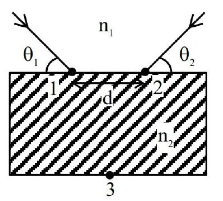
View full solution →Two light beams fall on a transparent material block at point 1 and 2 with angle $\theta_{1}$ and $\theta_{2}$, respectively, as shown in figure. After refraction, the beams intersect at point 3 which is exactly on the interface at other end of the block. Given : the distance between 1 and $2, d=4 \sqrt{3} \mathrm{~cm}$ and $\theta_{1}=\theta_{2}=\cos ^{-1}\left(\frac{n_{2}}{2 n_{1}}\right)$, where refractive index of the block $\mathrm{n}_{2}>$ refractive index of the outside medium $n_{1}$, then the thickness of the block is
____________ cm .
View full solution →A container of fixed volume contains a gas at $27^{\circ} \mathrm{C}$. To double the pressure of the gas, the temperature of gas should be raised to ____________ ${ }^{\circ} \mathrm{C}$.
View full solution →The coordinates of a particle with respect to origin in a given reference frame is $(1,1,1)$ meters. If a force of $\vec{F}=\hat{i}-\hat{j}+\hat{k}$ acts on the particle, then the magnitude of torque (with respect to origin) in $z$-direction is ____________ .
View full solution →500 J of energy is transferred as heat to 0.5 mol of Argon gas at 298 K and 1.00 atm . The final temperature and the change in internal energy respectively are :Given : $\mathrm{R}=8.3 \mathrm{~J} \mathrm{~K}^{-1} \mathrm{~mol}^{-1}$
Answer: D.
View full solution →Given below are two statements :
Statement (I): The radii of isoelectronic species increases in the order.
$\mathrm{Mg}^{2+}<\mathrm{Na}^{+}<\mathrm{F}^{-}<\mathrm{O}^{2-}$
Statement (II) : The magnitude of electron gain enthalpy of halogen decreases in the order.
$\mathrm{Cl}>\mathrm{F}>\mathrm{Br}>\mathrm{I}$
In the light of the above statements, choose the most appropriate answer from the options given below :
- A
Statement I is incorrect but Statement II is correct
- B
Both Statement I and Statement II are incorrect
- C
Statement I is correct but Statement II is incorrect
- ✓
Both Statement I and Statement II are correct
Answer: D.
View full solution →If $a_{0}$ is denoted as the Bohr radius of hydrogen atom, then what is the de-Broglie wavelength ( $\lambda$ ) of the electron present in the second orbit of hydrogen atom? [ n : any integer]
- A
$\frac{2 a_{0}}{n \pi}$
- ✓
$\frac{8 \pi a_{0}}{n}$
- C
$\frac{4 \pi a_{0}}{n}$
- D
$\frac{4 n}{\pi a_{0}}$
Answer: B.
View full solution →Choose the correct statements.
(A) Weight of a substance is the amount of matter present in it.
(B) Mass is the force exerted by gravity on an object.
(C) Volume is the amount of space occupied by a substance.
(D) Temperatures below $0^{\circ} \mathrm{C}$ are possible in Celsius scale, but in Kelvin scale negative temperature is not possible.
(E) Precision refers to the closeness of various measurements for the same quantity.
Answer: D.
View full solution →1.24 g of $\mathrm{AX}_{2}$ (molar mass $124 \mathrm{~g} \mathrm{~mol}^{-1}$ ) is dissolved in 1 kg of water to form a solution with boiling point of $100.0156^{\circ} \mathrm{C}$, while 25.4 g of $\mathrm{AY}_{2}$ (molar mass $250 \mathrm{~g} \mathrm{~mol}^{-1}$ ) in 2 kg of water constitutes a solution with a boiling point of $100.0260^{\circ} \mathrm{C}$.
$\mathrm{K}_{\mathrm{b}}\left(\mathrm{H}_{2} \mathrm{O}\right)=0.52 \mathrm{~K} \mathrm{~kg} \mathrm{~mol}^{-1}$ Which of the following is correct ?
- A
$\mathrm{AX}_{2}$ and $\mathrm{AY}_{2}$ (both) are completely unionised.
- B
$\mathrm{AX}_{2}$ and $\mathrm{AY}_{2}$ (both) are fully ionised.
- C
$\mathrm{AX}_{2}$ is completely unionised while $\mathrm{AY}_{2}$ is fully ionised.
- ✓
$\mathrm{AX}_{2}$ is fully ionised while $\mathrm{AY}_{2}$ is completely unionised.
Answer: D.
View full solution →If $\mathrm{A}_{2} \mathrm{~B}$ is $30 \%$ ionised in an aqueous solution, then the value of van't Hoff factor (i) is __________________ $\times 10^{-1}$.
View full solution →The molar mass of the water insoluble product formed from the fusion of chromite ore $\left(\mathrm{FeCr}_{2} \mathrm{O}_{4}\right)$ with $\mathrm{Na}_{2} \mathrm{CO}_{3}$ in presence of $\mathrm{O}_{2}$ is _________________ $\mathrm{g} \mathrm{mol}^{-1}$.
View full solution →The sum of sigma $(\sigma)$ and $\mathrm{pi}(\pi)$ bonds in Hex-1,3-dien-5-yne is _________________ .
View full solution →Given below are some nitrogen containing compounds.
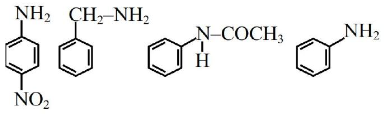
Each of them is treated with HCl separately. 1.0 g of the most basic compound will consume _____________ mg of HCl .
(Given molar mass in $\mathrm{g} \mathrm{mol}^{-1} \mathrm{C}: 12, \mathrm{H}: 1, \mathrm{O}: 16$, $\mathrm{Cl}: 35.5)$ View full solution →View full solution →