Question
Match the catalysts given in Column I with the processes given in Column II.
 
Column I (Catalyst)
 
Column II (Process)
(i)
Ni in the presence of hydrogen
(a)
Zieglar Natta catalyst
(ii)
Cu2Cl2
(b)
Contact process
(iii)
V2O5
(c)
Vegetable oil to ghee
(iv)
Finely divided iron
(d)
Sandmeyer reaction
(v)
TiCl4 + Al (CH3)3
(e)
Haber’s Process
 
 
(f)
Decomposition of KClO3

Answer

 
Column I (Catalyst)
 
Column II (Process)
(i)
Ni in the presence of hydrogen
(c)
Vegetable oil to ghee
(ii)
Cu2Cl2
(d)
Sandmeyer reaction
(iii)
V2O5
(b)
Contact process
(iv)
Finely divided iron
(e)
Haber’s Process
(v)
TiCl4 + Al (CH3)3
(a)
Zieglar Natta catalyst

Explanation:

Catalyst → Process

Ni in presence of H→ Vegetable oil to ghee

Cu2Cl→ Sandmayer reaction

V2O→ Contact process

Finely divided iron → Haber’s process

TiCl+ Al(CH3)→ Zieglar Natta catalyst

Need a full question paper?

Generate a complete, print-ready paper with questions like this in minutes — across 16+ boards, with answer keys.

Start Generating Free

Similar questions

  1. ‘Hormones are chemical messengers.’ Explain.
  2. Name the main disease caused due to lack of the vitamin and its source in each of the following: A, B6 and E.
A hydrocarbon ‘A’, (C4H8) on reaction with HCl gives a compound ‘B’, (C4H9Cl), which on reaction with 1 mol of NH3 gives compound ‘C’, (C4H11N). On reacting with NaNO2 and HCl followed by treatment with water, compound ‘C’ ields an optically active alcohol, ‘D’. Ozonolysis of ‘A’ gives 2 moles of acetaldehyde. Identify the compounds ‘A’ to ‘D’. Explain the reactions involved.
  1. A blackish brown coloured solid ‘A’ when fused with alkali metal hydroxides in presence of air, produces a dark green coloured compound ‘B’, which on electrolytic oxidation in alkaline medium gives a dark purple coloured compound C. Identify A, B and C and write the reactions involved.
  2. What happens when an acidic solution of the green compound (B) is allowed to stand for some time? Give the equation involved. What is this type of reaction called?
For an elementary reaction:
2A + B → 3C
the rate of appearance of C at time ‘t’ is 1.3 × 10⁻⁴ mol L-1 s-1. Calculate at this time:
  1. Rate of the reaction.
  2. Rate of disappearance of A.
Calculate the depression in the freezing point of water when 10 g of CH3CH2CHClCOOH is added to 250 g of water. Ka = 1.4 × 10⁻³, Kf = 1.86 K kg mol–1.
Derive formula for degree of dissociation and degree of condensation of the solute in the solvent.
Answer the following questions:

Account for the following:

  1. Methylamine in water reacts with ferric chloride to precipitate hydrated ferric oxide.
  2. Diazonium salts of aromatic amines are more stable than those of aliphatic amines.
  1. What are essential and non-essential amino acids? Give two examples of each.
  2. What are the two types of photosynthesis in green plants? Give the basic equations of photosynthesis.
  3. Mention the two products of glycolysis.
What happens to most probable kinetic energy and the energy of activation with increase in temperature?
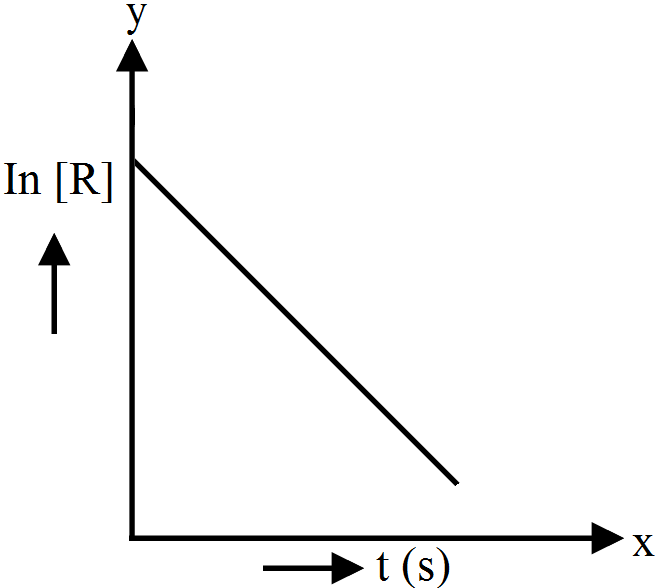
For a certain chemical reaction variation in the concentration ln [R] vs. time plot is given alongside.

For this reaction:

  1. What is the order of the reaction?
  2. What are the units of rate constant k?
  3. Give the relationship between k and t1/2 (half-life period).
  4. What is the slope of the curve?
  5. Draw the plot log [R]0 /[R] vs time t(s).