MCQ
Match the complex species given in Column $I$ with the possible isomerism given in Column $II$ and assign the correct code:
 
Column $I \ ($Complex species$)$
 
Column $II \ ($Isomerism$)$
$a.$
$\ce{[Co(NH_3)_4C_{l2}]^+}$
$1.$
Optical
$b.$
$\ce{cis-[Co(en)_2Cl_2]^+}$
$2.$
Ionisation
$c.$
$\ce{[Co(NH_3)_5 (NO_2)]Cl_2}$
$3.$
Coordination
$d.$
$\ce{[Co(NH_3)_6][Cr(CN)_6]}$
$4.$
Geometrical
 
 
$5.$
Linkage
  • A
    $A (1), B (2), C (4), D (5).$
  • B
    $A (4), B (3), C (2), D (1).$
  • C
    $A (4), B (1), C (5), D (3).$
  • $A (4), B (1), C (2), D (3).$

Answer

Correct option: D.
$A (4), B (1), C (2), D (3).$
 
Column $I \ ($Complex species$)$
 
Column $II \ ($Isomerism$)$
$a.$
$\ce{[Co(NH_3)_4C_{l2}]^+}$
$4.$
Geometrical
$b.$
$\ce{cis-[Co(en)_2Cl_2]^+}$
$1.$
Optical
$c.$
$\ce{[Co(NH_3)_5 (NO_2)]Cl_2}$
$2.$
Ionisation
$d.$
$\ce{[Co(NH_3)_6][Cr(CN)_6]}$
$3.$
Coordination
Isomerism in coordination compound is decided by type of ligands and geometry of coordination and arrangement of ligands.
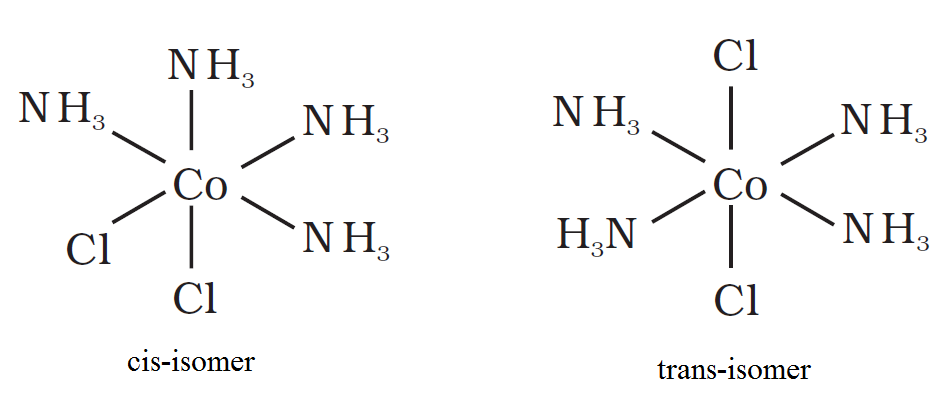
  1. $\ce{[Co(NH_3)_4Cl_2]+}$ shows geometrical isomerism due to presence of two types of ligand whose $\ce{[Co(NH_3)_4Cl_2]+}$ arrangement around central metal ion.
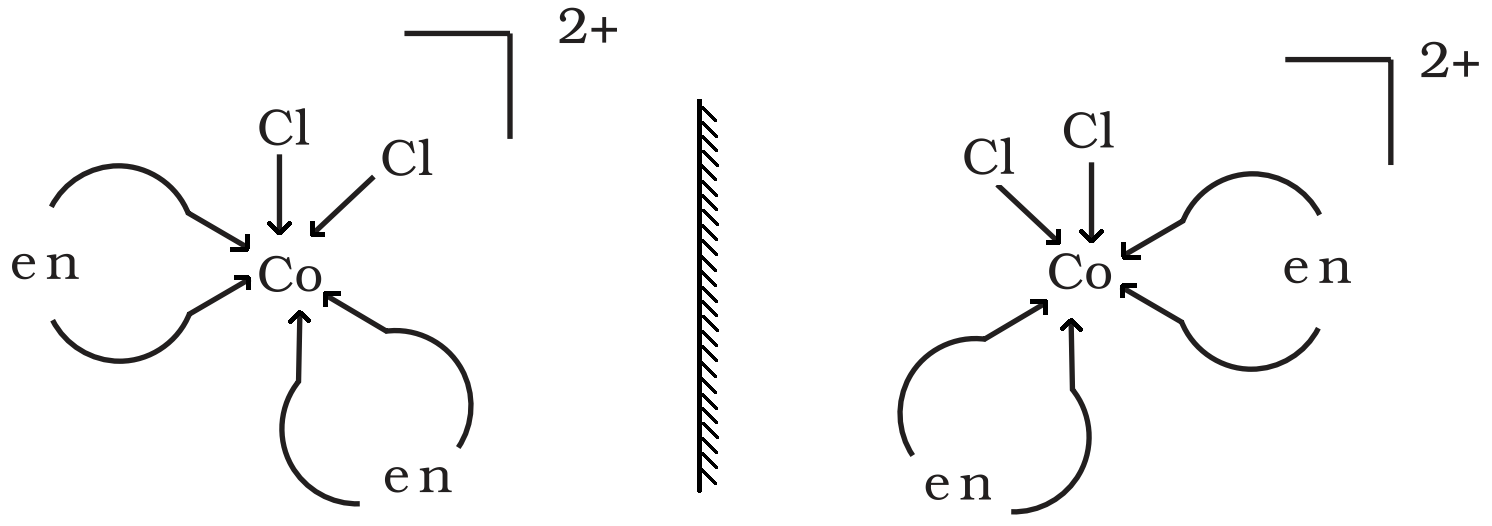
  1. $\ce{cis-[Co(en)_2Cl_2]+}$ shows optical isomer due to its non-superimposable mirror image relationship.
  1. $\ce{[Co(NH_3)_5(NO_2)]Cl_2}$ shows ionization isomer due to its interchanging ligand from outside the ionization sphere.
  2. $\ce{[Co(NH_3)_6][Cr(CN)_6]}$ shows coordination isomer due to interchanging of ligand in between two metal ions from one coordination sphere to another coordination sphere.
Hence, correct choice is $(d).$

Need a full question paper?

Generate a complete, print-ready paper with questions like this in minutes — across 16+ boards, with answer keys.

Start Generating Free

Similar questions

$\mathrm{CoSO}_4 \mathrm{Cl} .5 \mathrm{NH}_3$ exists in two isomeric forms ' A ' and ' B '. Isomer ' A ' reacts with $\mathrm{AgNO}_3$ to give white precipitate, but does not react with $\mathrm{BaCl}_2$. Isomer 'B' gives white precipitate with $\mathrm{BaCl}_2$ but does not react with $\mathrm{AgNO}_3$. Answer the following questions.
  1. Identify ‘A’ and ‘B’ and write their structural formulas.
  2. Name the type of isomerism involved.
  3. Give the IUPAC name of ‘A’ and ‘B’.
After watching a programme on TV about the presence of carcinogens (cancer causing agents) Potassium bromate and Potassium iodate in bread and other bakery products, Rupali a Class XII student decided to make others aware about the adverse effects of these carcinogens in foods. She consulted the school principal and requested him to instruct the canteen contractor to stop selling sandwiches, pizzas, burgers and other bakery products to the students. The principal took an immediate action and instructed the canteen contractor to replace the bakery products with some protein and vitamin rich food like fruits, salads, sprouts, etc. The decision was welcomed by the parents and the students.
After reading the above passage, answer the following questions:
  1. What are the values (at least two) displayed by Rupali?
  2. Which polysaccharide component of carbohydrates is commonly present in bread?
  3. Write the two types of secondary structures of proteins.
  4. Give two examples of water soluble vitamins.
  1. Account for the following:
  1. Transition metals form large number of complex compounds.
  2. The lowest oxide of transition metal is basic whereas the highest oxide is amphoteric or acidic.
  3. $E^\circ $ value for the $Mn^{3+}/Mn^{2+}$ couple is highly positive (+1.57 V) as compare to $Cr^{3+}/Cr^{2+}. 56/1/1 9.$
  1. Write one similarity and one difference between the chemistry of lanthanoid and actinoid elements.
Discuss the general characteristics of Group $15$ elements with reference to their electronic configuration, oxidation state, atomic size, ionisation enthalpy and electronegativity.
(a) Draw the structure of a galvanic cell and also describe the reaction taking place in it.
(b) What happens when opposite external potential is applied in the galvanic cell system? Explain.
Explain the method of preparing haloalkanes by free radical substitution of alkanes.
  1. Account for the following:
  1. $BiH_3$ is the strongest reducing agent in Group $15$ elements hydrides.
  2. $Cl_2​​​​​​​$​​​​​​​ acts as a bleaching agent.
  3. Noble gases have very low boiling points.
  1. Draw the structures of the following:
  1. $H_4P_2O_7$
  2. $XeOF_4$​​​​​​​
$CoSO_4Cl._5NH_3$ exists in two isomeric forms $'A \ '$ and $'B \ '.$ Isomer $'A \ '$ reacts with $AgNO_3$ to give white precipitate but does not react with $BaCl_2.$ Isomer $ 'B \ '$ gives a white precipitate with $BaCl_2$ but does not react with $AgNO_3.$ Answer the following questions.
$i.$ Identify $'A \ '$ and $'B\ '$ and write their structural formulas.
$ii.$ Name the type of isomerism involved.
$iii.$ Give the $ \text{IUPAC}$ name of $'A\ '$ and $'B \ '.$
  1. What are essential and non-essential amino acids? Give two examples of each.
  2. What are the two types of photosynthesis in green plants? Give the basic equations of photosynthesis.
  3. Mention the two products of glycolysis.
Show that in a cubic close packed structure, eight tetrahedral voids are present per unit cell.