Question
 Match the complex species given in Column I with the possible isomerism given in Column II and assign the correct code:

 
Column I (Complex species)
 
Column II (Isomerism)
a.
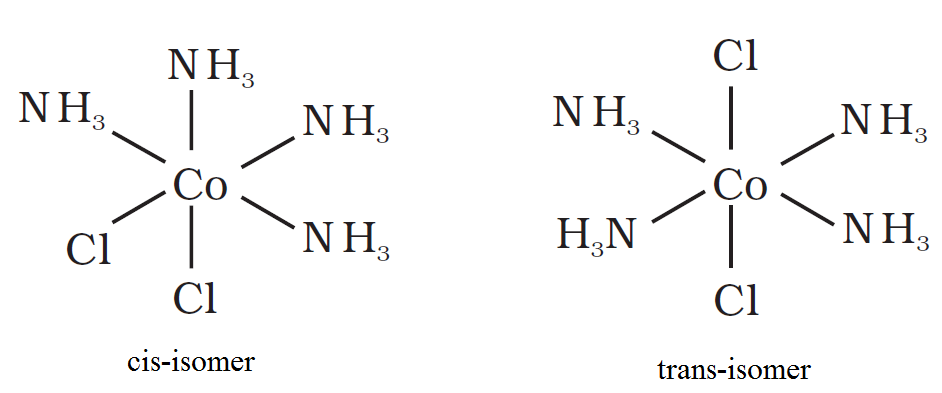
[Co(NH3)4Cl2]+
1.
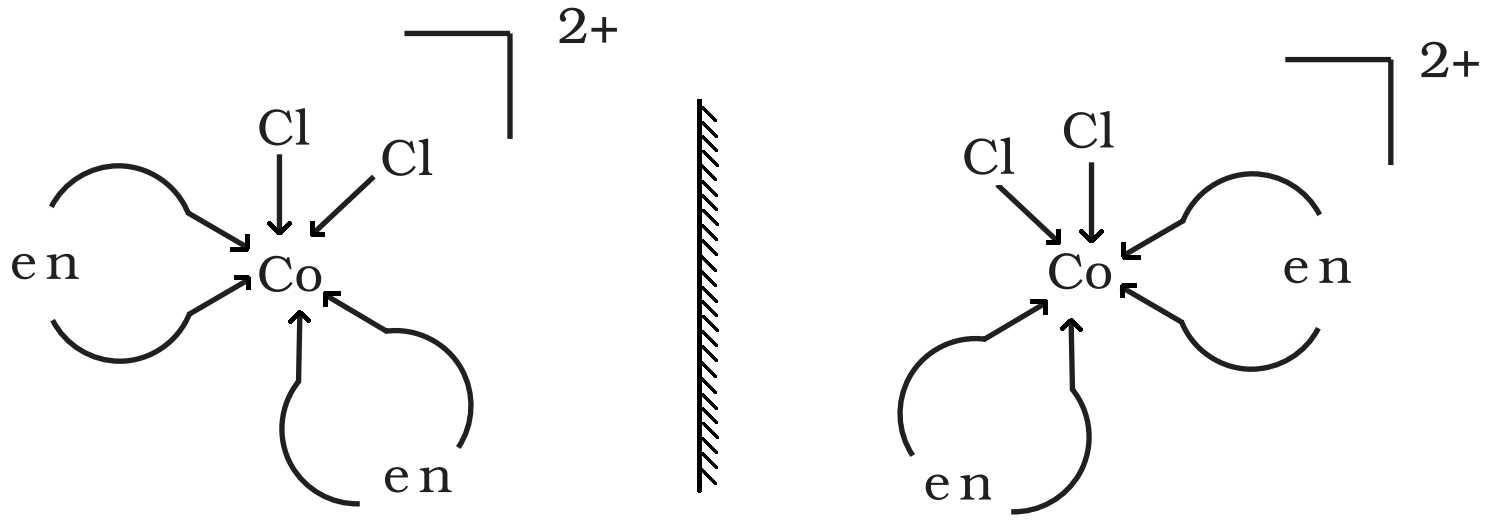
Optical
b.
cis-[Co(en)2Cl2]+
2.
Ionisation
c.
[Co(NH3)5 (NO2)]Cl2
3.
Coordination
d.
[Co(NH3)6][Cr(CN)6]
4.
Geometrical
 
 
5.
Linkage

Code:

  1. A (1), B (2), C (4), D (5).
  2. A (4), B (3), C (2), D (1).
  3. A (4), B (1), C (5), D (3).
  4. A (4), B (1), C (2), D (3).

Need a full question paper?

Generate a complete, print-ready paper with questions like this in minutes — across 16+ boards, with answer keys.

Start Generating Free

Similar questions

Explain the collision principle of any chemical reaction.
Concentration terms such as mass percentage, ppm, mole fraction and molality are independent of temperature, however molarity is a function of temperature. Explain.
  1. Following are the transition metal ions of 3d series:

Ti4+, V2+, Mn3+, Cr3+

(Atomic numbers : Ti = 22, V = 23, Mn = 25, Cr = 24)

Answer the following:

  1. Which ion is most stable in an aqueous solution and why?
  2. Which ion is a strong oxidising agent and why?
  3. Which ion is colourless and why?
  1. Complete the following equations:
  1. $2\text{ }\text{MnO}_4^-+16\text{ }\text{H}^++5\text{ }\text{S}^{2-}\xrightarrow{\text{ }\text{ }\text{ }\text{ }\text{ }\text{ }\text{ }\text{ }\text{ }\text{ }\text{ }}$
  1. $\text{KMnO}_4\xrightarrow{\text{ }\text{ }\text{ }\text{ }\text{ }\text{heat}\text{ }\text{ }\text{ }\text{ }\text{ }}$
A mixed oxide of iron and chromium, FeOCr2O3 is fused with sodium carbonate in the presence of air to form a yellow coloured compound (A). On acidification the compound (A) forms an orange coloured compound (B), which is a strong oxidising agent.
  1. Identify the compounds (A) and (B).
  2. Write balanced chemical equation for each step.
Match the items given in Column I with the type of solutions given in Column II.
 
Column I
 
Column II
i.
Soda water
a.
A solution of gas in solid.
ii.
Sugar solution
b.
A solution of gas in gas.
iii.
German silver
c.
A solution of solid in liquid.
iv.
Air
d.
A solution of solid in solid.
v.
Hydrogen gas in palladium
e.
A solution of gas in liquid.
 
 
f.
A solution of liquid in solid.
Answer the following questions:

For M2+/M and M3+/M2+ systems, E° values for some metals are as follows:

Cr2+/Cr = - 0.9 V Cr3+/Cr2+ = - 0.4 V
Mn2+/Mn = 0 1.2 V Mn3+/Mn2+ = +1.5 V
Fe2+/Fe = - 0.4 V Fe3+/Fe2+ = +0.8 V

Use this data to comment upon:

  1. The stability of Fe3+ in acid solution as compared to that of Cr3+ and Mn3+.
  2. The ease with which iron can be oxidised as compared to the similar process for either Cr or Mn metals.
  1. Account for the following:
  1. Transition metals show variable oxidation states.
  2. Zn, Cd and Hg are soft metals.
  3. Evalue for the Mn3+/Mn2+ couple is highly

positive (+ 1·57 V) as compared to Cr3+/Cr2+.

  1. Write one similarity and one difference between the chemistry of lanthanoid and actinoid elements.
write the classification of amino acids and give examples of each.
Explain the electrophilic substitution reactions of amine.
  1. Complete the following chemical equations:
  1. $ \text{MnO}_{4}^{-}\text{(aq)}+\text{S}_{2}\text{O}_{4}\text{(aq)}+\text{H}_{2}\text{O}\text{(l)}\rightarrow$
  2. $\text{Cr}_{2}\text{O}_{4}^{2-}\text{(aq)}+\text{Fe}^{2+}\text{(aq)}+\text{H}^{+}\text{(aq)}\rightarrow$
  1. Explain the following observations:
  1. La3+ (Z = 57) and Lu3+ (Z = 71) do not show any colour in solutions.
  2. Among the divalent cations in the first series of transition elements, manganese exhibits the maximum paramagnetism.
  3. Cu+ ion is not known in aqueous solutions.