Question
Answer the following questions:

For M2+/M and M3+/M2+ systems, E° values for some metals are as follows:

Cr2+/Cr = - 0.9 V Cr3+/Cr2+ = - 0.4 V
Mn2+/Mn = 0 1.2 V Mn3+/Mn2+ = +1.5 V
Fe2+/Fe = - 0.4 V Fe3+/Fe2+ = +0.8 V

Use this data to comment upon:

  1. The stability of Fe3+ in acid solution as compared to that of Cr3+ and Mn3+.
  2. The ease with which iron can be oxidised as compared to the similar process for either Cr or Mn metals.
Answer

  1. Higher the reduction potential of a species, greater is the ease with which it undergo reduction. Among these pairs, Mn3+/Mn2+ has largest positive reduction potential. Hence Mn3+ can be easily reduced to Mn2+ i.e., Mn3+ is least stable. Cr3+/Cr2+ has a negative E° value, therefore, Cr3+ is most stable. Fe3+/Fe2+ has a positive value but small. Hence, Fe3+ is more stable than Mn3+ but less stable than Cr3+.
  2. Lower the reduction potential or higher the oxidation potential of a species, greater is the ease with which it undergo oxidation. Among these pairs, Mn2+/Mn has the most negative reduction potential or most positive oxidation potential. Therefore, it will be most easily oxidised. Thus, the decreasing order of their ease of oxidation is Mn > Cr > Fe.

Need a full question paper?

Generate a complete, print-ready paper with questions like this in minutes — across 16+ boards, with answer keys.

Start Generating Free

Similar questions

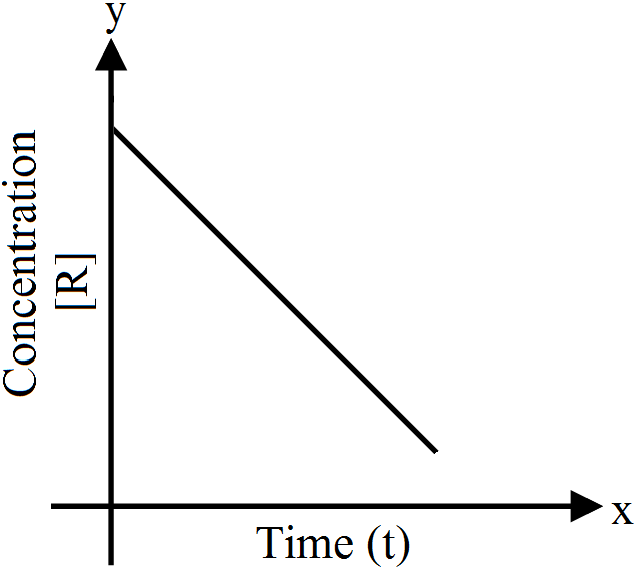
Consider the reaction $\text{R}\xrightarrow{\ \ \text{k}\ \ } \text{P}.$ The change in concentration of R with time is shown in the following plot:

  1. Predict the order of the reaction.
  2. Derive the expression for the time required for the completion of the reaction.
  3. What does the slope of the above line indicate?

Describe the preparation of potassium permanganate. How does the acidified permanganate solution react with (i) iron(II) ions (ii) SO2 and (iii) oxalic acid? Write the ionic equations for the reactions.
Explain Hoffmann bromamide degradation reaction with mechanism.
Match the catalysts given in Column I with the processes given in Column II.
 
Column I (Catalyst)
 
Column II (Process)
(i)
Ni in the presence of hydrogen
(a)
Zieglar Natta catalyst
(ii)
Cu2Cl2
(b)
Contact process
(iii)
V2O5
(c)
Vegetable oil to ghee
(iv)
Finely divided iron
(d)
Sandmeyer reaction
(v)
TiCl4 + Al (CH3)3
(e)
Haber’s Process
 
 
(f)
Decomposition of KClO3
What are the classification of proteins on the basis of molecular shape?
The activation energy of a reaction is 75.2kJ mol-1 in the absence of a catalyst and it lowers to 50.14kJ mol-1with a catalyst. How many times will the rate of reaction grow in the presence of a catalyst if the reaction proceeds at 25°C?
write the classification of amino acids and give examples of each.
Explain primary, secondary and tertiary structure of proteins with diagram.
Explain the effect of substitutents on the basic strength of aromatic amines.