Question
 Match the complex species given in Column I with the possible isomerism given in Column II and assign the correct code:

 
Column I (Complex species)
 
Column II (Isomerism)
a.
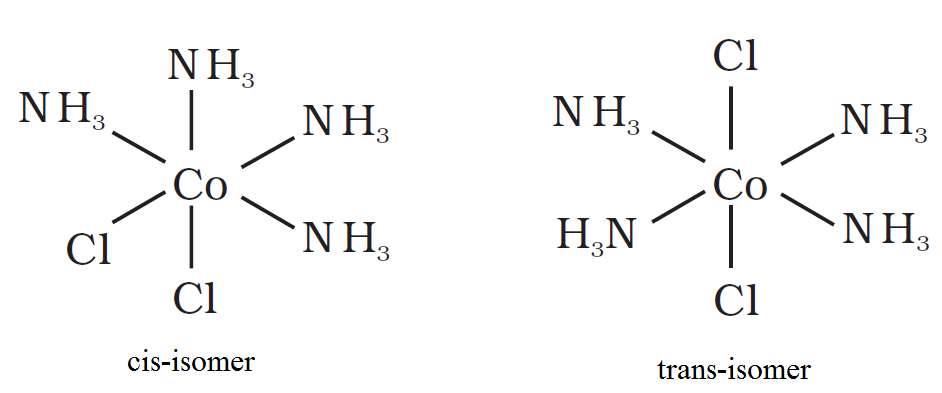
[Co(NH3)4Cl2]+
1.
Optical
b.
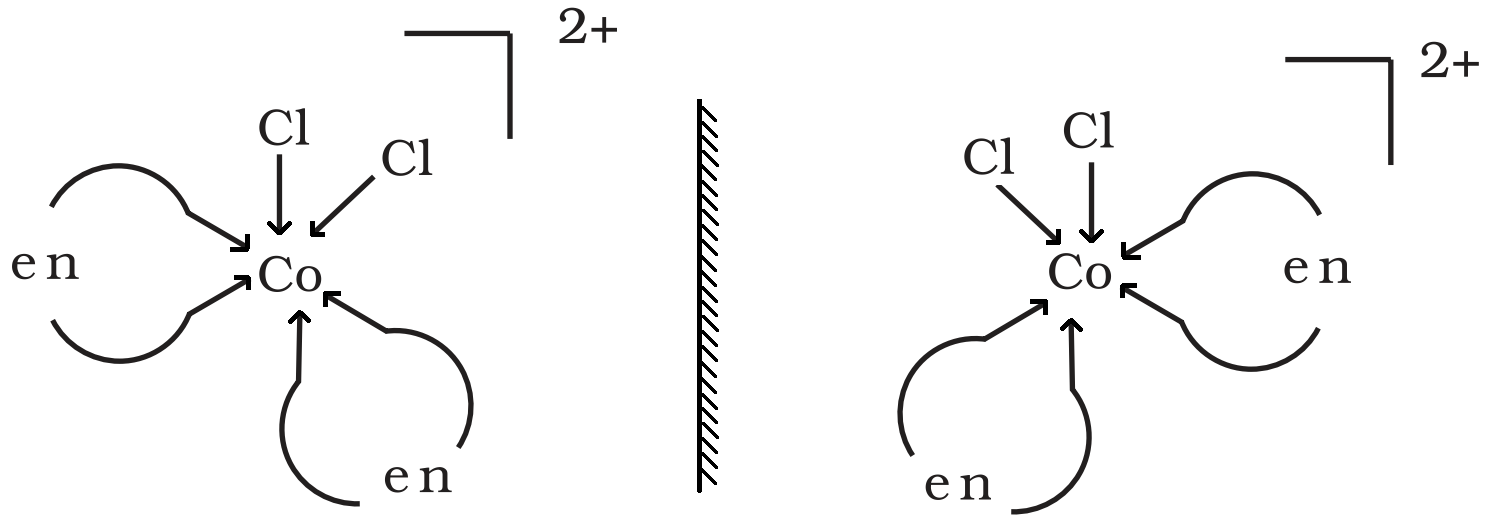
cis-[Co(en)2Cl2]+
2.
Ionisation
c.
[Co(NH3)5 (NO2)]Cl2
3.
Coordination
d.
[Co(NH3)6][Cr(CN)6]
4.
Geometrical
 
 
5.
Linkage

Code:

  1. A (1), B (2), C (4), D (5).
  2. A (4), B (3), C (2), D (1).
  3. A (4), B (1), C (5), D (3).
  4. A (4), B (1), C (2), D (3).

Need a full question paper?

Generate a complete, print-ready paper with questions like this in minutes — across 16+ boards, with answer keys.

Start Generating Free

Similar questions

Explain the properties and uses of methanol and ethanol.
Complete the following reactions :
(i) $C _6 H _5 NH _2+ CHCl _3+$ alc. $KOH \longrightarrow$
(ii) $C _6 H _5 N_2 Cl + H _3 PO _2+ H _2 O \longrightarrow$
(iii) $C _6 H _5 NH _2+ H _2 SO _4$ (conc.) ⟶
(iv) $C _6 H _5 N_2 Cl + C _2 H _5 OH \longrightarrow$
(v) $C _6 H _5 NH _2+ Br _2(a q) \longrightarrow$
(a) Draw the structure of a galvanic cell and also describe the reaction taking place in it.
(b) What happens when opposite external potential is applied in the galvanic cell system? Explain.
Match the terms given in Column I with the units given in Column II.

 
Column I


Column II

i.

$\wedge_{\text{m}}$

a.

Intensive property.

ii.

$\text{E}^{\ominus}_{\text{Cell}}$

b.

Depends on number of ions/volume.

iii.

$\text{K}$

c.

Extensive property.

iv.

$\Delta_{\text{r}}\text{G}_{\text{Cell}}$

d.

Increases with dilution.

Prove that boiling point elevation (AT) is proportional to the molality of solute present in the solution. Also find its mathematical form.
  1. How are lipids classified? Give an example of each class.
  2. Explain the following terms:
  1. Mutarotation.
  2. Avitaminosis.
How will you convert :
(i) Ethanoic acid into methanamine
(ii) Hexanenitrile into 1-aminopentane
(iii) Methanol to ethanoic acid
(iv) Ethanamine into methanamine
100 g of liquid A (molar mass 140 g mol-1) was dissolved in 1000 g of liquid B (molar mass 180 g mol-1). The vapour pressure of pure liquid B was found to be 500 Torr. Calculate the vapour pressure of pure liquid A and its vapour pressure in the solution if the total vapour pressure of the solution is 475 Torr.