Question
Match the following:
$a.$ If $E_1$ and $E_2$ are the two mutually exclusive events $i.$ $\text{E}_1\cap\text{E}_2=\text{E}_1$
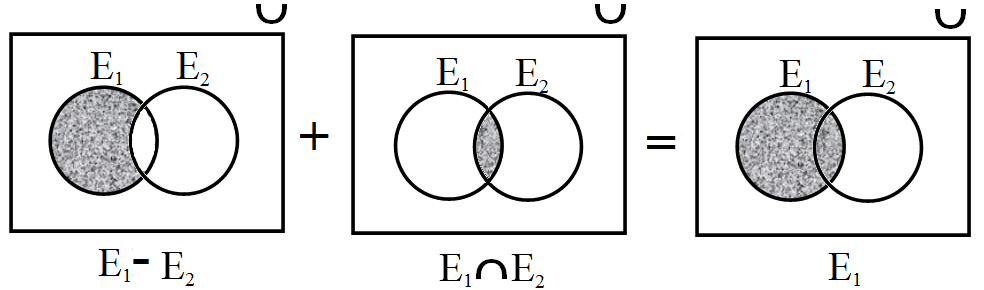
$b.$ If $E_1$ and $E_2$ are the mutually exclusive and exhaustive events $ii.$ $(\text{E}_1-\text{E}_2)\cup(\text{E}_1\cap\text{E}_2)=\text{E}_1$
$c.$ If $E_1$ and $E_2$ have common outcomes, then $iii.$ $\text{E}_1\cap\text{E}_2=\phi,\text{ E}_1\cup\text{E}_2=\text{S}$
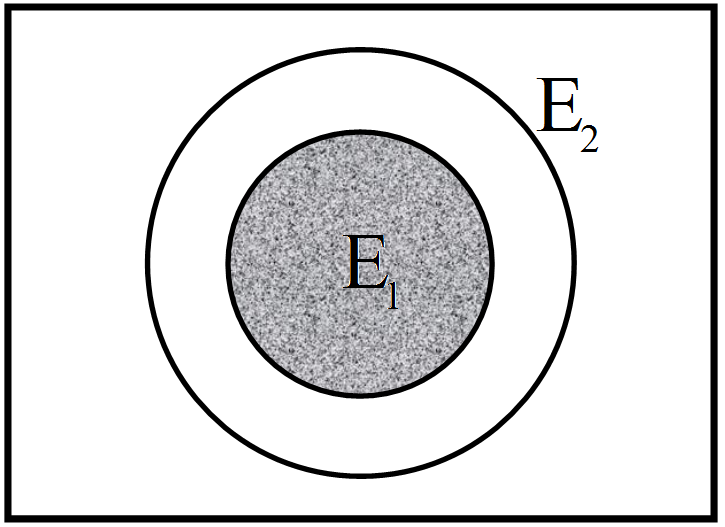
$d.$ If $E_1$ and $E_2$ are two events such that $\text{E}_1\subset\text{E}_2$ $iv.$ $\text{E}_1\cap\text{E}_2=\phi$

Answer

Match the following:
$a.$ If $E_1$ and $E_2$ are the two mutually exclusive events $iv.$ $\text{E}_1\cap\text{E}_2=\phi$
$b.$ If $E_1$ and $E_2$ are the mutually exclusive and exhaustive events $iii.$ $\text{E}_1\cap\text{E}_2=\phi,\text{ E}_1\cup\text{E}_2=\text{S}$
$c.$ If $E_1$ and $E_2$ have common outcomes, then $ii.$ $(\text{E}_1-\text{E}_2)\cup(\text{E}_1\cap\text{E}_2)=\text{E}_1$
$d.$ If $E_1$ and $E_2$ are two events such that $\text{E}_1\subset\text{E}_2$ $i.$ $\text{E}_1\cap\text{E}_2=\text{E}_1$
​​​​​​​
  1. If $E_1$ and $E_2$ are mutually exclusive events, then $\text{E}_1\cap\text{E}_2=\phi$
  2. If $E_1$ and $E_2$ are the mutually exclusive and exhaustive events $\text{E}_1\cap\text{E}_2=\phi,$ and $\text{E}_1\cup\text{E}_2=\text{S}$
  3. If $E_1$ and $E_2$ have common outcomes, then $(\text{E}_1-\text{E}_2)\cup(\text{E}_1\cap\text{E}_2)=\text{E}_1$​​​​​​​
  4. If $E_1$ and $E_2$ are two events such that
  5. $\text{E}_1\subset\text{E}_2\Rightarrow\text{E}_1\cap\text{E}_2=\text{E}_1$

Need a full question paper?

Generate a complete, print-ready paper with questions like this in minutes — across 16+ boards, with answer keys.

Start Generating Free

Similar questions