Questions

5 Marks Questions

Take a timed test

10 questions · self-marked practice — reveal the answer and mark yourself.

Question 15 Marks
Match the following:
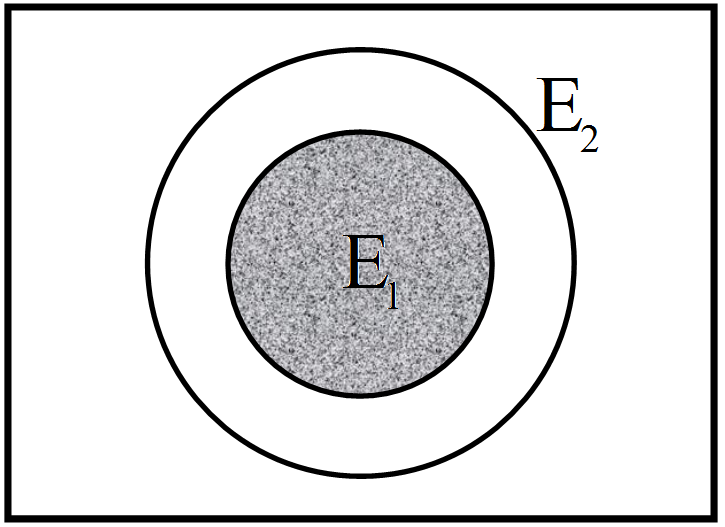
$a.$ If $E_1$ and $E_2$ are the two mutually exclusive events $i.$ $\text{E}_1\cap\text{E}_2=\text{E}_1$
$b.$ If $E_1$ and $E_2$ are the mutually exclusive and exhaustive events $ii.$ $(\text{E}_1-\text{E}_2)\cup(\text{E}_1\cap\text{E}_2)=\text{E}_1$
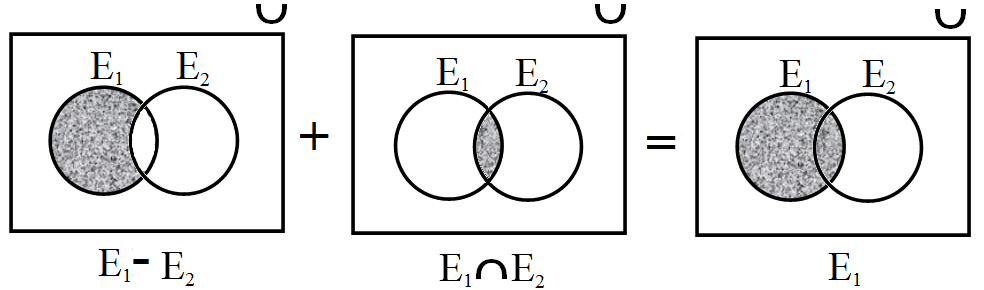
$c.$ If $E_1$ and $E_2$ have common outcomes, then $iii.$ $\text{E}_1\cap\text{E}_2=\phi,\text{ E}_1\cup\text{E}_2=\text{S}$
$d.$ If $E_1$ and $E_2$ are two events such that $\text{E}_1\subset\text{E}_2$ $iv.$ $\text{E}_1\cap\text{E}_2=\phi$
Answer
Match the following:
$a.$ If $E_1$ and $E_2$ are the two mutually exclusive events $iv.$ $\text{E}_1\cap\text{E}_2=\phi$
$b.$ If $E_1$ and $E_2$ are the mutually exclusive and exhaustive events $iii.$ $\text{E}_1\cap\text{E}_2=\phi,\text{ E}_1\cup\text{E}_2=\text{S}$
$c.$ If $E_1$ and $E_2$ have common outcomes, then $ii.$ $(\text{E}_1-\text{E}_2)\cup(\text{E}_1\cap\text{E}_2)=\text{E}_1$
$d.$ If $E_1$ and $E_2$ are two events such that $\text{E}_1\subset\text{E}_2$ $i.$ $\text{E}_1\cap\text{E}_2=\text{E}_1$
​​​​​​​
  1. If $E_1$ and $E_2$ are mutually exclusive events, then $\text{E}_1\cap\text{E}_2=\phi$
  2. If $E_1$ and $E_2$ are the mutually exclusive and exhaustive events $\text{E}_1\cap\text{E}_2=\phi,$ and $\text{E}_1\cup\text{E}_2=\text{S}$
  3. If $E_1$ and $E_2$ have common outcomes, then $(\text{E}_1-\text{E}_2)\cup(\text{E}_1\cap\text{E}_2)=\text{E}_1$​​​​​​​
  4. If $E_1$ and $E_2$ are two events such that
  5. $\text{E}_1\subset\text{E}_2\Rightarrow\text{E}_1\cap\text{E}_2=\text{E}_1$
View full question & answer
Question 25 Marks
Match the proposed probability under Column $C_1$ with the appropriate written description under column $C_2:$
  $C_1$   $C_2$
  Probability   Written Description.
$a.$ $0.95$ $i.$ An incorrect assignment.
$b.$ $0.02$ $ii.$ No chance of happening.
$c.$ $-0.3$ $iii.$ As much chance of happening as not.
$d.$ $0.5$ $iv.$ Very likely to happen.
$e.$ $0$ $v.$ Very little chance of happening.
Answer
  $C_1$   $C_2$
  Probability   Written Description.
$a.$ $0.95$ $iv.$ Very likely to happen.
$b.$ $0.02$ $v.$ Very little chance of happening.
$c.$ $-0.3$ $i.$ An incorrect assignment.
$d.$ $0.5$ $iii.$ As much chance of happening as not.
$e.$ $0$ $ii.$ No chance of happening.
  1. $=$ Very likely to happen, so it is close to $1.$
  2. $0.02 =$ Very little chance of happening as the probability is very low.
  3. $-0.3 =$ an incorrect assignment because probability is never negative.
  4. $0.5 =$ As much chance of happening as not because sum of chances of happening and not happening is one.
  5. $0 = $No chance of happening.
View full question & answer
Question 35 Marks
In a large metropolitan area$,$ the probabilities are $87, 36, 30$ that a family $($randomly chosen for a sample survey$)$ owns a colour television set$,$ a black and white television set$,$ or both kinds of sets. What is the probability that a family owns either anyone or both kinds of sets?
Answer
Let $E_1$ be the even that a family owns colour television set $E_2$ be the even that the family.
owns black and white television set.
Given that $P(E_1) = 0.87, P(E_2) = 0.36$
and $\text{P}(\text{E}_1\cap\text{E}_2)=0.30$
$\therefore$ The probability that a family owns either colour television set or black and white television set.
$\therefore\ \text{P}(\text{E}_1\cup\text{E}_2)=\text{P(E)}_1+\text{P(E)}_2-\text{P}(\text{E}_1\cap\text{E}_2)$
$=0.87+0.36-0.30$
$=0.93$
Hence$,$ the required probability $= 0.93$
View full question & answer
MCQ 45 Marks
$A$ sample space consists of $9$ elementary outcomes $e_1, e_2, ...., e_9$ whose probabilities are
$P(e_1) = P(e_2 ) = 0.08, P(e_3 ) = P(e_4) = P(e_5) = 0.1$
$P(e_6) = P(e_7) = 0.2, P(e_8) = P(e_9) = 0.07$
Suppose $A = {e_1, e_5, e_8}, B = {e_2, e_5, e_8, e_9}$
  • A
    Calculate $P (A), P (B),$ and $\text{P}(\text{A}\cap\text{B})$
  • B
    Using the addition law of probability$,$ calculate $\text{P}(\text{A}\cup\text{B})$
  • C
    List the composition of the event $\text{A}\cup\text{B},$ and calculate $\text{P}(\text{A}\cup\text{B})$ by adding the probabilities of the elementary outcomes.
  • D
    Calculate $\text{P}(\bar{\text{B}})$ from $P(B),$ also calculate $\text{P}(\bar{\text{B}})$ directly from the elementary outcomes of $\bar{\text{B}}$
Answer
$\text{P(A)}=\text{P}(\text{E}_1)+\text{P}(\text{E}_5)+\text{P}(\text{E}_8)$
$\text{P(A)}=0.08+0.1+0.07=0.25$
$\text{P(B)}=\text{P}(\text{E}_2)+\text{P}(\text{E}_5)+\text{P}(\text{E}_8)+\text{P}(\text{E}_9)$$\text{P(B)}=0.08+0.1+0.07+0.07=0.32$
$\text{P}(\text{A}\cup\text{B})=\text{P(A)}+\text{P(B)}-\text{P}(\text{A}\cap\text{B})$
Now$, \text{A}\cap\text{B}=\big\{\text{E}_5,\text{E}_8\big\}$
$\therefore\ \text{P}(\text{A}\cap\text{B})=\text{P}(\text{E}_5)+\text{P}(\text{E}_8)$
$=0.1+0.07=0.17$
$\therefore\ \text{P}(\text{A}\cup\text{B})=0.25+0.32-0.17=0.40$
$\text{A}\cup\text{B}=\big\{\text{E}_1,\text{E}_2,\text{E}_5,\text{E}_8,\text{E}_9\big\}$$\text{P}(\text{A}\cup\text{B})=\text{P}(\text{E}_1)+\text{P}(\text{E}_2)+\text{P}(\text{E}_5)+\text{P}(\text{E}_8)+\text{P}(\text{E}_9)$
$=0.08+0.08+0.1+0.07+0.07=0.40$
$\because\ \text{P}\bar{(\text{B})}=1-\text{P(B)}$$=1-0.32=0.68$
and $\bar{\text{B}}=\big\{\text{E}_1,\text{E}_3,\text{E}_4,\text{E}_6,\text{E}_7\big\}$
$\therefore\ \text{P}(\bar{\text{B}})=\text{P}(\text{E}_1)+\text{P}(\text{E}_3)+\text{P}(\text{E}_4)+\text{P}(\text{E}_6)+\text{P}(\text{E}_7)$
$=0.08+0.1+0.1+0.2+0.2=0.68$
View full question & answer
MCQ 55 Marks
A team of medical students doing their internship have to assist during surgeries at a city hospital. The probabilities of surgeries rated as very complex, complex, routine, simple or very simple are respectively, $0.15, 0.20, 0.31, 0.26, 08.$ Find the probabilities that a particular surgery will be rated:
  • A
    Complex or very complex.
  • B
    Neither very complex nor very simple.
  • C
    Routine or complex.
  • D
    Routine or simple.
Answer
Let $E_1, E_2, E_3, E_4,$ and $E_5$ be the event that surgeries are rated as very complex, complex, rautine, simple or very simple, respectively.
$\therefore\ \text{P}(\text{E}_1)=0.15,\text{ P}(\text{E}_2)=0.20,\text{ P}(\text{E}_3)=0.31,\text{ P}(\text{E}_4)=0.26,\text{ P}(\text{E}_5)=0.08$
$\text{P}($complex or very complex$),$
$=\text{P}(\text{E}_1\text{ or E}_2)=\text{P}(\text{E}_1\cup\text{E}_2)$
$=\text{P}(\text{E}_1)+\text{P}(\text{E}_2)-\text{P}(\text{E}_1\cap\text{E}_2)$
$=0.15+0.20-0$
$=0.35$
$\text{P}($neither very complex nor very simple$),$
$\text{P}(\text{E}'_1\cap\text{E}'_5)=\text{P}(\text{E}_1\cup\text{E}_5)'$
$=1-\text{P}(\text{E}_1\cup\text{E}_5)$
$=1-\big[\text{P}(\text{E}_1)+\text{P}(\text{E}_5)\big]$
$=1-(0.15+0.08)$
$=1-0.23$
$=0.77$
$\text{P}($routine or complex$),$
$=\text{P}(\text{E}_3\cup\text{E}_2)=\text{P}(\text{E}_3)+\text{P}(\text{E}_2)$
$=0.31+0.20$
$=0.57$
$\text{P}($routine or simple$),$
$=\text{P}(\text{E}_3\cup\text{E}_4)=\text{P}(\text{E}_3)+\text{P}(\text{E}_4)$
$=0.31+0.26$
$=0.57$
View full question & answer
Question 65 Marks
Four candidates $\text{A, B, C, D}$ have applied for the assignment to coach a school cricket team. If $A$ is twice as likely to be selected as $B,$ and $B$ and $C$ are given about the same chance of being selected, while $C$ is twice as likely to be selected as $D,$ what are the probabilities that:
  1. $C$ will be selected?
  2. $A$ will not be selected?
Answer
Given that $A$ is twice as likely to be selected as $B$
I.e., $\text{P(A)}=2\text{P(B)}$
and $C$ is twice as likely to be selected as $D$
$\therefore\ \text{P(C)}=2\text{P(D)}$
$\Rightarrow\text{P(B)}=2\text{P(D)}$
$\Rightarrow\frac{\text{P(A)}}{2}=2\text{P(D)}$
$\Rightarrow\text{P(D)}\frac{1}{4}\text{P(A)}$
Now $B$ and $C$ are given about the same chance
$\therefore\ \text{P(B)}=\text{P(C)}$
Since, sum of all probabilities $= 1$
$\therefore\ \text{P(A)}+\text{P(B)}+\text{P(C)}+\text{P(D)}=1$
$\Rightarrow\text{P(A)}+\frac{\text{P(A)}}{2}+\frac{\text{P(A)}}{2}+\frac{\text{P(A)}}{4}=1$
$\Rightarrow4\text{P(A)}+2\text{P(A)}+2\text{P(A)}+\text{P(A)}=4$
$\Rightarrow9\text{P(A)}=4$
$\Rightarrow\text{P(A)}=\frac{4}{9}$
  1. $P(C$ will be selected$)$

$=\text{P(C)}=\text{P(B)}=\frac{\text{P(A)}}{2}$
$=\frac{4}{9}\times\frac{1}{2}=\frac{2}{9}$
  1. $P(A$ will not be selected$)$

$\text{P}(\text{A}')=1-\text{P(A)}$
$=1-\frac{4}{9}$
$=\frac{5}{9}$
View full question & answer
Question 75 Marks
A die is loaded in such a way that each odd number is twice as likely to occur as each even number. Find P(G), where G is the event that a number greater than 3 occurs on a single roll of the die.
Answer
Given that probability of even numbers,
$=\frac{1}{2}\times\text{Probability of odd numbers}$
$\Rightarrow\text{P(Odd)}:\text{P(Even)}=2:1$
$\therefore\ \text{P(Odd number)}=\frac{2}{2+1}=\frac{2}{3}$
and $\text{P(even number)}=\frac{1}{2+1}=\frac{1}{3}$
Also given that, G the event that a number greater 3 occurs in single throw of die.
$\therefore$ The possible outcome are 4, 5 and 6 out of which two are even and one is odd.
 $\therefore\ \text{Required probability}=\text{P(G)}$
$=2\times\text{P(even)}\times\text{P(odd)}$
$=2\times\frac{1}{3}\times\frac{2}{3}=\frac{4}{9}$
Hence, the required probability is $\frac{4}{9}$
View full question & answer
Question 85 Marks
One of the four persons John, Rita, Aslam or Gurpreet will be promoted next month. Consequently the sample space consists of four elementary outcomes $S = \{$John promoted, Rita promoted, Aslam promoted, Gurpreet promoted$\}$ You are told that the chances of John’s promotion is same as that of Gurpreet, Rita’s chances of promotion are twice as likely as Johns. Aslam’s chances are four times that of John:
  1. Determine $P($John promoted$)$

$P($Rita promoted$)$
$P($Aslam promoted$)$
$P($Gurpreet promoted$)$
  1. If $A = \{$John promoted or Gurpreet promoted$\}$, find $P(A).$
Answer
Let Event, $J =$ John promoted
$R =$ Rita promoted
$A =$ Aslam promoted
$G =$ Gurpreet promoted
Given sample space, $S = \{$John promoted, Rita promoted, Aslam promoted, Gurpreet promoted$\}$
i.e. $S = \text{\{J, R, A, G\}}$
t is given that, chances of John’s promotion is same as that of Gurpreet.
$\text{P(J) = P(G)}$
Rita’s chances of promotion are twice as likely as John.
$\text{P(R) = 2P(J)}$
And Aslam’s chances of promotion are four times that of John.
$\text{P(A) = 4P(J)}$
Now, $\text{P(J) + P(R) + P(A) + P(G) = 1}$
$\Rightarrow \text{P(J) + 2P(J) + 4P(J) + P(J) = 1}$
$\Rightarrow \text{P(J)} = 1$
$\Rightarrow\text{P(J)}=\frac{1}{8}$
  1. $P($John promoted$)$

$=\text{P(J)}=\frac{1}{8}$
P(Rita promoted)
$=\text{P(R)}=2\text{P(J)}=2\times\frac{1}{8}=\frac{1}{4}$
A(Aslam promoted)
$=\text{P(A)}=4\text{P(J)}=4\times\frac{1}{8}=\frac{1}{2}$
P(Gurpreet promoted)
$=\text{P(G)}=\text{P(J)}=\frac{1}{8}$
  1. $A =$ John promoted or Gurpreet promoted

$\therefore\ \text{A}=\text{J}\cup\text{G}$
$\text{P(A)}=\text{P(J}\cup\text{G})$
$=\text{P(J)}+\text{P(G)}-\text{P}(\text{J}\cap\text{G})$
$=\frac{1}{8}+\frac{1}{8}-0$ $\big[\because\text{P(J}\cap\text{G})=0\big]$
$=\frac{1}{4}$
View full question & answer
Question 95 Marks
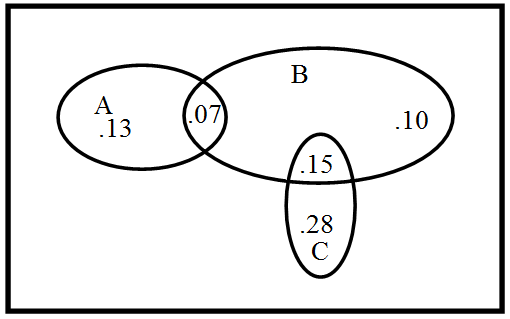
The accompanying Venn diagram shows three events, $A, B,$ and $C,$ and also the probabilities of the various intersections $($for instance, $\text{P}(\text{A}\cap\text{B})=.07)$ Determine:
  1. $\text{P(A)}$
  2. $\text{P}(\text{B}\cap\bar{\text{C}})$
  3. $\text{P(A}\cup\text{B})$
  4. $\text{P(A}\cap\bar{\text{B}})$
  5. $\text{P(B}\cap\text{C})$
  6. Probability of exactly one of the three occurs.
Answer
From the given Venn diagram.
  1. $\text{P(A)}=0.13+0.07=0.20$
  2. $\text{P}(\text{B}\cap\bar{\text{C}})=\text{P(B)}-\text{P}(\text{B}\cap\text{C})$

$=0.07+0.10+0.15-0.15$
$=0.07+0.10$
$=0.17$
  1. $\text{P}(\text{A}\cap\text{B})=\text{P(A)}+\text{P(B)}-\text{P}(\text{A}\cap\text{B})$

$=0.13+0.07+0.07+0.10+0.15-0.07$
$=0.13+0.07+0.10+0.15$
$=0.45$
  1. $\text{P}(\text{A}\cap\bar{\text{B}})=\text{P(A)}-\text{P}(\text{A}\cap\text{B})$

$=0.13+0.07-0.07$
$=0.03$
  1. $\text{P(B}\cap\text{C})=0.15$
  2. $P($exactly one of the three occurs$)$

$=0.13+0.10+0.28$
$=0.51$
View full question & answer
Question 105 Marks
Determine the probability $p,$ for each of the following events.
  1. An odd number appears in a single toss of a fair die.
  2. At least one head appears in two tosses of a fair coin.
  3. A king, $9$ of hearts, or $3$ of spades appears in drawing a single card from a well shuffled ordinary deck of $52$ cards.
  4. The sum of $6$ appears in a single toss of a pair of fair dice.
Answer
  1. When a die is thrown the possible outcomes are
$S = \{1, 2, 3,4, 5, 6\}$ out of which $1, 3, 5$ are odd,
$\therefore$ Required probability $=\frac{3}{6}=\frac{1}{2}$
  1. When a fair coin is tossed two times the space is
$S = \text{\{HH, HT, TH, TT\}}$
If at least one head appears then the favourable casses are $\text{HH, HT}$ and $\text{TH.}$
$\therefore$ Required probability $=\frac{3}{4}$
  1. When a pair of dice is rolled, total number of cases $= 6 \times 6 = 36$
If sum is $6$ then possible outcomes are $(1, 5), (5, 1), (2, 4), (4, 2)$ and $(3, 3)$
$\therefore$ Required probability$=\frac{5}{36}$
  1. $($missing$)$
View full question & answer