Question
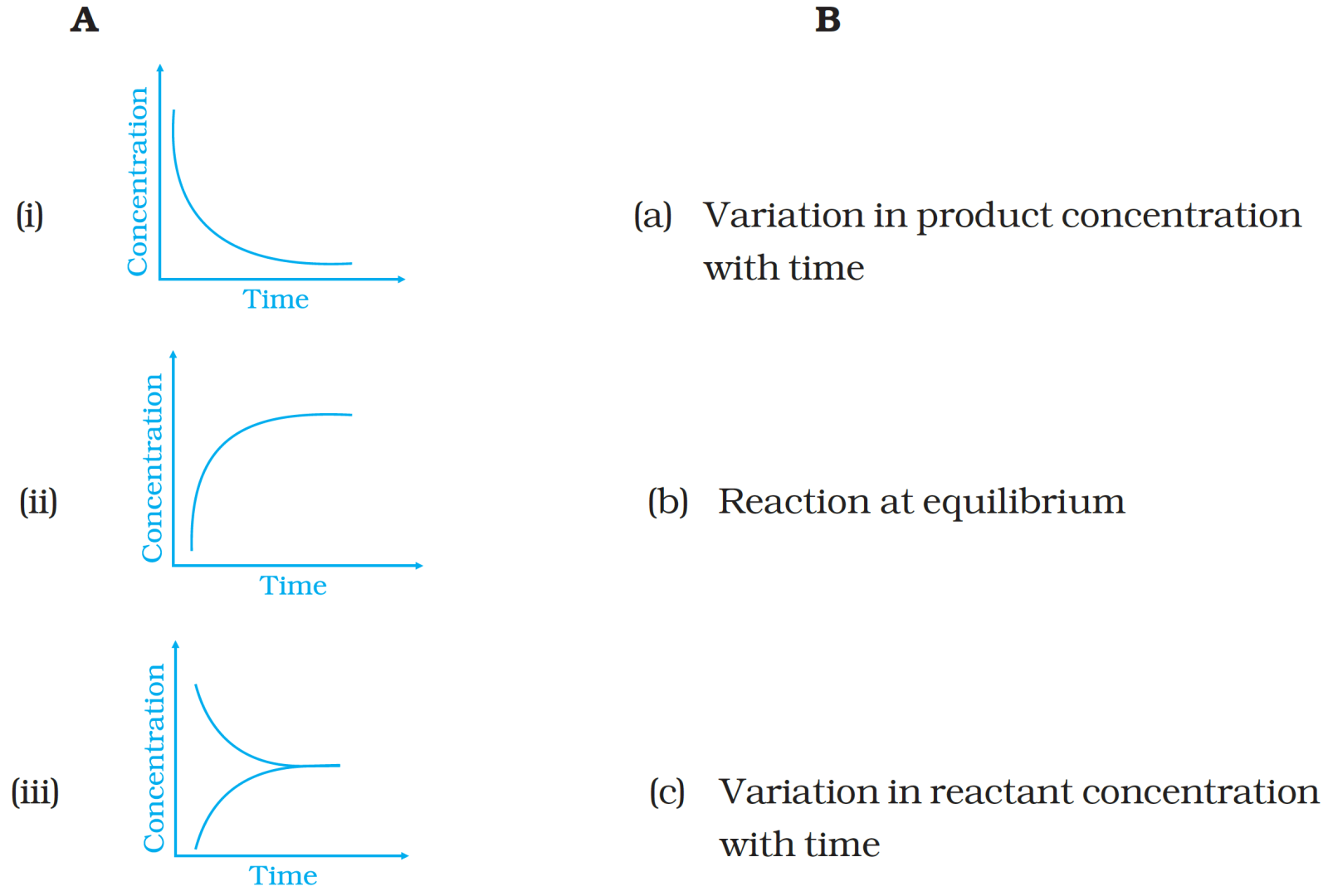
Match the following graphical variation with their description.
Answer

Get the step-by-step solution for this question inside the Vidyadip app.

Get the answer in the app

Need a full question paper?

Generate a complete, print-ready paper with questions like this in minutes — across 16+ boards, with answer keys.
Start Generating Free

Similar questions

  1. Which orbital is non-directional?
  2. What are the frequency and wavelength of a photon emitted during a transition from n = 5 state to n = 2 state in the hydrogen atom?
($h = 6.626 \times 10^{-34}Js$)
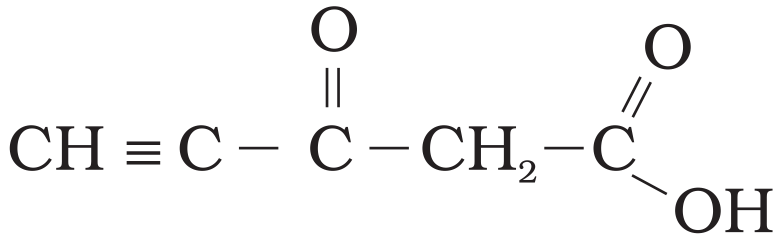
Predict the hybridization of each carbon in the molecule of organic compound given below. Also indicate the total number of sigma and pi bonds in this molecule.
Consider the reactions :
a. $6 CO _2(g)+6 H _2 O ( I ) \longrightarrow C _6 H _{12} O _6( aq )+6 O _2(g)$
b. $O _3(g)+ H _2 O _2( I ) \longrightarrow H _2 O ( I )+2 O _2(g)$
Why it is more appropriate to write these reactions as :
a. $6 CO _2+12 H _2 O ( I ) \longrightarrow C _6 H _{12} O _6( aq )+6 H _2 O ( I )+6 O _2(g)$
b. $O _3(g)+ H _2 O _2( I ) \longrightarrow H _2 O ( I )+ O _2(g)+ O _2(g)$
Also suggest a technique to investigate the path of the above (a) and (b) redox reactions.
What happens:
  1. When $\mathrm{F}_2$ reacts with hot water
  2. Barium peroxide reacts with phosphoric acid
  3. Hydrogen peroxide reacts with ozone.
Write the chemical reacts involved.
Consider the reactions:$2\text{S}_2\text{O}^{2-}_{3}(\text{aq})+\text{I}_2(\text{s})\rightarrow\text{S}_4\text{O}^{2-}_{6}(\text{aq})+2\text{I}^{-}(\text{aq})$
$\text{S}_2\text{O}^{2-}_{3}(\text{aq})+2\text{Br}_2(\text{l})+5\text{H}_2\text{O(l)}\rightarrow\\2\text{SO}^{2-}_{4}(\text{aq})+4\text{Br}^{-}(\text{aq})+10\text{H}^+(\text{aq})$
Why does the same reductant, thiosulphate react differently with iodine and bromine?
If $6.022 \times 10^{23}$ molecules of $\mathrm{N}_2$, react completely with $\mathrm{H}_2$ according to the equation:
$\mathrm{N}_2(\mathrm{~g})+3 \mathrm{H}_2(\mathrm{~g}) \rightarrow 2 \mathrm{NH}_3(\mathrm{~g})$
then calculate the number of molecules of $\mathrm{NH}_3$ formed.
What happens when:
  1. Mg is burnt in air?
  2. $\mathrm{Cl}_2(\mathrm{g})$ reacts with slaked lime?
Write chemical equations for the reactions involved.
Give one method of preparation of $\mathrm{H}_2 \mathrm{O}_2$. Write chemical reactions to justify that $\mathrm{H}_2 \mathrm{O}_2$​​​​​​​ can function as an oxidising as well as reducing agent. Write its two uses.
Which of the two: $\mathrm{O}_2 \mathrm{NCH}_2 \mathrm{CH}_2 \mathrm{O}$ - or $\mathrm{CH}_3 \mathrm{CH}_2 \mathrm{O}$ - is expected to be more stable and why?
What are the oxidation number of the underlined elements in the following and how do you rationalise your results?
$KI_3$