Sample QuestionsEquilibrium questions
One sample from each question group in this chapter. Select any group above to see the full set with answer keys.
Which of the following is the example of a reversible reaction?
- A
$\text{Pb(NO}_3)_2(\text{aq})+2\text{NaI(aq)}\xrightarrow{\ \ \ \ \ \ \ \ }\text{PbI}_2(\text{s})+2\text{NaNO}_3(\text{aq})$
- B
$\text{2Na(s)}+2\text{H}_2\text{O}(\text{l})\xrightarrow{\ \ \ \ \ \ \ \ \ \ }\text{2NaOH}(\text{aq})+\text{H}_2(\text{g})$
- C
$\text{AgNO}_3(\text{aq})+\text{HCl}(\text{aq})\xrightarrow{\ \ \ \ \ \ \ \ }\text{AgCl}(\text{s})+\text{HNo}_3(\text{aq})$
- ✓
$\text{KNO}_3(\text{aq})+\text{NaCl(aq)}\xrightarrow{\ \ \ \ \ \ \ \ \ }\text{KCl(aq)}+\text{NaNO}_3\text{(aq)}$
Answer: D.
View full solution →What is $\ce{pH}$ of resulting solution when equal volume when equal of $0.1M ,\ce{NaOH}$ and $0.01M, \ce{HCl}$ are mixed? $[\log 4.5 = 0.65]$
- A
$7$
- B
$1.04$
- ✓
$12.65$
- D
$2.0$
Answer: C.
View full solution →The $\ce{pH}$ of neutral water at $25^\circ C$ is $7.0.$ As the temperature increases, ionisation of water increases, however, the concentration of $\ce{H}^+$ ions and $\ce{OH}^-$ ions are equal. What will be the $\ce{pH}$ of pure water at $60^\circ C\ ?$
- A
Equal to $7.0$
- B
Greater than $7.0$
- ✓
Less than $7.0$
- D
Answer: C.
View full solution →$2\text{NO}_2(\text{g})\rightleftharpoons\text{N}_2\text{O}_4(\text{g})+60.0\text{KJ,}$ the increase in temperature :
Answer: B.
View full solution →Which is not a buffer solution :
- A
$ \mathrm{NH}_4 \mathrm{Cl}+\mathrm{NH}_4 \mathrm{OH} $
- B
$ \mathrm{CH}_3 \mathrm{COOH}+\mathrm{CH}_3 \mathrm{COONa} $
- ✓
$ \mathrm{CH}_3 \mathrm{COONH}_4$
- D
$ \mathrm{NH}_4 \mathrm{NO}_3$
Answer: C.
View full solution →Note : In the following questions a statement of Assertion $(A)$ followed by a statement of Reason $(R)$ is given. Choose the correct option out of the choices given below each question.
Assertion $(A)$ : The ionisation of hydrogen sulphide in water is low in the presence of hydrochloric acid.
Reason $(R)$ : Hydrogen sulphide is a weak acid.
- A
$A$ and $R$ both are correct, and $R$ is the correct explanation of $A.$
- ✓
$A$ and $R$ both are correct, but $R$ is not the correct explanation of $A$.
- C
$A$ is true but $R$ is false.
- D
$A$ and $R$ both are false.
Answer: B.
View full solution →Direction : In the following Questions, the Assertion and Reason have been put forward. Read the statements carefully and choose the correct alternative from the following:
Assertion : A solution containing a mixture of acetic acid and sodium acetate maintains a constant value of $\ce{pH}$ on addition of small amounts of acid or alkali.
Reason : A solution containing a mixture of acetic acid and sodium acetate acts as a buffer solution around $\ce{pH}\ 4.75.$
- ✓
Both Assertion and Reason are true and Reason is the correct explanation of Assertion.
- B
Both assertion and Reason are true but Reason is not the correct explanation of Assertion.
- C
Assertion is true but Reason is false.
- D
Both Assertion and Reason are false.
Answer: A.
View full solution →Note : In the following questions a statement of Assertion $(A)$ followed by a statement of Reason $(R)$ is given. Choose the correct option out of the choices given\ below each question.
Assertion $(A)$ : A solution containing a mixture of acetic acid and sodium acetate maintains a constant value of $\ce{pH}$ on addition of small amounts of acid or alkali.
Reason $(R)$ : A solution containing a mixture of acetic acid and sodium acetate acts as a buffer solution around $\ce{pH}\ 4.75.$
- A
$A$ and $R$ both are correct, and $R$ is the correct explanation of $A.$
- ✓
$A$ and $R$ both are correct, but $R$ is not the correct explanation of $A$.
- C
$A$ is true but $R$ is false.
- D
$A$ and $R$ both are false.
Answer: B.
View full solution →Note : In the following questions a statement of Assertion $(A)$ followed by a statement of Reason $(R)$ is given. Choose the correct option out of the choices given\ below each question.
Assertion $(A)$ : An aqueous solution of ammonium acetate can act as a buffer.
Reason $(R)$ : Acetic acid is a weak acid and $\ce{NH_4OH}$ is a weak base.
- A
$A$ and $R$ both are correct, and $R$ is the correct explanation of $A.$
- B
$A$ and $R$ both are correct, but $R$ is not the correct explanation of $A$.
- ✓
$A$ is true but $R$ is false.
- D
$A$ and $R$ both are false.
Answer: C.
View full solution →Note : In the following questions a statement of Assertion $(A)$ followed by a statement of Reason $(R)$ is given. Choose the correct option out of the choices given\ below each question.
Assertion $(A)$ : In the dissociation of $\mathrm{PCl}_5$ at constant pressure and temperature addition of helium at equilibrium increases the dissociation of $\mathrm{PCl}_5$.
Reason $(R)$ : Helium removes $\mathrm{Cl}_2$ from the field of action.
- A
Both $A$ and $R$ are true and $R$ is correct explanation of $A.$
- B
Both $A$ and $R$ are true but $R$ is not correct explanation of $A.$
- ✓
$A$ is true but $R$ is false.
- D
Both $A$ and $R$ are false.
Answer: C.
View full solution →For the following equilibrium, $\text{K}_{\text{c}}=6.3\times10^{14}\text{ at }1000\text{K}$
$\text{NO(g) + O}_3\text{(g)}\rightleftharpoons\text{NO}_2\text{(g) + O}_2\text{(g)}$
Both the forward and reverse reactions in the equilibrium are elementary bimolecular reactions. What is $\text{K}_{\text{c}}$, for the reverse reaction?
View full solution →What will be the conjugate bases for the Brönsted acids: $\mathrm{HF}, \mathrm{H}_2 \mathrm{SO}_4$ and $\text{HCO}_3^-$?
View full solution →Which of the following reactions will get affected by increasing the pressure? Also, mention whether change will cause the reaction to go into forward or backward direction.
$\text{4NH}_3\text{ (g) + 5O}_2\text{ (g)}\rightleftharpoons\text{4NO}\text{ (g) + 6H}_2\text{O (g)}$
View full solution →Calculate the hydrogen ion concentration in the following biological fluids whose pH are given below:
Human muscle-fluid, 6.83
Predict which of the following reaction will have appreciable concentration of reactants and products: $\text{Cl}_2\text{ (g)}+\text{2NO (g)}\rightleftharpoons2\text{NOCl (g) K}_\text{c}=3.7\times10^8$
View full solution →Calculate the pH of the resultant mixtures:
10 mL of $0.1 \mathrm{M} \mathrm{~H}_2 \mathrm{SO}_4+10 \mathrm{~mL}$ of 0.1 M KOH
View full solution →Does the number of moles of reaction products increase, decrease or remain same when each of the following equilibria is subjected to a decrease in pressure by increasing the volume?
$\text{PCl}_5\text{ (g)}\rightleftharpoons\text{PCl}_3\text{ (g) + }\text{Cl}_2\text{ (g)}$
View full solution →Explain why pure liquids and solids can be ignored while writing the equilibrium constant expression?
Assuming complete dissociation, calculate the pH of the following solutions:
0.005 M NaOH
A liquid is in equilibrium with its vapour in a sealed container at a fixed temperature. The volume of the container is suddenly increased.
What happens when equilibrium is restored finally and what will be the final vapour pressure?
Calculate the pH of the following solutions:
0.3g of NaOH dissolved in water to give 200mL of solution.
The concentration of hydrogen ion in a sample of soft drink is $3.8 \times 10^{-3} \mathrm{M}$. what is its pH ?
View full solution →The pH of a sample of vinegar is 3.76. Calculate the concentration of hydrogen ion in it.
Calculate the pH of the following solutions:
1mL of 13.6M HCl is diluted with water to give 1litre of solution.
Equilibrium constant, $K_c$ for the reaction
$\text{N}_2\text{ (g) + 3H}_2\text{ (g)}\rightleftharpoons2\text{NH}_3\text{ (g) at 500k is 0.061}$
At a particular time, the analysis shows that composition of the reaction mixture is $3.0 \mathrm{~mol} \mathrm{~L}^{-1} \mathrm{~N}_2, 2.0 \mathrm{~mol} \mathrm{~L}^{-1} \mathrm{H}_2$ and $0.5 \mathrm{~mol} \mathrm{~L}^{-1} \mathrm{NH}_3$. Is the reaction at equilibrium? If not in which direction does the reaction tend to proceed to reach equilibrium?
View full solution →Read the passage given below and answer the following questions from (i) to (iii).
Le Chatelier’s principle is also known as the equilibrium law, used to predict the effect of change on a system at chemical equilibrium. This principle states that equilibrium adjusts the forward and backward reactions in such a way as to accept the change affecting the equilibrium condition. When factor-like concentration, pressure, temperature, inert gas that affect equilibrium are changed, the equilibrium will shift in that direction where the effects caused by these changes are nullified. This principle is also used to manipulate reversible reactions in order to obtain suitable outcomes.
- Which one of the following conditions will favour the maximum formation of the product in the reaction?
$\text{A}_{2(\text{g})}+\text{B}_{2(\text{g})}\rightleftharpoons\text{X}_{2(\text{g})},\triangle_\text{r}\text{H}=-\text{XkJ}?$
- Low temperature and high pressure.
- Low temperature and low pressure.
- High temperature and high pressure.
- High temperature and low pressure.
- For the reversible reaction,
$\text{N}_{2(\text{g})}+3\text{H}_{2(\text{g})}\rightleftharpoons2\text{NH}_{3(\text{g})}+\text{heat}$
The equilibrium shifts in forwarding direction
- By increasing the concentration of $NH_3(g)$
- By decreasing the pressure.
- By decreasing the concentrations of $N_2(g)$ and $H_2(g)$
- By increasing pressure and decreasing temperature.
- In which one of the following equilibria will the point of equilibrium shift to left when the pressure of the system is increased?
- $\text{H}_{2(\text{g})}+\text{l}_{2(\text{g})}\rightleftharpoons2\text{HI}_{(\text{g})}$
- $2\text{NH}_{3(\text{g})}\rightleftharpoons\text{N}_{2(\text{g})}+3\text{H}_{2(\text{g})}$
- $\text{C}_{(\text{s})}+\text{O}_{2(\text{g})}\rightleftharpoons\text{CO}_{2{\text{g}}}$
- $2\text{H}_{2(\text{g})}+\text{O}_{2(\text{g})}\rightleftharpoons2\text{H}_2\text{O}_{(\text{g})}$
View full solution →Read the passage given below and answer the following questions from (i) to (v).
When a liquid evaporates in a closed container, molecules with relatively higher kinetic energy escape the liquid surface into the vapour phase and number of liquid molecules from the vapour phase strike the liquid surface and are retained in the liquid phase. It gives rise to a constant vapour pressure because of an equilibrium in which the number of molecules leaving the liquid equals the number returning to liquid from the vapour. We say that the system has reached equilibrium state at this stage. However, this is not static equilibrium and there is a lot of activity at the boundary between the liquid and the vapour. Thus, at equilibrium, the rate of evaporation is equal to the rate of condensation. It may be represented by
$\text{H}_2\text{O}_{(\text{l})}\rightleftharpoons\text{H}_2\text{O}_{(\text{vap})}$
The double half arrows indicate that the processes in both the directions are going on simultaneously. The mixture of reactants and products in the equilibrium state is called an equilibrium mixture.
Equilibrium can be established for both physical processes and chemical reactions. The reaction may be fast or slow depending on the experimental conditions and the nature of the reactants. When the reactants in a closed vessel at a particular temperature react to give products, the concentrations of the reactants keep on decreasing, while those of products keep on increasing for some time after which there is no change in the concentrations of either of the reactants or products. This stage of the system is the dynamic equilibrium
The chemical equilibrium may be classified in three groups.
- The reactions that proceed nearly to completion and only negligible concentrations of the reactants are left. In some cases, it may not be even possible to detect these experimentally.
- The reactions in which only small amounts of products are formed and most of the reactants remain unchanged at equilibrium stage.
- The reactions in which the concentrations of the reactants and products are comparable, when the system is in equilibrium.
The equilibrium involving ions in aqueous solutions which is called as ionic equilibrium.
Solid-Liquid Equilibrium Ice and water kept in a perfectly insulated thermos flask (no exchange of heat between its contents and the surroundings) at 273K and the atmospheric pressure are in equilibrium state and the system shows interesting characteristic features. We observe that the mass of ice and water do not change with time and the temperature remains constant. However, the equilibrium is not static. The intense activity can be noticed at the boundary between ice and water. Molecules from the liquid water collide against ice and adhere to it and some molecules of ice escape into liquid phase. There is no change of mass of ice and water, as the rates of transfer of molecules from ice into water and of reverse transfer from water into ice are equal at atmospheric pressure and 273 K. It is obvious that ice and water are in equilibrium only at particular temperature and pressure. For any pure substance at atmospheric pressure, the temperature at which the solid and liquid phases are at equilibrium is called the normal melting point or normal freezing point of the substance. The system here is in dynamic equilibrium and we can infer the following:
- Both the opposing processes occur simultaneously.
- Both the processes occur at the same rate so that the amount of ice and water remains constant.
Solid – Vapour Equilibrium Let us now consider the systems where solids sublime to vapour phase. If we place solid iodine in a closed vessel, after sometime the vessel gets filled up with violet vapour and the intensity of colour increases with time. After certain time the intensity of colour becomes constant and at this stage equilibrium is attained. Hence solid iodine sublimes to give iodine vapour and the iodine vapour condenses to give solid iodine. The equilibrium can be represented as,
$\text{l}_2(\text{solid})\rightleftharpoons\text{l}_2(\text{vapour})$
Other examples showing this kind of equilibrium are,
$\text{Camphor}_{(\text{solid})}\rightleftharpoons\text{Camphor}_{(\text{vapour})}$
$\text{NH}_4\text{CI}_{(\text{solid})}\rightleftharpoons\text{NH}_4\text{CI}_{(\text{vapour})}$
The equilibrium Involving Dissolution of Solid in Liquids Only a limited amount of salt or sugar can dissolves in a given amount of water at room temperature. If we make a thick sugar syrup solution by dissolving sugar at a higher temperature, sugar crystals separate out if we cool the syrup to the room temperature. We call it a saturated solution when no more of solute can be dissolved in it at a given temperature. The concentration of the solute in a saturated solution depends upon the temperature. In a saturated solution, a dynamic equilibrium exits between the solute molecules in the solid state and in the solution: Sugar (solution) Sugar (solid), and the rate of dissolution of sugar = rate of crystallisation of sugar. Equality of the two rates and dynamic nature of equilibrium has been confirmed with the help of radioactive sugar. If we drop some radioactive sugar into saturated solution of non-radioactive sugar, then after some time radioactivity is observed both in the solution and in the solid sugar. Initially there were no radioactive sugar molecules in the solution but due to dynamic nature of equilibrium, there is exchange between the radioactive and non-radioactive sugar molecules between the two phases. The ratio of the radioactive to non- radioactive molecules in the solution increases till it attains a constant value.
- Which of the following symbol represents equilibrium.
- $\rightleftharpoons$
- $\leftrightarrows$
- $\nLeftrightarrow$
- $\uparrow\downarrow$
- When there is no change in the concentrations of either of the reactants or products, this stage of the system is the …
- Static equilibrium
- Dynamic equilibrium
- Physical equilibrium
- Chemical equilibrium
- A … solution means no more of solute can be dissolved in it at a given temperature.
- Unsaturated
- Supersaturated
- Saturated
- None of these.
- The equilibrium involving ions in aqueous solutions which is called as …
- Static equilibrium
- Dynamic equilibrium
- Physical equilibrium
- Ionic equilibrium
- The concentration of the solute in a saturated solution depends upon the …
- Solvent
- Pressure
- Temperature
- System
View full solution →Read the passage given below and answer the following questions from $(i)$ to $(v).$
Predicting the Direction of the Reaction- The equilibrium constant helps in predicting the direction in which a given reaction will proceed at any stage. For this purpose, we calculate the reaction quotient $Q$. The reaction quotient, $Q (Qc$ with molar concentrations and $QP$ with partial pressures$)$ is defined in the same way as the equilibrium constant Kc except that the concentrations in $Qc$ are not necessarily equilibrium values. For a general reaction:
$\text{a}\text{A}+\text{b}\text{B}\rightleftharpoons\text{c}\text{C}+\text{d}\text{D}$
$\text{Q}\text{c}=\frac{[\text{C}]^\text{c}[\text{D}]^\text{d}}{[\text{A}]^\text{a}[\text{B}]^\text{b}}$
Then,
If $Qc > Kc,$ the reaction will proceed in the direction of reactants (reverse reaction).
If $Qc < Kc,$ the reaction will proceed in the direction of the products (forward reaction).
If $Qc = Kc,$ the reaction mixture is already at equilibrium. Consider the gaseous reaction of $H_2$ with $I_2$ ,
$\text{H}_{2(\text{g})}+\text{l}_{2(\text{g})}\rightleftharpoons2\text{Hl}_{(\text{g})};\text{kc}=57.0\text{at}700\text{k}.$
Suppose we have molar concentrations $[H_2 ]t =0.10M, [I_2 ]t = 0.20 M$ and $[HI]t = 0.40 M.$ (the subscript t on the concentration symbols means that the concentrations were measured at some arbitrary time t, not necessarily at equilibrium). Thus, the reaction quotient, Qc at this stage of the reaction is given by,
$\text{Qc}=\frac{[\text{Hl}]\text{t}^2}{[\text{H}]^2]_\text{t}[\text{l}_2]_\text{t}}=\frac{(0.40)_2}{(0.10)\times(0.20)}=8.0$
Now, in this case, $Qc (8.0)$ does not equal Kc $(57.0)$, so the mixture of $H2 _{(g)}, I2 _{(g)} $ and $HI_{(g)} $ is not at equilibrium; that is, more $H2 _{(g)} $ and $I 2 _{(g)} $ will react to form more $HI_{(g)} $ and their concentrations will decrease till $Qc = Kc.$ The reaction quotient, Qc is useful in predicting the direction of reaction by comparing the values of Qc and Kc.Thus, we can make the following generalisations concerning the direction of the reaction
If $Qc < Kc,$ net reaction goes from left to right
If $Qc > Kc,$ net reaction goes from right to left.
If $Qc = Kc,$ no net reaction occurs.
Calculating Equilibrium Concentrations In case of a problem in which we know the initial concentrations but do not know any of the equilibrium concentrations, the following three steps shall be followed:
Step 1) Write the balanced equation for the reaction.
Step 2) Under the balanced equation, make a table that lists for each substance involved in the reaction: $(a)$ the initial concentration, $(b)$ the change in concentration on going to equilibrium, and $(c)$ the equilibrium concentration. In constructing the table, define $x$ as the concentration (mol/L) of one of the substances that reacts on going to equilibrium, then use the stoichiometry of the reaction to determine the concentrations of the other substances in terms of $x.$
Step 3) Substitute the equilibrium concentrations into the equilibrium equation for the reaction and solve for x. If you are to solve a quadratic equation choose the mathematical solution that makes chemical sense.
Step 4) Calculate the equilibrium concentrations from the calculated value of $x.$
Step 5) Check your results by substituting them into the equilibrium equation.
Relationship between equilibrium constant K, reaction quotient Q and gibbs energy G The value of Kc for a reaction does not depend on the rate of the reaction. However, it is directly related to the thermodynamics of the reaction and in particular, to the change in Gibbs energy, $\triangle\text{G}.$ If,
$\triangle\text{G}$ is negative, then the reaction is spontaneous and proceeds in the forward direction.
$\triangle\text{G}$ is positive, then reaction is considered non-spontaneous. Instead, as reverse reaction would have a negative $\triangle\text{G},$ the products of the forward reaction shall be converted to the reactants.
$\triangle\text{G}$ is 0, reaction has achieved equilibrium; at this point, there is no longer any free energy left to drive the reaction. A mathematical expression of this thermodynamic view of equilibrium can be described by the following equation:
$\triangle\text{G}=\triangle\text{G}^\phi+\text{RT}\text{lnQ}$
where, $\triangle\text{G}^\phi$ is standard Gibbs energy. At equilibrium, when $\triangle\text{G}=0$ and $Q = Kc,$ the equation becomes,
$\triangle\text{G}=\text{G}^\phi+\text{RT}\text{lnk}=0$
$\triangle\text{G}^\phi=-\text{RT}\text{lnk}$
$\text{Ink}=\frac{-\triangle\text{G}^\phi}{\text{RT}}$
Taking antilog of both sides, we get,
$\text{K}=\text{e}-\frac{\triangle\text{G}0}{\text{RT}}$
Hence, using the equation, the reaction spontaneity can be interpreted in terms of the value of $\triangle\text{G}^\phi.$
If $\triangle\text{G}^\phi>0$ then $\frac{-\triangle\text{G}^\phi}{\text{RT}}$ is positive, and $>1$, making $K > 1$, which implies a spontaneous reaction or the reaction which proceeds in the forward direction to such an extent that the products are present predominantly.
If $\triangle\text{G}^\phi>0,$ then $\frac{-\triangle\text{G}^\phi}{\text{RT}}$ is negative, and $< 1$, that is, $K < 1$, which implies a non-spontaneous reaction or a reaction which proceeds in the forward direction to such a small degree that only a very minute quantity of product is formed.
Factors affecting equilibria One of the principal goals of chemical synthesis is to maximise the conversion of the reactants to products while minimizing the expenditure of energy. This implies maximum yield of products at mild temperature and pressure conditions. If it does not happen, then the experimental conditions need to be adjusted. For example, in the Haber process for the synthesis of ammonia from $N_2$ and $H_2,$ the choice of experimental conditions is of real economic importance. Annual world production of ammonia is about hundred million tones, primarily for use as fertilizers. Equilibrium constant, Kc is independent of initial concentrations. But if a system at equilibrium is subjected to a change in the concentration of one or more of the reacting substances, then the system is no longer at equilibrium; and net reaction takes place in some direction until the system returns to equilibrium once again. Similarly, a change in temperature or pressure of the system may also alter the equilibrium. In order to decide what course the reaction adopts and make a qualitative prediction about the effect of a change in conditions on equilibrium we use Le Chatelier’s principle. It states that a change in any of the factors that determine the equilibrium conditions of a system will cause the system to change in such a manner so as to reduce or to counteract the effect of the change. This is applicable to all physical and chemical equilibria.
Effect of Concentration Change In general, when equilibrium is disturbed by the addition/removal of any reactant/ products, Le Chatelier’s principle predicts that:
The concentration stress of an added reactant/product is relieved by net reaction in the direction that consumes the added substance.
The concentration stress of a removed reactant/product is relieved by net reaction in the direction that replenishes the removed substance. or in other words, “When the concentration of any of the reactants or products in a reaction at equilibrium is changed, the composition of the equilibrium mixture changes so as to minimize the effect of concentration changes”. Let us take the reaction,
$\text{H}_{2(\text{g})}+\text{l}_{2(\text{g})}\rightleftharpoons2\text{Hl}_{(\text{g})}$
If $H_2$ is added to the reaction mixture at equilibrium, then the equilibrium of the reaction is disturbed. In order to restore it, the reaction proceeds in a direction wherein $H_2$ is consumed, i.e., more of $H_2$ and $I_2$ react to form HI and finally the equilibrium shifts in right (forward) direction. This is in accordance with the Le Chatelier’s principle which implies that in case of addition of a reactant/product, a new equilibrium will be set up in which the concentration of the reactant/product should be less than what it was after the addition but more than what it was in the original mixture. The same point can be explained in terms of the reaction quotient, $Qc,$

$\text{Qc}=\frac{[\text{HI}]^2}{[\text{H}]_2[\text{I}]_2}$
Addition of hydrogen at equilibrium results in value of $Qc$ being less than $Kc$. Thus, in order to attain equilibrium again reaction moves in the forward direction. Similarly, we can say that removal of a product also boosts the forward reaction and increases the concentration of the products and this has great commercial application in cases of reactions, where the product is a gas or a volatile substance. In case of manufacture of ammonia, ammonia is liquified and removed from the reaction mixture so that reaction keeps moving in forward direction. Similarly, in the large scale production of $CaO$ (used as important building material) from $CaCO_3$, constant removal of $CO_2$ from the kiln drives the reaction to completion. It should be remembered that continuous removal of a product maintains Qc at a value less than Kc and reaction continues to move in the forward direction.
- If … the reaction will proceed in the direction of reactants (reverse reaction).
- $Qc > Kc$
- $Qc < Kc$
- $Qc = Kc$
- None of above
- If … the reaction will proceed in the direction of the products (forward reaction).
- $Qc > Kc$
- $Qc < Kc$
- $Qc = Kc$
- None of above
- If … the reaction mixture is already at equilibrium. Consider the gaseous reaction.
- $Qc > Kc$
- $Qc < Kc$
- $Qc = Kc$
- All of above
- If $\triangle\text{G}$ is …. then the reaction is spontaneous and proceeds in the forward direction.
- Zero
- Positive
- Negative
- None of above
- $\triangle\text{G}$ is … reaction has achieved equilibrium; at this point, there is no longer any free energy left to drive the reaction.
- Zero
- Positive
- Negative
- None of above
View full solution →Read the passage given below and answer the following questions from (i) to (v).
Arrhenius Concept of Acids and Bases According to Arrhenius theory, acids are substances that dissociates in water to give hydrogen ions $H ^{+}{ }_{(a q)}$ and bases are substances that produce hydroxyl ions $OH ^{-}{ }_{( aq )}$. The ionization of an acid $HX { }_{\text {(aq) }}$ can be represented by the following equations:
$HX_{(aq)} \rightarrow H^{+}{ }_{(aq)}+X_{(aq)}^{-}$
or
$HX_{(aq)}+H_2 O(l) \rightarrow H_3 O^{+}{ }_{(aq)}+X_{(aq)}^{-}$
A bare proton, $H ^{+}$is very reactive and cannot exist freely in aqueous solutions. Thus, it bonds to the oxygen atom of a solvent water molecule to give trigonal pyramidal hydronium ion, $H _3 O ^{+}\left\{\left[ H \left( H _2 O \right)\right]^{+}\right\}$(see box). In this chapter we shall use $H ^{+}{ }_{( aq )}$ and $H _3 O ^{+}{ }_{( aq )}$ interchangeably to mean the same i.e., a hydrated proton. Similarly, a base molecule like MOH ionizes in aqueous solution according to the equation:
$MOH_{(aq)} \rightarrow M^{+}{ }_{(aq)}+OH^{-}(aq)$
The hydroxyl ion also exists in the hydrated form in the aqueous solution. Arrhenius concept of acid and base, however, suffers from the limitation of being applicable only to aqueous solutions and also, does not account for the basicity of substances like, ammonia which do not possess a hydroxyl group.
The Brönsted-Lowry Acids and Bases The Danish chemist, Johannes Brönsted and the English chemist, Thomas M. Lowry gave a more general definition of acids and bases. According to Brönsted-Lowry theory, acid is a substance that is capable of donating a hydrogen ion $H ^{+}$and bases are substances capable of accepting a hydrogen ion, $H ^{+}$. In short, acids are proton donors and bases are proton acceptors. Consider the example of dissolution of $NH _3$ in $H _2 O$ represented by the following equation:
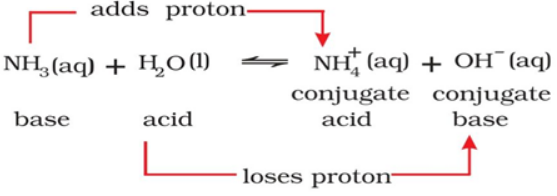
Hydronium and Hydroxyl lons Hydrogen ion by itself is a bare proton with very small size ( $\sim 10-15 m$ radius) and intense electric field, binds itself with the water molecule at one of the two available lone pairs on it giving $H _3 O ^{+}$. This species has been detected in many compounds (e.g., $H _3 O ^{+} Cl -$ ) in the solid state. In aqueous solution the hydronium ion is further hydrated to give species like $H _5 O _2^{+}, H7O3^{+}$and $H _9 4^{+}$. Similarly the hydroxyl ion is hydrated to give several ionic species like, $H _5 O 3$ - and H 7 O 4 - etc. The basic solution is formed due to the presence of hydroxyl ions. In this reaction, water molecule acts as proton donor and ammonia molecule acts as proton acceptor and are thus, called Lowry-Brönsted acid and base, respectively. In the reverse reaction, $H ^{+}$is transferred from $NH _4^{+}$to $OH ^{-}$. In this case, $NH _4^{+}$acts as a Bronsted acid while $OH ^{-}$acted as a Brönsted base. The acid-base pair that differs only by one proton is called a conjugate acid-base pair. Therefore, OH - is called the conjugate base of an acid $H _2 O$ and $NH _4{ }^{+}$is called conjugate acid of the base $NH _3$. f Brönsted acid is a strong acid then its conjugate base is a weak base and vice- versa. It may be noted that conjugate acid has one extra proton and each conjugate base has one less proton. Consider the example of ionization of hydrochloric acid in water. $HCl _{( aq )}$ acts as an acid by donating a proton to $H _2 O$ molecule which acts as a base.
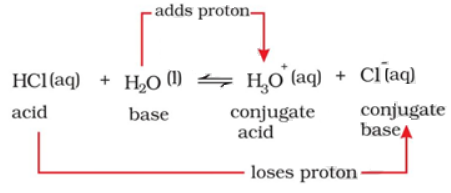
It can be seen in the above equation, that water acts as a base because it accepts the proton. The species $H _3 O ^{+}$is produced when water accepts a proton from HCl . Therefore, Cl - is a conjugate base of HCl and HCl is the conjugate acid of base $Cl -$. Similarly, $H _2 O$ is a conjugate base of an acid $H _3 O ^{+}$and $H _3 O ^{+}$is a conjugate acid of base $H _2 O$. It is interesting to observe the dual role of water as an acid and a base. In case of reaction with HCl water acts as a base while in case of ammonia it acts as an acid by donating a proton.
Lewis Acids and Bases G.N. Lewis in 1923 defined an acid as a species which accepts electron pair and base which donates an electron pair. As far as bases are concerned, there is not much difference between Brönsted-Lowry and Lewis concepts, as the base provides a lone pair in both the cases. However, in Lewis concept many acids do not have proton. A typical example is reaction of electron deficient species $BF _3$ with $NH _3 . BF _3$ does not have a proton but still acts as an acid and reacts with $NH _3$ by accepting its lone pair of electrons. The reaction can be represented by, $BF _3+: NH _3 \rightarrow BF _3: NH _3$
Electron deficient species like $AlCl _3, Co ^{3+}, Mg ^{2+}$, etc. can act as Lewis acids while species like $H _2 O , NH _3, OH ^{-}$etc. which can donate a pair of electrons, can act as Lewis bases.
The pH Scale Hydronium ion concentration in molarity is more conveniently expressed on a logarithmic scale known as the pH scale. The pH of a solution is defined as the negative logarithm to base 10 of the activity ( $a _{ H }{ }^{+}$) of hydrogen ion. In dilute solutions ( $<0.01 M$ ), activity of hydrogen ion $\left( H ^{+}\right)$is equal in magnitude to molarity represented by $\left[ H ^{+}\right]$. It should be noted that activity has no units and is defined as:
$\text{a}=\frac{[\text{H}^+]}{\text{mol}\text{L}^{–1}}$
From the definition of pH, the following can be written,
$\text{pH}={–\log\text{a}_\text{H}^+=\frac{-\log[\text{H}^+]}{\text{mol}\text{L}^{–1}}}$
Thus, an acidic solution of HCl (10–2M) will have a pH = 2. Similarly, a basic solution of NaOH having $[OH^–] =10^{–4}$M and [ $H_3O^+] = 10^{–10}M$ will have a $pH = 10. At 25 ^\circ C$, pure water has a concentration of hydrogen ions,$ [H^+] = 10^{–7} M.$ Hence, the pH of pure water is given as:
$pH = –\log(10^{–7}) = 7$
Acidic solutions possess a concentration of hydrogen ions, $[H^+] > 10^{–7}$M, while basic solutions possess a concentration of hydrogen ions,$ [H^+] < 10^{–7}$M. thus, we can summarise that
Acidic solution has pH < 7
Basic solution has pH > 7
Neutral solution has pH = 7
Now again, consider the equation at 298K
$Kw = [H_3O^+][OH^–] = 10^{–14}$
Taking negative logarithm on both sides of equation, we obtain
$–\log Kw = – \log{[ H_3O^+ ][OH– ]}$
$= – \log[H_3O^+] – \log[OH–]$
$= – log10^{–14}$
$pKw = pH + pOH = 14$
Note that although Kw may change with temperature the variations in pH with temperature are so small that we often ignore it. pKw is a very important quantity for aqueous solutions and controls the relative concentrations of hydrogen and hydroxyl ions as their product is a constant. It should be noted that as the pH scale is logarithmic, a change in pH by just one unit also means change in $\left[ H ^{+}\right]$by a factor of 10 . Similarly, when the hydrogen ion concentration, $\left[ H ^{+}\right]$changes by a factor of 100 , the value of pH changes by 2 units. Now you can realise why the change in pH with temperature is often ignored. Ionization Constants of Weak Acids Consider a weak acid HX that is partially ionized in the aqueous solution. The equilibrium can be expressed by::
$HX_{(aq)}+H_2O(l) \rightarrow H_3O^+_{(aq)} + X^–_{(aq)}$
Initial concentration (M)
c 0 0
Let α be the extent of ionization Change (M) -cα +cα +cα Equilibrium concentration (M) c-cα cα cα Here, c = initial concentration of the undissociated acid, HX at time, t = 0. α = extent up to which HX is ionized into ions. Using these notations, we can derive the equilibrium constant for the above discussed acid- dissociation equilibrium:
$\text{Ka}=\frac{\text{c}^2\alpha^2}{\text{c}(1-\alpha)}=\frac{\text{c}\alpha^2}{1-\alpha}$
Ka is called the dissociation or ionization constant of acid HX. It can be represented alternatively in terms of molar concentration as follows,
$\text{Ka}=\frac{[\text{H}^+][\text{X}^–]}{[\text{HX}]}$
At a given temperature T, Ka is a measure of the strength of the acid HX i.e., larger the value of Ka, the stronger is the acid. Ka is a dimensionless quantity with the understanding that the standard state concentration of all species is 1M.
- … is a substance that is capable of donating a hydrogen ion $H^+.$
- Acid
- Base
- Neutral substances
- Alkaline
- … are proton acceptors.
- Acids
- Bases
- Neutral substances
- All the above
- According to …bases are substances that produce hydroxyl ions $OH^–.$
- Johannes Brönsted
- Thomas M. Lowry
- Arrhenius
- G. N. Lewis
- Brönsted acid is a strong acid then its conjugate base is a … base.
- Strong
- Medium
- Non
- Weak
- According to … an acid as a species which accepts electron pair.
- Johannes Brönsted
- Thomas M. Lowry
- Arrhenius
- G. N. Lewis
View full solution →Read the passage given below and answer the following questions from (i) to (v).
Relation between Ka and Kb – Ka and Kb represent the strength of an acid and a base, respectively. In case of a conjugate acid-base pair, they are related in a simple manner so that if one is known, the other can be deduced. Considering the example of $NH_4^+$ and $NH_3$ we see,
${\text{NH}_4}^+{_{(\text{aq})}+\text{H}_2\text{O}_{(\text{l})}}\rightleftharpoons{\text{H}_3\text{O}}{^+}_{(\text{aq})}+\text{NH}_{3(\text{aq})}$
$\text{Ka}=\frac{[\text{H}_3\text{O}^+][\text{NH}_3]}{{[\text{NH}_4}^{+}]}=5.6\times10^{-10}$
$\text{NH}_{3(\text{aq})}+\text{H}_2\text{O}_{(\text{l})}\rightleftharpoons{{\text{NH}_4}^+}_{(\text{aq})}+{\text{OH}^-}_{(\text{aq})}$
$\text{Kb}=\frac{[{\text{NH}_4}^+][\text{OH}^-]}{[\text{NH}_3]}=1.8\times10^{-5}$
$\text{Net}:2{\text{H}_2\text{O}_{(\text{l})}}\rightleftharpoons{\text{H}_3\text{O}}{^+}_{(\text{aq})}+{\text{OH}^-}_{(\text{aq})}$
$\text{Kw}=[\text{H}_3\text{O}^+][\text{OH}^-]=1.0\times10^{-14}\text{M}$
Where, Ka represents the strength of $NH_4^+$ as an acid and Kb represents the strength of $NH_3$ as a base. It can be seen from the net reaction that the equilibrium constant is equal to the product of equilibrium constants Ka and Kb for the reactions added. Thus,
$\text{Ka}\times\text{Kb}=\Big\{\frac{[\text{H}_3\text{O}^+][\text{NH}_3]}{[{\text{NH}_4}^+]}\Big\}\times\Big\{\frac{[{\text{NH}_4}^+][\text{OH}^-]}{[\text{NH}_3]}\Big\}$
$= [H_3O^+ ][ OH^– ] = Kw = (5.6\times 10^{–10}) \times (1.8 \times 10^{–5}) = 1.0 \times 10^{–14} M$
This can be extended to make a generalisation. The equilibrium constant for a net reaction obtained after adding two (or more) reactions equals the product of the equilibrium constants for individual reactions:
$K_{NET} = K1 \times K2 \times$ ……
Similarly, in case of a conjugate acid-base pair,
Ka × Kb = Kw
Knowing one, the other can be obtained. It should be noted that a strong acid will have a weak conjugate base and vice-versa. Alternatively, the above expression
Kw = Ka × Kb, can also be obtained by considering the base-dissociation equilibrium reaction:
$\text{B}_{(\text{aq})}+\text{H}_2\text{O}_{(\text{l})}\rightleftharpoons{\text{BH}^+}_{(\text{aq})}+{\text{OH}^-}_{(\text{aq})}$
$\text{Kb}=\frac{[\text{BH}^+][\text{OH}^-]}{[\text{B}]}$
As the concentration of water remains constant it has been omitted from the denominator and incorporated within the dissociation constant. Then multiplying and dividing the above expression by $[H^+]$, we get:
$\text{Kb}=\frac{[\text{BH}^+][\text{OH}^-][\text{H}^+]}{[\text{B}][\text{H}^+]}$
$=\frac{[\text{OH}^-][\text{H}^+][\text{BH}^+]}{[\text{B}][\text{H}^+]}$
$=\frac{\text{Kw}}{\text{Ka}}$
or Ka × Kb = Kw
It may be noted that if we take negative logarithm of both sides of the equation, then pK values of the conjugate acid and base are related to each other by the equation:
pKa + pKb = pKw = 14 (at 298K)
Factors Affecting Acid Strength Having discussion on quantitatively the strengths of acids and bases, we come to a stage where we can calculate the pH of a given acid solution. But, the curiosity rises about why should some acids be stronger than others? What factors are responsible for making them stronger? The answer lies in its being a complex phenomenon. But, broadly speaking we can say that the extent of dissociation of an acid depends on the strength and polarity of the H-A bond. In general, when strength of H-A bond decreases, that is, the energy required to break the bond decreases, HA becomes a stronger acid. Also, when the H-A bond becomes more polar i.e., the electronegativity difference between the atoms H and A increases and there is marked charge separation, cleavage of the bond becomes easier thereby increasing the acidity. But it should be noted that while comparing elements in the same group of the periodic table, H-A bond strength is a more important factor in determining acidity than its polar nature. As the size of A increases down the group, H-A bond strength decreases and so the acid strength increases. For example,
Size increases
$HF << HCl << HBr << HI$
Acid strength increases
Similarly, $H_2S$ is stronger acid than $H_2O$. But, when we discuss elements in the same row of the periodic table, H-A bond polarity becomes the deciding factor for determining the acid strength. As the electronegativity of A increases, the strength of the acid also increases. For example,
Electronegativity of A increases
$CH4 < NH_3 < H_2O < HF$
Acid strength increases
Common Ion Effect in the Ionization of Acids and Bases Consider an example of acetic acid dissociation equilibrium represented as:
$CH3COOH_{(aq)} H^+_{(aq)} + CH3COO^–_{(aq)}$
or $HAc_{(aq)} H^+_{(aq)} + Ac^–_{(aq)}$
$\text{Ka}=\frac{[\text{H}^+][\text{Ac}^-]}{[\text{HAc}]}$
Addition of acetate ions to an acetic acid solution results in decreasing the concentration of hydrogen ions, $[H^+ ]$. Also, if $H^+$ ions are added from an external source then the equilibrium moves in the direction of undissociated acetic acid i.e., in a direction of reducing the concentration of hydrogen ions, $[H^+]$. This phenomenon is an example of common ion effect. It can be defined as a shift in equilibrium on adding a substance that provides more of an ionic species already present in the dissociation equilibrium. Thus, we can say that common ion effect is a phenomenon based on the Le Chatelier’s principle discussed earlier. In order to evaluate the pH of the solution resulting on addition of 0.05M acetate ion to 0.05M acetic acid solution, we shall consider the acetic acid dissociation equilibrium once again,
$\text{HAc}_{(\text{aq})}\rightleftharpoons{\text{H}^+}_{(\text{aq})}+{\text{Ac}^-}_{(\text{aq})}$
Initial concentration (M)
0.05 0 0.05
Let x be the extent of ionization of acetic acid.
Change in concentration (M)
-x +x +x
Equilibrium concentration (M)
0.05-x. x 0.05+x
Therefore, $\text{Ka}=\frac{[\text{H}^+][\text{Ac}^-]}{\text{HAc}}=\Big\{\frac{(0.05+\text{x})(\text{x})}{(0.05-\text{x})}\Big\}$
As Ka is small for a very weak acid, x<<0.05.
Hence, $(0.05+\text{x})\approx(0.05-\text{x})\approx0.05$
Thus, $=1.8\times10-5=\frac{(\text{x})(0.05+\text{x})}{(0.05-\text{x})}$
$=\frac{\text{x}(0.05)}{(0.05)}=\text{x}=[\text{H}^+]=1.8\times10^{-5}\text{M}$
$\text{pH}=-\log(1.8\times10^{-5})=4.74$
Buffer Solutions Many body fluids e.g., blood or urine have definite pH and any deviation in their pH indicates malfunctioning of the body. The control of pH is also very important in many chemical and biochemical processes. Many medical and cosmetic formulations require that these be kept and administered at a particular pH. The solutions which resist change in pH on dilution or with the addition of small amounts of acid or alkali are called Buffer Solutions. Buffer solutions.
Common Ion Effect on Solubility of Ionic Salts– It is expected from Le Chatelier’s principle that if we increase the concentration of any one of the ions, it should combine with the ion of its opposite charge and some of the salt will be precipitated till once again Ksp = Qsp . Similarly, if the concentration of one of the ions is decreased, more salt will dissolve to increase the concentration of both the ions till once again Ksp = Qsp . This is applicable even to soluble salts like sodium chloride except that due to higher concentrations of the ions, we use their activities instead of their molarities in the expression for Qsp . Thus if we take a saturated solution of sodium chloride and pass HCl gas through it, then sodium chloride is precipitated due to increased concentration (activity) of chloride ion available from the dissociation of HCl. Sodium chloride thus obtained is of very high purity and we can get rid of impurities like sodium and magnesium sulphates. The common ion effect is also used for almost complete precipitation of a particular ion as its sparingly soluble salt, with very low value of solubility product for gravimetric estimation. Thus we can precipitate silver ion as silver chloride, ferric ion as its hydroxide (or hydrated ferric oxide) and barium ion as its sulphate for quantitative estimations.
- H-A bond strength … and so the acid strength:
- Decreases, increases
- Increases, increases
- Increases, decreases
- Decreases, decreases
- As the electronegativity of A … the strength of the acid also:
- Decreases, increases
- Increases, increases
- Increases, decreases
- Decreases, decreases
- If the concentration of one of the ions is … more salt will dissolve to … the concentration of both the ions till once again Ksp = Qsp.
- Decreases, increases
- Increases, increases
- Increases, decreases
- Decreases, decreases
- The solutions which resist change in pH on dilution or with the addition of small amounts of acid or alkali are called:
- Neutral solution
- Basic solution
- Acidic solution
- Buffer solution
- When the H-A bond becomes more polar then the cleavage of the bond becomes easier thereby increasing the:
- Acidity
- Basicity
- Aromaticity
- Alkalinity
View full solution →The first ionization constant of $H_2S$ is $9.1 \times 10^{–8}$. Calculate the concentration of $HS^–$ ion in its $0.1M$ solution. How will this concentration be affected if the solution is $0.1M$ in HCl also ? If the second dissociation constant of $H_2S$ is $1.2 \times 10^{–13},$ calculate the concentration of $S^{2–}$ under both conditions.
View full solution →The pH of milk, black coffee, tomato juice, lemon juice and egg white are 6.8, 5.0, 4.2, 2.2 and 7.8 respectively. Calculate corresponding hydrogen ion concentration in each.
Determine the solubilities of silver chromate, barium chromate, ferric hydroxide, lead chloride and mercurous iodide at $298K$ from their solubility product constants given in Table $7.9$. Determine also the molarities of individual ions.
View full solution →Calculate the degree of ionization of $0.05M$ acetic acid if its $pK_a$ value is $4.74$. How is the degree of dissociation affected when its solution also contains (a) 0.01M (b) 0.1M in HCl?
View full solution →The ionization constant of acetic acid is $1.74 \times 10^{–5}$. Calculate the degree of dissociation of acetic acid in its $0.05M$ solution. Calculate the concentration of acetate ion in the solution and its pH.
View full solution →