MCQ
Match the LIST-I with LIST-II
LIST - I
(Molecules/ion)
LIST - II
(Hybridisation of central atom)
A.PF_(5)Idsp^(2)
B.SF_(6)II.sp^(3)d
C.Ni(CO)_(4)III.sp^(3)d^(2)
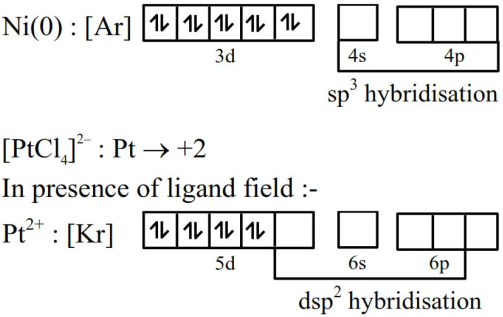
D.[PtCl_(4)]^(2-)IV.sp^(3)
Choose the correct answer from the options given below :
  • A
    A-II, B-III, C-IV, D-I
  • B
    A-IV, B-I, C-II, D-III
  • C
    A-I, B-II, C-III, D-IV
  • D
    A-III, B-I, C-IV, D-II

Need a full question paper?

Generate a complete, print-ready paper with questions like this in minutes — across 16+ boards, with answer keys.

Start Generating Free

Similar questions

When $5$ moles of $He$ gas expand isothermally and reversibly at $300 \,K$ from $10\, litre$ to $20 \,litre,$ the magnitude of the maximum work obtained is $.......\,J$. [nearest integer] (Given: $R =8.3 \,J \,K ^{-1} \,mol ^{-1}$ and $\log 2=0.3010$ )
Match List$-I$ with List$-II$

List$-I$ List$-II$
$(A)$ Spontaneous process $(I)\,\Delta H < 0$
$(B)$ Process with $\Delta P =0 \;\Delta T =0$ $(II)\,\Delta G _{ T , P } < 0$
$(C)\,\Delta H _{reaction}$ $(III)$ Isothermal and isobaric process
$(D)$ Exothermic process $(IV)$ [Bond energies of molecules in reactants] - [Bond energies of product molecules]

Choose the correct answer from the options given below:

Assertion : When a salt such as $NaCl$ dissolves, the $Na^+$ and $Cl^-$ ions leaving the crystal lattice acquire far greater freedom.
Reason : In thermodyanamic terms, the formation of solution occurs with a favourable change in free energy, i.e., $\Delta H$ has a high positive value and $T\Delta S$ a low negative value.
Match List I with List II
LIST-I   LIST-II 
A.Glucose //NaHCO_(3)//Delta  I.Gluconic acid
B.Glucose/ HNO_(3)II.No reaction
C.Glucose //HI//DeltaIII.n-hexane
 D.Glucose // Bromine water]IV.Saccharic acid
Choose the correct answer from the options given below:
 
The standard electrode potentlal ($E^-$) values of $\mathrm{Al}^{3+} / \mathrm{Al}, \mathrm{Ag}^{+} / \mathrm{Ag}, \mathrm{K}^{+} / \mathrm{K}$ and $\mathrm{Cr}^{3+} / \mathrm{Cr}$ are $-1.66 \;\mathrm{V}, 0.80 \;\mathrm{V}$ $-2.93\; \mathrm{V}$ and $-0.74\; \mathrm{V},$ respectively. The correct decreasing order of reducing power of the metal is
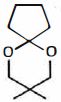
Which pair of reactants compounds may be used to make given acetal ?
The $IUPAC$ name of  (figure) is
Which of the following would the optically active
The maximum number of electrons which each sub-shell can occupy is
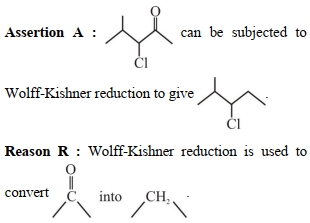
Given below are two statements, one is labelled as Assertion $A$ and the other is labelled as Reason $R$.