Match the List $I$ with the List $II$ from the combination shown. In the left side (List $I$) there are four different conditions and in the right side (List $II$), there are ratios of heat produced in each resistance for each condition :
| List $I$ | List $II$ |
| $(I)$ Two wires of same resistance are connected in series and same current is passed through them | $(A)$ $1:2$ |
| $(II)$ Two wires of resistance $R$ and $2R$ $ohm$ are connected in series and same $P . D .$ is applied across them | $(B)$ $4:1$ |
| $(III)$ Two wires of same resistance are connected in parallel and same current is flowing through them | $(C)$ $1:1$ |
| $(IV)$ Two wires of resistances in the ratio $1: 2$ are connected in parallel and same $P . D .$ is applied across the | $(D)$ $2:1$ |
Diffcult
Download our app for free and get started
(b)

Download our appand get started for free
Experience the future of education. Simply download our apps or reach out to us for more information. Let's shape the future of learning together!No signup needed.*
Similar Questions
- 1A resistor develops $500\, J$ of thermal energy in $20 \,s$ when a current of $1.5\, A$ is passed through it. If the current is increased from $1.5 \,A$ to $3\, A$ what will be the energy (in $J$) developed in $20\, s$.View Solution
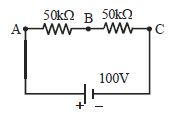
- 2In the adjacent shown circuit, a voltmeter of internal resistance $R$, when connected across $B$ and $C$ reads $\frac{{100}}{3}\,V$. Neglecting the internal resistance of the battery, the value of $R$ is ................. $k \Omega$View Solution
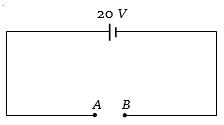
- 3In the shown circuit, what is the potential difference across $A$ and $B$ ......... $V$View Solution
- 4In a Wheatstone’s bridge all the four arms have equal resistance $R$. If the resistance of the galvanometer arm is also $R$, the equivalent resistance of the combination as seen by the battery isView Solution
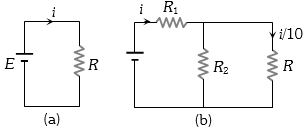
- 5Consider the circuits shown in the figure. Both the circuits are taking same current from battery but current through $R$ in the second circuit is $\frac{1}{{10}}$$^{th}$ of current through $R$ in the first circuit. If $R$ is $11$ $\Omega$, the value of $ R_1$ ................ $\Omega$View Solution
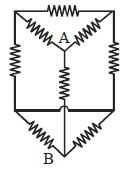
- 6Effective resistance between points $A$ and $B$ for following network is (each branch of resistance is $R$)View Solution
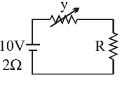
- 7In the figure shown the power generated in $y$ is maximum when $y = 5\,\Omega $. Then $R$ isView Solution
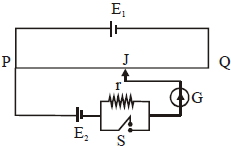
- 8A potentiometer wire $PQ$ of $1\,m$ length is connected to a standard cell $E _{1}$. Another cell $E _{2}$ of emf $1.02\, V$ is connected with a resistance $'r'$ and switch $S$ (as shown in figure). With switch $S$ open, the null position is obtained at a distance of $49\, cm$ from $Q$. The potential gradient in the potentiometer wire is.......$V/cm$View Solution
- 9A steady current $I$ is set up in a wire whose cross-sectional area decreases in the direction of the flow of the current. Then, as we examine the narrowing region,View Solution
- 10View SolutionIt is easier to start a car engine on a hot day than on a cold day. This is because the internal resistance of the car battery