MCQ
$\mathop {\lim }\limits_{n \to \infty } \frac{1}{{{1^3} + {n^3}}} + \frac{4}{{{2^3} + {n^3}}} + .... + \frac{1}{{2n}}$ is equal to
  • A
    $\frac{1}{3}{\log _e}3$
  • $\frac{1}{3}{\log _e}2$
  • C
    $\frac{1}{3}{\log _e}\frac{1}{3}$
  • D
    None of these

Answer

Correct option: B.
$\frac{1}{3}{\log _e}2$
b
(b) Let $S = \mathop {\lim }\limits_{n \to \infty } \,\frac{1}{{{1^3} + {n^3}}} + \frac{4}{{{2^3} + {n^3}}} + ... + \frac{1}{{2n}}$

$S = \mathop {\lim }\limits_{n \to \infty } \,\frac{1}{{{1^3} + {n^3}}} + \frac{4}{{{2^3} + {n^3}}} + ... + \frac{n^2}{{n^3 + n^3}}$

$\therefore \,\,\,S = \mathop {\lim }\limits_{n \to \infty } \,\,\sum\limits_{r = 1}^n {\,\,\frac{{{r^2}}}{{{r^3} + {n^3}}}} $

$ = \mathop {\lim }\limits_{n \to \infty } \,\,\,\sum\limits_{r = 1}^n {} \frac{{{r^2}}}{{{n^3}\,\left( {\frac{{{r^3}}}{{{n^3}}} + 1} \right)}}$

$ = \mathop {\lim }\limits_{n \to \infty } \,\,\,\sum\limits_{r = 1}^n {} \frac{1}{n}.\frac{{{{\left( {\frac{r}{n}} \right)}^2}}}{{\left[ {1 + \,{{\left( {\frac{r}{n}} \right)}^3}} \right]}}$

Applying the formula, we get 

$A = \int_0^1 {} \frac{{{x^2}}}{{1 + {x^3}}}dx$

$ \frac{1}{3}\int_0^1 {} \frac{{3{x^2}}}{{1 + {x^3}}}dx$

$ = \frac{1}{3}[{\log _e}(1 + {x^3})]_0^1 = \frac{1}{3}{\log _e}2.$

Need a full question paper?

Generate a complete, print-ready paper with questions like this in minutes — across 16+ boards, with answer keys.
Start Generating Free

Similar questions

If ${I_n} = \int_0^\infty {{e^{ - x}}{x^{n - 1}}dx,} $ then $\int_0^\infty {{e^{ - \lambda x}}{x^{n - 1}}dx = } $
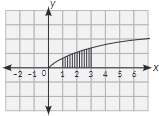
Shown below is the curve defined by the equation $y=\log (x+1)$ for $x \geq 0$.
Image
Which of these is the area of the shaded region?
Let a line having direction ratios $1,-4,2$ intersect the lines $\frac{x-7}{3}=\frac{y-1}{-1}=\frac{z+2}{1}$ and $\frac{x}{2}=\frac{y-7}{3}=\frac{z}{1}$ at the point $A$ and $B$. Then $( AB )^{2}$ is equal to
The value of the integral $\int {\frac{{\sin \,\left( {\ln \,(2 + 2x)} \right)}}{{x + 1}}dx} $ is
If $\text{y}=\log\sqrt{\tan\text{x}},$ then the value of $\frac{\text{dy}}{\text{dx}}$ at $\text{x}=\frac{\pi}{4}$ is givne by:
  1. $\infty$
  2. $1$
  3. $0$
  4. $\frac{1}{2}$
Let $P =\left[\begin{array}{ccc}3 & -1 & -2 \\ 2 & 0 & \alpha \\ 3 & -5 & 0\end{array}\right]$ where $\alpha \in R .$ Suppose $Q =\left[ q _{ ij }\right]$ is a matrix satisfying $PQ = kI _{3}$ for some non-zero $k \in R .$ If $q_{23}=-\frac{k}{8}$ and $|Q|=\frac{k^{2}}{2}$, then $\alpha^{2}+ k ^{2}$ is equal to...........
If $A = \left[ {\begin{array}{*{20}{c}}1&3&0\\{ - 1}&2&1\\0&0&2\end{array}} \right],B = \left[ {\begin{array}{*{20}{c}}2&3&4\\1&2&3\\{ - 1}&1&2\end{array}} \right]$, then $AB =$
Find area of the triangle with vertices at the point given in each of the following: $(1,0),(6,0),(4,3)$
If $L.M.V.$ theorem is true for $f(x) = x(x-1)(x-2);\, x \in [0,\, 1/2]$ , then $C =$ ?
If loge 4 = 1.3868, then loge 4.01 =
  1. 1.3968
  2. 1.3898
  3. 1.3893
  4. None of these