MCQ
$\mathop {\lim }\limits_{x \to - 2} \frac{{{{\sin }^{ - 1}}(x + 2)}}{{{x^2} + 2x}}$ is equal to
  • A
    $0$
  • B
    $\infty $
  • $-1/2$
  • D
    None of these

Answer

Correct option: C.
$-1/2$
c
(c) $y = \mathop {\lim }\limits_{x \to - 2} \frac{{{{\sin }^{ - 1}}(x + 2)}}{{{x^2} + 2x}}$,         $\left( {\frac{0}{0}{\rm{form}}} \right)$

Using $ L-$ Hospital’s rule

==> $y = \mathop {\lim }\limits_{x \to - 2} \frac{{\left( {\frac{1}{{\sqrt {1 - {{(x + 2)}^2}} }}} \right)}}{{2x + 2}}$

==> $y = \frac{1}{{ - 4 + 2}} = - \frac{1}{2}$.

Need a full question paper?

Generate a complete, print-ready paper with questions like this in minutes — across 16+ boards, with answer keys.

Start Generating Free

Similar questions

The distance between the directrices of the ellipse $\frac{{{x^2}}}{{36}} + \frac{{{y^2}}}{{20}} = 1$ is
$\lim\limits_{X\rightarrow 0} 2\sin\frac{23\text{x}}{x^2}$ is equal to:
Let $R$ be the focus of the parabola $y^2=20 x$ and the line $y=m x+c$ intersect the parabola at two points $P$ and $Q$. Let the point $G(10,10)$ be the centroid of the triangle $P Q R$. If $c-m=6$, then $( PQ )^2$ is
If $\frac{\pi}{2}<\text{x}<{\pi},$ and if $=\sqrt{\frac{1-\sin\text{x}}{1+\sin\text{x}}}+\sqrt{\frac{1+\sin\text{x}}{1-\sin\text{x}}},$ is equal to:
Consider the following lists:

$List-I$ $List-II$
($I$) $\left\{x \in\left[-\frac{2 \pi}{3}, \frac{2 \pi}{3}\right]: \cos x+\sin x=1\right\}$ ($P$) has two elements 
($II$) $\left\{x \in\left[-\frac{5 \pi}{18}, \frac{5 \pi}{18}\right]: \sqrt{3} \tan 3 x=1\right\}$ ($Q$) has three elements
($III$) $\left\{x \in\left[-\frac{6 \pi}{5}, \frac{6 \pi}{5}\right]: 2 \cos (2 x)=\sqrt{3}\right\}$ ($R$) has four elements
($I$) $\left\{x \in\left[-\frac{6 \pi}{5}, \frac{6 \pi}{5}\right]: 2 \cos (2 x)=\sqrt{3}\right\}$ ($S$) has five elements 
($VI$) $\left\{x \in\left[-\frac{7 \pi}{4}, \frac{7 \pi}{4}\right]: \sin x-\cos x=1\right\}$ ($T$) has six elements

The correct option is:

If $n$ is an integer, then $\mathop {\lim }\limits_{x \to n + 0} (x - [n]) = $
The distance of the point of intersection of the lines $2x - 3y + 5 = 0$ and $3x + 4y = 0$ from the line $5x - 2y = 0$ is:
If $A(3,\,5),B( - 5,\, - 4),C(7,\,10)$ are the vertices of a parallelogram, taken in the order, then the co-ordinates of the fourth vertex are
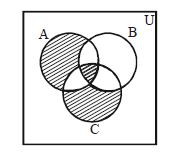
The shaded region in venn-diagram can be represented by which of the following ?
Let $0 < x < \frac{\pi }{4}.$ Then $\sec 2x - \tan 2x = $