MCQ 11 Mark
$\mathop {\lim }\limits_{x \to 1} \frac{1}{{|1 - x|}} = $
AnswerCorrect option: D. $\infty $
d
(d) $\mathop {\lim }\limits_{x \to 1 - } \,\,\frac{1}{{|\,\,1 - x\,\,|}} = \mathop {\lim }\limits_{h \to 0} \,\,\frac{1}{{1 - (1 - h)}} = \infty $
and $\mathop {\lim }\limits_{x \to 1 + } \,\,\frac{1}{{|\,\,1 - x\,\,|}} = \mathop {\lim }\limits_{h \to 0} \frac{1}{{1 + h - 1}} = \infty $
Hence $\mathop {\lim }\limits_{x \to 1} \,\frac{1}{{|\,\,1 - x\,\,|}} = \infty .$
View full question & answer→MCQ 21 Mark
$\mathop {\lim }\limits_{n \to \infty } \frac{{n{{(2n + 1)}^2}}}{{(n + 2)({n^2} + 3n - 1)}} = $
Answerc
(c) $\mathop {\lim }\limits_{n \to \infty } \,\frac{{n\,{{(2n + 1)}^2}}}{{(n + 2)\,\,({n^2} + 3n - 1)}} = \mathop {\lim }\limits_{n \to \infty } \,\,\frac{{4{n^3} + 4{n^2} + n}}{{{n^3} + 5{n^2} + 5n - 2}}$
$ = \mathop {\lim }\limits_{n \to \infty } \frac{{{n^3}\,\left( {4 + \frac{4}{n} + \frac{1}{{{n^2}}}} \right)}}{{{n^3}\left( {1 + \frac{5}{n} + \frac{5}{{{n^2}}} - \frac{2}{{{n^3}}}} \right)}} = 4$
View full question & answer→MCQ 31 Mark
$\mathop {\lim }\limits_{n \to \infty } \frac{{\sqrt n }}{{\sqrt n + \sqrt {n + 1} }} = $
- A
$1$
- ✓
$\frac{1}{2}$
- C
$0$
- D
$\infty $
AnswerCorrect option: B. $\frac{1}{2}$
b
(b) $\mathop {\lim }\limits_{n \to \infty } \,\frac{1}{{1 + \sqrt {1 + \frac{1}{n}} }} = \frac{1}{2}$.
View full question & answer→MCQ 41 Mark
$\mathop {\lim }\limits_{x \to \infty } {\left( {1 + \frac{2}{x}} \right)^x} = $
- A
$e$
- B
$\frac{1}{e}$
- ✓
${e^2}$
- D
AnswerCorrect option: C. ${e^2}$
c
(c)${\left[ {\mathop {\lim }\limits_{x \to \infty } {{\left( {1 + \frac{1}{{x/2}}} \right)}^{x/2}}} \right]^2} = {e^2}.$
View full question & answer→MCQ 51 Mark
$\mathop {\lim }\limits_{x \to 0} \frac{{{e^{1/x}} - 1}}{{{e^{1/x}} + 1}} = $
Answerd
(d) $f(x) = \left( {\frac{{{e^{1/x}} - 1}}{{{e^{1/x}} + 1}}} \right)\,,$ then
$\mathop {\lim }\limits_{x \to \,0 + } \,f(x) = \mathop {\lim }\limits_{h \to \,0} \left( {\frac{{{e^{1/h}} - 1}}{{{e^{1/h}} + 1}}} \right) $
$= \mathop {\lim }\limits_{h \to \,0} \frac{{{e^{1/h}}\left( {1 - \frac{1}{{{e^{1/h}}}}} \right)}}{{{e^{1/h}}\left( {1 + \frac{1}{{{e^{1/h}}}}} \right)}} = 1$
Similarly $\mathop {\lim }\limits_{x \to \,0 - } f(x) = - 1$.
Hence limit does not exist.
View full question & answer→MCQ 61 Mark
The value of $\mathop {\lim }\limits_{x \to \infty } \left( {\frac{{{x^2} + bx + 4}}{{{x^2} + ax + 5}}} \right)$ is
Answerb
(b)$\mathop {\lim }\limits_{x \to \infty } \,\left[ {\frac{{1 + \frac{b}{x} + \frac{4}{{{x^2}}}}}{{1 + \frac{a}{x} + \frac{5}{{{x^2}}}}}} \right] = 1.$
View full question & answer→MCQ 71 Mark
$\mathop {\lim }\limits_{x \to 0} \left\{ {\frac{{\sin x - x + \frac{{{x^3}}}{6}}}{{{x^5}}}} \right\} = $
- ✓
$1/120$
- B
$-1/120$
- C
$1/20$
- D
AnswerCorrect option: A. $1/120$
a
(a) Expand $\sin x$ and then solve.
Aliter : Apply $L-$ Hospital’s rule
$\mathop {\lim }\limits_{x \to 0} \frac{{\sin x - x + \frac{{{x^3}}}{6}}}{{{x^5}}} = \mathop {\lim }\limits_{x \to 0} \frac{{\cos x - 1 + \frac{{3{x^2}}}{6}}}{{5{x^4}}}$
$ = \mathop {\lim }\limits_{x \to 0} \frac{{ - \sin x + \frac{{6x}}{6}}}{{20{x^3}}} = \mathop {\lim }\limits_{x \to 0} \,\frac{{ - \cos x + 1}}{{60{x^2}}} = \mathop {\lim }\limits_{x \to 0} \frac{{\sin x}}{{120\,x}}$
$ = \mathop {\lim }\limits_{x \to 0} \frac{{\cos x}}{{120}} = \frac{1}{{120}}.$
View full question & answer→MCQ 81 Mark
$\mathop {\lim }\limits_{x \to 0} \left[ {\frac{1}{x} - \frac{{\log (1 + x)}}{{{x^2}}}} \right] =$
- ✓
$\frac{1}{2}.$
- B
$-1/2$
- C
$1$
- D
$-1$
AnswerCorrect option: A. $\frac{1}{2}.$
a
(a) Expand $\log \,(1 + x)$ and then solve.
Aliter : Apply $L-$ Hospital’s rule,
$\mathop {\lim }\limits_{x \to 0} \,\left[ {\frac{{x - \log \,(1 + x)}}{{{x^2}}}} \right]$
$ = \mathop {\lim }\limits_{x \to 0} \frac{{1 - \frac{1}{{1 + x}}}}{{2x}}$
$ = \mathop {\lim }\limits_{x \to 0} \,\,\frac{1}{2}\,{\left( {\frac{1}{{1 + x}}} \right)^2} = \frac{1}{2}.$
View full question & answer→MCQ 91 Mark
$\mathop {\lim }\limits_{n \to \infty } \left[ {\frac{{\Sigma {n^2}}}{{{n^3}}}} \right] = $
- A
$ - \frac{1}{6}$
- B
$\frac{1}{6}$
- ✓
$\frac{1}{3}$
- D
$ - \frac{1}{3}$
AnswerCorrect option: C. $\frac{1}{3}$
c
(c) $\mathop {\lim }\limits_{n \to \infty } \,\left[ {\frac{{n\,(n + 1)\,(2n + 1)}}{{6{n^3}}}} \right] = \mathop {\lim }\limits_{n \to \infty } \,\frac{{\left( {1 + \frac{1}{n}} \right)\,\left( {2 + \frac{1}{n}} \right)}}{6} = \frac{1}{3}.$
Note : Students should remember that
$\mathop {\lim }\limits_{n \to \infty } \,\frac{{\sum n}}{{{n^2}}} = \frac{1}{2},\,\,\,\mathop {\lim }\limits_{n \to \infty } \,\frac{{\sum {n^2}}}{{{n^3}}} = \frac{1}{3}$
and $\mathop {\lim }\limits_{n \to \infty } \,\frac{{\sum {n^3}}}{{{n^4}}} = \frac{1}{4}.$
View full question & answer→MCQ 101 Mark
If $f(a) = 2,\;f'(a) = 1,\;g(a) = - 1;\;g'(a) = 2$, then $\mathop {\lim }\limits_{x \to a} \frac{{g(x)f(a) - g(a)f(x)}}{{x - a}} = $
Answerb
(b) $\mathop {\lim }\limits_{x \to a} \,\frac{{f(a)\,[g(x) - g(a)] - g(a)\,[f(x) - f(a)]}}{{[x - a]}}$
$ = f(a)g'(a) - g(a)f'(a) = 2 \times 2 - ( - 1)\,(1) = 5.$
View full question & answer→MCQ 111 Mark
$\mathop {\lim }\limits_{y \to 0} \frac{{(x + y)\sec (x + y) - x\sec x}}{y} = $
- ✓
$\sec x(x\tan x + 1)$
- B
$x\tan x + \sec x$
- C
$x\sec x + \tan x$
- D
AnswerCorrect option: A. $\sec x(x\tan x + 1)$
a
(a) $\mathop {\lim }\limits_{y \to 0} \,\left\{ {\frac{{x\,\left\{ {\sec \,(x + y) - \sec x} \right\}}}{y} + \sec \,(x + y)} \right\}$
$ = \mathop {\lim }\limits_{y \to 0} \,\left[ {\frac{x}{y}\,\left\{ {\frac{{\cos x - \cos \,(x + y)}}{{\cos \,(x + y)\,\cos x}}} \right\}} \right] + \mathop {\lim }\limits_{y \to 0} \sec \,(x + y)$
$ = \mathop {\lim }\limits_{y \to 0} \,\left[ {\frac{{x\sin \,\left( {x + \frac{y}{2}} \right)}}{{\cos \,(x + y)\,.\,\,\cos x}}\,.\,\frac{{\sin \,\left( {\frac{y}{2}} \right)}}{{\,\,\,\frac{y}{2}}}} \right] + \sec x$
$= x\ tan\ x\ sec\ x + sec\ x = sec\ x\ (x\ tan\ x+1).$
Aliter : Apply $L-$ Hospital’s rule,
$\mathop {\lim }\limits_{y \to 0} \,\frac{{(x + y)\,\sec \,(x + y) - x\,\sec x}}{y}$
$ = \mathop {\lim }\limits_{y \to 0} \,\frac{{(x + y)\,\sec \,(x + y)\tan \,(x + y) + \sec \,(x + y) - 0}}{1}$
{Differentiating w.r.t.$y$ assuming $x$ as constant}
$ = x\sec x\tan x + \sec x. = \sec x(x\tan x + 1)$
View full question & answer→MCQ 121 Mark
$\mathop {\lim }\limits_{x \to 1} \frac{{1 - \sqrt x }}{{{{({{\cos }^{ - 1}}x)}^2}}} = $
- A
$1$
- B
$\frac{1}{2}$
- ✓
$\frac{1}{4}$
- D
AnswerCorrect option: C. $\frac{1}{4}$
c
(c) Put ${\cos ^{ - 1}}x = y$ and $x \to 1\, \Rightarrow \,\,y \to 0.$
$\mathop {\lim }\limits_{x \to 1} \,\frac{{1 - \sqrt x }}{{{{({{\cos }^{ - 1}}x)}^2}}} = \mathop {\lim }\limits_{y \to 0} \,\frac{{1 - \sqrt {\cos y} }}{{{y^2}}}$
Now rationalizing it, we get
$\mathop {\lim }\limits_{y \to 0} \,\frac{{(1 - \cos y)}}{{{y^2}(1 + \sqrt {\cos y} )}}$
$ = \mathop {\lim }\limits_{y \to 0} \,\frac{{1 - \cos y}}{{{y^2}}}\,.\,\mathop {\lim }\limits_{y \to 0} \,\frac{1}{{1 + \sqrt {\cos y} }} $
$= \frac{1}{2} \times \frac{1}{2} = \frac{1}{4}.$
View full question & answer→MCQ 131 Mark
$\mathop {\lim }\limits_{x \to 0} \frac{{\log (a + x) - \log a}}{x} + k\mathop {\lim }\limits_{x \to e} \frac{{\log x - 1}}{{x - e}} = 1,$ then
AnswerCorrect option: A. $k = e\left( {1 - \frac{1}{a}} \right)$
a
(a) Let $f(x) = \log x\,\, \Rightarrow \,\,f'\,(x) = \frac{1}{x}$
Therefore, given function $ = f'(a) + kf'(e) = 1$
$ \Rightarrow \,\,\frac{1}{a} + \frac{k}{e} = 1\,\, $
$\Rightarrow \,\,k = e\,\left( {\frac{{a - 1}}{a}} \right)$
Aliter : Apply $ L-$ Hospital’s rule to find both the limits.
View full question & answer→MCQ 141 Mark
$\mathop {\lim }\limits_{x \to \infty } {\left( {\frac{{x + 2}}{{x + 1}}} \right)^{x + 3}}$ is
Answerb
(b) Let $A = \mathop {\lim }\limits_{x \to \infty } \,{\left( {\frac{{x + 2}}{{x + 1}}} \right)^{x + 3}}$
$ = \mathop {\lim }\limits_{x \to \infty } \,{\left( {1 + \frac{1}{{x + 1}}} \right)^{x + 3}}$
$ = \mathop {\lim }\limits_{x \to \infty } \,{\left[ {{{\left( {1 + \frac{1}{{x + 1}}} \right)}^{x + 1}}} \right]^{\frac{{\,(x + 3)}}{{(x + 1)}}}} = e$
$\left\{ \because \,\,\underset{x\to \infty }{\mathop{\lim }}\,\,{{\left( 1+\frac{1}{x+1} \right)}^{x+1}}=e \right.$
and $\mathop {\lim }\limits_{x \to \infty } \frac{{\,(x + 3)}}{{(x + 1)}} = \left. {\mathop {\lim }\limits_{x \to \infty } \frac{{\,\left\{ {1 + (3/x)} \right\}}}{{\left\{ {1 + (1/x)} \right\}}} = 1} \right\}$.
View full question & answer→MCQ 151 Mark
$\mathop {\lim }\limits_{x \to \frac{\pi }{2}} |(1 - \sin x)\tan x$ is
- A
$\frac{\pi }{2}$
- B
$1$
- ✓
$0$
- D
$\infty $
Answerc
(c) $\mathop {\lim }\limits_{x \to \pi /2} \,\left\{ {(1 - \sin x)\tan x} \right\} = \mathop {\lim }\limits_{x \to \pi /2} \,\frac{{\sin x - {{\sin }^2}x}}{{\cos x}}$
Apply $L-$ Hospital’s rule, we get
$\mathop {\lim }\limits_{x \to \pi /2} \,\frac{{\cos x - \sin 2x}}{{ - \sin x}} = 0$.
View full question & answer→MCQ 161 Mark
$\mathop {\lim }\limits_{x \to 0} \frac{{\sin x + \log (1 - x)}}{{{x^2}}}$ is equal to
- A
$0$
- B
$\frac{1}{2}$
- ✓
$ - \frac{1}{2}$
- D
AnswerCorrect option: C. $ - \frac{1}{2}$
c
(c) Apply $ L -$ Hospital’s rule, we get
$\mathop {\lim }\limits_{x \to 0} \,\frac{{\cos x - \frac{1}{{1 - x}}}}{{2x}} = \mathop {\lim }\limits_{x \to 0} \,\frac{{ - \sin x - \frac{1}{{{{(1 - x)}^2}}}}}{2} = - \frac{1}{2}$.
Aliter : $\mathop {\lim }\limits_{x \to 0} \,\frac{{\sin x + \log \,(1 - x)}}{{{x^2}}}$
$ = \mathop {\lim }\limits_{x \to 0} \,\,\frac{{\left( {x - \frac{{{x^3}}}{{3\,\,!}} + \frac{{{x^5}}}{{5\,\,!}} - ...} \right)}}{{{x^2}}} + \mathop {\lim }\limits_{x \to 0} \,\,\frac{{\left( { - x - \frac{{{x^2}}}{2} - \frac{{{x^3}}}{3} - \frac{{{x^4}}}{4} - ...} \right)}}{{{x^2}}}$
$\left( {\because \sin x = x - \frac{{{x^3}}}{{3\,!}} + \frac{{{x^5}}}{{5\,!}} - ..} \right.$
and $\left. {\log \,(1 - x) = - x - \frac{{{x^2}}}{2} - \frac{{{x^3}}}{3} - ..} \right)$
$ = \mathop {\lim }\limits_{x \to 0} \,\frac{{\frac{{ - {x^2}}}{2} - {x^3}\left( {\frac{1}{{3\,\,!}} + \frac{1}{3}} \right) - \frac{{{x^4}}}{4}...}}{{{x^2}}} = - \frac{1}{2}.$
View full question & answer→MCQ 171 Mark
If $a,\;b,\;c,\;d$ are positive, then $\mathop {\lim }\limits_{x \to \infty } {\left( {1 + \frac{1}{{a + bx}}} \right)^{c + dx}} = $
- ✓
${e^{d/b}}$
- B
${e^{c/a}}$
- C
${e^{(c + d)/(a + b)}}$
- D
$e$
AnswerCorrect option: A. ${e^{d/b}}$
a
(a) $\mathop {\lim }\limits_{x \to \infty } \,{\left( {1 + \frac{1}{{a + bx}}} \right)^{c + dx}} $
$= \mathop {\lim }\limits_{x \to \infty } \,{\left\{ {{{\left( {1 + \frac{1}{{a + bx}}} \right)}^{a + bx}}} \right\}^{\frac{{c + dx}}{{a + bx}}}} = {e^{d/b}}$
$\left\{ {\because \,\,\mathop {\lim }\limits_{x \to \infty } \,{{\left( {1 + \frac{1}{{a + bx}}} \right)}^{a + bx}} = e} \right.$ and
$\left. {\mathop {\lim }\limits_{x \to \infty } \frac{{c + dx}}{{a + bx}} = \frac{d}{b}} \right\}$.
View full question & answer→MCQ 181 Mark
$\mathop {\lim }\limits_{n \to \infty } {({4^n} + {5^n})^{1/n}}$ is equal to
Answerb
(b) Given limit $ = \mathop {\lim }\limits_{n \to \infty } \,{({4^n} + {5^n})^{1/n}}$
$ = \mathop {\lim }\limits_{n \to \infty } \,5\,{\left[ {{{\left\{ {1 + {{\left( {\frac{4}{5}} \right)}^n}} \right\}}^{{{(5/4)}^n}}}} \right]^{(1/n)\,.\,{{(4/5)}^n}}} = 5\,.\,{e^0} = 5$.
$\left( {\because \,\,{{\left( {\frac{4}{5}} \right)}^n} \to 0\,{\text{as }}\,n \to \infty } \right)$
View full question & answer→MCQ 191 Mark
$\mathop {\lim }\limits_{x \to \infty } \sqrt {\frac{{x + \sin x}}{{x - \cos x}}} = $
Answerb
(b) $\mathop {\lim }\limits_{x \to \infty } \,\,\sqrt {\left( {\frac{{x + \sin x}}{{x - \cos x}}} \right)} $
$= \mathop {\lim }\limits_{x \to \infty } \,\sqrt {\left( {\frac{{1 + \frac{{\sin x}}{x}}}{{1 - \frac{{\cos x}}{x}}}} \right)} = \mathop {\lim }\limits_{x \to \infty } \sqrt 1 = 1$
$[\,\because \,\,\mathop {\lim }\limits_{x \to \infty } \,\frac{{\sin x}}{x}$ and $\mathop {\lim }\limits_{x \to \infty } \,\frac{{\cos x}}{x}$ both are equal to $0$ ]
View full question & answer→MCQ 201 Mark
If $0 < x < y$ then $\mathop {\lim }\limits_{n \to \infty } {({y^n} + {x^n})^{1/n}}$ is equal to
Answerc
(c) We have $\mathop {\lim }\limits_{n \to \infty } \,{({x^n} + {y^n})^{1/n}} = y\,\,\mathop {\lim }\limits_{n \to \infty } \,{\left( {1 + {{\left( {\frac{x}{y}} \right)}^n}} \right)^{1/n}}$
$ = y\mathop {\lim }\limits_{n \to \infty } \,\,{\left[ {{{\left( {1 + {{\left( {\frac{x}{y}} \right)}^n}} \right)}^{{{\left( {\frac{y}{x}} \right)}^n}.}}} \right]^{\frac{1}{n}.{{\left( {\frac{x}{y}} \right)}^n}}}$
$ = y{e^0} = y$,
$\left[ {\because \,\,\frac{x}{y} < 1\, \Rightarrow \,\,{{\left( {\frac{x}{y}} \right)}^n} \to 0\,\,{\text{as}}\,\,n \to \infty } \right]$.
View full question & answer→MCQ 211 Mark
$\mathop {\lim }\limits_{x \to - 1} \frac{{\sqrt \pi - \sqrt {{{\cos }^{ - 1}}x} }}{{\sqrt {x + 1} }}$ is given by
AnswerCorrect option: B. $\frac{1}{{\sqrt {2\pi } }}$
b
(b) Put ${\cos ^{ - 1}}x = y.$ So if $x \to - 1,\,\,y \to \pi $
$\therefore \,\,\,\mathop {\lim }\limits_{x \to - 1} \,\frac{{\sqrt \pi - \sqrt {{{\cos }^{ - 1}}x} }}{{\sqrt {x + 1} }} = \mathop {\lim }\limits_{y \to \pi } \,\frac{{\sqrt \pi - \sqrt y }}{{\sqrt {1 + \cos y} }}$
$ = \mathop {\lim }\limits_{y \to \pi } \,\frac{{\sqrt \pi - \sqrt y }}{{\sqrt 2 \,\cos \,(y/2)}}\, $
$= \mathop {\lim }\limits_{y \to \pi } \,\,\frac{{\sqrt \pi - \sqrt y }}{{\sqrt 2 \,\sin \,\left( {\frac{\pi }{2} - \frac{y}{2}} \right)}}\frac{{\left( {\frac{\pi }{2} - \frac{y}{2}} \right)}}{{\left( {\frac{\pi }{2} - \frac{y}{2}} \right)}}$
$ = \mathop {\lim }\limits_{y \to \pi } \,\frac{1}{{\frac{{\sqrt 2 }}{2}(\sqrt \pi + \sqrt y )}}.\frac{1}{{\frac{{\sin \,\left( {\frac{\pi }{2} - \frac{y}{2}} \right)}}{{\left( {\frac{\pi }{2} - \frac{y}{2}} \right)}}}} = \frac{1}{{\sqrt {2\pi } }}.$
View full question & answer→MCQ 221 Mark
$\mathop {\lim }\limits_{x \to \infty } \left[ {\sqrt {x + \sqrt {x + \sqrt x } } - \sqrt x } \right]$ is equal to
- A
$0$
- ✓
$\frac{1}{2}$
- C
$log 2$
- D
${e^4}$
AnswerCorrect option: B. $\frac{1}{2}$
b
(b) $\mathop {\lim }\limits_{x \to \infty } \,\left[ {\sqrt {x + \sqrt {x + \sqrt x } } - \sqrt x } \right] = \mathop {\lim }\limits_{x \to \infty } \frac{{x + \sqrt {x + \sqrt x } - x}}{{\sqrt {x + \sqrt {x + \sqrt x } } + \sqrt x }}$
$ = \mathop {\lim }\limits_{x \to \infty } \frac{{\sqrt {x + \sqrt x } }}{{\sqrt {x + \sqrt {x + \sqrt x } } + \sqrt x }} = \mathop {\lim }\limits_{x \to \infty } \,\frac{{\sqrt {1 + {x^{ - 1/2}}} }}{{\sqrt {1 + \sqrt {{x^{ - 1}} + {x^{ - 3/2}}} } + 1}} = \frac{1}{2}$.
View full question & answer→MCQ 231 Mark
If $f(x) = \frac{2}{{x - 3}},\;g(x) = \frac{{x - 3}}{{x + 4}}$ and $h(x) = - \frac{{2(2x + 1)}}{{{x^2} + x - 12}},$ then $\mathop {\lim }\limits_{x \to 3} [f(x) + g(x) + h(x)]$ is
- A
$ - 2$
- B
$ - 1$
- ✓
$ - \frac{2}{7}$
- D
$0$
AnswerCorrect option: C. $ - \frac{2}{7}$
c
(c) We have $f(x) + g(x) + h(x) = \frac{{{x^2} - 4x + 17 - 4x - 2}}{{{x^2} + x - 12}}$
$ = \frac{{{x^2} - 8x + 15}}{{{x^2} + x - 12}} = \frac{{(x - 3)\,(x - 5)}}{{(x - 3)\,(x + 4)}}$
$\therefore \,\,\mathop {\lim }\limits_{x \to 3} \,[f(x) + g(x) + h(x)] = \mathop {\lim }\limits_{x \to 3} \,\,\frac{{(x - 3)\,\,(x - 5)}}{{(x - 3)\,\,(x + 4)}} = - \frac{2}{7}$.
View full question & answer→MCQ 241 Mark
The value of $\mathop {\lim }\limits_{x \to 2} \frac{{\sqrt {1 + \sqrt {2 + x} } - \sqrt 3 }}{{x - 2}}$ is
- ✓
$\frac{1}{{8\sqrt 3 }}$
- B
$\frac{1}{{4\sqrt 3 }}$
- C
$0$
- D
AnswerCorrect option: A. $\frac{1}{{8\sqrt 3 }}$
a
(a) We have $\mathop {\lim }\limits_{x \to 2} \,\frac{{\sqrt {1 + \sqrt {2 + x} } - \sqrt 3 }}{{x - 2}}$
$ = \mathop {\lim }\limits_{x \to 2} \,\,\frac{{1 + \sqrt {2 + x} - 3}}{{(\sqrt {1 + \sqrt {2 + x} + \sqrt 3 )\,\,(x - 2)} }}$
$ = \mathop {\lim }\limits_{x \to 2} \,\,\frac{{\sqrt {2 + x} - 2}}{{(\sqrt {1 + \sqrt {2 + x} + \sqrt 3 )\,\,(x - 2)} }}$
$ = \mathop {\lim }\limits_{x \to 2} \,\,\frac{{(x - 2)}}{{(\sqrt {1 + \sqrt {2 + x} } + \sqrt 3 )\,\,(\sqrt {2 + x} + 2)\,\,(x - 2)}}$
$ = \frac{1}{{(2\sqrt 3 )\,4}} = \frac{1}{{8\sqrt 3 }}.$
View full question & answer→MCQ 251 Mark
The value of $\mathop {\lim }\limits_{x \to 0} \frac{{\sqrt {1 - \cos {x^2}} }}{{1 - \cos x}}$ is
- A
$\frac{1}{2}$
- B
$2$
- ✓
$\sqrt 2 $
- D
AnswerCorrect option: C. $\sqrt 2 $
c
(c) We have $\mathop {\lim }\limits_{x \to 0} \,\frac{{\sqrt {1 - \cos {x^2}} }}{{1 - \cos x}} = \mathop {\lim }\limits_{x \to 0} \,\,\frac{{\sqrt {2\,{{\sin }^2}({x^2}/2)} }}{{2\,{{\sin }^2}(x/2)}}$
$ = \frac{1}{{\sqrt 2 }}\,\mathop {\lim }\limits_{x \to 0} \,\left( {\frac{{\frac{{\sin \,({x^2}/2)}}{{{x^2}/2}}}}{{{{\left( {\frac{{\sin \,(x/2)}}{{x/2}}} \right)}^2}}}} \right).\frac{{{x^2}/2}}{{{x^2}/4}} = \sqrt 2 $.
View full question & answer→MCQ 261 Mark
The value of $\mathop {\lim }\limits_{x \to \infty } \frac{{\log x}}{{{x^n}}},\;n > 0$ is
- ✓
$0$
- B
$1$
- C
$\frac{1}{n}$
- D
$\frac{1}{{n!}}$
Answera
(a) ${\rm{ }}\mathop {\lim }\limits_{x \to \infty } \,\frac{{\log x}}{{{x^n}}} = \mathop {\lim }\limits_{x \to \infty } \,\frac{1}{{n{x^n}}} = 0$ (By $L-$ Hospital's rule)
View full question & answer→MCQ 271 Mark
$\mathop {\lim }\limits_{x \to \infty } \frac{{(2x - 3)(3x - 4)}}{{(4x - 5)(5x - 6)}} = $
- A
$0$
- B
$\frac{1}{{10}}$.
- C
$\frac{1}{{5}}$.
- ✓
$\frac{3}{{10}}$.
AnswerCorrect option: D. $\frac{3}{{10}}$.
d
(d) $\mathop {\lim }\limits_{x \to \infty } \,\,\frac{{(2x - 3)\,\,(3x - 4)}}{{(4x - 5)\,\,(5x - 6)}}$
$= \mathop {\lim }\limits_{x \to \infty } \,\,\frac{{{x^2}\left( {2 - \frac{3}{3}\,} \right)\,\left( {3 - \frac{4}{x}} \right)}}{{{x^2}\left( {4 - \frac{5}{x}} \right)\,\left( {5 - \frac{6}{x}} \right)}} = \frac{6}{{20}} = \frac{3}{{10}}$
View full question & answer→MCQ 281 Mark
If $f(x) = \frac{{\sin ({e^{x - 2}} - 1)}}{{\log (x - 1)}},$ then $\mathop {\lim }\limits_{x \to 2} f(x)$ is given by
Answerd
(d) $\mathop {\lim }\limits_{x \to 2} \,\,f(x) = \mathop {\lim }\limits_{x \to 2} \,\frac{{\sin \,({e^{x - 2}} - 1)}}{{\log \,(x - 1)}}$
$ = \mathop {\lim }\limits_{t \to 0} \,\,\frac{{\sin \,({e^t} - 1)}}{{\log \,(1 + t)}}$, $\{$Putting $x = 2 + t\} $
$ = \mathop {\lim }\limits_{t \to 0} \,\,\frac{{\sin \,({e^t} - 1)}}{{{e^t} - 1}}.\frac{{{e^t} - 1}}{t}.\frac{t}{{\log \,(1 + t)}}$
$ = \mathop {\lim }\limits_{t \to 0} \,\,\frac{{\sin \,({e^t} - 1)}}{{{e^t} - 1}}.\left( {\frac{1}{{1\,\,!}} + \frac{t}{{2\,\,!}} + ...} \right) \times \left[ {\frac{1}{{\left( {1 - \frac{1}{2}t + \frac{1}{3}{t^2} - ...} \right)}}} \right]$
$ = 1\,\,.\,\,1\,\,.\,\,1 = 1,\,\,\,\,(\because \,\,{\text{As}}\,\,t \to 0,\,\,{e^t} - 1 \to 0).$
View full question & answer→MCQ 291 Mark
$\mathop {\lim }\limits_{x \to \infty } (\sqrt {{x^2} + 8x + 3} - \sqrt {{x^2} + 4x + 3} ) = $
- A
$0$
- B
$\infty $
- ✓
$2$
- D
$\frac{1}{2}$
Answerc
(c) On rationalization $\mathop {\lim }\limits_{x \to \infty } \,\frac{{4x}}{{(\sqrt {{x^2} + 8x + 3} + \sqrt {{x^2} + 4x + 3} }}$
$ = \mathop {\lim }\limits_{x \to \infty } \,\frac{4}{{\left( {\sqrt {1 + \frac{8}{x} + \frac{3}{{{x^2}}}} + \sqrt {1 + \frac{4}{x} + \frac{3}{{{x^2}}}} } \right)}} = 2$.
View full question & answer→MCQ 301 Mark
If $\mathop {\lim }\limits_{x \to 5} \frac{{{x^k} - {5^k}}}{{x - 5}} = 500$, then the positve integral value of $k$ is
Answerb
(b) We know that, $\mathop {\lim }\limits_{x \to a} \,\frac{{{x^n} - {a^n}}}{{x - a}} = n\,\,{a^{n - 1}}$
$\therefore$ $\mathop {\lim }\limits_{x \to 5} \frac{{{x^k} - {5^k}}}{{x - 5}} = k{(5)^{k - 1}}$;
But given, $\mathop {\lim }\limits_{x \to 5} \,\frac{{{x^k} - {5^k}}}{{x - 5}} = 500$,
$\therefore$ $k{(5)^{k - 1}} = 500$; $k\,{(5)^{k - 1}} = 4\,{(5)^{4 - 1}},$
$\therefore \,\,\,k = 4$.
View full question & answer→MCQ 311 Mark
$\mathop {\lim }\limits_{x \to 0} \frac{{\sqrt {1 - {x^2}} - \sqrt {1 + {x^2}} }}{{{x^2}}}$ is equal to
Answerb
(b) On rationalising, the given limit
$ = \mathop {\lim }\limits_{x \to 0} \,\frac{{(1 - {x^2} - 1 - {x^2})}}{{{x^2}\,(\sqrt {1 - {x^2}} + \sqrt {1 + {x^2})} }}$
$ = \mathop {\lim }\limits_{x \to 0} \,\frac{{ - 2}}{{\,(\sqrt {1 - {x^2}} + \sqrt {1 + {x^2})} }} = \frac{{ - 2}}{{1 + 1}} = - 1$
View full question & answer→MCQ 321 Mark
If $f(x) = \left\{ \begin{array}{l}x,\;\;{\rm{if\, }}x\,{\rm{ \,is \,rational\, }}\\ - x,\;{\rm{if \,\,}}x\,{\rm{\, is\, irrational\,}}\end{array} \right.,$ then $\mathop {\lim }\limits_{x \to 0} f(x)$ is
Answera
(a) $\mathop {\lim }\limits_{x \to {0^ - }} f(x) = \mathop {\lim }\limits_{h \to 0} f(0 - h) = \mathop {\lim }\limits_{h \to 0} f(0 - h) = 0$
and $\mathop {\lim }\limits_{x \to {0^ + }} f(x) = \mathop {\lim }\limits_{h \to 0} f(0 + h) = \mathop {\lim }\limits_{h \to 0} \,\,\, - (0 + h) = 0$
$\therefore \,\,\,\mathop {\lim }\limits_{x \to 0} \,\,f(x) = 0$, $\left( {\because \mathop {\lim }\limits_{x \to {0^ - }} f(x) = \mathop {\lim }\limits_{x \to {0^ + }} f(x)} \right)$ .
View full question & answer→MCQ 331 Mark
$\mathop {\lim }\limits_{x \to 0} \frac{{x{e^x} - \log (1 + x)}}{{{x^2}}}$ equals
- A
$\frac{2}{3}$
- B
$\frac{1}{3}$
- C
$\frac{1}{2}$
- ✓
$\frac{3}{2}$
AnswerCorrect option: D. $\frac{3}{2}$
d
(d) Let $y = \mathop {\lim }\limits_{x \to 0} \,\,\frac{{x\,{e^x} - \log \,(1 + x)}}{{{x^2}}}$, $\left( {\frac{0}{0}\,{\rm{form}}} \right)$
Applying $ L-$ Hospital's rule,
$y = \mathop {\lim }\limits_{x \to 0} \,\,\frac{{{e^x} + x\,{e^x} - \frac{1}{{1 + x}}}}{{2x}}$, $\left( {\frac{0}{0}\,{\rm{form}}} \right)$
$y = \mathop {\lim }\limits_{x \to 0} \,\,\frac{1}{2}\,\left[ {{e^x} + {e^x} + x\,{e^x} + \frac{1}{{{{(1 + x)}^2}}}} \right]$
$y = \mathop {\lim }\limits_{x \to 0} \,\,\frac{1}{2}\,[1 + 1 + 0 + 1] = \frac{3}{2}$.
View full question & answer→MCQ 341 Mark
The value of $\mathop {\lim }\limits_{x \to - \infty } \frac{{\sqrt {4{x^2} + 5x + 8} }}{{4x + 5}} $ is
AnswerCorrect option: A. $ - 1/2$
a
(a) $\mathop {\lim }\limits_{x\, \to \, - \infty } \,\frac{{\sqrt {4{x^2} + 5x + 8} }}{{4x + 5}}$
$ = \mathop {\lim }\limits_{h \to 0} \,\,\frac{{\sqrt {4\,{{( - 1/h)}^2} + 5\,( - 1/h) + 8} }}{{4\,( - 1/h) + 5}}$
$ = \mathop {\lim }\limits_{h \to 0} \,\,\frac{{(1/h)\sqrt {4\, - 5h + 8{h^2}} }}{{(1/h)\,( - \,4 + 5h)}} = \frac{{\sqrt 4 }}{{ - 4}} = - \frac{1}{2}$.
View full question & answer→MCQ 351 Mark
$\mathop {\lim }\limits_{x \to \infty } {\left[ {1 + \frac{1}{{mx}}} \right]^x}$ equal to
- ✓
${e^{1/m}}$
- B
${e^{ - 1/m}}$
- C
${e^m}$
- D
${m^e}$
AnswerCorrect option: A. ${e^{1/m}}$
a
(a) Let $y = \mathop {\lim }\limits_{x \to \,\infty } \,{\left( {1 + \frac{1}{{mx}}} \right)^x} = \mathop {\lim }\limits_{x \to \,\infty } \,{\left( {1 + \frac{1}{{mx}}} \right)^{mx \cdot \frac{1}{m}}}$
$ \Rightarrow \,\,y = {e^{1/m}},\,\,\,\left( {\because \mathop {\lim }\limits_{x \to \,\infty } \,{{\left( {1 + \frac{1}{x}} \right)}^x} = e} \right)$
View full question & answer→MCQ 361 Mark
Let the function $f$ be defined by the equation $f(x) = \left\{ \begin{array}{l}3x\;\;\;\;\;\;{\rm{if}}\;0 \le x \le 1\\5 - 3x\;\;{\rm{if}}\;{\rm{1}} < x \le 2\end{array} \right.,$ then
- A
$\mathop {\lim }\limits_{x \to 1} f(x) = f(1)$
- B
$\mathop {\lim }\limits_{x \to 1} f(x) = 3$
- C
$\mathop {\lim }\limits_{x \to 1} f(x) = 2$
- ✓
$\mathop {\lim }\limits_{x \to 1} f(x)$ does not exist
AnswerCorrect option: D. $\mathop {\lim }\limits_{x \to 1} f(x)$ does not exist
d
(d) $L.H.L.$$ = \mathop {\lim }\limits_{x \to 1 - 0} f(x) = \mathop {\lim }\limits_{h \to 0} \,\,(1 - h) = \mathop {\lim }\limits_{h \to 0} \,\,3(1 - h)$
$ = \mathop {\lim }\limits_{h \to 0} \,\,(3 - 3h) = 3 - 3\,.\,0 = 3$
$R.H.L.$$ = \mathop {\lim }\limits_{x \to 1 + 0} f(x) = \mathop {\lim \,\,}\limits_{h \to 0} \,f\,(1 + h) = \mathop {\lim }\limits_{h \to 0} \,\,[5 - 3(1 + h)]$
$ = \mathop {\lim }\limits_{h \to 0} \,\,(2 - 3h) = 2 - 3\,.\,0 = 2$
Hence $\mathop {\lim }\limits_{x \to 1} \,\,f(x)$ does not exist.
View full question & answer→MCQ 371 Mark
The value of the limit of $\frac{{{x^3} - 8}}{{{x^2} - 4}}$as $(x → 2)$ is
- ✓
$3$
- B
$\frac{3}{2}$
- C
$1$
- D
$0$
Answera
(a) $\mathop {\lim }\limits_{x \to 2} \,\,\frac{{{x^3} - 8}}{{{x^2} - 4}}$, $\left( {\frac{0}{0}\,{\rm{form}}} \right)$
Applying $L-$ Hospital's rule, we get
$\mathop {\lim }\limits_{x \to 2} \,\,\frac{{3{x^2}}}{{2x}} = \mathop {\lim }\limits_{x \to 2} \,\,\frac{{3 \times 2 \times 2}}{{2 \times 2}} = 3$.
View full question & answer→MCQ 381 Mark
The value of the limit of $\frac{{{x^3} - {x^2} - 18}}{{x - 3}}$ as $x$ tends to $3$ is
Answerd
(d) Let $y = \mathop {\lim }\limits_{x \to 3} \,\,\frac{{{x^3} - {x^2} - 18}}{{x - 3}}$, $\left( {\frac{0}{0}\,{\rm{form}}} \right)$
Applying $ L-$ Hospital's rule, we get
$y = \mathop {\lim }\limits_{x \to 3} \,\,3{x^2} - 2x = (27 - 6) = 21$.
View full question & answer→MCQ 391 Mark
$\mathop {\lim }\limits_{x \to 0} \frac{{{{\tan }^{ - 1}}x}}{x}$ is
Answerd
(d) $\mathop {\lim }\limits_{x \to 0} \,\,\frac{{{{\tan }^{ - 1}}x}}{x}$, $\left( {\frac{0}{0}\,{\rm{form}}} \right)$
$ = \mathop {\lim }\limits_{x \to 0} \,\frac{{\frac{1}{{1 + {x^2}}}}}{1} = \mathop {\lim }\limits_{x \to 0} \,\,\frac{1}{{1 + {x^2}}} = \frac{1}{{1 + 0}} = 1$.
View full question & answer→MCQ 401 Mark
$\mathop {\lim }\limits_{x \to \infty} \frac{{2{x^2} + 3x + 4}}{{3{x^2} + 3x + 4}} $ is equal to
- ✓
$\frac{2}{3}$
- B
$1$
- C
$0$
- D
$\infty $
AnswerCorrect option: A. $\frac{2}{3}$
a
(a) $\mathop {\lim }\limits_{x \to \,\infty } \,\,\frac{{2{x^2} + 3x + 4}}{{3{x^2} + 3x + 4}} = \mathop {\lim }\limits_{x \to \infty } \,\,\frac{{2 + \frac{3}{x} + \frac{4}{{{x^2}}}}}{{3 + \frac{3}{x} + \frac{4}{{{x^2}}}}} = \frac{2}{3}$.
View full question & answer→MCQ 411 Mark
$\mathop {\lim }\limits_{x \to 4} \left[ {\frac{{{x^{3/2}} - 8}}{{x - 4}}} \right] = $
Answerb
(b) $y = \mathop {\lim }\limits_{x \to 4} \left[ {\frac{{{x^{3/2}} - 8}}{{x - 4}}} \right]$$ = \mathop {\lim }\limits_{x \to 4} \,\left[ {\frac{{{{({x^{1/2}})}^3} - {{(2)}^3}}}{{(\sqrt x - 2)(\sqrt x + 2)}}} \right]$
==> $y = \mathop {\lim }\limits_{x \to 4} \frac{{({x^{1/2}} - 2)(x + 4 + 2\sqrt x )}}{{(\sqrt x - 2)(\sqrt x + 2)}}$
==> $y = \mathop {\lim }\limits_{x \to 4} \frac{{(x + 4 + 2\sqrt x )}}{{(\sqrt x + 2)}}$$ = \frac{{4 + 4 + 2\sqrt 4 }}{{\sqrt 4 + 2}}$$ = \frac{{12}}{4} = 3$.
Trick : Applying $ L-$ Hospital’s rule, we get
$\mathop {\lim }\limits_{x \to 4} \frac{{\frac{3}{2}{x^{1/2}}}}{1}$$ = \frac{3}{2}{(4)^{1/2}} = 3.$
View full question & answer→MCQ 421 Mark
$\mathop {\lim }\limits_{x \to 0} \frac{{{{\sin }^{ - 1}}x - {{\tan }^{ - 1}}x}}{{{x^3}}}$ is equal to
Answerd
(d) $\mathop {\lim }\limits_{x \to 0} \frac{{{{\sin }^{ - 1}}x - {{\tan }^{ - 1}}x}}{{{x^3}}}$, $\left( {\frac{0}{0}} \,\,form \,\, \right)$
Applying $ L-$ Hospital’s rule,
$\mathop {\lim }\limits_{x \to 0} \frac{{\frac{1}{{\sqrt {1 - {x^2}} }} - \frac{1}{{1 + {x^2}}}}}{{3{x^2}}}$, $\left( {\frac{0}{0}} \,\,form \,\, \right)$
$ = \mathop {\lim }\limits_{x \to 0} \frac{{\frac{{ - 1}}{2} \times \frac{{ - 2x}}{{{{(1 - {x^2})}^{3/2}}}} + \frac{{2x}}{{{{(1 + {x^2})}^2}}}}}{{6x}}$
$ = \mathop {\lim }\limits_{x \to 0} \frac{1}{6}\left[ {\frac{1}{{{{(1 - {x^2})}^{3/2}}}} + \frac{2}{{{{(1 + {x^2})}^2}}}} \right]\, = \,\frac{1}{2}$.
View full question & answer→MCQ 431 Mark
$\mathop {\lim }\limits_{x \to \infty } \,{\left( {\frac{{x + a}}{{x + b}}} \right)^{x + b}} = $
- A
$1$
- B
${e^{b - a}}$
- ✓
${e^{a - b}}$
- D
${e^b}$
AnswerCorrect option: C. ${e^{a - b}}$
c
(c) $\mathop {{\rm{lim}}}\limits_{x \to \infty } \,{\left( {\frac{{x + a}}{{x + b}}} \right)^{x + b}} = \mathop {{\rm{lim}}}\limits_{x \to \infty } \,{\left( {1 + \frac{{a - b}}{{x + b}}} \right)^{x + b}}$
$ = \mathop {{\rm{lim}}}\limits_{x \to \infty } \,{\left\{ {{{\left( {1 + \frac{{a - b}}{{x + b}}} \right)}^{\frac{{x + b}}{{a - b}}}}} \right\}^{a - b}} = {e^{a - b}}$.
View full question & answer→MCQ 441 Mark
$\mathop {\lim }\limits_{x \to \pi /2} \frac{{{a^{\cot x}} - {a^{\cos x}}}}{{\cot x - \cos x}} = $
- ✓
$\log a$
- B
$\log 2$
- C
$a$
- D
$log\ x$
AnswerCorrect option: A. $\log a$
a
(a) $\mathop {{\rm{lim}}}\limits_{x \to \pi /2} \,\left( {\frac{{{a^{\cot x}} - {a^{\cos x}}}}{{\cot x - \cos x}}} \right)$
$ = \mathop {{\rm{lim}}}\limits_{x \to \pi /2} {a^{\cos x}}\left( {\frac{{{a^{\cot x - \cos x}} - 1}}{{\cot x - \cos x}}} \right)$
$ = {a^{\cos (\pi /2)}}\mathop {{\rm{lim}}}\limits_{x \to \pi /2} \left( {\frac{{{a^{\cot x - \cos x}} - 1}}{{\cot x - \cos x}}} \right)$$ = 1.\log a = \log a$.
View full question & answer→MCQ 451 Mark
If $f(x)\, = \left| {\,\begin{array}{*{20}{c}}{\sin x}&{\cos x}&{\tan x}\\{{x^3}}&{{x^2}}&x\\{2x}&1&1\end{array}\,} \right|$, then $\mathop {\lim }\limits_{x \to 0} \frac{{f(x)}}{{{x^2}}}$ is
Answerd
(d) $f(x) = x(x - 1)\sin x - ({x^3} - 2{x^2})\cos x - {x^3}\tan x$
$ = {x^2}\sin x - {x^3}\cos x - {x^3}\tan x + 2{x^2}\cos x - x\sin x$
Hence $\mathop {\lim }\limits_{x \to 0} \frac{{f(x)}}{{{x^2}}} = \mathop {\lim }\limits_{x \to 0} \,\left( {\sin x - x\cos x - x\tan x + 2\cos x - \left. {\frac{{\sin x}}{x}} \right)} \right.$
$ = 0 - 0 - 0 + 2 - 1 = 1$.
View full question & answer→MCQ 461 Mark
$\mathop {\lim }\limits_{n \to \infty } \,{\left( {\frac{{{n^2} - n + 1}}{{{n^2} - n - 1}}} \right)^{n(n - 1)}} = $
- A
$e$
- ✓
${e^2}$
- C
${e^{ - 1}}$
- D
$1$
AnswerCorrect option: B. ${e^2}$
b
(b) $\mathop {\lim }\limits_{n \to \infty } {\left( {\frac{{{n^2} - n + 1}}{{{n^2} - n - 1}}} \right)^{n(n - 1)}} = \mathop {\lim }\limits_{n \to \infty } {\left( {\frac{{n(n - 1) + 1}}{{n(n - 1) - 1}}} \right)^{n(n - 1)}}$
$ = \mathop {\lim }\limits_{n \to \infty } \frac{{{{\left( {1 + \frac{1}{{n(n - 1)}}} \right)}^{n(n - 1)}}}}{{{{\left( {1 - \frac{1}{{n(n - 1)}}} \right)}^{n(n - 1)}}}}$$ = \frac{e}{{{e^{ - 1}}}} = {e^2}$.
View full question & answer→MCQ 471 Mark
If $f(x)\, = {\cot ^{ - 1}}\left( {\frac{{3x - {x^3}}}{{1 - 3{x^2}}}} \right)$ and $g(x) = {\cos ^{ - 1}}\left( {\frac{{1 - {x^2}}}{{1 + {x^2}}}} \right)$, then $\mathop {\lim }\limits_{x \to a} \frac{{f(x) - f(a)}}{{g(x)\, - g(a)}},$ $0 < \,a < \frac{1}{2}$ is
AnswerCorrect option: D. $ - \frac{3}{2}$
d
(d) $f(x) = {\cot ^{ - 1}}\left\{ {\frac{{3x - {x^3}}}{{1 - 3{x^2}}}} \right\}$ and
$g(x) = {\cos ^{ - 1}}\left\{ {\frac{{1 - {x^2}}}{{1 + {x^2}}}} \right\}$
Put $x = \tan \theta $ in both equations
$f(\theta ) = {\cot ^{ - 1}}\left\{ {\frac{{3\tan \theta - {{\tan }^3}\theta }}{{1 - 3{{\tan }^2}\theta }}} \right\}$$ = {\cot ^{ - 1}}\left\{ {\tan 3\theta } \right\}$
$f(\theta ) = {\cot ^{ - 1}}\cot \left( {\frac{\pi }{2} - 3\theta } \right) = \frac{\pi }{2} - 3\theta \Rightarrow f'(\theta ) = - 3$ .….(i)
and $g(\theta ) = {\cos ^{ - 1}}\left\{ {\frac{{1 - {{\tan }^2}\theta }}{{1 + {{\tan }^2}\theta }}} \right\}$$ = {\cos ^{ - 1}}(\cos 2\theta ) = 2\theta $
$ \Rightarrow g'(\theta ) = 2$ …..(ii)
Now $\mathop {\lim }\limits_{x \to a} \left( {\frac{{f(x) - f(a)}}{{g(x) - g(a)}}} \right) = \mathop {\lim }\limits_{x \to a} \left( {\frac{{f(x) - f(a)}}{{x - a}}} \right)\frac{1}{{\mathop {\lim }\limits_{x \to a} \left( {\frac{{g(x) - g(a)}}{{x - a}}} \right)}}$
$ = f'(x).\frac{1}{{g'(x)}} = - 3 \times \frac{1}{2} = - \frac{3}{2}$.
View full question & answer→MCQ 481 Mark
$\mathop {\lim }\limits_{x \to - 2} \frac{{{{\sin }^{ - 1}}(x + 2)}}{{{x^2} + 2x}}$ is equal to
AnswerCorrect option: C. $-1/2$
c
(c) $y = \mathop {\lim }\limits_{x \to - 2} \frac{{{{\sin }^{ - 1}}(x + 2)}}{{{x^2} + 2x}}$, $\left( {\frac{0}{0}{\rm{form}}} \right)$
Using $ L-$ Hospital’s rule
==> $y = \mathop {\lim }\limits_{x \to - 2} \frac{{\left( {\frac{1}{{\sqrt {1 - {{(x + 2)}^2}} }}} \right)}}{{2x + 2}}$
==> $y = \frac{1}{{ - 4 + 2}} = - \frac{1}{2}$.
View full question & answer→MCQ 491 Mark
$\mathop {\lim }\limits_{x \to \infty } {\left( {\frac{{x + 3}}{{x + 1}}} \right)^{x + 1}} = $
- ✓
${e^2}$
- B
${e^3}$
- C
$e$
- D
${e^{ - 1}}$
AnswerCorrect option: A. ${e^2}$
a
(a) $\mathop {\lim }\limits_{x \to \infty } {\left( {\frac{{x + 3}}{{x + 1}}} \right)^{x + 1}}$
$ = \mathop {\lim }\limits_{x \to \infty } {\left( {1 + \frac{2}{{x + 1}}} \right)^{\frac{{x + 1}}{2}.2}}$
$ = {\left\{ {\mathop {\lim }\limits_{x \to \infty } {{\left( {1 + \frac{2}{{x + 1}}} \right)}^{\frac{{x + 1}}{2}}}} \right\}^2}$$ = {e^2}$.
View full question & answer→MCQ 501 Mark
$\mathop {\lim }\limits_{n \to \infty } {({3^n} + {4^n})^{\frac{1}{n}}} = $
Answerb
(b) $\mathop {{\rm{lim}}}\limits_{n \to \infty } \,{({3^n} + {4^n})^{\frac{1}{n}}}$
$ = \mathop {{\rm{lim}}}\limits_{n \to \infty } \,{({4^n})^{\frac{1}{n}}}{\left[ {\frac{{{3^n}}}{{{4^n}}} + 1} \right]^{\frac{1}{n}}}$
$ = \mathop {{\rm{lim}}}\limits_{n \to \infty } 4\,{\left[ {1 + \frac{1}{{{{\left( {\frac{4}{3}} \right)}^n}}}} \right]^{1/n}}$
$ = 4\mathop {{\rm{lim}}}\limits_{n \to \infty } \,{\left[ {1 + \frac{1}{{{{\left( {\frac{4}{3}} \right)}^n}}}} \right]^{1/n}}$
$ = 4{\left[ {1 + \frac{1}{\infty }} \right]^0} = 4 \times {(1)^0}$ $ = 4 \times 1 = 4$.
View full question & answer→MCQ 511 Mark
$\mathop {\lim }\limits_{x \to \infty } {\left( {1 - \frac{4}{{x - 1}}} \right)^{3x - 1}} = $
- A
${e^{12}}$
- ✓
${e^{ - 12}}$
- C
${e^4}$
- D
${e^3}$
AnswerCorrect option: B. ${e^{ - 12}}$
b
(b) $\mathop {\lim }\limits_{x \to \infty } {\left( {1 - \frac{4}{{x - 1}}} \right)^{3x - 1}} = \mathop {\lim }\limits_{x \to \infty } {\left[ {{{\left( {1 + \frac{{( - 4)}}{{x - 1}}} \right)}^{\left( {\frac{{x - 1}}{{ - 4}}} \right)}}} \right]^{\left( {\frac{{ - 4}}{{x - 1}}} \right)(3x - 1)}}$
$ = {e^{\mathop {\lim }\limits_{x \to \infty } \left[ {\frac{{ - 4\left( {3 - \frac{1}{x}} \right)}}{{\left( {1 - \frac{1}{x}} \right)}}} \right]}} = {e^{ - 12}}$.
View full question & answer→MCQ 521 Mark
$\mathop {\lim }\limits_{x \to 0} \left[ {\frac{{{e^x} - {e^{\sin x}}}}{{x - \sin x}}} \right]$ is equal to
Answerc
(c) $\mathop {\lim }\limits_{x \to 0} \left[ {\frac{{{e^x} - {e^{\sin x}}}}{{x - \sin x}}} \right]$, $\left( {\frac{0}{0} \, \, \,{\rm{form}}} \right)$
Using $ L-$ Hospital’s rule three times, then
$\mathop {\lim }\limits_{x \to 0} \frac{{{e^x} - {e^{\sin x}}.\cos x}}{{1 - \cos x}} = \mathop {\lim }\limits_{x \to 0} \frac{{{e^x} - {e^{\sin x}}{{\cos }^2}x + \sin x.{e^{\sin x}}}}{{\sin x}}$
$ = \mathop {\lim }\limits_{x \to 0} \frac{{{e^x} - {e^{\sin x}}.{{\cos }^3}x + {e^{\sin x}}2\cos x\sin x + {e^{\sin x}}.\cos x\sin x + {e^{\sin x}}.\cos x}}{{\cos x}}$
$ = 1$.
View full question & answer→MCQ 531 Mark
If $\mathop {\lim }\limits_{n \to \infty } \frac{{1 - {{(10)}^n}}}{{1 + {{(10)}^{n + 1}}}} = \frac{{ - \alpha }}{{10}}$, then give the value of $\alpha $ is
Answerc
(c) $\mathop {\lim }\limits_{n \to \infty } \frac{{1 - {{(10)}^n}}}{{1 + {{(10)}^{n + 1}}}}$
$ = \mathop {\lim }\limits_{n \to \infty } \frac{{{{(10)}^n}\left[ {{{\left( {\frac{1}{{10}}} \right)}^n} - 1} \right]}}{{{{(10)}^{n + 1}}\left( {1 + \frac{1}{{{{10}^{n + 1}}}}} \right)}} = - \frac{1}{{10}}$
$\therefore \alpha = 1$.
View full question & answer→MCQ 541 Mark
The value of $\mathop {\lim }\limits_{x \to 0} \frac{{\log [1 + {x^3}]}}{{{{\sin }^3}x}} = $
Answerb
(b) $\mathop {\lim }\limits_{x \to 0} \frac{{\log (1 + {x^3})}}{{{{\sin }^3}x}}$
$ = \mathop {\lim }\limits_{x \to 0} \frac{{3{x^2}/(1 + {x^3})}}{{3{{\sin }^2}x\cos x}}$
[By using $ L-$ Hospital rule]
$ = \mathop {\lim }\limits_{x \to 0} \left[ {\frac{1}{{1 + {x^3}}}{{\left( {\frac{x}{{\sin x}}} \right)}^2}.\frac{1}{{\cos x}}} \right]$
$ = \frac{1}{{1 + 0}}.{(1)^2}.\frac{1}{1} = 1$.
View full question & answer→MCQ 551 Mark
The value of $\mathop {\lim }\limits_{x \to 0} \frac{{{{27}^x} - {9^x} - {3^x} + 1}}{{\sqrt 5 - \sqrt {4 + \cos x} }}$ is
- A
$\sqrt 5 {(\log 3)^2}$
- B
$8\sqrt 5 \log 3$
- C
$16\sqrt 5 \log 3$
- ✓
$8\sqrt 5 {(\log 3)^2}$
AnswerCorrect option: D. $8\sqrt 5 {(\log 3)^2}$
d
(d) Applying $L-$ Hospital’s rule.
View full question & answer→MCQ 561 Mark
The value of $\mathop {\lim }\limits_{n \to \infty } \frac{1}{{1.3}} + \frac{1}{{3.5}} + \frac{1}{{5.7}} + \frac{1}{{7.9}} + ... + \frac{1}{{(2n - 1)(2n + 1)}}$ is equal to
Answera
(a) $\mathop {\lim }\limits_{n \to \infty } \frac{1}{2}\left[ {\left( {1 - \frac{1}{3}} \right) + \left( {\frac{1}{3} - \frac{1}{5}} \right) + \left( {\frac{1}{5} - \frac{1}{7}} \right) + ....} \right.$
$\left. { + \left( {\frac{1}{{(2n - 1)}} - \frac{1}{{(2n + 1)}}} \right)} \right]$
$ = \mathop {\lim }\limits_{n \to \infty } \frac{1}{2}\left[ {1 - \frac{1}{{2n + 1}}} \right] = \frac{1}{2}$.
View full question & answer→MCQ 571 Mark
$\mathop {\lim }\limits_{n \to \infty } \left[ {\frac{1}{{{n^3} + 1}} + \frac{4}{{{n^3} + 1}} + \frac{9}{{{n^3} + 1}} + ........ + \frac{{{n^2}}}{{{n^3} + 1}}} \right] = $
- A
$1$
- B
$2/3$
- ✓
$\frac{1}{3}\,$
- D
$0$
AnswerCorrect option: C. $\frac{1}{3}\,$
c
(c) Given limit $ = \mathop {\lim }\limits_{n \to \infty } \,\,\frac{{{1^2} + {2^2} + {3^2} + ..... + {n^2}}}{{1 + {n^3}}} = \mathop {\lim }\limits_{n \to \infty } \,\,\frac{{\Sigma {n^2}}}{{1 + {n^3}}}$
$ = \mathop {\lim }\limits_{n \to \infty } \,\,\frac{1}{6}\frac{{n\,(n + 1)\,(2n + 1)}}{{1 + {n^3}}}$
$ = \mathop {\lim }\limits_{n \to \infty } \,\frac{1}{6}\frac{{\left( {1 + \frac{1}{n}} \right)\,\left( {2 + \frac{1}{n}} \right)}}{{\left( {\frac{1}{{{n^3}}} + 1} \right)}}$
$ = \frac{1}{6}\,.\,1\,.\,\frac{2}{{(1)}} = \left( {\frac{1}{3}} \right).$
View full question & answer→MCQ 581 Mark
The value of $\mathop {\lim }\limits_{n\, \to \,\infty } \frac{{1 - {n^2}}}{{\sum n}}$ will be
Answera
(a) $\mathop {\lim }\limits_{n \to \infty } \,\frac{{1 - {n^2}}}{{\Sigma n}}$ $ = \mathop {\lim }\limits_{n \to \infty } \frac{{(1 - n)(1 + n)}}{{\frac{1}{2}n(n + 1)}}$
$ = \mathop {\lim }\limits_{n \to \infty } \,\frac{{2\,(1 - n)}}{n}$
$ = \mathop {\lim }\limits_{n \to \infty } 2\,\left( {\frac{1}{n} - 1} \right)$$ = 2(0 - 1) = - 2$.
View full question & answer→MCQ 591 Mark
$\mathop {\lim }\limits_{x \to \infty } \frac{{{{(x + 1)}^{10}} + {{(x + 2)}^{10}} + ..... + {{(x + 100)}^{10}}}}{{{x^{10}} + {{10}^{10}}}}$ is equal to
Answerd
(d) $\mathop {\lim }\limits_{x \to \infty } \frac{{{{(x + 1)}^{10}} + {{(x + 2)}^{10}} + ...... + {{(x + 100)}^{10}}}}{{{x^{10}} + {{10}^{10}}}}$
$ = \mathop {\lim }\limits_{x \to \infty } \frac{{{x^{10}}\left[ {{{\left( {1 + \frac{1}{x}} \right)}^{10}} + {{\left( {1 + \frac{2}{x}} \right)}^{10}} + ... + {{\left( {1 + \frac{{100}}{x}} \right)}^{10}}} \right]}}{{{x^{10}}\left[ {1 + \frac{{{{10}^{10}}}}{{{x^{10}}}}} \right]}} = 100$.
View full question & answer→MCQ 601 Mark
The value of $\mathop {\lim }\limits_{n \to \infty } \frac{{1 + 2 + 3 + ....n}}{{{n^2} + 100}}$ is equal
- A
$\infty $
- ✓
$\frac{1}{2}$
- C
$2$
- D
$0$
AnswerCorrect option: B. $\frac{1}{2}$
b
(b) We have, $\mathop {\lim }\limits_{n \to \infty } \frac{{1 + 2 + 3 + ..... + n}}{{{n^2} + 100}}$
$ = \mathop {\lim }\limits_{n \to \infty } \frac{{n(n + 1)}}{{2({n^2} + 100)}} = \mathop {\lim }\limits_{n \to \infty } \frac{{{n^2}\left( {1 + \frac{1}{n}} \right)}}{{2{n^2}\left( {1 + \frac{{100}}{{{n^2}}}} \right)}} = \frac{1}{2}$.
View full question & answer→MCQ 611 Mark
The value of $\mathop {\lim }\limits_{x \to 0} \frac{{\int_0^x {\cos {t^2}} }}{x}\,dt$ is
Answerb
(b) $\mathop {\lim }\limits_{x \to 0} \frac{{\int_0^x {\cos {t^2}dt} }}{x}$
Applying $ L- $ Hospital rule, we get
$\mathop {\lim }\limits_{x \to 0} \frac{{\int_0^x {\cos {t^2}dt} }}{x} = \mathop {\lim }\limits_{x \to 0} \frac{{\cos {x^2}}}{1} = 1$.
View full question & answer→MCQ 621 Mark
True statement for $\mathop {\lim }\limits_{x \to 0} \frac{{\sqrt {1 + x} - \sqrt {1 - x} }}{{\sqrt {2 + 3x} - \sqrt {2 - 3x} }}$ is
AnswerCorrect option: B. Lies between $0$ and $\frac{1}{2}$
b
(b) $\mathop {\lim }\limits_{x \to 0} \,\frac{{(1 + x) - (1 - x)}}{{(2 + 3x) - (2 - 3x)}}\,\left[ {\frac{{\sqrt {2 + 3x} + \sqrt {2 - 3x} }}{{\sqrt {1 + x} + \sqrt {1 - x} }}} \right]$
$ = \frac{1}{3}\,\left[ {\frac{{2\sqrt 2 }}{2}} \right] = \frac{{\sqrt 2 }}{3},\,\,0 < \frac{{\sqrt 2 }}{3} < \frac{1}{2}.$
Aliter : Apply $ L-$ Hospital’s rule,
$\mathop {\lim }\limits_{x \to 0} \frac{{\sqrt {1 + x} - \sqrt {1 - x} }}{{\sqrt {2 + 3x} - \sqrt {2 - 3x} }} $
$= \mathop {\lim }\limits_{x \to 0} \,\frac{{\frac{1}{{2\sqrt {1 + x} }} + \frac{1}{{2\sqrt {1 - x} }}}}{{\frac{3}{{2\sqrt {2 + 3x} }} + \frac{3}{{2\sqrt {2 - 3x} }}}}$
$ = \frac{{\frac{1}{2} + \frac{1}{2}}}{{\frac{3}{{2\sqrt 2 }} + \frac{3}{{2\sqrt 2 }}}} = \frac{{2\sqrt 2 }}{6} = \frac{{\sqrt 2 }}{3}$.
View full question & answer→MCQ 631 Mark
If $[.]$ denotes the greatest integer less than or equal to $x$, then the value of $\mathop {\lim }\limits_{x \to 1} (1 - x + [x - 1] + [1 - x])$ is
Answerc
(c) We have $\mathop {\lim }\limits_{x \to 1 - } \,\,(1 - x + [x - 1] + [1 - x])$
$ = \mathop {\lim }\limits_{h \to 0} \,\,(1 - (1 - h) + [1 - h - 1] + [1 - (1 - h)])\,$
$ = \mathop {\lim }\limits_{h \to 0} \,(h + [ - h] + [h]) = \mathop {\lim }\limits_{h \to 0} \,(h - 1 + 0) = - 1$
and $\mathop {\lim }\limits_{x \to 1 + } \,(1 - x + [x - 1] + [1 - x])\,$
$ = \mathop {\lim }\limits_{h \to 0} \,(1 - (1 + h) + [1 + h - 1] + [1 - (1 + h)])$
$ = \mathop {\lim }\limits_{h \to 0} \,( - h + [h] + [ - h]) = \mathop {\lim }\limits_{h \to 0} \,( - h + 0 - 1) = - 1$
$\therefore$ $\mathop {\lim }\limits_{x \to 1} \,f(x) = - 1$.
View full question & answer→MCQ 641 Mark
If $\mathop {\lim }\limits_{x \to a} \frac{{{a^x} - {x^a}}}{{{x^x} - {a^a}}} = - 1$, then
- ✓
$a = 1$
- B
$a = 0$
- C
$a = e$
- D
AnswerCorrect option: A. $a = 1$
a
(a) Using $ L-$ Hospital's rule, we get
$ - 1 = \mathop {\lim }\limits_{x \to a} \,\,\frac{{{a^x} - {x^a}}}{{{x^x} - {a^a}}} = \mathop {\lim }\limits_{x \to a} \,\frac{{{a^x}{{\log }_e}a - a{x^{a - 1}}}}{{{x^x} + {a^a}{{\log }_e}a}}$
$ \Rightarrow \,\, - 1 = \frac{{{a^a}{{\log }_e}a - a\,.\,{a^{a - 1}}}}{{{a^a} + {a^a}{{\log }_e}a}} = \frac{{{{\log }_e}a - 1}}{{{{\log }_e}a + 1}}$.....$(i)$
Now $(i)$ is satisfied only when $a = 1.$
View full question & answer→MCQ 651 Mark
If $G(x) = - \sqrt {25 - {x^2}} $, then $\mathop {\lim }\limits_{x \to 1} \frac{{G(x) - G(1)}}{{x - 1}} = $
- A
$\frac{1}{{24}}$
- B
$\frac{1}{5}$
- C
$ - \sqrt {24} $
- ✓
Answerd
(d) $\mathop {\lim }\limits_{x \to 1} \,\,\frac{{G(x) - G(1)}}{{x - 1}} = \mathop {\lim }\limits_{x \to 1} \,\,\frac{{ - \sqrt {25 - {x^2}} + \sqrt {24} }}{{x - 1}}$
{Multiply both numerator and denominator by $(\sqrt {24} + \sqrt {25 - {x^2}} )$}
$ = \mathop {\lim }\limits_{x \to 1} \,\,\frac{{x + 1}}{{\sqrt {24} + \sqrt {25 - {x^2}} }} = \frac{1}{{\sqrt {24} }}$ .
View full question & answer→MCQ 661 Mark
$\mathop {\lim }\limits_{n \to \infty } n\cos \left( {\frac{\pi }{{4n}}} \right)\sin \left( {\frac{\pi }{{4n}}} \right) = k$, then $k$ is equal to
- ✓
$\frac{\pi }{4}$
- B
$\frac{\pi }{3}$
- C
$\pi $
- D
AnswerCorrect option: A. $\frac{\pi }{4}$
a
(a) $\mathop {\lim }\limits_{n \to \infty } n\,\,\cos \frac{\pi }{{4n}}\sin \frac{\pi }{{4n}} = \frac{1}{2}$$\mathop {\lim }\limits_{n \to \infty } n\,\,.\,\,2\,\,\sin \frac{\pi }{{4n}}\cos \frac{\pi }{{4n}}$
$ = \frac{1}{2}\,\,\mathop {\lim }\limits_{n \to \infty } \,n\,\,.\,\,\sin \frac{\pi }{{2n}}$ $ = \frac{\pi }{4}\,\mathop {\lim }\limits_{n \to \infty } \,\frac{{\sin \frac{\pi }{{2n}}}}{{\frac{\pi }{{2n}}}} = \frac{\pi }{4}$
View full question & answer→MCQ 671 Mark
If $f(1) = 1$ and $f'(1) = 4,$ then the value of $\mathop {\lim }\limits_{x \to 1} \frac{{\sqrt {f(x)} - 1}}{{\sqrt x - 1}}$ is
Answerb
(b) $\mathop {\lim }\limits_{x \to 1} \frac{{\sqrt {f(x)} - 1}}{{\sqrt x - 1}} = \mathop {\lim }\limits_{x \to 1} \frac{{\sqrt x f'(x)}}{{\sqrt {f(x)} }} = \frac{{f'(1)}}{{\sqrt {f(1)} }} = 4$.
View full question & answer→MCQ 681 Mark
If $f(a) = 2$, $f'(a) = 1$, $g(a) = - 3$, $g'(a) = - 1$, then $\mathop {\lim }\limits_{x \to a} \,\frac{{f(a)\,g(x) - f(x)\,g(a)}}{{x - a}} = $
Answera
(a) $\mathop {{\rm{lim}}}\limits_{x \to a} \,\frac{{f(a)\,g(x) - f(x)\,g(a)}}{{x - a}}$, $\left( {\frac{0}{0}{\rm{form}}} \right)$
Using L-Hospital’s rule, $\mathop {{\rm{lim}}}\limits_{x \to a} \,\frac{{f(a)\,g'(x) - f'(x)\,g(a)}}{{1 - 0}}$
$ = f(a) \times g'(a) - f'(a) \times g(a)$$ = 2 \times ( - 1) - 1 \times ( - 3) = 1$.
View full question & answer→MCQ 691 Mark
Consider the following statements:
$I$. $\lim _{n \rightarrow \infty} \frac{2^n+(-2)^n}{2^n}$ does not exist
$II$. $\lim _{n \rightarrow \infty} \frac{3^n+(-3)^n}{4^n}$ does not exist $\,\,$Then,
- ✓
$I$ is true and $II$ is false
- B
$I$ is false and $II$ is true
- C
$I$ and $II$ are true
- D
Neither $I$ nor $II$ is true
AnswerCorrect option: A. $I$ is true and $II$ is false
a
(a)
$I$. $\lim _{n \rightarrow \infty} \frac{2^n+(-2)^n}{2^n}=\lim _{n \rightarrow \infty} 1+(-1)^n=$ does not exist
$11$. $\lim _{n \rightarrow \infty} \frac{3^n+(-3)^n}{4^n}=\lim _{n \rightarrow \infty}\left(\frac{3}{4}\right)^n+\left(\frac{-3}{4}\right)^n$
$=0+0=0$
View full question & answer→MCQ 701 Mark
Define a sequence $\left\{s_n\right\}$ of real number by $s_n=\sum_{k=0}^n \frac{1}{\sqrt{n^2+k}}$, for $n \geq 1$
Then, $\lim _{n \rightarrow \infty} s_n$
- A
- B
Exists and lies in the interval $(0,1)$
- ✓
Exists and lies in the interval $[1, 2)$
- D
Exists and lies in the interval $[2, \infty)$
AnswerCorrect option: C. Exists and lies in the interval $[1, 2)$
c
(c)
Given, $S_n=\sum_{k=\bullet}^n \frac{1}{\sqrt{n^2+k}}$
$\frac{1}{\sqrt{n^2+n}}+\frac{1}{\sqrt{n^2+n}}+\ldots+\frac{1}{\sqrt{n^2+n}}$
$\leq \frac{1}{\sqrt{n^2}}+\frac{1}{\sqrt{n^2+1}}+\ldots+\frac{1}{\sqrt{n^2+n}}$ $\leq \frac{1}{\sqrt{n^2}}+\frac{1}{\sqrt{n^2}}+\ldots+\frac{1}{\sqrt{n^2}}$
$\lim _{n \rightarrow \infty} \frac{n+1}{\sqrt{n^2+n}} \leq \lim _{n \rightarrow \infty} S_n \leq \lim _{n \rightarrow \infty} \frac{n+1}{\sqrt{n^2}}$
$1 \leq \lim _{n \rightarrow \infty} S_n \leq 1 \Rightarrow \lim _{n \rightarrow \infty} S_n=1$
View full question & answer→MCQ 711 Mark
The value of the limit $\lim _{x \rightarrow-\infty}\left(\sqrt{4 x^2-x}+2 x\right)$ is
- A
$-\infty$
- B
$-\frac{1}{4}$
- C
$0$
- ✓
$\frac{1}{4}$
AnswerCorrect option: D. $\frac{1}{4}$
d
(d)
We have, $\lim _{x \rightarrow-\infty}\left(\sqrt{4 x^2-x}+2 x\right)$
$=\lim _{x \rightarrow-\infty} \frac{4 x^2-x-4 x^2}{\sqrt{4 x^2-x-2 x}}$
$=\lim _{x \rightarrow-\infty} \frac{-x}{-\sqrt{\left.\sqrt{4-\frac{x}{x^2}}+2\right)}}=\frac{1}{2+2}=\frac{1}{4}$
$=\lim _{x \rightarrow-\infty} \frac{1}{\sqrt{4-\frac{1}{x}+2}}$
View full question & answer→MCQ 721 Mark
Let $x_n=\left(2^n+3^n\right)^{1 / 2 n}$ for all natural numbers $n$. Then,
- A
$\lim _{n \rightarrow \infty} x_n=\infty$
- ✓
$\lim _{n \rightarrow \infty} x_n=\sqrt{3}$
- C
$\lim _{n \rightarrow \infty} x_n=\sqrt{3}+\sqrt{2}$
- D
$\lim _{n \rightarrow \infty} x_n=\sqrt{5}$
AnswerCorrect option: B. $\lim _{n \rightarrow \infty} x_n=\sqrt{3}$
b
(b)
We have,
$x_n =\left(2^n+3^n\right)^{\frac{1}{2 n}}$
$\Rightarrow \quad \lim _{n \rightarrow \infty} x_n =\lim _{n \rightarrow \infty}\left(2^n+3^n\right)^{\frac{1}{2 n}}$
$=\lim _{n \rightarrow \infty} 3^{n / 2 n}\left[\left(\frac{2}{3}\right)^n+1\right]^{\frac{1}{2 n}}$
$=3^{3 / 2} \times 1=\sqrt{3}$
View full question & answer→MCQ 731 Mark
Let $\alpha >0$ be a real number. Then the limit $\lim _{x \rightarrow 2} \frac{a^x+a^{3-x}-\left(a^2+a\right)}{a^{3-x}-a^{x / 2}}$ is
- A
$2 \log a$
- B
$-\frac{4}{3} a$
- C
$\frac{a^2+a}{2}$
- ✓
$\frac{2}{3}(1-a)$
AnswerCorrect option: D. $\frac{2}{3}(1-a)$
d
(d)
Let $L=\lim _{x \rightarrow 2} \frac{a^x+a^{3-x}-\left(a^2+a\right)}{a^{3-x}-a^{x / 2}}$
Apply L-Hospital rule
$L=\lim _{x \rightarrow 2} \frac{a^x \log a-a^{3-x} \log a}{-a^{3-x} \log a-\frac{1}{2} e^{x / 2} \log a}$
$L=\lim _{x \rightarrow 2} \frac{a^x-a^{3-x}}{-a^{3-x}-\frac{a^{x / 2}}{2}}$
$L=\frac{a^2-a}{-a-\frac{a}{2}}=\frac{2}{3}(1-a)$
View full question & answer→MCQ 741 Mark
Let $p(x)$ be a polynomial such that $p(x)-p^{\prime}(x)=x^n$, where $n$ is a positive integer. Then, $p(0)$ equals
- ✓
$n !$
- B
$(n-1) !$
- C
$\frac{1}{n !}$
- D
$\frac{1}{(n-1) !}$
Answera
$(a)$
Let
$p =\lim _{x \rightarrow 0}\left(\frac{x}{\sin x}\right)^{6 / x^2}$
$\Rightarrow \quad \log p =\lim _{x \rightarrow 0} \frac{6}{x^2} \log \left(\frac{x}{\sin x}\right)$
$\Rightarrow \quad \log p =\lim _{x \rightarrow 0} \frac{6 \log \left(\frac{x}{\sin x}\right)}{x^2}$
Apply $L-$ Hospital rule
$\log p=\lim _{x \rightarrow 0}$
$6 \frac{\frac{\sin x}{x} \frac{(\sin x-x \cos x)}{\sin ^2 x}}{2 x}$
$\log p=\lim _{x \rightarrow 0} 6 \frac{\sin x(\sin x-x \cos x)}{x \cdot 2 x \sin ^2 x}$
$\log p=\lim _{x \rightarrow 0} 3 \frac{\sin x}{x} \times \lim _{x \rightarrow 0}$
$\frac{\sin x-x \cos x}{\frac{\sin ^2 x}{x^2}} \times x^3$
$\log p=3 \times \lim _{x \rightarrow 0} \frac{\sin x-x \cos x}{x^3}$
$\Rightarrow \quad \log p=3 \times \lim _{x \rightarrow 0} \frac{\sin x-x \cos x}{x^3}$
Again apply L.Hospital's rule
$\log p=3 \lim _{x \rightarrow 0} \frac{\cos x-\cos x+x \sin x}{3 x^2}$
$\Rightarrow \log p=\lim _{x \rightarrow 0} \frac{\sin x}{x}=1$
$\therefore \quad p=e^1=e$
View full question & answer→MCQ 751 Mark
The value of the limit $\lim _{x \rightarrow 0}\left(\frac{x}{\sin x}\right)^{6 / x^2}$ is
- ✓
$e$
- B
$e^{-1}$
- C
$e^{-1 / 6}$
- D
$e^6$
Answera
(a)
Let
$p =\lim _{x \rightarrow 0}\left(\frac{x}{\sin x}\right)^{6 / x^2}$
$\log p =\lim _{x \rightarrow 0} \frac{6}{x^2} \log \left(\frac{x}{\sin x}\right)$
$\log p =\lim _{x \rightarrow 0} \frac{6 \log \left(\frac{x}{\sin x}\right)}{x^2}$
Apply L-Hospital rule
$\log p=\lim _{x \rightarrow 0} 6 \frac{\frac{\sin x}{x} \frac{(\sin x-x \cos x)}{\sin ^2 x}}{2 x}$
$\Rightarrow \log p=\lim _{x \rightarrow 0} 6 \frac{\sin x(\sin x-x \cos x)}{x \cdot 2 x \sin ^2 x}$
$\Rightarrow \log p=\lim _{x \rightarrow 0} 3 \frac{\sin x}{x} \times \lim _{x \rightarrow 0}$
$\frac{\sin x-x \cos x}{\frac{\sin ^2 x}{x^2}} \times x^3$
$\Rightarrow \quad \log p=3 \times \lim _{x \rightarrow 0} \frac{\sin x-x \cos x}{x^3}$
Again apply L.Hospital's rule
$\quad \log p=3 \lim _{x \rightarrow 0} \frac{\cos x-\cos x+x \sin x}{3 x^2}$
$\Rightarrow \log p=\lim _{x \rightarrow 0} \frac{\sin x}{x}=1$
$\therefore \quad p=e^1=e$
View full question & answer→MCQ 761 Mark
Let $f: R \rightarrow R$ be a function such that $\lim _{x \rightarrow \infty} f(x)=M>0$. Then which of the following is false ?
- A
$\lim _{x \rightarrow \infty} x \sin (1 / x) f(x)=M$
- B
$\lim _{x \rightarrow \infty} \sin (f(x))=\sin M$
- ✓
$\lim _{x \rightarrow \infty} x \sin \left(e^{-x}\right) f(x)=M$
- D
$\lim _{x \rightarrow \infty} \frac{\sin }{x} \underline{x} \cdot f(x)=0$
AnswerCorrect option: C. $\lim _{x \rightarrow \infty} x \sin \left(e^{-x}\right) f(x)=M$
c
(c) We have,
$\lim _{x \rightarrow \infty} f(x)=M > 0$
(a) $\lim _{x \rightarrow \infty} x \sin \left(\frac{1}{x}\right) f(x)=\lim _{x \rightarrow \infty} \frac{\sin \left(\frac{1}{x}\right)}{\frac{1}{x}} f(x)$ $=\lim _{x \rightarrow \infty} \frac{\sin \left(\frac{1}{x}\right)}{\frac{1}{x}} \times \lim _{x \rightarrow \infty} f(x)=1 \times M=M$
Hence, option (a) is true.
(b) $\lim _{x \rightarrow \infty} \sin (f(x))$
$\sin \left(\lim _{x \rightarrow \infty} f(x)\right)=\sin M$
Option (b) is also true.
(c) $\lim _{x \rightarrow \infty} x \sin \left(e^{-x}\right) f(x)$
$\lim _{x \rightarrow \infty} x e^{-x} \frac{\sin \left(e^{-x}\right)}{e^{-x}} f(x)$
$=0 \times 1 \times M=0$
Hence, option (c) is false.
(d) $\lim _{x \rightarrow \infty} \frac{\sin x}{x} f(x)=0 \times M=0$
Option (d) is also true.
View full question & answer→MCQ 771 Mark
Define a sequence $\left\langle a_n\right\rangle$ by $a_1=5, a_n=a_1 a_2 \ldots a_{n-1}+4$ for $n > 1$. Then, $\lim _{n \rightarrow \infty} \frac{\sqrt{ a _n}}{ a _{n-1}}$
- A
equals $\frac{1}{2}$
- ✓
equals $1$
- C
equals $\frac{2}{5}$
- D
AnswerCorrect option: B. equals $1$
b
(b)
We have,
$a_n = a _1 \cdot a_2 \cdot a_3 \ldots a_{n-1}+4, a_1=5$
$a_2 =a_1+4=5+4=9$
$a_3 =a_1 a_2+4=5 \times 9+4=49$
$a_4 =a_1 a_2 a_3=5 \times 9 \times 49+4=2209$
$a_4=\left(a_3-2\right)^2=(49-2)^2=47^2=2209$
$a_3 =\left(a_2-2\right)^2=(9-2)^2=49$
$a_n =\left(a_{n-1}-2\right)^2$
$\therefore \quad \lim _{n \rightarrow \infty} \frac{\sqrt{ a _n}}{a_{n-1}} =\lim _{n \rightarrow \infty} \frac{\sqrt{\left(a_{n-1}-2\right)^2}}{a_{n-1}}$
$=\lim _{n \rightarrow \infty}\left(\frac{ a _{n-1}-2}{a_{n-1}}\right)=1$
View full question & answer→MCQ 781 Mark
Define a sequence $\left\{a_n\right\}_n \geq 0$ by $\alpha_n=\sqrt{\frac{1+a_{n-1}}{2}}$ for $n \geq 1, a_0=\cos \theta \neq \pm 1$ Then, $\lim _{n \rightarrow \infty} 4^n\left(1-a_n\right)$ equals
- A
$\theta^2$
- ✓
$\frac{\theta^2}{2}$
- C
$\frac{\theta}{2}$
- D
$\theta$
AnswerCorrect option: B. $\frac{\theta^2}{2}$
b
(b)
We have,
$a_n=\sqrt{\frac{1+a_{n-1}}{2}}$ for $n \geq 1, a_0=\cos \theta$
$a_1=\sqrt{\frac{1+a_0}{2}}=\sqrt{\frac{1+\cos \theta}{2}}$
$a_1=\sqrt{\frac{2 \cos ^2 \frac{\theta}{2}}{2}}=\cos \frac{\theta}{2}$
$a_2=\sqrt{\frac{1+\cos \frac{\theta}{2}}{2}}=\cos \frac{\theta}{2^2}$
$a_n=\cos \frac{\theta}{2^n}$
$\lim _{n \rightarrow \infty} 4^n\left(1-a_n\right)$
$=\lim _{n \rightarrow \infty} 4^n\left(1-\cos \frac{\theta}{2^n}\right)$
$=\lim _{n \rightarrow \infty} 4^n\left(2 \sin ^2 \frac{\theta}{2^{n+1}}\right)$
$=\lim _{n \rightarrow \infty} 4^n \cdot 2\left(\frac{\sin \frac{\theta}{2^{n+1}}}{\frac{\theta}{2^{n+1}}}\right)^2 \times \frac{\theta^2}{2^{2 n+2}}$
$=\lim _{n \rightarrow \infty} \frac{4^n}{4^n \cdot 2}\left(\frac{\sin \frac{\theta}{2^{n+1}}}{\frac{\theta}{2^{n+1}}}\right)^2 \times \theta^2=\frac{\theta^2}{2}$
View full question & answer→MCQ 791 Mark
Consider all natural number whose decimal expansion has only the even digits $0,2,4,6,8$. Suppose these are arranged in increasing order. If $a _n$ denotes the $n$th number in this sequence, then $\frac{\lim _{n \rightarrow \infty} \log a_n}{\log n}$ equals
- A
$0$
- ✓
$\log _5 10$
- C
$\log _2 10$
- D
$2$
AnswerCorrect option: B. $\log _5 10$
b
(b)
We have all natural numbers whose decimal expansion has only even digits $0,2,4,6,8$.
$a_n=n$th number of sequence if these are arranged in increasing orders.
Let $n=5^K$, then $5$ based representation of $n$ is a $1$ followed by $K$ zeroes,
$\therefore$ Decimal representation and doubling its value, we obtain a $2$ followed by $K$ zeroes that is $210^K$.
$\therefore \quad \log a_n=K+\log _{10} 2$
$\Rightarrow \log n =K \log _{10} 5$
$\Rightarrow \quad \lim _{n \rightarrow \infty} \frac{\log a_n}{\log n} =\frac{K+\log _{10} 2}{K \log _{10} 5}$
$K$ goes to infinity
$\therefore \quad \lim _{n \rightarrow \infty} \frac{\log a_n}{\log n}=\frac{1}{\log _{10} 5}=\log _5 10$
View full question & answer→MCQ 801 Mark
If $a=\lim _{x \rightarrow 0} \frac{\sqrt{1+\sqrt{1+x^4}}-\sqrt{2}}{x^4}$ and $b=\lim _{x \rightarrow 0} \frac{\sin ^2 x}{\sqrt{2}-\sqrt{1+\cos x}}$, then the value of $a b^3$ is
Answerb
$a=\lim _{x \rightarrow 0} \frac{\sqrt{1+\sqrt{1+x^4}}-\sqrt{2}}{x^4} $
$ =\lim _{x \rightarrow 0} \frac{\sqrt{1+x^4}-1}{x^4\left(\sqrt{1+\sqrt{1+x^4}}+\sqrt{2}\right)} $
$ =\lim _{x \rightarrow 0} \frac{x^4}{x^4\left(\sqrt{1+\sqrt{1+x^4}}+\sqrt{2}\right)\left(\sqrt{1+x^4}+1\right)}$
Applying limit $\mathrm{a}=\frac{1}{4 \sqrt{2}}$
$ b=\lim _{x \rightarrow 0} \frac{\sin ^2 x}{\sqrt{2}-\sqrt{1+\cos x}} $ $=\lim _{x \rightarrow 0} \frac{\left(1-\cos ^2 x\right)(\sqrt{2}+\sqrt{1+\cos x})}{2-(1+\cos x)} $
$ b=\lim _{x \rightarrow 0}(1+\cos x)(\sqrt{2}+\sqrt{1+\cos x})$
View full question & answer→MCQ 811 Mark
If $\lim _{x \rightarrow 0} \frac{3+\alpha \sin x+\beta \cos x+\log _e(1-x)}{3 \tan ^2 x}=\frac{1}{3}$, then $2 \alpha-\beta$ is equal to :
Answerc
$ \lim _{x \rightarrow 0} \frac{3+\alpha \sin x+\beta \cos x+\log _e(1-x)}{3 \tan ^2 x}=\frac{1}{3} $
$ \Rightarrow \lim _{x \rightarrow 0} \frac{3+\alpha\left[x-\frac{x^3}{3 !}+\ldots\right]+\beta\left[1-\frac{x^2}{2 !}+\frac{x^4}{4 !} \ldots\right]+\left(-x-\frac{x^2}{2}-\frac{x^3}{3} \ldots\right)}{3 \tan ^2 x}=\frac{1}{3} $
$ \Rightarrow \lim _{x \rightarrow 0} \frac{(3+\beta)+(\alpha-1) x+\left(-\frac{1}{2}-\frac{\beta}{2}\right) x^2+\ldots}{3 x^2} \times \frac{x^2}{\tan ^2 x}=\frac{1}{3} $
$ \Rightarrow \beta+3=0, \alpha-1=0 \text { and } \frac{-\frac{1}{2}-\frac{\beta}{2}}{3}=\frac{1}{3} $
$ \Rightarrow \beta=-3, \alpha=1 $
$ \Rightarrow 2 \alpha-\beta=2+3=5$
View full question & answer→MCQ 821 Mark
Suppose $f(x)=\frac{\left(2^x+2^{-x}\right) \tan x \sqrt{\tan ^{-1}\left(x^2-x+1\right)}}{\left(7 x^2+3 x+1\right)^3}$. Then the value of $f^{\prime}(0)$ is equal to
- A
$\pi$
- B
$0$
- ✓
$\sqrt{\pi}$
- D
$\frac{\pi}{2}$
AnswerCorrect option: C. $\sqrt{\pi}$
c
$ f^{\prime}(0)=\lim _{h \rightarrow 0} \frac{f(h)-f(0)}{h} $
$ =\lim _{h \rightarrow 0} \frac{\left(2^h+2^{-h}\right) \tan h \sqrt{\tan ^{-1}\left(h^2-h+1\right)}-0}{\left(7 h^2+3 h+1\right)^3 h} $
$ =\sqrt{\pi}$
View full question & answer→MCQ 831 Mark
Let $a$ be the sum of all coefficients in the expansion of $\left(1-2 x+2 x^2\right)^{2023}\left(3-4 x^2+2 x^3\right)^{2024}$ and $b=\lim _{x \rightarrow 0}\left(\frac{\int_0^x \frac{\log (1+t)}{t^{2024}+1} d t}{x^2}\right)$. If the equations $\mathrm{cx}^2+\mathrm{dx}+\mathrm{e}=0$ and $2 \mathrm{bx}^2+\mathrm{ax}+4=0$ have a common root, where $c, d, e \in R$, then $d: c: e$ equals
- A
$2: 1: 4$
- B
$4: 1: 4$
- C
$1: 2: 4$
- ✓
$1: 1: 4$
AnswerCorrect option: D. $1: 1: 4$
d
Put $\mathrm{x}=1$
$\therefore a=1$
$\mathrm{b}=\lim _{\mathrm{x} \rightarrow 0} \frac{\int_0^{\mathrm{x}} \frac{\ln (1+\mathrm{t})}{1+\mathrm{t}^{2024}} \mathrm{dt}}{\mathrm{x}^2}$
Using $L' HOPITAL$ Rule
$b=\lim _{x \rightarrow 0} \frac{\ln (1+x)}{\left(1+x^{2024}\right)} \times \frac{1}{2 x}=\frac{1}{2}$
$\begin{array}{ll}\text { Now, } \mathrm{cx}^2+\mathrm{dx}+\mathrm{e}=0, & \mathrm{x}^2+\mathrm{x}+4=0 \\ & (\mathrm{D}<0)\end{array}$
$\therefore \frac{\mathrm{c}}{1}=\frac{\mathrm{d}}{1}=\frac{\mathrm{e}}{4}$
View full question & answer→MCQ 841 Mark
$\lim _{x \rightarrow 0} \frac{e^{2 |\text { sin } x | \mid}-2|\sin x|-1}{x^2}$
- A
is equal to -$1$
- B
- C
is equal to $1$
- ✓
is equal to $2$
AnswerCorrect option: D. is equal to $2$
d
$\lim _{x \rightarrow 0} \frac{e^{2 s i n x}-2|\sin x|-1}{x^2}$
$lim _{x \rightarrow 0} \frac{e^{2 s i n x}-2|\sin x|-1}{|\sin x|^2} \times \frac{\sin ^2 x}{x^2}$
Let $|\sin x|=t$
$\lim _{t \rightarrow 0} \frac{e^{2 t}-2 t-1}{t^2} \times \lim _{x \rightarrow 0} \frac{\sin ^2 x}{x^2}$
$=\lim _{t \rightarrow 0} \frac{2 e^{2 t}-2}{2 t} \times 1=2 \times 1=2$
View full question & answer→MCQ 851 Mark
If $\lim _{x \rightarrow 0} \frac{a x^2 e^x-b \log _e(1+x)+c x e^{-x}}{x^2 \sin x}=1$, then $16\left(a^2+b^2+c^2\right)$ is equal to ...........................
Answerc
$\lim _{x \rightarrow 0} \frac{a^2\left(1+x+\frac{x^2}{2 !}+\frac{x^3}{3 !}+\ldots . .\right)-b\left(x-\frac{x^2}{2}+\frac{x^3}{3}-\ldots \ldots . .\right)+c x\left(1-x+\frac{x^2}{x !}-\frac{x^3}{3 !}+\ldots \ldots . .\right)}{x^3 \cdot \frac{\sin x}{x}} $
$=\lim _{x \rightarrow \infty} \frac{(c-b) x+\left(\frac{b}{2}-c+a\right) x^2+\left(a-\frac{b}{3}+\frac{c}{2}\right) x^3+\ldots \ldots .}{x^3}=1$
$\mathrm{c}-\mathrm{b}=0, \quad \frac{\mathrm{b}}{2}-\mathrm{c}+\mathrm{a}=0$
$ \mathrm{a}-\frac{\mathrm{b}}{3}+\frac{\mathrm{c}}{2}=1 \quad \mathrm{a}=\frac{3}{4} \quad \mathrm{~b}=\mathrm{c}=\frac{3}{2} $
$ \mathrm{a}^2+\mathrm{b}^2+\mathrm{c}^2=\frac{9}{16}+\frac{9}{4}+\frac{9}{4} $
$16\left(\mathrm{a}^2+\mathrm{b}^2+\mathrm{c}^2\right)=81$
$=\lim _{x \rightarrow \infty} \frac{(c-b) x+\left(\frac{b}{2}-c+a\right) x^2+\left(a-\frac{b}{3}+\frac{c}{2}\right) x^3+\ldots \ldots .}{x^3}=1$
$\mathrm{c}-\mathrm{b}=0, \quad \frac{\mathrm{b}}{2}-\mathrm{c}+\mathrm{a}=0$
$ \mathrm{a}-\frac{\mathrm{b}}{3}+\frac{\mathrm{c}}{2}=1 \quad \mathrm{a}=\frac{3}{4} \quad \mathrm{~b}=\mathrm{c}=\frac{3}{2} $
$ \mathrm{a}^2+\mathrm{b}^2+\mathrm{c}^2=\frac{9}{16}+\frac{9}{4}+\frac{9}{4} $
$16\left(\mathrm{a}^2+\mathrm{b}^2+\mathrm{c}^2\right)=81$
$16\left(\mathrm{a}^2+\mathrm{b}^2+\mathrm{c}^2\right)=81$
View full question & answer→MCQ 861 Mark
Let $\{x\}$ denote the fractional part of $\mathrm{x}$ and $f(x)=\frac{\cos ^{-1}\left(1-\{x\}^2\right) \sin ^{-1}(1-\{x\})}{\{x\}-\{x\}^3}, x \neq 0$. If $L$ and $\mathrm{R}$ respectively denotes the left hand limit and the right hand limit of $f(x)$ at $x=0$, then $\frac{32}{\pi^2}\left(L^2+R^2\right)$ is equal to..........................
Answera
Finding right hand limit
$\lim _{x \rightarrow 0^{+}} f(x)=\lim _{h \rightarrow 0} f(0+h)$
$=\lim _{h \rightarrow 0} f(h)$
$=\lim _{h \rightarrow 0} \frac{\cos ^{-1}\left(1-h^2\right) \sin ^{-1}(1-h)}{h\left(1-h^2\right)}$
$=\lim _{h \rightarrow 0} \frac{\cos ^{-1}\left(1-h^2\right)}{h}\left(\frac{\sin ^{-1} 1}{1}\right)$
Let $\cos ^{-1}\left(1-h^2\right)=\theta \Rightarrow \cos \theta=1-h^2$
$=\frac{\pi}{2} \lim _{\theta \rightarrow 0} \frac{\theta}{\sqrt{1-\cos \theta}}$
$=\frac{\pi}{2} \lim _{\theta \rightarrow 0} \frac{1}{\sqrt{\frac{1-\cos \theta}{\theta^2}}}$
$=\frac{\pi}{2} \frac{1}{\sqrt{1 / 2}}$
$\mathrm{R}=\frac{\pi}{\sqrt{2}}$
View full question & answer→MCQ 871 Mark
If $\lim _{x \rightarrow 1} \frac{(5 x+1)^{1 / 3}-(x+5)^{1 / 3}}{(2 x+3)^{1 / 2}-(x+4)^{1 / 2}}=\frac{m \sqrt{5}}{n(2 n)^{2 / 3}}$, where $\operatorname{gcd}(m, n)=1$, then $8 m+12 n$ is equal to..............................
Answera
$ \lim _{x \rightarrow 1} \frac{\frac{1}{3}(5 x+1)^{-2 / 3} 5-\frac{1}{3}(x+5)^{-2 / 3}}{\frac{1}{2}(2 x+3)^{-1 / 2} \cdot 2-\frac{1}{2}(x+4)^{-1 / 2}} $
$=\frac{8}{3} \frac{\sqrt{5}}{6^{2 / 3}} \quad \begin{gathered}\mathrm{m}=8 \\ \mathrm{n}=3\end{gathered}$
$ 8 m+12 n=100$
View full question & answer→MCQ 881 Mark
Let $f(x)=\int_0^x\left(t+\sin \left(1-e^t\right)\right) d t, x \in \mathbb{R}$. Then $\lim _{x \rightarrow 0} \frac{f(x)}{x^3}$ is equal to
- A
$\frac{1}{6}$
- ✓
$-\frac{1}{6}$
- C
$-\frac{2}{3}$
- D
$\frac{2}{3}$
AnswerCorrect option: B. $-\frac{1}{6}$
b
$\lim _{x \rightarrow 0} \frac{f(x)}{x^3}$
Using L Hopital Rule.
$\lim _{x \rightarrow 0} \frac{f^{\prime}(x)}{3 x^2}=\lim _{x \rightarrow 0} \frac{x+\sin \left(1-e^x\right)}{3 x^2}$ (Again L Hopital)
Using $L.H.$ Rule
$ =\lim _{x \rightarrow 0} \frac{-\left[\sin \left(1-e^x\right)\left(-e^x\right) \cdot e^x+\cos \left(1-e^x\right) \cdot e^x\right]}{6} $
$ =-\frac{1}{6}$
View full question & answer→MCQ 891 Mark
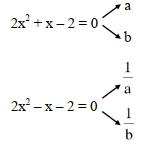
Let $\mathrm{a}>0$ be a root of the equation $2 \mathrm{x}^2+\mathrm{x}-2=0$.
If $\lim _{x \rightarrow \frac{1}{a}} \frac{16\left(1-\cos \left(2+x-2 x^2\right)\right)}{\left(1-a x^2\right)}=\alpha+\beta \sqrt{17}$, where $\alpha, \beta \in Z$ then $\alpha+\beta$ is equal to....................
Answerb
$\lim _{x \rightarrow \frac{1}{a}} 16 \cdot \frac{\left(1-\cos 2\left(x-\frac{1}{a}\right)\left(x-\frac{1}{b}\right)\right)}{4\left(x-\frac{1}{b}\right)^2} \times \frac{4\left(x-\frac{1}{b}\right)^2}{a^2\left(x-\frac{1}{a}\right)^2}$
$ =16 \times \frac{2}{\mathrm{a}^2}\left(\frac{1}{\mathrm{a}}-\frac{1}{\mathrm{~b}}\right)^2 $
$ =\frac{32}{\mathrm{a}^2}\left(\frac{17}{4}\right)=\frac{17.8}{\mathrm{a}^2}=\frac{17 \times 8 \times 16}{(-1+\sqrt{117})^2} $
$ =\frac{136.16}{18.2 \sqrt{7}} \times \frac{18+2 \sqrt{7}}{18+2 \sqrt{7}} $
$ =\frac{136}{256}(18+2 \sqrt{7}) \cdot 16 $
$ =153+17 \sqrt{17}=\alpha+\beta \sqrt{17} $
$ \alpha+\beta=153+17=170$
View full question & answer→MCQ 901 Mark
$\lim _{n \rightarrow \infty} \frac{\left(1^2-1\right)(n-1)+\left(2^2-2\right)(n-2)+\ldots .+\left((n-1)^2-(n-1)\right) \cdot 1}{\left(1^3+2^3+\ldots .+n^3\right)-\left(1^2+2^2+\ldots . .+n^2\right)}$ is equal to:
- A
$\frac{2}{3}$
- ✓
$\frac{1}{3}$
- C
$\frac{3}{4}$
- D
$\frac{1}{2}$
AnswerCorrect option: B. $\frac{1}{3}$
b
$ \lim _{n \rightarrow \infty} \frac{\sum_{r=1}^{n-1}\left(r^2-r\right)(n-r)}{\sum_{r=1}^n r^3-\sum_{r=1}^n r^2} $
$ \lim _{n \rightarrow \infty} \frac{\sum_{r=1}^{n-1}\left(-r^3+r^2(n+1)-n r\right)}{\left(\frac{n(n+1)}{2}\right)^2-\frac{n(n+1)(2 n+1)}{6}} $
$ \lim _{n \rightarrow \infty} \frac{\left(\frac{((n-1) n)}{2}\right)^2+\frac{(n+1)(n-1) n(2 n-1)}{6}-\frac{n^2(n-1)}{2}}{\frac{n(n+1)}{2}\left(\frac{n(n+1)}{2}-\frac{2 n+1}{3}\right)} $
$ \lim _{n \rightarrow \infty} \frac{n(n-1)\left(\frac{-n(n-1)}{2}+\frac{(n+1)(2 n-1)}{3}-n\right)}{\frac{n(n+1)}{2} \frac{3 n^2+3 n-4 n-2}{6}} $
$ \lim _{n \rightarrow \infty} \frac{(n-1)\left(-3 n^2+3 n+2\left(2 n^2+n-1\right)-6\right)}{(n+1)\left(3 n^2-n-2\right)} $
$ \lim _{n \rightarrow \infty} \frac{(n-1)\left(n^2+5 n-8\right)}{(n+1)\left(3 n^2-n-2\right)}=\frac{1}{3}$
View full question & answer→MCQ 911 Mark
The value of $\lim _{x \rightarrow 0} 2\left(\frac{1-\cos x \sqrt{\cos 2 x} \sqrt[3]{\cos 3 x} \ldots . . \sqrt[10]{\cos 10 x}}{x^2}\right)$ is ............
Answerb
$\lim _{x \rightarrow 0} 2\left(\frac{1-\left(1-\frac{x^2}{2 !}\right)\left(1-\frac{4 x^2}{2 !}\right)\left(1-\frac{9 x^2}{2 !}\right) \ldots . .\left(1-\frac{100 x^2}{2 !}\right)}{x^2}\right)$
By expansion
$\lim _{x \rightarrow 0} \frac{2\left(1-\left(1-\frac{x^2}{2}\right)\right)\left(1-\frac{1}{2} \cdot \frac{4 x^2}{2}\right)\left(1-\frac{1}{3} \cdot \frac{9 x^2}{2}\right) \ldots \ldots\left(1-\frac{1}{10} \cdot \frac{100 x^2}{2}\right)}{x^2}$
$\lim _{x \rightarrow 0} 2\left(\frac{1-\left(1-\frac{x^2}{2}\right)\left(1-\frac{2 x^2}{2}\right)\left(1-\frac{3 x^2}{2}\right) \ldots\left(1-\frac{10 x^2}{2}\right)}{x^2}\right)$
$\lim _{x \rightarrow 0} \frac{2\left(1-1+x^2\left(\frac{1}{2}+\frac{2}{2}+\frac{3}{2}+\ldots .+\frac{10}{2}\right)\right)}{x^2}$
$ 2\left(\frac{1}{2}+\frac{2}{2}+\frac{3}{2}+\ldots . .+\frac{10}{2}\right) $
$ 1+2+\ldots \ldots+10=\frac{10 \times 11}{2}=55$
View full question & answer→MCQ 921 Mark
If $\alpha=\lim _{x \rightarrow 0^{+}}\left(\frac{e^{\sqrt{\tan x}}-e^{\sqrt{x}}}{\sqrt{\tan x}-\sqrt{x}}\right)$ and $\beta=\lim _{x \rightarrow 0}(1+\sin x)^{\frac{1}{2} \cot x}$ are the roots of the quadratic equation $a x^2+b x-\sqrt{e}=0$, then 12 $\log _e(a+b)$ is equal to.............
Answerb
$ \alpha=\lim _{x \rightarrow 0^{+}} e^{\sqrt{x}} \frac{\left(e^{\sqrt{\tan x}-\sqrt{x}}-1\right)}{\sqrt{\tan x}-\sqrt{x}} $
$ =1 $
$ \beta=\lim _{x \rightarrow 0}(1+\sin x)^{\frac{1}{2} \cot x} $
$ =e^{1 / 2} $
$ x^2-(1+\sqrt{e})+\sqrt{e}=0 $
$ a x^2+b x-\sqrt{e}=0$
On comparing
$ a=-1, b=\sqrt{e}+1 $
$ 12 \ln (a+b)=12 \times \frac{1}{2}=6$
View full question & answer→MCQ 931 Mark
Let a circle passing through $(2,0)$ have its centre at the point $(\mathrm{h}, \mathrm{k})$. Let $\left(\mathrm{x}_{\mathrm{c}}, \mathrm{y}_{\mathrm{c}}\right)$ be the point of intersection of the lines $3 x+5 y=1$ and $(2+c) x+$ $5 c^2 y=1$. If $h=\lim _{c \rightarrow 1} x_c$ and $k=\lim _{c \rightarrow 1} y_c$, then the equation of the circle is :
- ✓
$25 x^2+25 y^2-20 x+2 y-60=0$
- B
$5 x^2+5 y^2-4 x-2 y-12=0$
- C
$25 x^2+25 y^2-2 x+2 y-60=0$
- D
$5 x^2+5 y^2-4 x+2 y-12=0$
AnswerCorrect option: A. $25 x^2+25 y^2-20 x+2 y-60=0$
a
$ (2+c) x+5 c^2\left(\frac{1-3 x}{5}\right)=1 $
$ \mathrm{x}=\frac{1-\mathrm{c}^2}{2+\mathrm{c}-3 \mathrm{c}^2}, \mathrm{y}=\frac{1-3 \mathrm{x}}{5}=\frac{\mathrm{c}-1}{5\left(2+\mathrm{c}-3 \mathrm{c}^2\right)} $
$ \mathrm{h}=\lim _{\mathrm{c} \rightarrow 1} \frac{(1-\mathrm{c})(1+\mathrm{c})}{(1-\mathrm{c})(2+3 \mathrm{c})}=\frac{2}{5} $
$ \mathrm{~K}=\lim _{\mathrm{c} \rightarrow 1} \frac{\mathrm{c}-1}{-5(\mathrm{c}-1)(3 \mathrm{c}+2)}=-\frac{1}{25} $
$ \text { Centre }\left(\frac{2}{25},-\frac{1}{25}\right), $
$ \mathrm{r}=\sqrt{\left(2-\frac{2}{5}\right)^2+\left(0-\frac{1}{25}\right)^2}=\sqrt{\frac{64}{25}+\frac{1}{625}} $
$ \mathrm{r}=\frac{\sqrt{161}}{25} $
$ \left(\mathrm{x}-\frac{2}{5}\right)^2+\left(\mathrm{y}+\frac{1}{25}\right)^2=\frac{161}{125} $
$ \Rightarrow 25 \mathrm{x}^2+25 \mathrm{y}^2-20 \mathrm{x}+2 \mathrm{y}-60=0$
View full question & answer→MCQ 941 Mark
$\operatorname{Lim}_{x \rightarrow 0} \frac{e-(1+2 x)^{\frac{1}{2 x}}}{x}$ is equal to :
- ✓
$e$
- B
$\frac{-2}{\mathrm{e}}$
- C
$0$
- D
$e-e^2$
Answera
$ \operatorname{Lim}_{x \rightarrow 0} \frac{e-e^{\frac{1}{2 x} \ln (1+2 x)}}{x} $
$ =\operatorname{Lim}_{x \rightarrow 0}(-e) \frac{\left(e^{\frac{\ln (1+2 x)}{2 x}-1}-1\right)}{x} $
$ =\operatorname{Lim}_{x \rightarrow 0}(-e) \frac{\ln (1+2 x)-2 x}{2 x^2} $
$ =(-e) \times(-1) \frac{4}{2 \times 2}=e$
View full question & answer→MCQ 951 Mark
$\lim _{x \rightarrow \frac{\pi}{2}}\left(\frac{\int_{x^3}^{(\pi / 2)^3}\left(\sin \left(2 t^{1 / 3}\right)+\cos \left(t^{1 / 3}\right)\right) d t}{\left(x-\frac{\pi}{2}\right)^2}\right)$ is equal to:
- ✓
$\frac{9 \pi^2}{8}$
- B
$\frac{11 \pi^2}{10}$
- C
$\frac{3 \pi^2}{2}$
- D
$\frac{5 \pi^2}{9}$
AnswerCorrect option: A. $\frac{9 \pi^2}{8}$
a
$ \lim _{x \rightarrow \frac{\pi}{2}} \frac{0-\{\sin (2 x)+\cos (x)\} \cdot 3 x^2}{2\left(x-\frac{\pi}{2}\right)} $
$ =\lim _{x \rightarrow \frac{\pi}{2}} \frac{-\{2 \sin x \cos x+\cos x\} 3 x^2}{2\left(x-\frac{\pi}{2}\right)} $
$ =\lim _{x \rightarrow \frac{\pi}{2}}\left\{\frac{2 \sin x \sin \left(\frac{\pi}{2}-x\right)}{2\left(x-\frac{\pi}{2}\right)}+\frac{\sin \left(\frac{\pi}{2}-x\right)}{2\left(\frac{\pi}{2}-x\right)}\right\} 3 x^2 $
$ =\left(1(1)+\frac{1}{2}\right) 3\left(\frac{\pi}{2}\right)^2 $
$ =\frac{9 \pi^2}{8}$
View full question & answer→MCQ 961 Mark
$\lim _{t \rightarrow 0}\left(1^{\frac{1}{\sin ^2 t}}+2^{\frac{1}{\sin ^2 t}}+\ldots .+n^{\frac{1}{\sin ^2 t}}\right)^{\sin ^2 t}$ is equal to $.......$
- A
$n^2+n$
- ✓
$n$
- C
$\frac{ n ( n +1)}{2}$
- D
$n^2$
Answerb
$\begin{array}{l}\lim _{t \rightarrow 0}\left(1^{\operatorname{cosec}^2 t}+2^{\operatorname{cosec}^2 t}+\ldots \ldots . .+n^{\operatorname{cosec}^2 t}\right)^{\sin ^2 t} \\ =\lim _{t \rightarrow 0} n \left(\left(\frac{1}{n}\right)^{\operatorname{cosec}^2 t}+\left(\frac{2}{n}\right)^{\operatorname{cosec}^2 t}+\ldots \ldots . .+1\right)^{\sin ^2 t} \\ = n \end{array}$
View full question & answer→MCQ 971 Mark
The set of all values of $a$ for which $\operatorname{Lim}_{x \rightarrow a}([x-5]-[2 x+2])=0$, where $[\propto]$ denotes the greater integer less than or equal to $\propto$ is equal to
- ✓
$(-7.5,-6.5)$
- B
$(-7.5,-6.5]$
- C
$[-7.5,-6.5]$
- D
$[-7.5,-6.5)$
AnswerCorrect option: A. $(-7.5,-6.5)$
a
$\lim _{x \rightarrow a}(\lfloor x-5]-\lfloor 2 x+2\rfloor)=0$
$\lim _{x \rightarrow a}([x]-5-[2 x]-2)=0$
$\lim _{x \rightarrow a}([x]-[2 x])=7$
${[a]-[2 a]=7}$
$a \in I, \quad a=-7$
$a \notin I, \quad a=I+f$
$\text { Now, }[a]-[2 a]=7$
$\quad-I-[2 f]=7$
$\text { Case-I: f } \in\left(0, \frac{1}{2}\right)$
$2 f \in(0,1)$
$-I=7$
$I=-7 \Rightarrow a \in(-7,-6.5)$
Case$-II:$ $f \in\left(\frac{1}{2}, 1\right)$
$2 f \in(1,2)$
$- I -1=7$
$I =-8 \Rightarrow a \in(-7.5,-7)$
Hence, $a \in(-7.5,-6.5)$
View full question & answer→MCQ 981 Mark
The value of $\operatorname{Lim}_{n \rightarrow \infty} \frac{1+2-3+4+5-6+\ldots+(3 n-2)+(3 n-1)-3 n}{\sqrt{2 n^4+4 n+3-} \sqrt{n^4+5 n+4}}$ is :
AnswerCorrect option: C. $\frac{3}{2}(\sqrt{2}+1)$
c
$\operatorname{Lim}_{n \rightarrow \infty} \frac{0+3+6+9+\ldots . n \text { terms }}{\sqrt{2 n^4+4 n+3}-\sqrt{n^4+5 n+4}}$
$\operatorname{Lim}_{n \rightarrow \infty} \frac{3 n(n-1)}{2\left(\sqrt{2 n^4+4 n+3}-\sqrt{n^4+5 n+4}\right)}$
$=\frac{3}{2(\sqrt{2}-1)}=\frac{3}{2}(\sqrt{2}+1)$
View full question & answer→MCQ 991 Mark
Let $x=2$ be a root of the equation $x^2+p x+q=0$ and $f(x)=\left\{\begin{array}{cc}\frac{1-\cos \left(x^2-4 p x+q^2+8 q+16\right)}{(x-2 p)^4}, & x \neq 2 p \\ 0, & x=2 p\end{array}\right.$ Then $\lim _{x \rightarrow 22^{+}}[f(x)]$ where [. ] denotes greatest integer function, is $........$
Answerc
$\lim _{x \rightarrow 2 p^{+}}\left(\frac{1-\cos \left(x^2-4 p x+q^2+8 q+16\right)}{\left(x^2-4 p x+q^2+8 q+16\right)^2}\right)\left(\frac{\left(x^2-4 p x+q^2+8 q+16\right)^2}{(x-2 p)^2}\right)$
$\lim _{h \rightarrow 0} \frac{1}{2}\left(\frac{(2 p+h)^2-4 p(2 p+h)+q^2+82+16}{h^2}\right)^2=\frac{1}{2}$
Using L'Hospital's
$\lim _{x \rightarrow 2 p^{+}}[f(x)]=0$
View full question & answer→MCQ 1001 Mark
$\lim _{x \rightarrow 0} \frac{48}{x^4} \int \limits_0^x \frac{t^3}{t^6+1} d t$ is equal to $.......$.
Answerd
$48 \lim _{x \rightarrow 0} \frac{\int_0^x \frac{t^3}{t^6+1} d t}{x^4}\left(\frac{0}{0}\right)$
Applying L'Hospitals Rule
$48 \lim _{x \rightarrow 0} \frac{x^3}{x^6+1} \times \frac{1}{4 x^3}$
$=12$
View full question & answer→MCQ 1011 Mark
$\lim _{x \rightarrow \infty} \frac{(\sqrt{3 x+1}+\sqrt{3 x-1})^6+(\sqrt{3 x+1}-\sqrt{3 x-1})^6}{\left(x+\sqrt{x^2-1}\right)^6+\left(x-\sqrt{x^2-1}\right)^6} x^3$
AnswerCorrect option: B. is equal to $27$
b
$\lim _{x \rightarrow \infty} \frac{(\sqrt{3 x+1}+\sqrt{3 x-1})^6+(\sqrt{3 x+1}-\sqrt{3 x-1})^6}{\left(x+\sqrt{x^2-1}\right)^6+\left(x-\sqrt{x^2-1}\right)^6} x^3$
$\lim _{x \rightarrow \infty} x^3 \times\left\{\frac{x^3\left\{\left(\sqrt{3+\frac{1}{x}}+\sqrt{3-\frac{1}{x}}\right)^6+\left(\sqrt{3+\frac{1}{x}}-\sqrt{3-\frac{1}{x}}\right)^6\right\}}{x^6\left\{\left(1+\sqrt{1-\frac{1}{x^2}}\right)^6+\left(1-\sqrt{1-\frac{1}{x^2}}\right)^6\right\}}\right\}$
$=\frac{(2 \sqrt{3})^6+0}{2^6+0}=3^3=(27)$
View full question & answer→MCQ 1021 Mark
$\lim _{x \rightarrow 0}\left(\left(\frac{1-\cos ^2(3 x)}{\cos ^3(4 x)}\right)\left(\frac{\sin ^3(4 x)}{\left.\left(\log _e(2 x+1)\right)^5\right)}\right)\right)$ is equal to $.........$.
Answerb
$\lim _{x \rightarrow 0}\left[\frac{1-\cos ^2 3 x}{9 x^2}\right] \frac{9 x^2}{\cos ^3 4 x} \cdot \frac{\left(\frac{\sin 4 x}{4 x}\right)^3 \times 64 x^3}{\left[\frac{\ln (1+2 x)}{2 x}\right]^5 \times 32 x^5}$
$\lim _{x \rightarrow 0} 2\left(\frac{1}{2} \times \frac{9}{1} \times \frac{1 \times 64}{1 \times 32}\right)=18$
View full question & answer→MCQ 1031 Mark
If $\alpha > \beta > 0$ are the roots of the equation $ax ^2+ bx +$ $1=0$, and $\lim _{x \rightarrow \frac{1}{\alpha}}\left(\frac{1-\cos \left(x^2+b x+a\right)}{2(1-\alpha x)^2}\right)^{\frac{1}{2}}=\frac{1}{k}\left(\frac{1}{\beta}-\frac{1}{\alpha}\right)$, then $k$ is equal to
- A
$2 \beta$
- ✓
$2 \alpha$
- C
$\alpha$
- D
$\beta$
AnswerCorrect option: B. $2 \alpha$
b
$\therefore a x^2+b x+1=a(x-\alpha)(x-\beta) \therefore \alpha \beta=\frac{1}{a}$
$\therefore x^2+b x+a=a(1-\alpha x)(1-\beta x)$
$\therefore \lim _{x \rightarrow \frac{1}{\alpha}}\left\{\frac{1-\cos \left(x^2+b x+a\right)}{2(1-\alpha x)^2}\right\}^{\frac{1}{2}}=\lim _{x \rightarrow \frac{1}{2}}\left\{\frac{1-\cos a(1-\alpha x)(1-\beta x)}{2\{a(1-\alpha x)(1-\beta x)\}^2} \cdot a^2(1-\beta x)^2\right\}^{\frac{1}{2}}$
$=\left[\frac{1}{2} \cdot \frac{1}{2} a ^2\left(1-\frac{\beta}{\alpha}\right)^2\right]^{\frac{1}{2}}$
$=\frac{1}{2} \frac{1}{\alpha \beta}\left(1-\frac{\beta}{\alpha}\right)=\frac{1}{2}\left(\frac{1}{\alpha \beta}-\frac{1}{\alpha^2}\right)$
$=\frac{1}{2 \alpha}\left(\frac{1}{\beta}-\frac{1}{\alpha}\right)=\frac{1}{ k }\left(\frac{1}{\beta}-\frac{1}{\alpha}\right)$
$\therefore k =2 \alpha$
View full question & answer→MCQ 1041 Mark
If $\lim _{x \rightarrow 0} \frac{e^{a x}-\cos (b x)-\frac{c x e^{-c x}}{2}}{1-\cos (2 x)}=17$, then $5 a ^2+ b ^2$ is equal to
Answerc
$\lim _{x \rightarrow 0} \frac{e^{a x}-\cos (b x)-\frac{c x e^{-c x}}{2}}{\frac{(1-\cos 2 x)}{4 x^2} \times 4 x^2}=17$
On expansion,
$\lim _{x \rightarrow 0} \frac{\left(1+a x+\frac{a^2 x^2}{2}\right)-\left(1-\frac{b^2 x^2}{2}\right)-\frac{c x}{2}(1-c x)}{2 x^2}=17$
$\lim _{x \rightarrow 0} \frac{\left(a-\frac{c}{2}\right) x+x^2\left(\frac{a^2}{2}+\frac{b^2}{2}+\frac{c^2}{2}\right)}{2 x^2}=17$
For limit to be exist a $-\frac{c}{2}=0$
$a=\frac{c}{2}$
and $\frac{a^2+b^2+c^2}{4}=17$
$a^2+b^2+4 a^2=17 \times 4$
$5 a^2+b^2=68$
View full question & answer→MCQ 1051 Mark
Let $a_1, a_2, a_3 \ldots a_n$ be $n$ positive consecutive terms of an arithmetic progression. If $d > 0$ is its common difference, then $\lim _{n \rightarrow \infty} \sqrt{\frac{d}{n}}\left(\frac{1}{\sqrt{a_1}+\sqrt{a_2}}+\frac{1}{\sqrt{a_2}+\sqrt{a_3}}+\ldots \ldots .+\frac{1}{\sqrt{a_{n-1}}+\sqrt{a_n}}\right)$
- ✓
$1$
- B
$\sqrt{ d }$
- C
$\frac{1}{\sqrt{ d }}$
- D
$0$
Answera
$\lim _{n \rightarrow \infty} \sqrt{\frac{ d }{ n }}\left(\frac{1}{\sqrt{a_1}+\sqrt{a_2}}+\frac{1}{\sqrt{a_2}+\sqrt{a_3}}+\ldots \ldots \ldots+\frac{1}{\sqrt{a_{n-1}}+\sqrt{a_n}}\right)$
On rationalising each term
$\lim _{n \rightarrow \infty} \sqrt{\frac{d}{n}}\left(\frac{\sqrt{a_n}-\sqrt{a_1}}{d}\right)$
$\lim _{n \rightarrow \infty} \sqrt{\frac{d}{n}}\left(\frac{(n-1) d}{\left(\sqrt{a_n}+\sqrt{a_1}\right) d}\right)=1$
View full question & answer→MCQ 1061 Mark
$\operatorname{Lim}_{n \rightarrow \infty}\left\{\left(2^{\frac{1}{2}}-2^{\frac{1}{3}}\right)\left(2^{\frac{1}{2}}-2^{\frac{1}{5}}\right) \ldots \ldots\left(2^{\frac{1}{2}}-2^{\frac{1}{2 n+1}}\right)\right\}$ is equal to
- A
$\frac{1}{\sqrt{2}}$
- B
$1$
- C
$\sqrt{2}$
- ✓
$0$
Answerd
$\left(2^{\frac{1}{2}}-2^{\frac{1}{3}}\right)^n < \left(2^{\frac{1}{2}}-2^{\frac{1}{3}}\right)\left(2^{\frac{1}{2}}-2^{\frac{1}{5}}\right)\left(2^{\frac{1}{2}}-2^{\frac{1}{7}}\right)$
$--\left(2^{\frac{1}{2}}-2^{\frac{1}{2 n+1}}\right) < \left(2^{\frac{1}{2}}-2^{\frac{1}{2 n+1}}\right)^n$
$\left(2^{\frac{1}{2}}-2^{\frac{1}{3}}\right)^n < L < \left(2^{\frac{1}{2}}-2^{\frac{1}{2 n+1}}\right)^n$
$\lim _{n \rightarrow \infty}\left(2^{\frac{1}{2}}-2^{\frac{1}{3}}\right)^n=0 \text { and } \lim _{n \rightarrow \infty}\left(2^{\frac{1}{2}}-2^{\frac{1}{2 n+1}}\right)^n=0$
$\Rightarrow \lim _{n \rightarrow \infty} L=0$
View full question & answer→MCQ 1071 Mark
Let $[ t ]$ denote the greatest integer $\leq t$ and $\{ t \}$ denote the fractional part of $t$. Then integral value of $\alpha$ for which the left hand limit of the function $f(x)=[1+x]+\frac{\alpha^{2[x]+[x]}+[x]-1}{2[x]+\{x\}}$ at $x=0$ is equal to $\alpha-\frac{4}{3}$ is
Answerb
$f(x)=[1+x]+\frac{\alpha^{2[x]+\{x\}}+[x]-1}{2[x]+\{x\}}$
$\lim \limits_{x \rightarrow 0^{-}} f(x)=\alpha-\frac{4}{3} \Rightarrow 0+\frac{\alpha^{-1}-2}{-1}=\alpha-\frac{4}{3}$
$\Rightarrow 2-\frac{1}{\alpha}=\alpha-\frac{4}{3}$
$\Rightarrow \alpha+\frac{1}{\alpha}=\frac{10}{3}$
$\Rightarrow \alpha=3 ; \alpha \in I$
View full question & answer→MCQ 1081 Mark
The value of $\lim\limits _{x \rightarrow 1} \frac{\left(x^{2}-1\right) \sin ^{2}(\pi x)}{x^{4}-2 x^{3}+2 x-1}$ is equal to
- A
$\frac{\pi^{2}}{6}$
- B
$\frac{\pi^{2}}{3}$
- C
$\frac{\pi^{2}}{2}$
- ✓
$\pi^{2}$
AnswerCorrect option: D. $\pi^{2}$
d
$\lim \limits_{x \rightarrow 1} \frac{\left(x^{2}-1\right) \sin ^{2} \pi x}{\left(x^{2}-1\right)(x-1)^{2}}=\lim \limits_{x \rightarrow 1}\left(\frac{\sin ((1-x) \pi))}{\pi(1-x)}\right)^{2} \pi^{2}=\pi^{2}$
View full question & answer→MCQ 1091 Mark
If the function $f(x)=\left\{\begin{array}{c}\frac{\log _{e}\left(1-x+x^{2}\right)+\log _{e}\left(1+x+x^{2}\right)}{\sec x-\cos x}, x \in\left(\frac{-\pi}{2}, \frac{\pi}{2}\right)-\{0\} \\ k \end{array}\right.$ is continuous at $x =0$, then $k$ is equal to.
Answera
$\lim _{x \rightarrow 0} \frac{\left(\ln \left(1+x^{2}+x^{4}\right)\right) \cos x}{1-\cos ^{2} x}$
$\lim _{x \rightarrow 0} \frac{\left(\frac{\ln \left(1+x^{2}+x^{4}\right)}{x^{2}+x^{4}}\right) x^{2}\left(1+x^{2}\right) \cos x}{\left(\frac{\sin ^{2} x}{x^{2}}\right) x^{2}}=1$
$\therefore k =1$
View full question & answer→MCQ 1101 Mark
$\lim \limits_{x \rightarrow \frac{\pi}{2}}(\tan ^{2} x((2 \sin ^{2} x+3 \sin x+4)^{\frac{1}{2}}$ $-(\sin ^{2} x+6 \sin x+2)^{\frac{1}{2}}))$ is equal to
- ✓
$\frac{1}{12}$
- B
$-\frac{1}{18}$
- C
$-\frac{1}{12}$
- D
$-\frac{1}{6}$
AnswerCorrect option: A. $\frac{1}{12}$
a
$\lim \limits_{x \rightarrow \frac{\pi}{2}} \tan ^{2} x\left[\sqrt{2 \sin ^{2} x+3 \sin x+4}-\sqrt{\sin ^{2} x+6 \sin x+2}\right]$
$=\lim \limits_{x \rightarrow \frac{\pi}{2}} \frac{\tan ^{2} x\left[\sin ^{2} x-3 \sin x+2\right]}{\sqrt{9}+\sqrt{9}}$
$=\lim \limits_{x \rightarrow \frac{\pi}{2}} \frac{\tan ^{2} x(\sin x-1)(\sin x-2)}{6}$
$=\frac{1}{6} \lim \limits_{x \rightarrow \frac{\pi}{2}} \tan ^{2} x(1-\sin x)$
$=\frac{1}{6} \lim \limits_{x \rightarrow \frac{\pi}{2}} \frac{\sin ^{2} x(1-\sin x)}{(1-\sin x)(1+\sin x)}=\frac{1}{12}$
View full question & answer→MCQ 1111 Mark
$\lim\limits _{x \rightarrow 0} \frac{\cos (\sin x)-\cos x}{x^{4}}$ is equal to :
- A
$\frac{1}{3}$
- B
$\frac{1}{4}$
- ✓
$\frac{1}{6}$
- D
$\frac{1}{12}$
AnswerCorrect option: C. $\frac{1}{6}$
c
$\lim\limits _{x \rightarrow 0} \frac{\cos (\sin x)-\cos x}{x^{4}} ;\left(\frac{0}{0}\right)$
$\lim \limits_{x \rightarrow 0}\left(\frac{2 \cdot \sin \left(\frac{x+\sin x}{2}\right) \sin \left(\frac{x-\sin x}{2}\right)}{x^{4}}\right)$
$\lim\limits _{x \rightarrow 0} 2\left(\frac{\sin \left(\frac{x+\sin x}{2}\right)}{\left(\frac{x+\sin x}{2}\right)}\left(\frac{\sin \left(\frac{x-\sin x}{2}\right)}{\left(\frac{x-\sin x}{2}\right)}\right)\left(\frac{\left.\frac{x+\sin x}{2}\right)}{x^{4}}\left(\frac{x-\sin x}{2}\right)\right.\right.$
$\lim\limits _{x \rightarrow 0}\left(\frac{x^{2}-\sin ^{2} x}{2 x^{4}}\right):\left(\frac{0}{0}\right)$
Apply $L-Hopital\; Rule$ :
$\lim \limits_{x \rightarrow 0} \frac{2 x-2 \sin x \cos x}{2.4 \cdot x^{3}}$
$\lim\limits _{x \rightarrow 0} \frac{2 x-\sin 2 x}{8 x^{3}} ; \frac{0}{0}:$ Again apply $L-Hopital \;rule$
$\lim \limits_{x \rightarrow 0} \frac{2-2 \cos (2 x)}{8(3) x^{2}}$
$\lim \limits_{x \rightarrow 0} \frac{2(1-\cos (2 x))}{24\left(4 x^{2}\right)} \times 4 \Rightarrow \frac{2}{24} \times \frac{1}{2} \times 4 \Rightarrow \frac{1}{6}$
View full question & answer→MCQ 1121 Mark
$\lim \limits_{x \rightarrow \frac{1}{\sqrt{2}}} \frac{\sin \left(\cos ^{-1} x\right)-x}{1-\tan \left(\cos ^{-1} x\right)}$ is equal to
- A
$\sqrt{2}$
- B
$-\sqrt{2}$
- C
$\frac{1}{\sqrt{2}}$
- ✓
$-\frac{1}{\sqrt{2}}$
AnswerCorrect option: D. $-\frac{1}{\sqrt{2}}$
d
$\lim \limits_{x \rightarrow \frac{1}{\sqrt{2}}} \frac{\sin \left(\cos ^{-1} x\right)-x}{1-\tan \left(\cos ^{-1} x\right)}$
$\lim \limits_{x \rightarrow \frac{1}{\sqrt{2}}} \frac{\sin \left(\sin ^{-1} \sqrt{1-x^{2}}\right)-x}{1-\tan \left(\tan ^{-1}\left(\frac{\sqrt{1-x^{2}}}{x}\right)\right)}$
$\lim \limits_{x \rightarrow \frac{1}{\sqrt{2}}} \frac{\sqrt{1-x^{2}}-x}{1-\left(\frac{\sqrt{1-x^{2}}}{x}\right)}$
$\lim \limits_{x \rightarrow \frac{1}{\sqrt{2}}}(-x)=-\frac{1}{\sqrt{2}}$
View full question & answer→MCQ 1131 Mark
Let a be an integer such that $\lim \limits_{x \rightarrow 7} \frac{18-[1-x]}{[x-3 a]}$ exists, where $[ t ]$ is greatest integer $\leq t$. Then a is equal to
Answerc
$\lim \limits_{x \rightarrow 7} \frac{18-[1-x]}{[x]-3 a}$
$L.H.L.$ $\lim \limits_{x \rightarrow 7-} \frac{18-[1-x]}{[x]-3 a}$
$=\frac{18-(-6)}{6-3 a}$
$=\frac{24}{6-3 a}$
$R.H.L.$ $\lim \limits_{x \rightarrow 7^{+}} \frac{18-[1-x]}{[x]-3 a}$
$=\frac{18-(-7)}{7-3 a}$
$=\frac{25}{7-3 a}$
Now $L.H.L. \;= \;R.H.L.$
$\frac{24}{6-3 a}=\frac{25}{7-3 a}$
$\Rightarrow 168-72 a=150-75 a$
$\Rightarrow 18=-3 a$
$\Rightarrow a =-6$
View full question & answer→MCQ 1141 Mark
If $\lim\limits _{x \rightarrow 1} \frac{\sin \left(3 x^{2}-4 x+1\right)-x^{2}+1}{2 x^{3}-7 x^{2}+a x+b}=-2$, then the value of $(a-b)$ is equal to
Answerc
$\lim \limits_{x \rightarrow 1} \frac{\sin \left(3 x^{2}-4 x+1\right)-x^{2}+1}{2 x^{3}-7 x^{2}+a x+b}=-2$
For finite limit
$a+b-5=0$...............$(1)$
Apply $L'H $rule
$\lim\limits _{x \rightarrow 1} \frac{\cos \left(3 x^{2}-4 x+1\right)(6 x-4)-2 x}{\left(6 x^{2}-14 x+a\right)}=-2$
For finite limit
$6-14+a=0$
$a=8$
From $(1)\,\,\,\,\,\, b=-3$
Now $(a-b)=11$
View full question & answer→MCQ 1151 Mark
$\lim _{x \rightarrow \frac{\pi}{4}} \frac{8 \sqrt{2}-(\cos x+\sin x)^{7}}{\sqrt{2}-\sqrt{2} \sin 2 x}$ is equal to
- ✓
$14$
- B
$7$
- C
$14 \sqrt{2}$
- D
$7 \sqrt{2}$
Answera
$\lim _{x \rightarrow \frac{\pi}{4}} \frac{8 \sqrt{2}-(\cos x+\sin x)^{7}}{\sqrt{2}-\sqrt{2} \sin 2 x} \quad\left(\frac{0}{0}\right.$ form $)$
$=\lim _{x \rightarrow \frac{\pi}{4}} \frac{-7(\cos x+\sin x)^{6}(-\sin x+\cos x)}{-2 \sqrt{2} \cos 2 x}$ using $L-H$
$=\lim _{x \rightarrow \frac{\pi}{4}} \frac{56(\cos x-\sin x)}{2 \sqrt{2} \cos 2 x}\left(\frac{0}{0}\right)$
$=\lim _{x \rightarrow \frac{\pi}{4}} \frac{-56(\sin x+\cos x)}{-4 \sqrt{2} \sin 2 x} \quad$ using L-H Rule
$=7 \sqrt{2} \cdot \sqrt{2}=14$
View full question & answer→MCQ 1161 Mark
If $\lim _{n \rightarrow \infty}\left(\sqrt{n^{2}-n-1}+n \alpha+\beta\right)=0$ then $8(\alpha+\beta)$ is equal to :
Answerc
$\lim _{n \rightarrow \infty} n\left(1-\frac{n+1}{n^{2}}\right)^{\frac{1}{2}}+\alpha n+\beta=0$
$\lim _{n \rightarrow \infty}\left\{1-\frac{1}{2}\left(\frac{n+1}{n^{2}}\right)+\frac{\left(\frac{1}{2}\right)\left(-\frac{1}{2}\right)}{2 !}\left(\frac{n+1}{n^{2}}\right)^{2}+\ldots .\right\}+\alpha n+\beta=0$
$\lim _{n \rightarrow \infty} n-\frac{1}{2}+\frac{1}{n}+\ldots+n \alpha+\beta=0$
$\alpha=-1, \beta=\frac{1}{2}$
$8(\alpha+\beta)=-4$
View full question & answer→MCQ 1171 Mark
If $\lim _{n \rightarrow \infty} \frac{(n+1)^{k-1}}{n^{k+1}}[(n k+1)+(n k+2)+\ldots+$ $(n k+n)]=33 . \lim _{n \rightarrow \infty} \frac{1}{n^{k+1}} \cdot\left[1^{k}+2^{k}+3^{k}+\ldots+n^{k}\right]$, then the integral value of $k$ is equal to $....$
Answerb
$LHS$
$\lim _{n \rightarrow \infty} \frac{(n+1)^{k-1}}{n^{k+1}}[n k \cdot n+1+2+\ldots+n]$
$=\lim _{n \rightarrow \infty} \frac{(n+1)^{k-1}}{n^{k+1}} \cdot\left[n^{2} k+\frac{n(n+1)}{2}\right]$
$=\lim _{n \rightarrow \infty} \frac{(n+1)^{k-1} \cdot n^{2}\left(k+\frac{\left(1+\frac{1}{n}\right)}{2}\right)}{n^{k+1}}$
$\lim _{n \rightarrow \infty}\left(1+\frac{1}{n}\right)\left(k+\frac{\left(1+\frac{1}{n}\right)}{2}\right)$
$\left(k+\frac{1}{2}\right)$
$RHS$
$\lim _{ n \rightarrow \infty} \frac{1}{ n ^{ k +1}}\left(1^{ k }+2^{ k }+\ldots+ n ^{ k }\right)=\frac{1}{ k +1}$
$\text { LHS }=\text { RHS }$
$k +\frac{1}{2}=33 \cdot \frac{1}{ k +1}$
$(2 k +1)( k +1)=66$
$( k -5)(2 k +13)=0$
$k =5 \text { or }-\frac{13}{2}$
View full question & answer→MCQ 1181 Mark
Let $\beta=\lim _{x \rightarrow 0} \frac{\alpha x-\left(e^{3 x}-1\right)}{\alpha x\left(e^{3 x}-1\right)}$ for some $\alpha \in R$. Then the value of $\alpha+\beta$ is.
- A
$\frac{14}{5}$
- B
$\frac{3}{2}$
- ✓
$\frac{5}{2}$
- D
$\frac{7}{2}$
AnswerCorrect option: C. $\frac{5}{2}$
c
$\beta=\lim _{x \rightarrow 0} \frac{\alpha x-\left(e^{3 x}-1\right)}{\alpha x\left(e^{3 x}-1\right)}$
$\beta=\lim _{x \rightarrow 0} \frac{1+\alpha x-\left[1+3 x+\frac{9 x^{2}}{2 !}+\ldots .\right]}{(\alpha x) \frac{\left(e^{3 x}-1\right)}{3 x} 3 x}$
$\beta=\lim _{x \rightarrow 0} \frac{(\alpha x-3 x)-\frac{9 x^{2}}{2 !}-\ldots \ldots .}{3 \alpha x^{2}}$
For existence of limit $\alpha-3=0$ $\alpha=3$
Limit $\beta=\frac{-3}{2 \alpha}$
$\beta=-\frac{1}{2}$
Now,$\alpha+\beta=\frac{5}{2}$
View full question & answer→MCQ 1191 Mark
$\lim _{x \rightarrow 0}\left(\frac{(x+2 \cos x)^{3}+2(x+2 \cos x)^{2}+3 \sin (x+2 \cos x)}{(x+2)^{3}+2(x+2)^{2}+3 \sin (x+2)}\right)^{\frac{100}{x}}$is equal to$.....$
Answerb
$\lim _{x \rightarrow 0}\left(\frac{(x+2 \cos x)^{3}+2(x+2 \cos x)^{2}+3 \sin (x+2 \cos x)}{(x+2)^{3}+2(x+2)^{2}+3 \sin (x+2)}\right)^{\frac{100}{x}}$
From $1^{\infty}$
$=e^{\lim _{x \rightarrow 0}\left[\left(\frac{(x+2 \cos x)^{3}+2(x+2 \cos x)^{2}+3 \sin (x+2 \cos x)}{(x+2)^{3}+2(x+2)^{2}+3 \sin (x+2)}\right)-1\right] \times \frac{100}{x}}$
$=e^{\lim _{x \rightarrow 0}\left[\frac{100}{x}\left(\frac{(x+2 \cos x)^{3}+2(x+2 \cos x)^{2}+3 \sin (x+2 \cos x)-\left((x+2)^{3}+2(x+2)^{2}+3 \sin (x+2)\right)}{(x+2)^{3}+2(x+2)^{2}+3 \sin (x+2)}\right)\right]}$
$=e^{\lim _{x \rightarrow 0} \frac{100}{x}\left[\left(\frac{(x+2 \cos x)^{3}+(x+2)^{3}+2(x+2 \cos x)^{2}-2(x+2)^{2}+3 \sin (x+2 \cos x)-3 \sin (x+2)}{8+8+3 \sin ^{2}}\right)\right]}$
$=e^{\frac{100}{16+3 \sin ^{2}}} \lim _{x \rightarrow 0} \frac{3(x+2 \cos x)^{2} \times(1+2 \sin x)-3(x+2)^{2}-4(x+2 \cos x)}{x(1-2 \sin x)-4(x+2)+3 \cos (x+2 \cos x) \times(1-2 \sin x)-3 \cos (x+2)}$
$=e^{\frac{100}{16+3 \sin 2}}\left(\frac{12-3(4)+8 \times 1-8+3 \cos 2-3 \cos 2}{1}\right)$
Using $L'H$ rule.
$=e^{o}=1$
View full question & answer→MCQ 1201 Mark
If $\lim _{x \rightarrow 0} \frac{\alpha e^{x}+\beta e^{-x}+\gamma \sin x}{x \sin ^{2} x}=\frac{2}{3}$, where $\alpha, \beta, \gamma \in R$, then which of the following is $NOT$ correct ?
- A
$\alpha^{2}+\beta^{2}+\gamma^{2}=6$
- B
$\alpha \beta+\beta \gamma+\gamma \alpha+1=0$
- ✓
$\alpha \beta^{2}+\beta \gamma^{2}+\gamma \alpha^{2}+3=0$
- D
$\alpha^{2}-\beta^{2}+\gamma^{2}=4$
AnswerCorrect option: C. $\alpha \beta^{2}+\beta \gamma^{2}+\gamma \alpha^{2}+3=0$
c
$\lim _{x \rightarrow 0} \frac{\alpha\left(1+x+\frac{x^{2}}{2 !}+\frac{x^{3}}{3 !}+\ldots\right)+\beta\left(1-x+\frac{x^{2}}{2 !}-\frac{x^{3}}{3 !}+\ldots\right)+\gamma\left(x-\frac{x^{3}}{3 !}+\ldots\right)}{x^{3}}$
constant terms should be zero
$a+\beta=0$
coeff of $x$ should be zero
$\alpha-\beta+\gamma=0$
$\operatorname{coeff}$ of $x^{2}$ should be zero
$\lim _{x \rightarrow 0} \frac{x^{3}\left(\frac{\alpha}{3 !}-\frac{\beta}{3 !}-\frac{\gamma}{3 !}\right)+x^{4}\left(\frac{\alpha}{3 !}-\frac{\beta}{3 !}-\frac{\gamma}{3 !}\right)}{x}=\frac{2}{3}$
$\frac{\alpha}{2}+\frac{\beta}{2}=0$
$\frac{\alpha}{6}-\frac{\beta}{6}-\frac{\gamma}{6}=2 / 3$
$\alpha=1, \beta=-1, \gamma=-2$
View full question & answer→MCQ 1211 Mark
The value of the limit $\lim _{\theta \rightarrow 0} \frac{\tan \left(\pi \cos ^{2} \theta\right)}{\sin \left(2 \pi \sin ^{2} \theta\right)}$ is equal to :
- ✓
$-\frac{1}{2}$
- B
$-\frac{1}{4}$
- C
$0$
- D
$\frac{1}{4}$
AnswerCorrect option: A. $-\frac{1}{2}$
a
$\lim _{\theta \rightarrow 0} \frac{\tan \left(\pi\left(1-\sin ^{2} \theta\right)\right)}{\sin \left(2 \pi \sin ^{2} \theta\right)}$
$=\lim _{\theta \rightarrow 0} \frac{-\tan \left(\pi \sin ^{2} \theta\right)}{\sin \left(2 \pi \sin ^{2} \theta\right)}$
$=\lim _{\theta \rightarrow 0}-\left(\frac{\tan \left(\pi \sin ^{2} \theta\right)}{\pi \sin ^{2} \theta}\right)\left(\frac{2 \pi \sin ^{2} \theta}{\sin \left(2 \pi \sin ^{2} \theta\right)}\right) \times \frac{1}{2}$
$=\frac{-1}{2}$
View full question & answer→MCQ 1221 Mark
$\lim _{n \rightarrow \infty} \tan \left\{\sum_{r=1}^{n} \tan ^{-1}\left(\frac{1}{1+r+r^{2}}\right)\right\}$ is equal to..........
Answera
$\lim _{n \rightarrow a} \tan \left(\sum_{r=1}^{n} \tan ^{-1}\left(\frac{1}{1+r(r+1)}\right)\right)$
$=\lim _{n \rightarrow a} \tan \left(\sum_{r=1}^{n} \tan ^{-1}\left(\frac{r+1-r}{1+r(r+1)}\right)\right)$
$=\tan \left(\lim _{n \rightarrow a} \sum_{r=1}^{n}\left[\tan ^{-1}(r+1)-\tan ^{-1}(r)\right]\right)$
$=\tan \left(\lim _{n \rightarrow \infty}\left(\tan ^{-1}(n+1)-\frac{\pi}{4}\right)\right)$
$=\tan \left(\frac{\pi}{4}\right)=1$
View full question & answer→MCQ 1231 Mark
Let $f(x)$ be a differentiable function at $x=a$ with $f^{\prime}(a)=2$ and $f(a)=4$. Then $\lim _{x \rightarrow a} \frac{x f(a)-a f(x)}{x-a}$ equals ...... .
- A
$2 a +4$
- ✓
$4-2 a$
- C
$2 a-4$
- D
$a +4$
AnswerCorrect option: B. $4-2 a$
b
$f^{\prime}(a)=2, f(a)=4$
$\lim _{x \rightarrow a} \frac{x f(a)-a f(x)}{x-a}$
$\Rightarrow \lim _{x \rightarrow a} \frac{f(a)-a f^{\prime}(x)}{1} \quad$ (Lopitals rule)
$=f(a)-a f^{\prime}(a)$
$=4-2 a$
View full question & answer→MCQ 1241 Mark
$\lim _{x \rightarrow 2}\left(\sum_{n=1}^{9} \frac{x}{n(n+1) x^{2}+2(2 n+1) x+4}\right)$ is equal to :
- ✓
$\frac{9}{44}$
- B
$\frac{5}{24}$
- C
$\frac{1}{5}$
- D
$\frac{7}{36}$
AnswerCorrect option: A. $\frac{9}{44}$
a
$\mathrm{S}=\lim _{x \rightarrow 2} \sum_{n=1}^{9} \frac{x}{n(n+1) x^{2}+2(2 n+1) x+4}$
$S=\sum_{n=1}^{9} \frac{2}{4\left(n^{2}+3 n+2\right)}=\frac{1}{2} \sum_{n=1}^{9}\left(\frac{1}{n+1}-\frac{1}{n+2}\right)$
$S=\frac{1}{2}\left(\frac{1}{2}-\frac{1}{11}\right)=\frac{9}{44}$
View full question & answer→MCQ 1251 Mark
Let $\mathrm{f}: \mathrm{R} \rightarrow \mathrm{R}$ be a function such that $\mathrm{f}(2)=4$ and $\mathrm{f}^{\prime}(2)=1$. Then, the value of $\lim _{x \rightarrow 2} \frac{x^{2} f(2)-4 f(x)}{x-2}$ is equal to:
Answerd
Apply L'Hopital Rule
$\lim _{x \rightarrow 2}\left(\frac{2 x f(2)-4 f^{\prime}(x)}{1}\right)$
$=\frac{4(4)-4}{1}=12$
View full question & answer→MCQ 1261 Mark
The value of $\lim _{h \rightarrow 0} 2\left\{\frac{\sqrt{3} \sin \left(\frac{\pi}{6}+h\right)-\cos \left(\frac{\pi}{6}+h\right)}{\sqrt{3} h(\sqrt{3} \cosh -\sinh )}\right\}$ is
- ✓
$\frac{4}{3}$
- B
$\frac{2}{\sqrt{3}}$
- C
$\frac{3}{4}$
- D
$\frac{2}{3}$
AnswerCorrect option: A. $\frac{4}{3}$
a
$L=\lim _{h \rightarrow 0} 2\left(\frac{\sqrt{3}\left(\frac{1}{2} \cosh +\frac{\sqrt{3}}{2} \sinh \right)-\left(\frac{\sqrt{3}}{2} \cosh -\frac{\sinh }{2}\right)}{(\sqrt{3} h)(\sqrt{3})}\right)$
$L=\lim _{h \rightarrow 0} \frac{4 \sinh }{3 h}$
$\Rightarrow L=\frac{4}{3}$
View full question & answer→MCQ 1271 Mark
If $\lim _{x \rightarrow 0} \frac{ ae ^{x}- b \cos x + ce ^{- x }}{ x \sin x }=2,$ then $a + b + c$ is equal to ...........
Answerd
$\lim _{x \rightarrow 0} \frac{a e^{x}-b \cos x+c e^{-x}}{x \sin x}=2$
$\Rightarrow \lim _{x \rightarrow 0} \frac{a\left(1+x+\frac{x^{2}}{2 !} \ldots\right)-b\left(1-\frac{x^{2}}{2 !}+\ldots\right)+c\left(1-x+\frac{x^{2}}{2 !}\right)}{\left(\frac{x \sin x}{x}\right) x}=2$
$a-b+c=0$ $.......(1)$
$a-c=0$ $............(2)$
$\frac{a+b+c}{2}=2$
$\Rightarrow a+b+c=4$
View full question & answer→MCQ 1281 Mark
The value of $\lim _{x \rightarrow 0^{+}} \frac{\cos ^{-1}\left(x-[x]^{2}\right) \cdot \sin ^{-1}\left(x-[x]^{2}\right)}{x-x^{3}},$ where $[ x ]$ denotes the greatest integer $\leq x$ is
- A
$\pi$
- B
$0$
- C
$\frac{\pi}{4}$
- ✓
$\frac{\pi}{2}$
AnswerCorrect option: D. $\frac{\pi}{2}$
d
$\lim _{x \rightarrow 0^{+}} \frac{\cos ^{-1} x}{\left(1-x^{2}\right)} \times \frac{\sin ^{-1} x}{x}=\frac{\pi}{2}$
View full question & answer→MCQ 1291 Mark
If $\lim _{x \rightarrow 0} \frac{\sin ^{-1} x-\tan ^{-1} x}{3 x^{3}}$ is equal to $L,$ then the value of $(6 L +1)$ is
- A
$\frac{1}{6}$
- B
$\frac{1}{2}$
- C
$6$
- ✓
$2$
Answerd
$\lim _{x \rightarrow 0} \frac{\left(x+\frac{x^{3}}{3 !} \ldots\right)-\left(x-\frac{x^{3}}{3} \ldots\right)}{3 x^{3}}=\frac{1}{6}$
So $6 L+1=2$
View full question & answer→MCQ 1301 Mark
The value of $\lim _{n \rightarrow \infty} \frac{[ r ]+[2 r ]+\ldots . .+[ nr ]}{ n ^{2}},$ where
is non-zero real number and $[r]$ denotes the greatest integer less than or equal to $r$, is equal to ...... .
- ✓
$\frac{ r }{2}$
- B
$r$
- C
$2r$
- D
$0$
AnswerCorrect option: A. $\frac{ r }{2}$
a
We know that
and
$\begin{array}{c} r \leq[ r ]< r +1 \\ 2 r \leq[2 r ]<2 r +1 \end{array} $$ $$ \begin{array}{ccc} 3 r & \leq[3 r ] & <3 r +1 \\ \vdots & \vdots & \vdots \\ nr & \leq[ nr ] & < nr +1 \end{array}$
$r +2 r +\ldots+ nr \leq[ r ]+[2 r ]+\ldots+[ nr ]<( r +2 r +\ldots+ nr )+ n$
$\frac{\frac{n(n+1)}{2} \cdot r}{n^{2}} \leq \frac{[r]+[2 r]+\ldots . .+[n r]}{n^{2}}<\frac{\frac{n(n+1)}{2} r+n}{n^{2}}$
Now,
$\lim _{n \rightarrow \infty} \frac{n(n+1) \cdot r}{2 \cdot n^{2}}=\frac{r}{2}$
and
$\lim _{n \rightarrow \infty} \frac{\frac{n(n+1) r}{2}+n}{n^{2}}=\frac{r}{2}$
So, by Sandwich Theorem, we can conclude that
$\lim _{n \rightarrow \infty} \frac{[r]+[2 r]+\ldots \ldots+[n r]}{n^{2}}=\frac{r}{2}$
View full question & answer→MCQ 1311 Mark
$\lim _{n \rightarrow \infty}\left(1+\frac{1+\frac{1}{2}+\ldots \ldots .+\frac{1}{n}}{n^{2}}\right)^{n}=.........$
- A
$\frac{1}{2}$
- B
$0$
- C
$\frac{1}{ e }$
- ✓
$1$
Answerd
Given limit is of $1^{\infty}$ form
$\text { So, } l=\exp \left(\lim _{n \rightarrow \infty} \frac{1+\frac{1}{2}+\frac{1}{3}+\ldots \ldots .+\frac{1}{n}}{n}\right)$
Now,
$0 \leq 1+\frac{1}{2}+\frac{1}{3}+\ldots .+\frac{1}{n} \leq 1+\frac{1}{\sqrt{2}}+\frac{1}{\sqrt{3}}+\ldots+\frac{1}{\sqrt{n}}$
$\leq 2 \sqrt{n}-1$
So, $l=\exp (0)$ (from sandwich theorem)
$=1$
View full question & answer→MCQ 1321 Mark
If $\lim _{x \rightarrow 0} \frac{a x-\left(e^{4 x}-1\right)}{a x\left(e^{4 x}-1\right)}$ exists and is equal to $b$, then the value of $a-2 b$ is ....... .
Answerc
$\lim _{x \rightarrow 0} \frac{\operatorname{ax}-\left(e^{4 x}-1\right)}{\operatorname{ax}\left(e^{4 x}-1\right)} \quad\left(\frac{0}{0}\right)$
$=\lim _{x \rightarrow 0} \frac{\operatorname{ax}-\left(e^{4 x}-1\right)}{\operatorname{ax} \cdot 4 x} \quad$ Use $\lim _{x \rightarrow 0} \frac{e^{4 x}-1}{4 x}=1$
Apply L'Hospital Rule
$=\lim _{x \rightarrow 0} \frac{a-4 e ^{4 x }}{8 ax } \quad\left(\frac{ a -4}{0}\right.$ form $)$
limit exists only when $a-4=0 \Rightarrow a=4$
$=\lim _{x \rightarrow 0} \frac{4-4 e^{4 x}}{32 x}$
$=\lim _{x \rightarrow 0} \frac{1-e^{4 x}}{8 x}$
$\left(\frac{0}{0}\right)$
$=\lim _{x \rightarrow 0} \frac{- e ^{4 x } \cdot 4}{8}=-\frac{1}{2} \Rightarrow b =-\frac{1}{2}$
$a-2 b=4-2\left(-\frac{1}{2}\right)$
$=5$
View full question & answer→MCQ 1331 Mark
If $\alpha, \beta$ are the distinct roots of $x^{2}+b x+c=0$ then $\lim _{x \rightarrow \beta} \frac{e^{2\left(x^{2}+b x+c\right)}-1-2\left(x^{2}+b x+c\right)}{(x-\beta)^{2}}$ is equal to:
AnswerCorrect option: C. $2\left(b^{2}-4 c\right)$
c
$\lim _{x \rightarrow \beta} \frac{e^{2\left(x^{2}+b x+c\right)}-1-2\left(x^{2}+b x+c\right)}{(x-\beta)^{2}}$
$\Rightarrow \lim _{x \rightarrow \beta} \frac{1\left(1+\frac{2\left(x^{2}+b x+c\right)}{1 !}+\frac{2^{2}\left(x^{2}+b x+c\right)^{2}}{2 !}+\ldots\right)-1-2\left(x^{2}+b x+c\right)}{(x-\beta)^{2}}$
$\Rightarrow \lim _{x \rightarrow \beta} \frac{2\left(x^{2}+b x+1\right)^{2}}{(x-\beta)^{2}}$
$\Rightarrow \lim _{x \rightarrow \beta} \frac{2(x-\alpha)^{2}(x-\beta)^{2}}{(x-\beta)^{2}}$
$\Rightarrow 2(\beta-\alpha)^{2}=2\left(b^{2}-4 c\right)$
View full question & answer→MCQ 1341 Mark
If $\lim _{x \rightarrow \infty}\left(\sqrt{x^{2}-x+1}-a x\right)=b$, then the ordered pair $(a, b)$ is:
- A
$\left(1, \frac{1}{2}\right)$
- ✓
$\left(1,-\frac{1}{2}\right)$
- C
$\left(-1, \frac{1}{2}\right)$
- D
$\left(-1,-\frac{1}{2}\right)$
AnswerCorrect option: B. $\left(1,-\frac{1}{2}\right)$
b
$\lim _{x \rightarrow \infty}\left(\sqrt{x^{2}-x+1}\right)-a x=b \quad(\infty-\infty)$
$\Rightarrow a>0$
Now, $\lim _{x \rightarrow \infty} \frac{\left(x^{2}-x+1-a^{2} x^{2}\right)}{\sqrt{x^{2}-x+1}+a x}=b$
$\Rightarrow \quad \lim _{x \rightarrow \infty} \frac{\left(1-a^{2}\right) x^{2}-x+1}{\sqrt{x^{2}-x+1}+a x}=b$
$\Rightarrow \lim _{x \rightarrow \infty} \frac{\left(1-a^{2}\right) x^{2}-x+1}{x\left(\sqrt{\left.1-\frac{1}{x}+\frac{1}{x^{2}}+a\right)}=b\right.}$
Now, $\lim _{x \rightarrow \infty} \frac{-x+1}{x\left(\sqrt{\left.1-\frac{1}{x}+\frac{1}{x^{2}}+a\right)}\right.}=b$
$\Rightarrow \frac{-1}{1+a}=b \Rightarrow b=-\frac{1}{2}$
$(a, b)=\left(1,-\frac{1}{2}\right)$
View full question & answer→MCQ 1351 Mark
$\lim _{x \rightarrow 0} \frac{\sin ^{2}\left(\pi \cos ^{4} x\right)}{x^{4}}$ is equal to :
- A
$\pi^{2}$
- B
$2 \pi^{2}$
- ✓
$4 \pi^{2}$
- D
$4 \pi$
AnswerCorrect option: C. $4 \pi^{2}$
c
$\lim _{x \rightarrow 0} \frac{\sin ^{2}\left(\pi \cos ^{4} x\right)}{x^{4}}$
$\lim _{x \rightarrow 0} \frac{1-\cos \left(2 \pi \cos ^{4} x\right)}{2 x^{4}}$
$\lim _{x \rightarrow 0} \frac{1-\cos \left(2 \pi-2 \pi \cos ^{4} x\right)}{\left[2 \pi\left(1-\cos ^{4} x\right)\right]^{2}} 4 \pi^{2} \cdot \frac{\sin ^{4} x}{2 x^{4}}\left(1+\cos ^{2} x\right)^{2}$
$=\frac{1}{2} \cdot 4 \pi^{2} \cdot \frac{1}{2}(2)^{2}=4 \pi^{2}$
View full question & answer→MCQ 1361 Mark
If $\alpha=\lim _{x \rightarrow \pi / 4} \frac{\tan ^{3} x-\tan x}{\cos \left(x+\frac{\pi}{4}\right)}$ and $\beta=\lim _{x \rightarrow 0}(\cos x)^{\operatorname{cotx}}$ are the roots of the equation, $a x^{2}+b x-4=0$, then the ordered pair $(\mathrm{a}, \mathrm{b})$ is :
- A
$(1,-3)$
- B
$(-1,3)$
- C
$(-1,-3)$
- ✓
$(1,3)$
AnswerCorrect option: D. $(1,3)$
d
$\alpha=\lim _{x \rightarrow \frac{\pi}{4}} \frac{\tan ^{3} x-\tan x}{\cos \left(x+\frac{\pi}{4}\right)} ; \frac{0}{0}$ form
Using L Hopital rule
$\alpha=\lim _{x \rightarrow \frac{\pi}{4}} \frac{3 \tan ^{2} x \sec ^{2} x-\sec ^{2} x}{-\sin \left(x+\frac{\pi}{4}\right)}$
$\Rightarrow \alpha=-4$
$\beta=\lim _{x \rightarrow 0}(\cos x)^{\cot x}=e^{\lim _{x \rightarrow 0} \frac{(\cos x-1)}{\tan x}}$
$\beta=e^{\lim _{x \rightarrow 0} \frac{-(1-\cos x)}{x^{2}} \frac{x^{2}}{\left(\frac{\tan x}{x}\right)^{x}}}$
$\beta=e^{\lim _{x \rightarrow 0}\left(\frac{-1}{2}\right)^{\frac{x}{1}}}=e^{0} \Rightarrow \beta=1$
$\alpha=-4 ; \beta=1$
If $a x^{2}+b x-4=0$ are the roots then $16 a-4 b-4=0\, \&\, a+b-4=0$
$\Rightarrow \mathrm{a}=1 \,\&\, \mathrm{~b}=3$
View full question & answer→MCQ 1371 Mark
Let $f(x)=x^{6}+2 x^{4}+x^{3}+2 x+3, x \in R$. Then the natural number $\mathrm{n}$ for which $\lim _{x \rightarrow 1} \frac{\mathrm{x}^{\mathrm{n}} \mathrm{f}(1)-\mathrm{f}(\mathrm{x})}{\mathrm{x}-1}=44$ is ...... .
Answerb
$f(n)=x^{6}+2 x^{4}+x^{3}+2 x+3$
$\lim _{x \rightarrow 1} \frac{x^{n} f(1)-f(x)}{x-1}=44$
$\lim _{x \rightarrow 1} \frac{9 x^{n}-\left(x^{6}+2 x^{4}+x^{3}+2 x+3\right)}{x-1}=44$
$\lim _{x \rightarrow 1} \frac{9 n x^{n-1}-\left(6 x^{5}+8 x^{3}+3 x^{2}+2\right)}{1}=44$
$\Rightarrow 9 n-(19)=44$
$\Rightarrow 9 n=63$
$\Rightarrow n=7$
View full question & answer→MCQ 1381 Mark
If the value of $\lim _{x \rightarrow 0}(2-\cos x \sqrt{\cos 2 x})^{\left(\frac{x+2}{x^{2}}\right)}$ is equal to $e^{a}$, then $a$ is equal to $.....$
Answerc
$\lim _{x \rightarrow 0}(2-\cos x \sqrt{\cos } x)^{\frac{x+2}{x^{2}}}$
form $1^{\infty}$
$e^{\lim _{x \rightarrow 0}}\left(\frac{1-\cos x \sqrt{\cos 2} x}{x^{2}}\right) \times(x+2)$
Now limt ${x \rightarrow 0} \frac{\lim _{x \rightarrow 0} \frac{1-\cos x \sqrt{\cos 2} x}{}}{x^{2}}$
$\lim _{x \rightarrow 0} \frac{\sin x \sqrt{\cos 2} x-\cos x \times \frac{1}{2 \sqrt{\cos 2 x}} \times(-2 \sin 2 x)}{x^{2}}$
(by L' Hospital Rule)
$\lim _{x \rightarrow 0} \frac{\sin x \cos 2 x+\sin 2 x \cdot \cos x}{2 x}$
$=\frac{1}{2}+1=\frac{3}{2}$
So, $e^{\operatorname{limit_x \rightarrow 0}\left(\frac{1-\cos x \sqrt{\cos 2 x}}{x^{2}}\right)(x+2)}$
$=e^{\frac{3}{2} \times 2}=e^{3}$
$\Rightarrow a=3$
View full question & answer→MCQ 1391 Mark
If $\lim _{x \rightarrow 0} \frac{\alpha x e^{x}-\beta \log _{e}(1+x)+\gamma x^{2} e^{-x}}{x \sin ^{2} x}=10, \alpha, \beta, \gamma \in R$, then the value of $\alpha+\beta+\gamma$ is $......$
Answerc
$\lim _{x \rightarrow 0} \frac{\alpha x\left(1+x+\frac{x^{2}}{2}\right)-\beta\left(x-\frac{x^{2}}{2}+\frac{x^{3}}{3}\right)+\gamma x^{2}(1-x)}{x^{3}}$
$\lim _{x \rightarrow 0} \frac{x(\alpha-\beta)+x^{2}\left(\alpha+\frac{\beta}{2}+\gamma\right)+x^{3}\left(\frac{\alpha}{2}-\frac{\beta}{3}-\gamma\right)}{x^{3}}$
For limit to exist
$\alpha-\beta=0, \alpha+\frac{\beta}{2}+\gamma=0$
$\frac{\alpha}{2}-\frac{\beta}{3}-\gamma=10 \ldots \text { (i) }$
$\beta=\alpha, \gamma=-3 \frac{\alpha}{2}$
Put in $(i)$
$\frac{\alpha}{2}-\frac{\alpha}{3}+\frac{3 \alpha}{2}=10$
$\frac{\alpha}{6}+\frac{3 \alpha}{2}=10 \Rightarrow \frac{\alpha+9 \alpha}{6}=10$
$\Rightarrow \alpha=6$
$\alpha=6, \beta=6, \gamma=-9$
$\alpha+\beta+\gamma=3$
View full question & answer→MCQ 1401 Mark
The value of $\lim _{x \rightarrow 0}\left(\frac{x}{\sqrt[8]{1-\sin x}-\sqrt[8]{1+\sin x}}\right)$ is equal to:
Answerb
Rationalize denominator three times
$\lim _{x \rightarrow 0} \frac{x\left\{(1-\sin x)^{1 / 8}+(1+\sin x)^{1 / 8}\right\}\left\{(1-\sin x)^{1 / 4}+(1+\sin x)^{1 / 4}\right\}\left\{(1-\sin x)^{1 / 2}+(1+\sin x)^{1 / 2}\right\}}{(1-\sin x-1-\sin x)}$
$\lim _{x \rightarrow 0} \frac{8 x}{-2 \sin x}=-4$
View full question & answer→MCQ 1411 Mark
Let $S_{k}=\sum_{r=1}^{k} \tan ^{-1}\left(\frac{6^{r}}{2^{2 r+1}+3^{2 r+1}}\right) .$ Then $\lim _{k \rightarrow \infty} S_{k}$ is equal to
AnswerCorrect option: C. $\cot ^{-1}\left(\frac{3}{2}\right)$
c
$S_{ k }=\sum_{ r =1}^{ k } \tan ^{-1}\left(\frac{6^{ r }}{2^{2 r +1}+3^{2 r +1}}\right)$
Divide by $3^{2 r }$
$\sum_{r=1}^{k} \tan ^{-1}\left(\frac{\left(\frac{2}{3}\right)^{r}}{\left(\frac{2}{3}\right)^{2 r} \cdot 2+3}\right)$
$\sum_{r=1}^{k} \tan ^{-1}\left(\frac{\left(\frac{2}{3}\right)^{r}}{3\left(\left(\frac{2}{3}\right)^{2 r+1}+1\right)}\right)$
Let $\left(\frac{2}{3}\right)^{r}=t$
$\sum_{r=1}^{k} \tan ^{-1}\left(\frac{\frac{t}{3}}{1+\frac{2}{3} t^{2}}\right)$
$\sum_{r=1}^{k} \tan ^{-1}\left(\frac{t-\frac{2 t}{3}}{1+t \cdot \frac{2 t}{3}}\right)$
$\sum_{ r =1}^{ k }\left(\tan ^{-1}( t )-\tan ^{-1}\left(\frac{2 t }{3}\right)\right)$
$\sum_{ r =1}^{ k }\left(\tan ^{-1}\left(\frac{2}{3}\right)^{ r }-\tan ^{-1}\left(\frac{2}{3}\right)^{ r +1}\right)$
$S _{ k }=\tan ^{-1}\left(\frac{2}{3}\right)-\tan ^{-1}\left(\frac{2}{3}\right)^{ k +1}$
$S _{\infty}=\lim _{ k \rightarrow \infty}\left(\tan ^{-1}\left(\frac{2}{3}\right)-\tan ^{-1}\left(\frac{2}{3}\right)^{ k +1}\right)$
$=\tan ^{-1}\left(\frac{2}{3}\right)-\tan ^{-1}(0)$
$\therefore \quad S _{\infty}=\tan ^{-1}\left(\frac{2}{3}\right)=\cot ^{-1}\left(\frac{3}{2}\right)$
View full question & answer→MCQ 1421 Mark
If $\lim \limits_{x \rightarrow 1} \frac{x+x^{2}+x^{3}+\ldots+x^{n}-n}{x-1}=820,(n \in N)$ then the value of $n$ is equal to
Answerc
$\lim _{x \rightarrow 1} \frac{x+x^{2}+\ldots \ldots+x^{2}-n}{x-1}=820$
$\Rightarrow \quad \lim _{x \rightarrow 1}\left(\frac{x-1}{x-1}+\frac{x^{2}-1}{x-1}+\ldots . . \frac{x^{n}-1}{x-1}\right)=820$
$\Rightarrow 1+2+\ldots .+n=820$
$\Rightarrow \quad n(n+1)=2 \times 820$
$\Rightarrow \quad n(n+1)=40 \times 41$
since $\mathrm{n} \in \mathrm{N},$ so $n=40$
View full question & answer→MCQ 1431 Mark
$\lim \limits_{x \rightarrow 0}\left(\tan \left(\frac{\pi}{4}+x\right)\right)^{\frac{1}{x}}$ is equal to
AnswerCorrect option: D. $e^{2}$
d
$\lim \limits_{x \rightarrow 0}\left\{\tan \left(\frac{\pi}{4}+x\right)\right\}^{1 / x}$
$=\lim \limits_{x \rightarrow 0} \frac{1}{x}\left\{\tan \left(\frac{\pi}{4}+x\right)-1\right\}$
$=\lim \limits_{x \rightarrow 0}\left(\frac{1+\tan x-1+\tan x}{x(1-\tan x)}\right)$
$=e^{\lim \limits_{x \rightarrow 0} \frac{2 \tan x}{x(1-\tan x)}}$
$=e^{2}$
View full question & answer→MCQ 1441 Mark
If $\lim \limits_{x \rightarrow 0}\left\{\frac{1}{x^{8}}\left(1-\cos \frac{x^{2}}{2}-\cos \frac{x^{2}}{4}+\cos \frac{x^{2}}{2} \cos \frac{x^{2}}{4}\right)\right\}=2^{-k}$ then the value of $k$ is
Answerb
$\lim _{x \rightarrow 0}\left\{\frac{1}{x^{8}}\left(1-\cos \frac{x^{2}}{2}-\cos \frac{x^{2}}{4}+\cos \frac{x^{2}}{2} \cos \frac{x^{2}}{4}\right)\right\}=2^{-k}$
$\Rightarrow \lim _{x \rightarrow 0} \frac{\left(1-\cos \frac{x^{2}}{2}\right)\left(1-\cos \frac{x^{2}}{4}\right)}{4\left(\frac{x^{2}}{2}\right)^{2}}=\frac{1}{16\left(\frac{x^{2}}{4}\right)^{2}}=\frac{1}{8} \times \frac{1}{32}=2^{-k}$
$\Rightarrow 2^{-8}=2^{-k} \Rightarrow k=8$
View full question & answer→MCQ 1451 Mark
If the function $\mathrm{f}$ defined on $\left(-\frac{1}{3}, \frac{1}{3}\right)$ by $f(x)=\left\{\begin{array}{ll}{\frac{1}{x} \log _{e}\left(\frac{1+3 x}{1-2 x}\right)} & {, \text { when } x \neq 0} \\ {k} & {, \text { when } x=0}\end{array}\right.$ is continuous, then $\mathrm{k}$ is equal to
Answerb
$\mathrm{k}=\lim _{\mathrm{x} \rightarrow 0}\left(\frac{\ln (1+3 \mathrm{x})}{\mathrm{x}}-\frac{\ln (1-2 \mathrm{x})}{\mathrm{x}}\right)$
$\mathrm{k}=3+2=5$
View full question & answer→MCQ 1461 Mark
$\lim\limits_{x \rightarrow 2} \frac{3^{x}+3^{3-x}-12}{3^{-x / 2}-3^{1-x}}$ is equal to
Answerb
$\lim _{x \rightarrow 2} \frac{3^{x}+3^{3-x}-12}{3^{-x / 2}-3^{1-x}} \Rightarrow \lim _{x \rightarrow 2} \frac{3^{2 x}-12.3^{x}+27}{3^{x / 2}-3}$
$=\lim _{x \rightarrow 2} \frac{\left(3^{x}-9\right)\left(3^{x}-3\right)}{\left(3^{x / 2}-3\right)}$
$=\lim _{x \rightarrow 2} \frac{\left(3^{x / 2}+3\right)\left(3^{x / 2}-3\right)\left(3^{x}-3\right)}{\left(3^{x / 2}-3\right)}$
$=36$
View full question & answer→MCQ 1471 Mark
$\lim\limits_{x \rightarrow 0}\left(\frac{3 x^{2}+2}{7 x^{2}+2}\right)^{\frac{1}{x^{2}}}$ is equal to
- A
$\frac{1}{e}$
- B
$e^2$
- C
$e$
- ✓
$\frac{1}{e^2}$
AnswerCorrect option: D. $\frac{1}{e^2}$
d
Required limit $=e^{\lim _{x \rightarrow 0}\left(\frac{3 x^{2}+2}{7 x^{2}+2}-1\right) \frac{1}{x^{2}}}$
$=e^{\lim _{x \rightarrow 0}\left(\frac{-4}{7 x^{2}+2}\right)}=\frac{1}{e^{2}}$
View full question & answer→MCQ 1481 Mark
Let $[t]$ denote the greatest integer $\leq t$ and $\mathop {\lim }\limits_{x \to 0} x\left[\frac{4}{x}\right]=A .$ Then the function. $\mathrm{f}(\mathrm{x})=\left[\mathrm{x}^{2}\right] \sin (\pi \mathrm{x})$ is discontinuous, when $\mathrm{x}$ is equal to
- A
$\sqrt{A+5}$
- ✓
$\sqrt{A+1}$
- C
$\sqrt{A}$
- D
$\sqrt{A+21}$
AnswerCorrect option: B. $\sqrt{A+1}$
b
$A=\lim _{x \rightarrow 0} x\left[\frac{4}{x}\right]=\lim _{x \rightarrow 0} x\left(\frac{4}{x}\right)-x\left\{\frac{4}{x}\right\}=4$
$f(\mathrm{x})=\left[\mathrm{x}^{2}\right] \sin (\pi \mathrm{x})$ will be discontinuous at nonintegers
$\therefore \mathrm{x}=\sqrt{\mathrm{A}+1}$ i.e. $\sqrt{5}$
View full question & answer→MCQ 1491 Mark
$\lim \limits_{x \rightarrow a} \frac{(a+2 x)^{\frac{1}{3}}-(3 x)^{\frac{1}{3}}}{(3 a+x)^{\frac{1}{3}}-(4 x)^{\frac{1}{3}}}(a \neq 0)$ is equal to
- ✓
$\left(\frac{2}{3}\right)\left(\frac{2}{9}\right)^{\frac{1}{3}}$
- B
$\left(\frac{2}{3}\right)^{\frac{4}{3}}$
- C
$\left(\frac{2}{9}\right)^{\frac{4}{3}}$
- D
$\left(\frac{2}{9}\right)\left(\frac{2}{3}\right)^{\frac{1}{3}}$
AnswerCorrect option: A. $\left(\frac{2}{3}\right)\left(\frac{2}{9}\right)^{\frac{1}{3}}$
a
Required limit
$ L =\lim _{h \rightarrow 0} \frac{(a+2(a+h))^{1 / 3}-(3(a+h))^{1 / 3}}{(3 a+a+h)^{1 / 3}-(4(a+h))^{1 / 3}} $
$=\lim _{h \rightarrow 0} \frac{(3 a)^{1 / 3}\left(1+\frac{2 h}{3 a}\right)^{1 / 3}-(3 a)^{1 / 3}\left(1+\frac{h}{a}\right)^{1 / 3}}{(4 a)^{1 / 3}\left(1+\frac{h}{4 a}\right)^{1 / 3}-(4 a)^{1 / 3}\left(1+\frac{h}{a}\right)^{1 / 3}} $
$=\lim _{h \rightarrow 0}\left(\frac{3^{1 / 3}}{4^{1 / 3}}\right)\left[\frac{\left(1+\frac{2 h}{9 a}\right)-\left(1+\frac{h}{3 a}\right)}{\left(1+\frac{h}{12 a}\right)-\left(1+\frac{h}{3 a}\right)}\right]$
$=\left(\frac{3}{4}\right)^{1 / 3} \frac{\left(\frac{2}{9}-\frac{1}{3}\right)}{\left(\frac{1}{12}-\frac{1}{3}\right)}=\left(\frac{3}{4}\right)^{1 / 3}\left(\frac{8-12}{3-12}\right)$
$=\left(\frac{3}{4}\right)^{1 / 3}\left(\frac{-4}{-9}\right)=\frac{4^{1-\frac{1}{3}}}{3^{2-\frac{1}{3}}}=\frac{4^{2 / 3}}{3^{5 / 3}}$
$=\frac{(8 \times 2)^{1 / 3}}{(27 \times 9)^{1 / 3}}=\frac{2}{3}\left(\frac{2}{9}\right)^{1 / 3}$
View full question & answer→MCQ 1501 Mark
Let $[ t ]$ denote the greatest integer $\leq t$. If for some $\lambda \in R -\{0,1\}, \lim \limits_{x \rightarrow 0}\left|\frac{1-x+|x|}{\lambda-x+[x]}\right|=L,$ then $L$ is equal to
- A
$1$
- ✓
$2$
- C
$\frac{1}{2}$
- D
$0$
Answerb
$\operatorname{LHL}: \lim _{x \rightarrow 0^{-}}\left|\frac{1-x-x}{\lambda-x-1}\right|=\left|\frac{1}{\lambda-1}\right|$
$\operatorname{RHL}: \lim _{x \rightarrow 0^{+}}\left|\frac{1-x+x}{\lambda-x+1}\right|=\left|\frac{1}{\lambda}\right|$
For existence of limitt
$LHL = RHD$
$\Rightarrow \frac{1}{|\lambda-1|}=\frac{1}{|\lambda|} \Rightarrow \lambda=\frac{1}{2}$
$\therefore \quad L=\frac{1}{|\lambda|}=2$
View full question & answer→MCQ 1511 Mark
$\lim \limits_{x \rightarrow 0} \frac{x\left(e^{\frac{\left(\sqrt{1+x^{2}+x^{4}}-1\right)}{x}}-1\right)}{\sqrt{1+x^{2}+x^{4}}-1}$ is equal to
Answerd
$\lim _{x \rightarrow 0} \frac{x\left(e^{\left(\sqrt{1+x^{2}+x^{4}}-1\right) / x}-1\right)}{\sqrt{1+x^{2}+x^{4}}-1}$
$\because \lim _{x \rightarrow 0} \frac{\sqrt{1+x^{2}+x^{4}}-1}{x}\left(\frac{0}{0}\right.$ from $)$
$\lim _{x \rightarrow 0} \frac{\left(1+x^{2}+x^{4}\right)-1}{x\left(\sqrt{1+x^{2}+x^{4}}+1\right.}$
$\lim _{x \rightarrow 0} \frac{x\left(1+x^{2}\right)}{\left(\sqrt{1+x^{2}+x^{4}}+1\right)}=0$
$\lim _{x \rightarrow 0} \frac{e^{\frac{\sqrt{1+x^{2}+x^{4}-1}}{x}-1}}{\left(\frac{\sqrt{1+x^{2}+x^{4}}-1}{x}\right)}=1$
View full question & answer→MCQ 1521 Mark
If $\alpha$ is the positive root of the equation, $p(x)=x^{2}-x-2=0,$ then $\lim \limits_{x \rightarrow \alpha^{+}} \frac{\sqrt{1-\cos (p(x))}}{x+\alpha-4}$ is equal to
- ✓
$\frac{3}{\sqrt{2}}$
- B
$\frac{3}{2}$
- C
$\frac{1}{\sqrt{2}}$
- D
$\frac{1}{2}$
AnswerCorrect option: A. $\frac{3}{\sqrt{2}}$
a
$x^{2}-x-2=0$
roots are $2 -1$
$\Rightarrow \lim _{x \rightarrow 2^{+}} \frac{\sqrt{1-\cos \left(x^{2}-x-2\right)}}{(x-2)}$
$=\lim _{x \rightarrow 2^{+}} \frac{\sqrt{2 \sin ^{2} \frac{\left(x^{2}-x-2\right)}{2}}}{(x-2)}$
$=\lim _{x \rightarrow 2^{+}} \frac{\sqrt{2} \sin \left(\frac{(x-2)(x+1)}{2}\right)}{(x-2)}$
$=\frac{3}{\sqrt{2}}$
View full question & answer→MCQ 1531 Mark
$\mathop {\lim }\limits_{y \to 0} \frac{{\sqrt {1 + \sqrt {1 + {y^4}} } - \sqrt 2 }}{{{y^4}}} = $
- ✓
exists and equals $\frac{1}{{4\sqrt 2 }}$
- B
exists and equals $\frac{1}{{2\sqrt 2 \left( {\sqrt 2 + 1} \right)}}$
- C
exists and equals $\frac{1}{{2\sqrt 2 }}$
- D
AnswerCorrect option: A. exists and equals $\frac{1}{{4\sqrt 2 }}$
a
${\left( {1 + x} \right)^n} \cong 1 + nx$ (when $x \to 0$)
So, $\sqrt {1 + {y^4}} = 1 + \frac{{{y^4}}}{2}$
$\mathop {\lim }\limits_{y \to 0} \frac{{\sqrt {2 + \frac{{{y^4}}}{2}} - \sqrt 2 }}{{{y^4}}}$
$ = \frac{{\sqrt 2 \left( {1 + \frac{{{y^4}}}{8} - 1} \right)}}{{{y^4}}} = \frac{{\sqrt 2 }}{8} = \frac{1}{{4\sqrt 2 }}$
View full question & answer→MCQ 1541 Mark
For each $x\,\in R,$ let $[x]$ be the greatest integer less than or equal to $x.$ Then $\mathop {\lim }\limits_{x \to {0^ + }} \frac{{x([x] + [x])\,\sin \,[x]}}{{\left| x \right|}}$ is equal to
- ✓
$-\,sin\,1$
- B
$0$
- C
$1$
- D
$sin\,1$
AnswerCorrect option: A. $-\,sin\,1$
a
$\mathop {\lim }\limits_{x \to {0^ + }} \frac{{x\left( {\left[ x \right] + \left| x \right|} \right)\sin \left[ x \right]}}{{\left| x \right|}}$
$x \to {0^ - }$
$\left. \begin{array}{l}
\left[ x \right] = - 1\\
\left| x \right| = - x
\end{array} \right\} \Rightarrow \mathop {\lim }\limits_{x \to {0^ - }} \frac{{x\left( { - x - 1} \right)\sin \left( { - 1} \right)}}{{ - x}} = - \sin 1$
View full question & answer→MCQ 1551 Mark
For each $t \in R$, let $[t]$ be the greatest integer less than or equal to $t$. Then $\mathop {\lim }\limits_{x \to 1 + } \,\frac{{\left( {1 - \left| x \right| + \sin \left| {1 + x} \right|} \right)\,\sin \,\left( {\frac{\pi }{2}\,\left[ {1 - x} \right]} \right)}}{{\left| {1 - x} \right|\left| {1 - x} \right|}}$
- A
equals $1$
- ✓
equals $0$
- C
equals $-1$
- D
AnswerCorrect option: B. equals $0$
b
$\mathop {\lim }\limits_{x \to 1 + } \frac{{\left( {1 - \left| x \right| + \sin \left| {1 - x} \right|} \right)\sin \left( {\left[ {1 - x} \right]\frac{\pi }{2}} \right)}}{{\left| {1 - x} \right|\left[ {1 - x} \right]}}$
$\mathop {\lim }\limits_{x \to 1 + } \frac{{\left( {1 - x + \sin \left( {1 - x} \right)} \right)\sin \left( { - \frac{\pi }{2}} \right)}}{{\left( {x - 1} \right)\left( { - 1} \right)}}$
$\mathop {\lim }\limits_{x \to 1 + } \frac{{ - \left( {x - 1} \right)\sin \left( {x - 1} \right)}}{{\left( {x - 1} \right)}} = - 1 + 1 = 0$
View full question & answer→MCQ 1561 Mark
Let $[x]$ denote the greatest integer less than or equal to $x$ Then
$\mathop {\lim }\limits_{x \to 0} \,\frac{{\tan \,(\pi \,{{\sin }^2}\,x) + \,{{(\left| x \right|\, - \,\sin \,(x\,[x]))}^2}}}{{{x^2}}}$
- ✓
- B
equals $\,\,\pi $
- C
equals $\,\,\pi \,+\,1$
- D
equals $\,\,0$
Answera
$\mathop {Lt}\limits_{x \to 0} \frac{{\tan \left( {\pi {{\sin }^2}x} \right)}}{{\pi {{\sin }^2}x}}.\frac{{\pi {{\sin }^2}x}}{{{x^2}}} + {\left( {\frac{{\left| x \right| - \sin \left( {x\left[ x \right]} \right)}}{{\left| x \right|}}} \right)^2}$
$1\left( \pi \right).{\left( 1 \right)^2} + \mathop {Lt}\limits_{x \to 0} {\left( {1 - \frac{{\sin x\left[ x \right]}}{{x\left[ x \right]}}.\frac{{x\left[ x \right]}}{{\left| x \right|}}} \right)^2}\,\,\,\,\,\,\,\,......\left( i \right)$
$\mathop {Lt}\limits_{x \to {0^ - }} \frac{{x\left[ x \right]}}{{\left| x \right|}} = \frac{x}{{ - x}}\left( { - 1} \right) = 1$
$\mathop {Lt}\limits_{x \to {0^ + }} \frac{{x\left[ x \right]}}{{\left| x \right|}} = \frac{{x\left( 0 \right)}}{x} = 0$
Put in equation $(i)$
$\therefore $ Limit does not exist.
View full question & answer→MCQ 1571 Mark
$\mathop {\lim }\limits_{x \to 0} \,\frac{{x\,\cot \,\left( {4x} \right)}}{{{{\sin }^2}\,x\,{{\cot }^2}\,\left( {2x} \right)}}$ is equal to
Answerd
$\frac{{x\cos 4x{{\sin }^2}2x}}{{{{\sin }^2}x.{{\cos }^2}2x.\sin 4x}}$
$ = \frac{{4x}}{{\sin 4x}}.\frac{{\cos 4x}}{{{{\cos }^2}2x}}{\cos ^2}x$
$ \Rightarrow 1\,\,\,\,\,as\,\,\,x \to 0$
View full question & answer→MCQ 1581 Mark
$\mathop {\lim }\limits_{x \to \pi /4} \frac{{{{\cot }^3}\,x - \tan \,x}}{{\cos \left( {x + \pi /4} \right)}}$ is
- A
$4$
- B
$4 \sqrt 2$
- C
$8 \sqrt 2$
- ✓
$8$
Answerd
Using $LH$ rule
$\mathop {\lim }\limits_{x \to \frac{\pi }{4}} \frac{{3{{\cot }^2}x\left( { - \cos \,e{c^2}x} \right) - {{\sec }^2}x}}{{ - \sin \left( {x + \frac{\pi }{4}} \right)}} = 8$
View full question & answer→MCQ 1591 Mark
$\mathop {\lim }\limits_{x \to {1^ - }} \frac{{\sqrt \pi - \sqrt {2\,{{\sin }^{ - 1}}x} }}{{\sqrt {1 - x} }}$ is equal to
- A
$\frac{1}{{\sqrt {2\pi } }}$
- ✓
$\sqrt {\frac{2}{\pi }} $
- C
$\sqrt {\frac{\pi }{2}} $
- D
$\sqrt \pi $
AnswerCorrect option: B. $\sqrt {\frac{2}{\pi }} $
b
$\mathop {\lim }\limits_{x \to {1^ - }} \frac{{\sqrt \pi - \sqrt {2{{\sin }^{ - 1}}x} }}{{\sqrt {1 - x} }} \times \frac{{\sqrt \pi + \sqrt {2{{\sin }^{ - 1}}x} }}{{\sqrt \pi + \sqrt {2{{\sin }^{ - 1}}x} }}$
$\mathop {\lim }\limits_{x \to {1^ - }} \frac{{2\left( {\frac{\pi }{2} - {{\sin }^{ - 1}}x} \right)}}{{\sqrt {1 - x} \left( {\sqrt \pi + \sqrt {2{{\sin }^{ - 1}}x} } \right)}}$
$\mathop {\lim }\limits_{x \to {1^ - }} \frac{{2{{\cos }^{ - 1}}x}}{{\sqrt {1 - x} }}.\frac{1}{{2\sqrt \pi }}$
Assuming $x = \cos \theta $
$\mathop {\lim }\limits_{\theta \to {0^ + }} \frac{{2\theta }}{{\sqrt 2 \sin \left( {\frac{\theta }{2}} \right)}}.\frac{1}{{2\sqrt \pi }} = \sqrt {\frac{2}{\pi }} $
View full question & answer→MCQ 1601 Mark
$\mathop {\lim }\limits_{x \to 0} \,\frac{{{{\sin }^2}\,x}}{{\sqrt 2 - \sqrt {1 + \cos \,x} }}$ equals
- A
$\sqrt 2 $
- ✓
$4\sqrt 2 $
- C
$4$
- D
$2\sqrt 2 $
AnswerCorrect option: B. $4\sqrt 2 $
b
$\mathop {\lim }\limits_{x \to 0} \frac{{\left( {\frac{{{{\sin }^2}x}}{{{x^2}}}} \right)\left( {\sqrt 2 + \sqrt {1 + \cos x} } \right)}}{{\left( {\frac{{1 - \cos x}}{{{x^2}}}} \right)}}$
$ = \frac{{{{\left( 1 \right)}^2}.\left( {2\sqrt 2 } \right)}}{{\frac{1}{2}}} = 4\sqrt 2 $
View full question & answer→MCQ 1611 Mark
Let $f : R \to R$ be a differentiable function satisfying $f’’(3) + f’(2) = 0$. Then $\mathop {\lim }\limits_{x \to \infty } {\left( {\frac{{1 + f\left( {3 + x} \right) - f\left( 3 \right)}}{{1 + f\left( {2 - x} \right) - f\left( 2 \right)}}} \right)^{\frac{1}{x}}}$ is equal to
Answerb
${1^\infty }$ form
$k = \mathop {\lim }\limits_{x \to 0} \left( {\frac{{f\left( {3 + x} \right) - f\left( {2x} \right) - f\left( 3 \right)\left( {f\left( 2 \right)} \right)}}{{x\left( {1 + f\left( {2 - x} \right) - f\left( 2 \right)} \right)}}} \right)$
$ = \mathop {\lim }\limits_{x \to 0} \frac{{f'\left( {3 + x} \right) + f'\left( {2 - x} \right)}}{{\left( {1 + f\left( {2 - x} \right) - f\left( 2 \right)} \right) - xf'\left( {2 - x} \right)}}$
$ = 0$
$ \Rightarrow {e^k} = 1$
View full question & answer→MCQ 1621 Mark
If $f:R \to R$ is a differentiable function and $f\left( 2 \right) = 6$, then $\mathop {\lim }\limits_{x \to 2} \int\limits_6^{f\left( x \right)} {\frac{{2\,tdt}}{{\left( {x - 2} \right)}}} $ is
- A
$0$
- B
$2f'\left( 2 \right)$
- ✓
$12f'\left( 2 \right)$
- D
$24f'\left( 2 \right)$
AnswerCorrect option: C. $12f'\left( 2 \right)$
c
$\mathop {\lim }\limits_{x \to 2} \int\limits_6^{f\left( x \right)} {\frac{{2tdt}}{{\left( {x - 2} \right)}}} dx$ {given that $\,f\left( 2 \right) = 6$}
$\frac{0}{0}$ from, so we use $L-$ Hopital Rule
$ = \mathop {\lim }\limits_{x \to 2} \frac{{f'\left( x \right).2f\left( x \right)}}{1}$
$ = f'\left( 2 \right).2f\left( 2 \right)$
$ = 12f'\left( 2 \right)$
View full question & answer→MCQ 1631 Mark
If $\mathop {\lim }\limits_{x - 1} \frac{{{x^4} - 1}}{{x - 1}} = \mathop {\lim }\limits_{x - k} \frac{{{x^3} - {k^3}}}{{{x^2} - {k^2}}}$, then $k$ is
- A
$\frac{3}{8}$
- ✓
$\frac{8}{3}$
- C
$\frac{4}{3}$
- D
$\frac{3}{2}$
AnswerCorrect option: B. $\frac{8}{3}$
b
$\mathop {\lim }\limits_{x \to 1} \frac{{{x^4} - 1}}{{x - 1}} = \mathop {\lim }\limits_{x \to 1} \left( {x + 1} \right)\left( {{x^2} + 1} \right)......\left( 1 \right)$
$\mathop {\lim }\limits_{x \to k} \frac{{{x^3} - {k^3}}}{{{x^2} - {k^2}}} = \frac{{{k^2} + {k^2} + {k^2}}}{{2k}}.........\left( 2 \right)$
$(1)=(2)$
$ \Rightarrow k = \frac{8}{3}$
View full question & answer→MCQ 1641 Mark
$\mathop {\lim }\limits_{n \to \infty } \left( {\frac{{{{\left( {n + 1} \right)}^{1/3}}}}{{{n^{4/3}}}} + \frac{{{{\left( {n + 2} \right)}^{1/3}}}}{{{n^{4/3}}}} + .... + \frac{{{{\left( {2n} \right)}^{1/3}}}}{{{n^{4/3}}}}} \right)$ is equal to
- ✓
$\frac{3}{4}{\left( 2 \right)^{4/3}} - \frac{3}{4}$
- B
$\frac{4}{3}{\left( 2 \right)^{3/4}}$
- C
$\frac{3}{4}{\left( 2 \right)^{4/3}} - \frac{4}{3}$
- D
$\frac{4}{3}{\left( 2 \right)^{4/3}}$
AnswerCorrect option: A. $\frac{3}{4}{\left( 2 \right)^{4/3}} - \frac{3}{4}$
a
$\mathop {\lim }\limits_{n \to \infty } \sum\limits_{r = 1}^n {\frac{1}{n}} {\left( {\frac{{n + r}}{n}} \right)^{1/3}}$
$ = \int\limits_0^1 {{{\left( {1 + x} \right)}^{1/3}}} dx = \frac{3}{4}\left( {{2^{4/3}} - 1} \right)$
View full question & answer→MCQ 1651 Mark
If $\mathop {\lim }\limits_{x \to 1} \frac{{{x^2}\,\, - \,ax\, + \,b}}{{x\, - \,1}}\,\, = \,3,$ then $a + b$ is equal to
Answerd
$\mathop {\lim }\limits_{x \to 1} \frac{{{x^2} - ax + b}}{{x - 1}} = 5$
$1 - a + b = 0\,\,\,\,\,\,\,.......\left( i \right)$
$2 - a = 5\,\,\,\,\,\,\,.....\left( {ii} \right)$
$ \Rightarrow a + b = - 7$
View full question & answer→MCQ 1661 Mark
Let $f\left( x \right) = 5 - \left| {x - 2} \right|$ and $g\left( x \right) = \left| {x + 1} \right|,x \in R$. If $f(x)$ attains maximum value at $\alpha $ and $g(x)$ attains minimum value at $\beta $, then $\mathop {\lim }\limits_{x \to \alpha \beta } \frac{{\left( {x - 1} \right)\left( {{x^2} - 5x + 6} \right)}}{{{x^2} - 6x + 8}}$ is equal to
- A
$\frac{3}{2}$
- B
$\frac{-3}{2}$
- ✓
$\frac{1}{2}$
- D
$\frac{-1}{2}$
AnswerCorrect option: C. $\frac{1}{2}$
c
$f\left( x \right) = 5 - \left| {x - 2} \right|$
$f\left( x \right)$ attains maximum value when $\left| {x - 2} \right| = 0 \Rightarrow x = 2 = \alpha $
$g\left( x \right) = \left| {x + 1} \right|$
$g\left( x \right)$ attins minimum value of $x = - 1 = \beta $
$\mathop {\lim }\limits_{x \to - \alpha \beta } \frac{{\left( {x - 1} \right)\left( {{x^2} - 5x + 6} \right)}}{{{x^2} - 6x + 8}}$
$ = \mathop {\lim }\limits_{x \to 2} \frac{{\left( {x - 1} \right)\left( {x - 2} \right)\left( {x - 3} \right)}}{{\left( {x - 2} \right)\left( {x - 4} \right)}}$
$ = \frac{{\left( {2 - 1} \right)\left( {2 - 3} \right)}}{{\left( {2 - 4} \right)}} = \frac{1}{2}$
View full question & answer→MCQ 1671 Mark
$\mathop {\lim }\limits_{x \to 0} \frac{{x + 2\,\sin \,x}}{{\sqrt {{x^2} + 2\sin \,x + 1} - \sqrt {{{\sin }^2}\,x - x + 1} }}$ is
Answera
$\mathop {\lim }\limits_{x \to 0} \frac{{x + 2\sin x}}{{\sqrt {{x^2} + 2\sin x + 1} - \sqrt {{{\sin }^2}x - x + 1} }}$
$ = \mathop {\lim }\limits_{x \to 0} \frac{{x + 2\sin x}}{{{x^2} + 2\sin x + 1 - {{\sin }^2}x - x + 1}}$ $\left( {\sqrt {{x^2} + 2\sin x + 1} + \sqrt {{{\sin }^2}x - x + 1} } \right)$
$ = \mathop {\lim }\limits_{x \to \infty } \frac{{x + 2\sin x}}{{{x^2} + 2\sin x - {{\sin }^2}x + x}}.\left( 2 \right)$
Applying $L'H$ Rule
$ = \mathop {\lim }\limits_{x \to \infty } \frac{{2.\left( {1 + 2\cos x} \right)}}{{2x + 2\cos x - 2\sin x\cos x + 1}}$
$ = \frac{{2\left( 3 \right)}}{{2 + 1}} = 2$
Hence the correct answer is option $(A)$.
View full question & answer→MCQ 1681 Mark
For each $t \in R$ ,let $\left[ t \right]$ be the greatest interger less than or equal to $t$ . Then $\mathop {\lim }\limits_{x \to 0 + } x\left( {\left[ {\frac{1}{x}} \right] + \left[ {\frac{2}{x}} \right] + .\;.\;.\; + \left[ {\frac{{15}}{x}} \right]} \right) =$ . .. . .
- A
$15$
- ✓
$120$
- C
does not exit (In $R$)
- D
$0$
Answerb
$(2)$ Since, $\mathop {\lim }\limits_{x \to {0^ + }} x\left( {\left[ {\frac{1}{x}} \right] + \left[ {\frac{2}{x}} \right] + .... + \left[ {\frac{{15}}{x}} \right]} \right)$
$ = \mathop {\lim }\limits_{x \to {0^ + }} x\left( {\frac{{1 + 2 + 3 + .... + 15}}{x}} \right) - \left( {\left\{ {\frac{1}{x}} \right\} + \left\{ {\frac{2}{x}} \right\} + .. + \left\{ {\frac{{15}}{x}} \right\}} \right)$
$\because $ $0 \le \left\{ {\frac{r}{x}} \right\} < 1\,\,\,\,\,\,\,\,\, \Rightarrow 0 \le x\left\{ {\frac{r}{x}} \right\} < x$
$\therefore \mathop {\lim }\limits_{x \to {0^ + }} x\left( {\frac{{1 + 2 + 3 + .... + 15}}{x}} \right) = \frac{{15 \times 16}}{2} = 120$
View full question & answer→MCQ 1691 Mark
$\mathop {\lim }\limits_{x \to 0} \frac{{x\,\tan \,2x - 2x\,\tan \,x}}{{{{\left( {1 - \cos \,2x} \right)}^2}}}$ equals
- A
$1$
- B
$ - \frac{1}{2}$
- C
$ \frac{1}{4}$
- ✓
$ \frac{1}{2}$
AnswerCorrect option: D. $ \frac{1}{2}$
d
Let,
$L = \,\,\,\mathop {\lim }\limits_{x \to 0} \frac{{\left( {x\tan 2x - 2x\tan \,x} \right)}}{{{{\left( {1 - \cos \,2x} \right)}^2}}} = \mathop {\lim }\limits_{x \to 0} K$ (say)
$ \Rightarrow K = \frac{{x\left[ {\frac{{2\tan \,x}}{{1 - {{\left( {\tan \,x} \right)}^2}}}} \right] - 2x\,\tan x}}{{{{\left( {1 - \left( {1 - 2{{\sin }^2}x} \right)} \right)}^2}}}$
$ = \frac{{2x\,\tan x - \left[ {2x\,\tan x - 2x\,{{\tan }^3}x} \right]}}{{4{{\sin }^4}\,x \times \left( {1 - {{\tan }^2}x} \right)}}$
$ = \frac{{2x\,{{\tan }^3}x}}{{4{{\sin }^4}\,x \times \left( {1 - {{\tan }^2}x} \right)}}$
$ = \frac{{2x\,{{\tan }^3}x}}{{4{{\sin }^4}\,x \times \left( {\frac{{{{\cos }^2}x - {{\sin }^2}x}}{{{{\cos }^2}x}}} \right)}}$
$ = \frac{{2x\,\frac{{{{\sin }^3}x}}{{{{\cos }^3}x}}}}{{4{{\sin }^4}\,x \times \left( {\frac{{{{\cos }^2}x - {{\sin }^2}x}}{{{{\cos }^2}x}}} \right)}}$
$ \Rightarrow K = \frac{x}{{2\sin \,x \times \left( {{{\cos }^2}x - {{\sin }^2}x} \right)\cos x}}$
$L = \mathop {\lim }\limits_{x \to 0} \frac{x}{{2\sin \,x}} \times \mathop {\lim }\limits_{x \to 0} \frac{1}{{\cos x\left( {{{\cos }^2}x - {{\sin }^2}x} \right)}}$
$ = \mathop {\lim }\limits_{x \to 0} \frac{x}{{2\sin \,x}} \times \mathop {\lim }\limits_{x \to 0} \frac{1}{{\cos 0\left( {{{\cos }^2}0 - {{\sin }^2}0} \right)}}$
$ = \frac{1}{2}$
View full question & answer→MCQ 1701 Mark
$\mathop {\lim }\limits_{x \to 0} \frac{{{{(27 + x)}^{_{\frac{1}{3}}}} - 3}}{{9 - {{(27 + x)}^{\frac{2}{3}}}}}$ equals.
- A
$-\frac {1}{3}$
- B
$\frac {1}{6}$
- ✓
$-\frac {1}{6}$
- D
$\frac {1}{3}$
AnswerCorrect option: C. $-\frac {1}{6}$
c
Let $L = \,\,\,\mathop {\lim }\limits_{x \to 0} \frac{{{{\left( {27 + x} \right)}^{\frac{1}{3}}} - 3}}{{9 - {{\left( {27 + x} \right)}^{\frac{2}{3}}}}}$
Here $'L'$ is in the indeterminate from i.e.,$\frac{0}{0}$
$\therefore $ usinh the $L'$ Hosoital rule we get:
$L = \,\,\,\mathop {\lim }\limits_{x \to 0} \frac{{\frac{1}{3}{{\left( {27 + x} \right)}^{\frac{{ - 2}}{3}}}}}{{ - \frac{2}{3}{{\left( {27 + x} \right)}^{\frac{{ - 1}}{3}}}}} = \frac{{\frac{1}{3} \times {{\left( {27} \right)}^{\frac{{ - 2}}{3}}}}}{{\frac{{ - 2}}{3} \times {{\left( {27} \right)}^{\frac{{ - 1}}{3}}}}} = - \frac{1}{6}$
View full question & answer→MCQ 1711 Mark
$\mathop {\lim }\limits_{x \to \frac{\pi }{2}} \frac{{\cot x - \cos x}}{{{{\left( {\pi - 2x} \right)}^3}}} = $ . . . .
- A
$\frac{1}{4}$
- B
$\frac{1}{{24}}$
- ✓
$\frac{1}{{16}}$
- D
$\frac{1}{8}$
AnswerCorrect option: C. $\frac{1}{{16}}$
c
$\mathop {\lim }\limits_{x \to \frac{\pi }{2}} \frac{{\cot \,x\left( {1 - \sin \,x} \right)}}{{ - 8{{\left( {x - \frac{\pi }{2}} \right)}^3}}} = \mathop {\lim }\limits_{x \to \frac{\pi }{2}} \frac{{\cot \,x\left( {1 - \sin \,x} \right)}}{{8{{\left( {\frac{\pi }{2} - x} \right)}^3}}}$
Put $\frac{\pi }{2} - x = t \Rightarrow $ as $x \to \frac{\pi }{2} \Rightarrow t \to 0$
$ = \mathop {\lim }\limits_{t \to 0} \frac{{\cot \left( {\frac{\pi }{2} - t} \right)\left( {1 - \sin \left( {\frac{\pi }{2} - t} \right)} \right)}}{{8{t^3}}}$
$ = \mathop {\lim }\limits_{t \to 0} \frac{{\tan \,t\left( {1 - \cos \,t} \right)}}{{8{t^3}}}$
$ = \mathop {\lim }\limits_{t \to 0} \frac{{\tan \,t}}{{8t}}.\frac{{1 - \cos t}}{{{t^2}}}$
$ = \frac{1}{8}.1.\frac{1}{2} = \frac{1}{{16}}$
View full question & answer→MCQ 1721 Mark
$\mathop {\lim }\limits_{x \to 3} \frac{{\sqrt {3x} - 3}}{{\sqrt {2x - 4} - \sqrt 2 }}$ is equal to
- A
$\sqrt 3 $
- ✓
$\frac{1}{{\sqrt 2 }}$
- C
$\frac{{\sqrt 3 }}{2}$
- D
$\frac{1}{{2\sqrt 2 }}$
AnswerCorrect option: B. $\frac{1}{{\sqrt 2 }}$
b
Let $A = \,\,\,\mathop {\lim }\limits_{x \to 3} \frac{{\sqrt {3x} - 3}}{{\sqrt {2x - 4} - \sqrt 2 }}$
Rationalise
$ \Rightarrow A = \,\,\,\mathop {\lim }\limits_{x \to 3} \frac{{\left( {3x - 9} \right) \times \left( {2x - 4 + \sqrt 2 } \right)}}{{\left\{ {\left( {2x - 4 - 2} \right)} \right\} \times \left( {\sqrt {3x} + 3} \right)}}$
$ = \,\,\,\mathop {\lim }\limits_{x \to 3} \frac{{3\left( {x - 3} \right)}}{{2\left( {x - 3} \right)}} \times \frac{{\sqrt {2x - 4} + \sqrt 2 }}{{\left( {\sqrt {3x} + 3} \right)}}$
$ = \frac{3}{2} \times \frac{{2\sqrt 2 }}{6} = \frac{1}{{\sqrt 2 }}$
View full question & answer→MCQ 1731 Mark
If $\mathop {\lim }\limits_{n \to \infty } \frac{{{1^a} + {2^a} + ....... + {n^a}}}{{{{\left( {n + 1} \right)}^{a - 1}}\left[ {\left( {na + 2} \right) + ......\left( {na + n} \right)} \right]}} = \frac{1}{{60}}$ for some positive real number $a$, then $a$ is equal to
- ✓
$7$
- B
$8$
- C
$\frac{15}{2}$
- D
$\frac{17}{2}$
Answera
$\,\mathop {\lim }\limits_{n \to \infty } \frac{{\frac{1}{{\left( {a + 1} \right)}}{n^{a + 1}} + {a_1}{n^a} + {a_2}{n^{a - 1}} + .......}}{{{{\left( {n + 1} \right)}^{a - 1}}.{n^2}\left( {a + \frac{{1 + \frac{1}{n}}}{2}} \right)}} = \frac{1}{{60}}$
$\,\mathop {\lim }\limits_{n \to \infty } \frac{{{{\left( {\frac{1}{n}} \right)}^a} + {{\left( {\frac{2}{n}} \right)}^a} + ..... + {{\left( {\frac{n}{n}} \right)}^a}}}{{{{\left( {n + 1} \right)}^{a - 1}}\left[ {{n^a} + \frac{{n\left( {n + 1} \right)}}{2}} \right]}}.$
$ = \,\frac{{\mathop {\lim }\limits_{n \to \infty } \frac{1}{n}\sum\limits_{r = 1}^n {{{\left( {\frac{r}{n}} \right)}^a}} }}{{{{\left( {1 + \frac{1}{n}} \right)}^{a - 1}}\left[ {a + \frac{1}{2}\left( {1 + \frac{1}{n}} \right)} \right]}}\, = \frac{1}{{60}}$
$ = \frac{{\int\limits_0^1 {{x^n}dx} }}{{\left( {a + \frac{1}{2}} \right)}} = \frac{1}{{60}} = \frac{{\frac{1}{{a + 1}}}}{{a + \frac{1}{2}}} = \frac{1}{{60}}$
$ \Rightarrow \frac{{\frac{1}{{a + 1}}}}{{\left( {a + \frac{1}{2}} \right)}} = \frac{1}{{60}} \Rightarrow \left( {a + 1} \right)\left( {2a + 1} \right) = 120$
$ \Rightarrow 2{a^2} + 3a - 119 = 0$
$ \Rightarrow 2{a^2} + 17a - 14a - 119 = 0$
$ \Rightarrow \left( {a - 7} \right)\left( {2a + 17} \right) = 0$
$a = 7, - \frac{{17}}{2}$
View full question & answer→MCQ 1741 Mark
Let $p = \mathop {\lim }\limits_{x \to 0 + } {\left( {1 + {{\tan }^2}\sqrt x } \right)^{\frac{1}{{2x}}}},$ then $\log p = $ . . .
- ✓
$\frac{1}{2}\;\;$
- B
$\frac{1}{4}$
- C
$2$
- D
$1$
AnswerCorrect option: A. $\frac{1}{2}\;\;$
a
${\rm{p}} = {{\rm{e}}^{\mathop {\lim }\limits_{x \to {0^ + }} \frac{1}{2}{{\left( {\frac{{{\mathop{\rm san}\nolimits} \sqrt x }}{{\sqrt x }}} \right)}^2}}} = \sqrt e $
$\log p = \frac{1}{2}$
View full question & answer→MCQ 1751 Mark
If $\mathop {\lim }\limits_{x \to \infty } {\left( {1 + \frac{a}{x} - \frac{4}{{{x^2}}}} \right)^{2x}} = {e^3},$ then $'a'$ is equal to
- A
$2$
- ✓
$\frac {3}{2}$
- C
$\frac {1}{2}$
- D
$\frac {2}{3}$
AnswerCorrect option: B. $\frac {3}{2}$
b
$\,\mathop {\lim }\limits_{x \to \infty } {\left( {1 + \frac{a}{x} - \frac{4}{{{x^2}}}} \right)^{2x}}\,\,\,\,\,\,\,\,\,\left( {{1^{\infty \,}}from} \right)$
$\, = e\left[ {\mathop {\lim }\limits_{x \to \infty } \left( {1 + \frac{a}{x} - \frac{4}{{{x^2}}} - 1} \right)2x} \right]$
$\, = e\left[ {\mathop {\lim }\limits_{x \to \infty } \left( {1 + \frac{a}{x} - \frac{4}{{{x^2}}} - 1} \right)2x} \right]$
$\therefore 2a = 3 \Rightarrow a = 3/2$
View full question & answer→MCQ 1761 Mark
$\mathop {\lim }\limits_{x \to 0} \frac{{{{\left( {1 - \cos \,2x} \right)}^2}}}{{2x\,\tan \,x - x\,\tan \,2x}}$ is
- A
$2$
- B
$ - \frac{1}{2}$
- ✓
$-2$
- D
$ \frac{1}{2}$
Answerc
$\,\left( C \right)\,\,\,\,\,\,\mathop {\lim }\limits_{x \to 0} \frac{{{{\left( {1 - \cos 2x} \right)}^2}}}{{2x\tan x - x\tan 2x}}$
$\, = \,\mathop {\lim }\limits_{x \to 0} \frac{{{{\left( {{{\sin }^2}x} \right)}^2}}}{{2x\left( {x + \frac{{{x^3}}}{3} + \frac{{2{x^5}}}{{15}} + ....} \right) - x\left( {2x + \frac{{{2^3}{x^3}}}{3} + \frac{{{2^5}{x^5}}}{{15}} + ....} \right)}}$
$\, = \mathop {\lim }\limits_{x \to 0} \frac{{4{{\left( {x + \frac{{{x^3}}}{{3!}} + \frac{{{x^5}}}{{5!}} - ....} \right)}^4}}}{{{x^4}\left( {\frac{2}{3} - \frac{8}{5}} \right) + {x^6}\left( {\frac{4}{{15}} - \frac{{64}}{{15}}} \right)}}$
$ = \mathop {\lim }\limits_{x \to 0} \frac{{4{{\left( {1 + \frac{{{x^3}}}{{3!}} + \frac{{{x^5}}}{{5!}} - ....} \right)}^4}}}{{ - 2 + {x^2}\left( { - \frac{{60}}{{15}}} \right) + ......}}$
(dividing numerator & denominator by ${{x^4}}$)
$=2$
View full question & answer→MCQ 1771 Mark
$\mathop {\lim }\limits_{x \to 0} \frac{{{e^{{x^2}}} - \,\cos \,x}}{{{{\sin }^2}\,x}}$ is equal to
- A
$2$
- B
$3$
- ✓
$\frac {3}{2}$
- D
$\frac {5}{4}$
AnswerCorrect option: C. $\frac {3}{2}$
c
$\mathop {\lim }\limits_{x \to 0} \frac{{2x{e^{{x^2}}} + \sin x}}{{2\sin x\cos x}}$
$\mathop {\lim }\limits_{x \to 0} \left( {\frac{x}{{\sin x}}{e^{{x^2}}} + \frac{1}{2}} \right)\frac{1}{{\cos x}} = 1 + \frac{1}{2} = \frac{3}{2}$
View full question & answer→MCQ 1781 Mark
$\mathop {{\rm{lim}}}\limits_{x \to 0} \frac{{{\rm{sin}}\left( {\pi {{\cos }^2}x} \right)}}{{{x^2}}} = $
- A
$ - \pi $
- ✓
$\;\pi $
- C
$\frac{\pi }{2}$
- D
$1$
AnswerCorrect option: B. $\;\pi $
b
$\mathop {lim}\limits_{x \to 0} \frac{{\sin \left( {\pi {{\cos }^2}x} \right)}}{{{x^2}}}$
$ = \mathop {lim}\limits_{x \to 0} \frac{{\sin \left( {\pi \left( {1 - {{\sin }^2}x} \right)} \right)}}{{{x^2}}}$
$ = \mathop {lim}\limits_{x \to 0} \frac{{\sin \left( {\pi {{\sin }^2}x} \right)}}{{{x^2}}}$
$ = \mathop {lim}\limits_{x \to 0} \frac{{\sin \left( {\pi {{\sin }^2}x} \right)}}{{{x^2}}}$
$ = \mathop {lim}\limits_{x \to 0} \frac{{\sin \left( {\pi {{\sin }^2}x} \right)}}{{\pi {{\sin }^2}x}} \cdot \frac{{\pi {{\sin }^2}x}}{{{x^2}}}$
We know, $\mathop {lim}\limits_{x \to 0} \frac{{\sin \left( {f\left( x \right)} \right)}}{{f\left( x \right)}} = 1$
So, our limits becomes,
$ = 1 \cdot \pi \left( 1 \right) = \pi $
$\therefore \mathop {lim}\limits_{x \to 0} \frac{{\sin \left( {\pi {{\cos }^2}x} \right)}}{{{x^2}}} = \pi $
View full question & answer→MCQ 1791 Mark
If $f(x)$ is continuous and $f\left( {\frac{9}{2}} \right) = \frac{2}{9}$, then $\mathop {\lim }\limits_{x \to 0} f \left( {\frac{{1 - \cos \,3x}}{{{x^2}}}} \right)$ is equal to:
- A
$\frac{9}{2}$
- ✓
$\frac{2}{9}$
- C
$0$
- D
$\frac{8}{9}$
AnswerCorrect option: B. $\frac{2}{9}$
b
given that $f\left( {\frac{9}{2}} \right) = \frac{2}{9}$
$\,\mathop {\lim }\limits_{x \to 0} f\left( {\frac{{1 - \cos 3x}}{{{x^2}}}} \right) = \mathop {\lim }\limits_{x \to 0} \left( {\frac{{{x^2}}}{{1 - \cos 3x}}} \right)$
$\, = \,\mathop {\lim }\limits_{x \to 0} \left( {\frac{{{x^2}}}{{2{{\sin }^2}\frac{{3x}}{2}}}} \right)$
$\, = \frac{1}{2}\mathop {\lim }\limits_{x \to 0} \left( {\frac{{\frac{9}{4}.{x^2}.\frac{4}{9}}}{{{{\sin }^2}\frac{{3x}}{2}}}} \right)$
$ = \frac{4}{{9 \times 2}}\mathop {\lim }\limits_{x \to 0} \left( {\frac{1}{{\frac{{{{\sin }^2}\frac{{3x}}{2}}}{{{{\left( {\frac{{3x}}{2}} \right)}^2}}}}}} \right)$
$ = \frac{2}{9}\frac{{\mathop {\lim }\limits_{x \to 0} }}{{\mathop {\lim }\limits_{x \to 0} \frac{{{{\sin }^2}\frac{{3x}}{2}}}{{{{\left( {\frac{{3x}}{2}} \right)}^2}}}}}$
$\left\{ {\mathop {\lim }\limits_{x \to 0} \frac{{\sin x}}{x} = 1} \right\}$
$ = \frac{2}{9}\left[ {\frac{1}{1}} \right] = \frac{2}{9}$
View full question & answer→MCQ 1801 Mark
If $\mathop {\lim }\limits_{x \to 2} \frac{{\tan \left( {x - 2} \right)\{ {x^2} + (k - 2)x - 2k\} }}{{{x^2} - 4x + 4}} = 5$ , then $k$ is equal to
Answerd
$\left( d \right)\,\,\mathop {\lim }\limits_{x \to 2} \frac{{\tan \left( {x - 2} \right)\left\{ {{x^2} + \left( {k - 2} \right)x - 2k} \right\}}}{{{x^2} - 4x + 4}} = 5$
$\, \Rightarrow \,\mathop {\lim }\limits_{x \to 2} \frac{{\tan \left( {x - 2} \right)\left\{ {{x^2} + kx - 2x - 2k} \right\}}}{{{{\left( {x - 2} \right)}^2}}} = 5$
$\, \Rightarrow \mathop {\lim }\limits_{x \to 2} \frac{{\tan \left( {x - 2} \right)\left\{ {x\left( {x - 2} \right) + k\left( {x - 2} \right)} \right\}}}{{\left( {x - 2} \right) \times \left( {x - 2} \right)}} = 5$
$\, \Rightarrow \mathop {\lim }\limits_{x \to 2} \left( {\frac{{\tan \left( {x - 2} \right)}}{{\left( {x - 2} \right)}}} \right) \times \mathop {\lim }\limits_{x \to 2} \left( {\frac{{\left( {k + 2} \right)\left( {x - 2} \right)}}{{\left( {x - 2} \right)}}} \right) = 5$
$ \Rightarrow 1 \times \mathop {\lim }\limits_{x \to 2} \left( {k + x} \right) = 5$
{$\because $ $\mathop {\lim }\limits_{h \to 0} \frac{{\tan \,h}}{h} = 1$}
or $k + 2 = 5$
$ \Rightarrow \boxed{k = 3}$
View full question & answer→MCQ 1811 Mark
$\mathop {{\rm{lim}}}\limits_{x \to 0} \frac{{\left( {1 - cos2x} \right)\left( {3 + \cos x} \right)}}{{x\;tan4x}}$ =
- A
$ - \frac{1}{4}$
- B
$\frac{1}{2}$
- C
$1$
- ✓
$2$
Answerd
$\mathop {\lim }\limits_{x \to 0} \frac{{\left( {1 - \cos 2x} \right)\left( {3 + \cos x} \right)}}{{x\,\tan 4x}}$
$ = \mathop {\lim }\limits_{x \to 0} \frac{{2{{\sin }^2}x\left( {3 + \cos x} \right)}}{{x \times \frac{{\tan 4x}}{{4x}} \times 4x}}$
$ = \mathop {\lim }\limits_{x \to 0} \frac{{2{{\sin }^2}x}}{{{x^2}}} \times \mathop {\lim }\limits_{x \to 0} \frac{{\left( {3 + \cos x} \right)}}{4} \times \frac{1}{{\mathop {\lim }\limits_{x \to 0} \frac{{\tan 4x}}{{4x}}}}$
$ = 2 \times \frac{4}{4} \times 1$ ($\because $ $\mathop {\lim }\limits_{\theta \to 0} \frac{{\sin \theta }}{\theta } = 1$ and $\mathop {\lim }\limits_{\theta \to 0} \frac{{\tan \theta }}{\theta } = 1$)
$=2$
View full question & answer→MCQ 1821 Mark
The value of $\mathop {\lim }\limits_{x \to 0} \frac{1}{x}\,\left[ {{{\tan }^{ - 1}}\,\left( {\frac{{x + 1}}{{2x + 1}}} \right) - \frac{\pi }{4}} \right]$ is
- A
$1$
- ✓
$ - \frac{1}{2}$
- C
$2$
- D
$0$
AnswerCorrect option: B. $ - \frac{1}{2}$
b
$\,\,\mathop {\lim }\limits_{x \to 0} \left( {\frac{1}{x}} \right)\left[ {{{\tan }^{ - 1}}\left( {\frac{{x + 1}}{{2x + 1}}} \right) - \frac{\pi }{4}} \right]$
$\, = \,\mathop {\lim }\limits_{x \to 0} \left( {\frac{1}{x}} \right)\left[ {{{\tan }^{ - 1}}\left( {\frac{{x + 1}}{{2x + 1}}} \right) - {{\tan }^{ - 1}}\left( 1 \right)} \right]$
$ = \mathop {\lim }\limits_{x \to 0} \left( {\frac{1}{x}} \right).{\tan ^{ - 1}}\left( {\frac{{\frac{{x + 1}}{{2x + 1}} - 1}}{{1 + \frac{{x + 1}}{{2x + 1}}}}} \right)$
$ = \mathop {\lim }\limits_{x \to 0} \frac{1}{x}.{\tan ^{ - 1}}\left( {\frac{{ - x}}{{3x + 2}}} \right)$
$ = \mathop {\lim }\limits_{x \to 0} \left[ {\frac{{{{\tan }^{ - 1}}\left( {\frac{x}{{3x + 2}}} \right)}}{{\frac{x}{{3x + 2}}}} \times \frac{1}{{3x + 2}}} \right] = - \frac{1}{2}$
View full question & answer→MCQ 1831 Mark
Let $k \in R$. If $\lim _{x \rightarrow 0^{+}}(\sin (\sin k x)+\cos x+x)^{\frac{2}{x}}= e ^6$, then the value of $k$ is
Answerb
$\begin{array}{l}\lim _{x \rightarrow 0} \frac{2}{x}(\sin (\sin k x)+\cos x+x-1)=6 \\ \lim _{x \rightarrow 0} \frac{\sin (\sin k x) \cdot \sin k x}{(\sin k x) k x} \cdot k+1-\lim _{x \rightarrow 0} \frac{1-\cos x}{x^2} \cdot x=3 \\ k+1=3 \Rightarrow k=2\end{array}$
View full question & answer→MCQ 1841 Mark
Let $S$ be the set of all $(\alpha, \beta) \in R \times R$ such that
$\lim _{x \rightarrow \infty} \frac{\sin \left(x^2\right)\left(\log _e x\right)^\alpha \sin \left(\frac{1}{x^2}\right)}{x^{\alpha \beta}\left(\log _e(1+x)^\beta\right.}=0$
Then which of the following is (are) correct?
$(A)$ $(-1,3) \in S$ $(B)$ $(-1,1) \in S$ $(C)$ $(1,-1) \in S$ $(D)$ $(1,-2) \in S$
Answerc
$\begin{array}{l}\lim _{x \rightarrow \infty} \frac{\sin x^2 \cdot\left(\log _0 x\right)^\alpha \cdot \sin \frac{1}{x^2}}{x^{\alpha \beta} \cdot\left(\log _0(1+x)\right)^\beta}=0 \\ \lim _{x \rightarrow \infty} \frac{\left(\log _0 x\right)^\alpha}{\left(\log _{\bullet}(x+1)\right)^\beta \cdot x^{\alpha \beta+2}}=0\end{array}$
$\lim _{x \rightarrow \infty}\left(\frac{\log _0 x}{\log _0(x+1)}\right)^\beta \cdot \frac{\left(\log _0 x\right)^{\alpha-\beta}}{x^{\alpha \beta+2}}=0$
$\lim _{x \rightarrow \infty} \frac{\left(\log _8 x\right)^{\alpha-\beta}}{x^{\alpha \beta+2}}=0 \quad \text { Put } \log _e x=t$
$\lim _{t \rightarrow \infty} \frac{t^{\alpha-\beta}}{\left(e^t\right)^{\alpha \beta+2}}=0$
As we know $\lim _{ x \rightarrow \infty} \frac{ x }{ e ^{ x }}=0$
$\alpha \beta+2>0 \Rightarrow \alpha \beta>-2$
View full question & answer→MCQ 1851 Mark
Let $f:(0,1) \rightarrow \mathbb{R}$ be the functions defined as $f(x)=\sqrt{n}$ if $x \in\left[\frac{1}{n+1}, \frac{1}{n}\right)$ where $n \in N$. Let $g:(0,1) \rightarrow \mathbb{R}$ be a function such that $\int_{x^2}^x \sqrt{\frac{1-t}{t}} d t$ $ < g(x) < 2 \sqrt{x}$ for all $x \in(0,1)$. Then $\lim _{x \rightarrow 0} f(x) g(x)$
- A
does $NOT$ exist
- B
is equal to $1$
- ✓
is equal to $2$
- D
is equal to $3$
AnswerCorrect option: C. is equal to $2$
c
$\int_{x^2}^x \sqrt{\frac{1-t}{t}} d t \cdot \sqrt{n} \leq f(x) g(x) \leq 2 \sqrt{x} \sqrt{n}$
$\because \int_{x^2}^x \sqrt{\frac{1-t}{t}} d t=\sin ^{-1} \sqrt{x}+\sqrt{x} \sqrt{1-x}-\sin ^{-1} x-x \sqrt{1-x^2}$
$\Rightarrow \lim _{x \rightarrow 0}\left(\frac{\sin ^{-1} \sqrt{x}+\sqrt{x} \sqrt{1-x}-\sin ^{-1} x-x \sqrt{1-x^2}}{\sqrt{x}} \leq f(x) g(x) \leq \frac{2 \sqrt{x}}{\sqrt{x}}\right)$
$\Rightarrow 2 \leq \lim _{x \rightarrow 0} f(x) g(x) \leq 2$
$\Rightarrow \lim _{x \rightarrow 0} f(x) g(x)=2$
View full question & answer→MCQ 1861 Mark
If $\beta=\lim _{x \rightarrow 0} \frac{e^{x^3}-\left(1-x^3\right)^{\frac{1}{3}}+\left(\left(1-x^2\right)^{\frac{1}{2}}-1\right) \sin x}{x \sin ^2 x}$
then the value of $6 \beta$ is $\qquad$
Answera
$\beta=\lim _{x \rightarrow 0} \frac{e^{x^3}-\left(1-x^3\right)^{1 / 3}}{\frac{x \sin ^2 x}{x^2} x^2}+\frac{\left(\left(1-x^2\right)^{1 / 2}-1\right) \sin x}{x \frac{\sin ^2 x}{x^2} x^2}$
use expansion
$\beta=\lim _{x \rightarrow 0} \frac{\left(1+x^3\right)-\left(1-\frac{x^3}{3}\right)}{x^3}+\lim _{x \rightarrow 0} \frac{\left(\left(1-\frac{x^2}{2}\right)-1\right)}{x^2} \frac{\sin x}{x}$
$\beta=\lim _{x \rightarrow 0} \frac{4 x^3}{3 x^3}+\lim _{x \rightarrow 0} \frac{-x^2}{2 x^2}$
$\beta=\frac{4}{3}-\frac{1}{2}=\frac{5}{6}$
$6 \beta=5$
View full question & answer→MCQ 1871 Mark
Let $\alpha$ be a positive real number. Let $f: R \rightarrow R$ and $g :(\alpha, \infty) \rightarrow R$ be the functions defined by
$f(x)=\sin \left(\frac{\pi x}{12}\right) \text { and } g(x)=\frac{2 \log _{ e }(\sqrt{x}-\sqrt{\alpha})}{\log _{ e }\left( e ^{\sqrt{x}}- e ^{\sqrt{\alpha}}\right)} \text {. }$
Then the value of $\lim _{ x \rightarrow \alpha^{+}} f( g ( x ))$ is
- A
$0.30$
- B
$0.40$
- ✓
$0.50$
- D
$0.55$
AnswerCorrect option: C. $0.50$
c
$\lim _{x \rightarrow a^{+}} \frac{2 \ln (\sqrt{x}-\sqrt{\alpha})}{\ln \left(e^{\sqrt{x}}-e^{\sqrt{\alpha}}\right)}\left(\frac{0}{0} \text { form }\right)$
$\therefore$ Using Lopital rule,
$=2 \lim _{x \rightarrow a^{+}} \frac{\left(\frac{1}{\sqrt{x}-\sqrt{\alpha}}\right) \cdot \frac{1}{2 \sqrt{x}}}{\left(\frac{1}{e^{\sqrt{x}}-e^{\sqrt{a}}}\right) \cdot e^{\sqrt{x}} \cdot \frac{1}{2 \sqrt{x}}}$
$=\frac{2}{e^{\sqrt{a}}} \lim _{x \rightarrow a^{+}} \frac{\left(e^{\sqrt{x}}-e^{\sqrt{a}}\right)}{(\sqrt{x}-\sqrt{\alpha})}\left(\frac{0}{0}\right)$
$=\frac{2}{e^{\sqrt{a}}} \lim _{x \rightarrow a^{+}} \frac{\left(e^{\sqrt{x}} \cdot \frac{1}{2 \sqrt{x}}-0\right)}{\left(\frac{1}{2 \sqrt{x}}-0\right)}=2$
$\lim _{x \rightarrow a^{+}} f(g(x))=\lim _{x \rightarrow a^{+}} f(2)$
$=f(2)=\sin \frac{\pi}{6}=\frac{1}{2}$
$=0.50$
View full question & answer→MCQ 1881 Mark
Let $f:\left[-\frac{\pi}{2}, \frac{\pi}{2}\right] \rightarrow R$ be a continuous function such that
$f(0)=1 \text { and } \int_0^{\frac{\pi}{3}} f( t ) dt =0$
Then which of the following statements is (are) $TRUE$?
$(A)$ The equation $f( x )-3 \cos 3 x =0$ has at least one solution in $\left(0, \frac{\pi}{3}\right)$
$(B)$ The equation $f( x )-3 \sin 3 x =-\frac{6}{\pi}$ has at least one solution in $\left(0, \frac{\pi}{3}\right)$
$(C)$ $\lim _{x \rightarrow 0} \frac{x \int_0^x f(t) d t}{1- e ^{x^2}}=-1$
$(D)$ $\lim _{ x \rightarrow 0} \frac{\sin x \int_0^{ x } f( t ) dt }{ x ^2}=-1$
- ✓
$A,B,C$
- B
$A,B,D$
- C
$A,B$
- D
$A,C$
AnswerCorrect option: A. $A,B,C$
a
$(A)$ Let $g(x)=f(x)-3 \cos 3 x$
Now $\int_0^{\pi / 3} g(x) d x=\int_0^{\pi / 3} f(x) d x-3 \int_0^{\pi / 3} \cos 3 x d x=0$
Hence $g ( x )=0$ has a root in $\left(0, \frac{\pi}{3}\right)$
$(B)$ Let $h ( x )=f( x )-3 \sin 3 x +\frac{6}{\pi}$
Now $\int_0^{\pi / 3} h(x) d x=\int_0^{\pi / 3} f(x) d x-3 \int_0^{\pi / 3} \sin 3 x d x+\int_0^{\pi / 3} \frac{6}{\pi} d x$ $=0-2+2=0$
Hence $h(x)=0$ has a root in $\left(0, \frac{\pi}{3}\right)$
$(C)$ $\lim _{x \rightarrow 0} \frac{x \int_0^x f(t) d t}{1- e ^{x^2}}=\lim _{x \rightarrow 0} \underbrace{\left.\frac{x^2}{1-e^{x^2}}\right)}_{-1} \underbrace{\frac{\int_0^x f(t) d t}{x}}_{\text {Apply }}$
$=-1 \lim _{x \rightarrow 0} \frac{f( x )}{1}=-1$
$(D)$ $\lim _{ x \rightarrow 0} \frac{(\sin x ) \int_0 f( t ) dt }{ x ^2}$
$=\lim _{x \rightarrow 0} \underbrace{\left(\frac{\sin x}{x}\right)}_1\underbrace{\frac{\int_0^x f(t) d t}{x}}_{\text {Apply }}$
$=1 \lim _{x \rightarrow 0} \frac{f(x)}{1}=1$
Ans. $A,B,C$
View full question & answer→MCQ 1891 Mark
Let e denote the base of the natural logarithm. The value of the real number a for which the right hand limit
$\lim _{x \rightarrow 0^{+}} \frac{(1-x)^{\frac{1}{x}}-e^{-1}}{x^a}$
is equal to a nonzero real number, is. . . . . . .
Answerb
Sol.
$\frac{e^{\left(\frac{\ln (1-x)}{x}\right)}-\frac{1}{e}}{x^2}$
$=\lim _{x-0^{+}} \frac{1}{e} \frac{e^{\left(1+\frac{(n(1-x)}{x}\right)}-1}{x^{ a }}$
$=\frac{1}{e} \lim _{ x -0^{+}} \frac{1+\frac{\ell \operatorname{n}(1-x)}{ x }}{ x ^{ a }}$
$=\frac{1}{e} \lim _{x-0^{+}} \frac{\ln (1-x)+x}{x^{(a+1)}}$
$=\frac{1}{e} \lim _{x \rightarrow 0^{+}} \frac{\left(-x-\frac{x^2}{2}-\frac{x^3}{3}-\ldots \ldots . .\right)+x}{x^{a+1}}$
Thus, $a=1$
View full question & answer→MCQ 1901 Mark
The value of the limit
$\lim _{x \rightarrow \frac{\pi}{2}} \frac{4 \sqrt{2}(\sin 3 x+\sin x)}{\left(2 \sin 2 x \sin \frac{3 x}{2}+\cos \frac{5 x}{2}\right)-\left(\sqrt{2}+\sqrt{2} \cos 2 x+\cos \frac{3 x}{2}\right)}$ is. . . . . .
Answerc
$\begin{array}{l}\lim _{x \rightarrow \frac{\pi}{2}} \frac{4 \sqrt{2} \cdot 2 \sin 2 x \cos x}{2 \sin 2 x \sin \frac{3 x}{2}+\left(\cos \frac{5 x}{2}-\cos \frac{3 x}{2}\right)-\sqrt{2}(1+\cos 2 x)} \\ \lim _{x \rightarrow \frac{\pi}{2}} \frac{16 \sqrt{2} \sin x \cos ^2 x}{2 \sin 2 x\left(\sin \frac{3 x}{2}-\sin \frac{x}{2}\right)-2 \sqrt{2} \cos ^2 x} \\ \lim _{x \rightarrow \frac{\pi}{2}} \frac{16 \sqrt{2} \sin x \cos ^2 x}{4 \sin x \cos x\left(2 \cos x \cdot \sin \frac{x}{2}\right)-2 \sqrt{2} \cos ^2 x} \\ \lim _{x \rightarrow \frac{\pi}{2}} \frac{16 \sqrt{2} \sin x}{8 \sin x \cdot \sin \frac{x}{2}-2 \sqrt{2}}=8\end{array}$
View full question & answer→MCQ 1911 Mark
For each positive integer $n$, let $y _{ n }=\frac{1}{ n }(( n +1)( n +2) \ldots( n + n ))^{\frac{1}{n}}$.
For $x \in R$, let $[x]$ be the greatest integer less than or equal to $x$. If $\lim _{n \rightarrow \infty} y_n=L$, then the value of $[ L ]$ is. . . . . . . .
Answerd
$y _{ n }=\frac{1}{ n } \log \left[\frac{ n +1}{ n } \cdot \frac{ n +2}{ n } \ldots \cdot \frac{ n + n }{ n }\right]$
$=\frac{1}{ n } \sum_{ r =1}^{ n } \log \left(1+\frac{ r }{ n }\right)$
$\lim _{ n \rightarrow \infty} \ell n y _{ n }=\lim _{ n \rightarrow \infty} \frac{1}{n}$ $\sum_{ r =1}^{ n } \log \left(1+\frac{ r }{ n }\right)$
$\ell n\left(\lim _{n \rightarrow \infty} y_n\right)=\int_0^1 \log (1+x) d x$
$\ell n ( L )=[\log (1+ x ) \cdot x ]_0^1-\int_0^1 \frac{ x }{1+ x } dx$
$=\log 2-\left[\left. x \right|_0 ^1-\ell n \mid 1+ x \|_0^1\right]$
$=\log 2-1+[\ell n 2-0]$
$=\ell n \left(\frac{4}{ e }\right)$
$L =\frac{4}{ e }$
${[ L ]=1}$
View full question & answer→MCQ 1921 Mark
Let $f :(0, \pi) \rightarrow R$ be a twice differentiable function such that
$\lim _{t \rightarrow x} \frac{f(x) \sin t-f(t) \sin x}{t-x}=\sin ^2 x \text { for all } x \in(0, \pi)$
If $f \left(\frac{\pi}{6}\right)=-\frac{\pi}{12}$, then which of the following statement(s) is (are) TRUE?
$(A)$ $f \left(\frac{\pi}{4}\right)=\frac{\pi}{4 \sqrt{2}}$
$(B)$ $f(x)<\frac{x^4}{6}-x^2$ for all $x \in(0, \pi)$
$(C)$ There exists $\alpha \in(0, \pi)$ such that $f ^{\prime}(\alpha)=0$
$(D)$ $f ^{\prime \prime}\left(\frac{\pi}{2}\right)+ f \left(\frac{\pi}{2}\right)=0$
- A
$A,B,C$
- B
$A,B,D$
- ✓
$B,C,D$
- D
$A,C$
AnswerCorrect option: C. $B,C,D$
c
$\lim _{t \rightarrow x} \frac{f(x) \sin (t)-f(t) \sin (x)}{t-x}=\sin ^2(x)$
$\Rightarrow \lim _{t \rightarrow x} \frac{f(x) \cos (t)-f^{\prime}(t) \sin (x)}{1}=\sin ^2(x)$
$\Rightarrow f(x) \cos x-f^{\prime}(x) \sin (x)=\sin ^2(x)$
$\Rightarrow \frac{d}{d x}\left(\frac{f(x)}{\sin x}\right)=-1$
$\Rightarrow f(x)=-x \sin (x) \quad(\because C=0)$
For $f(x)=-x \sin (x)$, option $(B), (C), (D)$ are correct.
View full question & answer→MCQ 1931 Mark
Let $f(x)=\frac{1-x(1+|1-x|)}{|1-x|} \cos \left(\frac{1}{1-x}\right)$ for $x \neq 1$. Then
$[A]$ $\lim _{x \rightarrow 1^{-}} f(x)=0$
$[B]$ $\lim _{x \rightarrow 1^{-}} f(x)$ does not exist
$[C]$ $\lim _{x \rightarrow 1^{+}} f(x)=0$
$[D]$ $\lim _{x \rightarrow 1^{+}} f(x)$ does not exist
- A
$A,B,C$
- B
$A,C$
- C
$A,B,$
- ✓
$A,D$
Answerd
$\lim _{x \rightarrow 1^{-}} f(x)=\lim _{h \rightarrow 0} \frac{h^2}{h} \cos \frac{1}{h}=0$
$\lim _{x \rightarrow 1^{+}} f(x)=\lim _{h \rightarrow 0} \frac{-h(2+h)}{h} \cos \frac{1}{h} \text { does not exist }$
View full question & answer→MCQ 1941 Mark
Let $f: \mathrm{R} \rightarrow \mathrm{R}$ be a differentiable function such that $f(0)=0, \mathrm{f}\left(\frac{\pi}{2}\right)=3$ and $f^{\prime}(0)=1$. If$g(x)=\int_x^{\pi / 2}\left[f^{\prime}(t) \operatorname{cosec} t-\cot t \operatorname{cosec} t f(t)\right] d t$ for $x \in\left(0, \frac{\pi}{2}\right]$, then $\lim _{x \rightarrow 0} g(x)=$
Answerc
$g(x)=\int_x^{\pi / 2}\left[f^{\prime}(t) \operatorname{cosec} t-\cot (t) \operatorname{cosec}(t) f(t)\right] d t$
$\Rightarrow g(x)=\left.f(t) \operatorname{cosec}(t)\right|_x ^{\pi / 2}=3-\frac{f(x)}{\sin x}$
$\Rightarrow \lim _{x \rightarrow 0} g(x)=\lim _{x \rightarrow 0}\left(3-\frac{f(x)}{\sin x}\right)$
$=3-f^{\prime}(0)=2$
View full question & answer→MCQ 1951 Mark
Let $\alpha, \beta \in \mathbb{R}$ be such that $\lim _{x \rightarrow 0} \frac{x^2 \sin (\beta x)}{\alpha x-\sin x}=1$. Then $6(\alpha+\beta)$ equals
Answerb
$\lim _{x \rightarrow 0} \frac{x^2 \sin (\beta x)}{a x-\sin x}=1$
$\lim _{x \rightarrow 0} \frac{x^2\left(\beta x-\frac{\beta^3 x^3}{3!}+\ldots\right)}{a x-\left(x-\frac{x^3}{3!}+\ldots\right)}=1$
$\lim _{x \rightarrow 0} \frac{x^3\left(\beta-\frac{\beta^3 x^2}{3!}+\ldots\right)}{(\alpha-1) x+\frac{x^3}{3!}-\ldots}=1$
$\lim _{x \rightarrow 0} \frac{x^2\left(\beta-\frac{\beta^3 x^2}{3!}+\ldots\right)}{(\alpha-1)+\frac{x^2}{3!}-\ldots}=1$
$\Rightarrow a-1=0 \Rightarrow a=1$
$\text { At } a=1$
$\lim _{x \rightarrow 0} \frac{x^2\left(\beta-\frac{\beta^3 x^2}{3!}+\cdots\right)}{\frac{x^2}{3!} \ldots}=1$
$\Rightarrow \beta \times 3!=1 \Rightarrow \beta=\frac{1}{6}$
$\therefore 6(\alpha+\beta)=6\left(1+\frac{1}{6}\right)=7$
View full question & answer→MCQ 1961 Mark
Let $f(x)=\lim _{n \rightarrow \infty}\left(\frac{n^n(x+n)\left(x+\frac{n}{2}\right) \cdots\left(x+\frac{n}{n}\right)}{n!\left(x^2+n^2\right)\left(x^2+\frac{n^2}{4}\right) \cdots\left(x^2+\frac{n^2}{n^2}\right)}\right)^{\frac{x}{n}}$, for all $x>0$. Then
($A$) $f\left(\frac{1}{2}\right) \geq f(1)$
($B$) $f\left(\frac{1}{3}\right) \leq f\left(\frac{2}{3}\right)$
($C$) $f^{\prime}(2) \leq 0$
($D$) $\frac{f^{\prime}(3)}{f(3)} \geq \frac{f^{\prime}(2)}{f(2)}$
- A
$B,A$
- ✓
$B,C$
- C
$B,D$
- D
$B,C,D$
Answerb
We have,
$f(x)=\lim _{n \rightarrow \infty}\left\{\frac{n^n(x+n)\left(x+\frac{n}{2}\right) \ldots\left(x+\frac{n}{2}\right)}{n!\left(x^2+n^2\right)\left(x^2+\frac{n^2}{4}\right) \ldots\left(x^2+\frac{n^2}{n^2}\right)}\right\}$
$\Rightarrow \log f(x)=\lim _{n \rightarrow \infty} \frac{x}{n} \log \left\{\prod_{r=1}^n \frac{\left(x+\frac{n}{r}\right)}{\left(x^2+\frac{n^2}{r^2}\right)} \cdot \frac{n}{r}\right\}$
$\Rightarrow \log f(x)=\lim _{n \rightarrow \infty} \frac{x}{2} \sum_{r=1}^n \log \left\{\left(\frac{x+\frac{n}{r}}{x^2+\frac{n^2}{r^2}}\right) \cdot \frac{1}{\frac{r}{n}}\right\}$
$\Rightarrow \log f(x)=\lim _{n \rightarrow \infty} \frac{x}{n} \sum_{r=1}^n \log \left\{\frac{1+\frac{r}{n} x}{1+\left(\frac{r}{n} x\right)^2}\right\}$
$\Rightarrow \log f(x)=x \lim _{n \rightarrow \infty} \sum_{r=1}^n \log \left\{\frac{1+\frac{r}{n} x}{1+\left(\frac{r}{n} x\right)^2}\right\} \frac{1}{n}$
$\Rightarrow \log f(x)=x \int_0^1 \log \left\{\frac{1+t x}{1+(t x)^2}\right\} d t$
$\Rightarrow \log f(x)=\int_0^x \log \left(\frac{1+u}{1+u^2}\right) d u \text {, where } u=t tx$
$\Rightarrow \frac{f^{\prime}(x)}{f(x)}=\log \left(\frac{1+x}{1+x^2}\right)$
We observe that $f(x)>0$ for all $a>0$.
Also,
$\log \left(\frac{1+x}{1+x^2}\right) > 0 \Leftrightarrow \frac{1+x}{1+x^2} > 1 \Leftrightarrow x>x^2 \Leftrightarrow 0$
$ < x < 1$
$\therefore \frac{f^{\prime}(x)}{f(x)}>0 \text { for } 0
$ < 0 \text { for } x > 1$
$\Rightarrow f(x)$ is increasing on $(0,1)$ and decreasing on $(1, \infty)$.
$\Rightarrow f\left(\frac{1}{2}\right) \leq f(1) \text { and } f\left(\frac{1}{3}\right) \leq f\left(\frac{2}{3}\right)$
So option$(b)$ is correct and option $(a)$ is incorrect.
From$(ii)$, we obtain
$f^{\prime}(2) < 0$. So,option $(c)$ is correct.
From$(i)$, we obtain
$\frac{f^{\prime}(3)}{f(3)}-\frac{f^{\prime}(2)}{f(2)}=\frac{\log (4)}{10}-\frac{\log (3)}{5}=\log \left(\frac{2}{3}\right) < 0$
$\Rightarrow \frac{f^{\prime}(3)}{f(3)} < \frac{f^{\prime}(2)}{f(2)} \text {. So, option (d) is not correct. }$
View full question & answer→MCQ 1971 Mark
Let $f(x)=\sin \left(\frac{\pi}{6} \sin \left(\frac{\pi}{2} \sin x\right)\right)$ for all $x \in R$ and $g(x)=\frac{\pi}{2} \sin x$ for all $x \in R$. Let (f० g)(x) denote $f(g(x))$ and $(g \circ f)(x)$ denote $g(f(x))$. Then which of the following is (are) true ?
$(A)$ Range of $f$ is $\left[-\frac{1}{2}, \frac{1}{2}\right]$
$(B)$ Range of $f \circ g$ is $\left[-\frac{1}{2}, \frac{1}{2}\right]$
$(C)$ $\lim _{x \rightarrow 0} \frac{f(x)}{g(x)}=\frac{\pi}{6}$
$(D)$ There is an $x \in R$ such that $( g \circ f )(x)=1$
- ✓
$(A,B,C)$
- B
$(A,B,D)$
- C
$(A,C,D)$
- D
$(B,C,D)$
AnswerCorrect option: A. $(A,B,C)$
a
Given $g ( x )=\frac{\pi}{2} \sin x \quad \forall x \in R$
$f(x)=\sin \left(\frac{1}{3} g(g(x))\right)$
$\Rightarrow g(g(x)) \in\left[-\frac{\pi}{2}, \frac{\pi}{2}\right] \forall x \in R$
Also, $g(g(g(x))) \in\left[-\frac{\pi}{2}, \frac{\pi}{2}\right] \forall x \in R$
Hence, $f(x)$ and $f(g(x)) \in\left[-\frac{1}{2}, \frac{1}{2}\right]$
$\lim _{x \rightarrow 0} \frac{f(x)}{g(x)}=\lim _{x \rightarrow 0} \frac{\sin \left(\frac{1}{3} g(g(x))\right)}{\frac{1}{3} g(g(x))} \cdot \frac{\frac{1}{3} g(g(x))}{g(x)}$
View full question & answer→MCQ 1981 Mark
Let $m$ and $n$ be two positive integers greater than $1$ . If
$\lim _{\alpha \rightarrow 0}\left(\frac{e^{\cos \left(\alpha^n\right)}-e}{\alpha^m}\right)=-\left(\frac{e}{2}\right)$
then the value of $\frac{m}{n}$ is
Answerb
$\lim _{\alpha \rightarrow 0} \frac{e^{\cos \left(\alpha^n\right)}-e}{\alpha^m}=-\frac{e}{2}$
$\lim _{\alpha \rightarrow 0} \frac{e\left(e^{\left(\cos (\alpha)^n-1\right)}-1\right)\left(\cos \alpha^n-1\right)}{\left(\cos \left(\alpha^n\right)-1\right) \alpha^m \alpha^{2 n}} \alpha^{2 n}=-\frac{e}{2} \text { if and only if } 2 n-m=0$
View full question & answer→MCQ 1991 Mark
Let $f : R \rightarrow R$ be a continuous odd function, which vanishes exactly at one point and $f(1)=\frac{1}{2}$. Suppose that $F(x)=\int_{-1}^x f(t) d t$ for all $x \in[-1,2]$ and $G(x)=\int_{-1}^x t|f(f(t))| d t$ for all $x \in[-1,2]$. If $\lim _{x \rightarrow 1} \frac{F(x)}{G(x)}=\frac{1}{14}$, then the value of $f\left(\frac{1}{2}\right)$ is
Answerb
$G(1)=\int_{-1}^1 t|f(f(t))| d t=0$
$f(-x)=-f(x)$
$\text { Given } f(1)=\frac{1}{2}$
$\lim _{x \rightarrow 1} \frac{F(x)}{G(x)}=\lim _{x \rightarrow 1} \frac{\frac{F(x)-F(1)}{x-1}}{\frac{G(x)-G(1)}{x-1}}=\frac{f(1)}{|f(f(1))|}=\frac{1}{14}$
$\Rightarrow \frac{1 / 2}{|f(1 / 2)|}=\frac{1}{14}$
$\Rightarrow f\left(\frac{1}{2}\right)=7 .$
View full question & answer→MCQ 2001 Mark
The largest value of the non-negative integer a for which $\lim _{x \rightarrow 1}\left\{\frac{-a x+\sin (x-1)+a}{x+\sin (x-1)-1}\right\}^{\frac{1-x}{1 \sqrt{x}}}=\frac{1}{4}$ is
Answera
$\lim _{x \rightarrow 1}\left\{\frac{-a x+\sin (x-1)+a}{x+\sin (x-1)-1}\right\}^{\frac{1-x}{1-\sqrt{x}}}=\frac{1}{4} $
$\Rightarrow \quad \lim _{x \rightarrow 1}\left\{\frac{-a x+\sin (x-1)+a}{x+\sin (x-1)-1}\right\}^{x+\sqrt{x}}=\frac{1}{4}$
Hence $\lim _{x \rightarrow 1}\left\{\frac{-a x+\sin (x-1)+a}{(x-1)+\sin (x-1)}\right\}^{1+\sqrt{x}}=\frac{1}{4}$
put $x=1+h$,
$\lim _{h \rightarrow 0}\left\{\frac{-a h+\sin h}{h+\sinh }\right\}^{1+\sqrt{1+h}}=\frac{1}{4}$
or $\quad \frac{- a +1}{2}=\frac{1}{2} \quad$ or $-\frac{1}{2} \Rightarrow \quad a =0$ or $2$
But at $a = 2 , \frac{-a h+\sinh }{h+\sinh }$ tends to negative value
So correct Answer is $a =0$
However $a = 2$ may be accepted if this is not considered
View full question & answer→MCQ 2011 Mark
If $\lim _{x \rightarrow \infty}\left(\frac{x^2+x+1}{x+1}-a x-b\right)=4$, then
- A
$a=1, b=4$
- ✓
$a=1, b=-4$
- C
$a=2, b=-3$
- D
$a=2, b=3$
AnswerCorrect option: B. $a=1, b=-4$
b
$\lim _{x \rightarrow \infty}\left(\frac{x^2+x+1}{x+1}-a x-b\right)=4 $
$\lim _{x \rightarrow \infty}\left(\frac{x^2(1-a)+x(1-a-b)+(1-b)}{x+1}\right)=4$
Limit is finite
It exists when $\quad 1- a =0 \quad \Rightarrow a =1$
then
$\lim _{x \rightarrow \infty}\left(\frac{1-a-b+\frac{1-b}{x}}{1+\frac{1}{x}}\right)=4$
$\therefore \quad 1-a-b=4 \quad \Rightarrow \quad b=-4$
View full question & answer→MCQ 2021 Mark
If $\lim _{x \rightarrow 0}\left[1+x \ln \left(1+b^2\right)\right]^{\frac{1}{x}}=2 b \sin ^2 \theta, b>0 \text { and } \theta \in(-\pi, \pi],$ then the value of $\theta$ is
- A
$\pm \frac{\pi}{4}$
- B
$\pm \frac{\pi}{3}$
- C
$\pm \frac{\pi}{6}$
- ✓
$\pm \frac{\pi}{2}$
AnswerCorrect option: D. $\pm \frac{\pi}{2}$
d
$e^{\ln \left(1+b^2\right)}=2 b \sin ^2 \theta$
$\Rightarrow \sin ^2 \theta=\frac{1+b^2}{2 b}$
$\Rightarrow \sin ^2 \theta=1 \text { as } \frac{1+b^2}{2 b} \geq 1$
$\theta=\pm \frac{\pi}{2}$
View full question & answer→MCQ 2031 Mark
Let $L=\lim _{x \rightarrow 0} \frac{a-\sqrt{a^2-x^2}-\frac{x^2}{4}}{x^4}, \quad a>0 .$ If $L$ is finite, then
$(A)$ $\quad a=2$ $(B)$ $a=1$ $(C)$ $L=\frac{1}{64}$ $(D)$ $L=\frac{1}{32}$
- A
$(A,B)$
- ✓
$(A,C)$
- C
$(B,D)$
- D
$(B,C)$
AnswerCorrect option: B. $(A,C)$
b
$L=\lim _{x \rightarrow 0} \frac{a-\sqrt{a^2-x^2}-\frac{x^2}{4}}{x^4}$
$=\lim _{x \rightarrow 0} \frac{a-a\left(1-\frac{x^2}{a^2} \frac{1}{2}-\frac{x^2}{4}\right.}{x^4}$
$=\lim _{x \rightarrow 0} \frac{a-a\left(1-\frac{1 x^2}{2 a^2}+\frac{\frac{1}{2}\left(\frac{1}{2} 1\right)}{2}\left(\frac{-x^2}{a^2}\right)^2\right)^{-\frac{x^2}{4}}}{x^4}$
$=\lim _{x \rightarrow 0} \frac{a-a\left(1-\frac{1 x^2}{2 a^2} \frac{1 x^4}{8 a_4}\right)-\frac{x^2}{4}}{x^4}$
$=\lim _{ x \rightarrow 0} \frac{\frac{1 x ^2}{2 a }+\frac{1 x ^4}{8 x ^2} \frac{ x ^4}{4}}{ x ^4}$
$=\lim _{x \rightarrow 0} \frac{x^2\left(\frac{1}{2 a} \frac{1}{4}\right)+\frac{x^4}{8 a^3}}{x^4}$
Limit is finite, when $\frac{1}{2 a }=\frac{1}{4}$
$a =2$
$\therefore L =\frac{1}{8 a ^3}$
$\therefore L =\frac{1}{8 \times 4}$
$\therefore L =\frac{1}{64}$
$\therefore L =\frac{1}{64}, a =2$
View full question & answer→MCQ 2041 Mark
Let $p(x)$ be a polynomial of degree $4$ having extremum at $x=1,2$ and $\lim _{x \rightarrow 0}\left(1+\frac{p(x)}{x^2}\right)=2 .$ Then the value of $p(2)$ is
Answerb
Let $P ( x )= ax ^4+ bx ^3+ cx ^2+ dx + e$
When $x \rightarrow o$ then, for existence of $\frac{P(x)}{x^2} d=e=o$ and $\lim _{x \rightarrow 0}\left(1+\frac{P(x)}{x^2}\right)=2$
So $c=1$.
$P^{\prime}(1)=P^{\prime}(2)=0$
$4 a+3 b+2 c+d=0$
$4 a+3 b+2=0 \quad \ldots \ldots \ldots . \text { eq. } 1$
$4 a \cdot 8+3 b \cdot 4+2 c \cdot 2+d=0$
$32 a+12 b+4 c+d=0$
$32 a+12 b+4=0 \quad \ldots \ldots . \text { eq. }$
By solving eq. $1$ and eq. $2$ we get $a =\frac{1}{4} ; b =-1$
So, $P ( x )=\frac{1}{4} x ^4- x ^3+ x ^2$.
$P (2)=4-8+4=0$
View full question & answer→MCQ 2051 Mark
If $f$ is strictly increasing function, then $\mathop {\lim }\limits_{x \to 0} \frac{{f({x^2}) - f(x)}}{{f(x) - f(0)}}$ is equal to
Answerc
(c) $\mathop {\lim }\limits_{x \to 0} \frac{{f({x^2}) - f(x)}}{{f(x) - f(0)}}$, $\left( {\frac{0}{0} \,\, {\rm{form}}} \right)$
$ = \mathop {\lim }\limits_{x \to 0} \frac{{2xf'({x^2}) - f'(x)}}{{f'(x)}}$, (using $L'$ Hospital's rule)
$ = - 1 + \mathop {\lim }\limits_{x \to 0} \frac{{2xf'({x^2})}}{{f'(x)}} = - 1,f'(0) \ne 0,\,$
as $f$ is strictly increasing.
View full question & answer→MCQ 2061 Mark
If $\mathop {\lim }\limits_{x \to 0} \frac{{[(a - n)\,nx - \tan x]\sin nx}}{{{x^2}}} = 0,$ where $n$ is non zero real number, then $a$ is equal to
- A
$0$
- B
$\frac{{n + 1}}{n}$
- C
$n$
- ✓
$n + \frac{1}{n}$
AnswerCorrect option: D. $n + \frac{1}{n}$
d
(d) $\mathop {\lim }\limits_{x \to 0} n\frac{{\sin nx}}{{nx}}.\mathop {\lim }\limits_{x \to 0} \left( {(a - n)n - \frac{{\tan x}}{x}} \right) = 0$
==> $n((a - n)n - 1) = 0 \Rightarrow (a - n)n = 1 $
$\Rightarrow a = n + \frac{1}{n}$.
View full question & answer→MCQ 2071 Mark
Given that$f'(2)=6$ and $f'(1) = 4) = $, then $\mathop {\lim }\limits_{h \to 0} \frac{{f(2h + 2 + {h^2}) - f(2)}}{{f(h - {h^2} + 1) - f(1)}} = $
Answerd
(d) $\mathop {\lim }\limits_{h \to 0} \frac{{f(2h + 2 + {h^2}) - f(2)}}{{f(h - {h^2} + 1) - f(1)}} = \mathop {\lim }\limits_{h \to 0} \frac{{f'(2h + 2 + {h^2})(2 + 2h)}}{{f'(h - {h^2} + 1)(1 - 2h)}}$
$ = \frac{{6 \times 2}}{{4 \times 1}} = 3$.
View full question & answer→MCQ 2081 Mark
The integer $n$ for which $\mathop {\lim }\limits_{x \to 0} \,\frac{{(\cos x - 1)\,(\cos x - {e^x})}}{{{x^n}}}$ is a finite non-zero number is
Answerc
(c) $n$ cannot be negative integer for then the limit $= 0$
Limit $ = \mathop {\lim }\limits_{x \to 0} \frac{{2{{\sin }^2}\frac{x}{2}}}{{{2^2}{{(x/2)}^2}}}\frac{{{e^x} - \cos x}}{{{x^{n - 2}}}} = \frac{1}{2}\mathop {\lim }\limits_{x \to 0} \frac{{{e^x} - \cos x}}{{{x^{n - 2}}}}$
$(n \ne 1$ for then the limit $ = 0)$
$ = \frac{1}{2}\mathop {\lim }\limits_{x \to 0} \frac{{{e^x} + \sin x}}{{(n - 2){x^{n - 3}}}}$.
So, if $n = 3,$ the limit is $\frac{1}{{2(n - 2)}}$ which is finite.
If $n = 4,$ the limit is infinite.
View full question & answer→MCQ 2091 Mark
Let $f:R \to R$ be such that $f(1)\, = 3$ and $f'\,(1) = 6$. Then $\mathop {\lim }\limits_{x \to 0} {\left\{ {\frac{{f(1 + x)}}{{f(1)}}} \right\}^{\frac{1}{x}}}$ equals
- A
$1$
- B
${e^{1/2}}$
- ✓
${e^2}$
- D
${e^3}$
AnswerCorrect option: C. ${e^2}$
c
(c) Limit $ = {e^{\mathop {\lim }\limits_{x \to 0} \frac{1}{x}\left[ {\log f(1 + x) - \log f(1)} \right]}} = {e^{\mathop {\lim }\limits_{x \to 0} \frac{{f'(1 + x)/f(1 + x)}}{1}}}$
$ = {e^{\frac{{f'(1)}}{{f(1)}}}} = {e^{6/3}} = {e^2}$.
View full question & answer→MCQ 2101 Mark
$\mathop {\lim }\limits_{x \to 0} \frac{{\sin (\pi {{\cos }^2}x)}}{{{x^2}}} = $
- A
$( - 1,1)$
- ✓
$\pi $
- C
$\pi /2$
- D
$1$
AnswerCorrect option: B. $\pi $
b
(b) Limit $ = \mathop {{\rm{lim}}}\limits_{x \to 0} \,\left( {\frac{{\cos (\pi {{\cos }^2}x).\pi .2\cos x( - \sin x)}}{{2x}}} \right)$
$ = \mathop {{\rm{lim}}}\limits_{x \to 0} \pi \cos (\pi {\cos ^2}x).\cos x.\left( {\frac{{ - \sin x}}{x}} \right)$
$ = \pi ( - 1).1.( - 1) = \pi $.
View full question & answer→MCQ 2111 Mark
For $x \in R,\,\,\,\mathop {\lim }\limits_{x \to \infty } \,{\left( {\frac{{x - 3}}{{x + 2}}} \right)^x}$ is equal to
- A
$e$
- B
${e^{ - 1}}$
- ✓
${e^{ - 5}}$
- D
${e^5}$
AnswerCorrect option: C. ${e^{ - 5}}$
c
(c) $\mathop {\lim }\limits_{x \to \infty } {\left( {\frac{{x + 2 - 5}}{{x + 2}}} \right)^x} = \mathop {\lim }\limits_{x \to \infty } {\left[ {{{\left( {1 - \frac{5}{{x + 2}}} \right)}^{\frac{{x + 2}}{{ - 5}}}}} \right]^{ - \,\frac{{5x}}{{x + 2}}}} = {e^{ - 5}}$
$\left( {\because \,\mathop {\lim }\limits_{x \to \infty } \frac{{ - 5x}}{{x + 2}} = \,\mathop {\lim }\limits_{x \to \infty } \frac{{ - 5}}{{1 + \frac{2}{x}}} = - 5} \right)$.
View full question & answer→MCQ 2121 Mark
$\mathop {\lim }\limits_{x \to 0} \frac{{x\tan 2x - 2x\tan x}}{{{{(1 - \cos 2x)}^2}}}$ is
- A
$2$
- B
$-2$
- ✓
$\frac{1}{2}$
- D
$ - \frac{1}{2}$
AnswerCorrect option: C. $\frac{1}{2}$
c
(c) $\mathop {\lim }\limits_{x \to 0} \,\frac{{x\tan 2x - 2x\tan x}}{{{{(1 - \cos \,\,2x)}^2}}}$
$ = \mathop {\lim }\limits_{x \to 0} \,\frac{{x(\tan \,\,2x - 2\tan x)}}{{{{(2\,{{\sin }^2}x)}^2}}} = \mathop {\lim }\limits_{x \to 0} \,\,\frac{1}{4}\,\frac{{x\,(\tan 2x - 2\tan x)}}{{{{\sin }^4}x}}$
$ = \mathop {\lim }\limits_{x \to 0} \frac{1}{4}\frac{{x\left\{ {\left( {2x + \frac{1}{3}{{(2x)}^3} + \frac{2}{{15}}\,{{(2x)}^5} + ...} \right) - 2\left( {x + \frac{{{x^3}}}{3} + \frac{2}{{15}}{x^5} + ...} \right)} \right\}}}{{{x^4}\,{{\left( {1 - \frac{{{x^2}}}{{3\,\,!}} + \frac{{{x^4}}}{{5\,\,!}} + ....} \right)}^4}}}$
$ = \frac{1}{4}\,.\,\left( {\frac{8}{3} - \frac{2}{3}} \right) = \frac{2}{4} = \frac{1}{2}$.
View full question & answer→MCQ 2131 Mark
$\mathop {\lim }\limits_{x \to 1} \frac{{\sqrt {1 - \cos 2(x - 1)} }}{{x - 1}}$
- A
Exists and it equals $\sqrt 2 $
- B
Exists and it equals $ - \sqrt 2 $
- C
Does not exist because $x - 1 \to 0$
- ✓
Does not exist because left hand limit is not equal to right hand limit
AnswerCorrect option: D. Does not exist because left hand limit is not equal to right hand limit
d
(d) $f(1 + ) = \mathop {\lim }\limits_{h \to 0} f(1 + h) = \mathop {\lim }\limits_{h \to 0} \,\,\frac{{\sqrt {1 - \cos \,\,2h} }}{h}$
$ = \mathop {\lim }\limits_{h \to 0} \,\sqrt 2 \frac{{\sin \,h}}{h} = \sqrt 2 $
$f(1 - ) = \mathop {\lim }\limits_{h \to 0} f(1 - h) = \mathop {\lim }\limits_{h \to 0} \,\,\frac{{\sqrt {1 - \cos \,( - 2h)} }}{{ - h}}$
$ = \mathop {\lim }\limits_{h \to 0} \,\sqrt 2 \frac{{\sin \,h}}{{ - h}} = - \sqrt 2 .$
$\therefore $ limit does not exist because left hand limit is not equal to right hand limit.
View full question & answer→MCQ 2141 Mark
$\mathop {\lim }\limits_{x \to 0} {\left( {\frac{{1 + 5{x^2}}}{{1 + 3{x^2}}}} \right)^{1/{x^2}}} = $
- ✓
${e^2}$
- B
$e$
- C
${e^{ - 2}}$
- D
${e^{ - 1}}$
AnswerCorrect option: A. ${e^2}$
a
(a) $\mathop {\lim }\limits_{x \to 0} \,{\left( {\frac{{1 + 5{x^2}}}{{1 + 3{x^2}}}} \right)^{1/{x^2}}} = A$
$ \Rightarrow \;{\log _e}A\; = \;\mathop {\lim }\limits_{x \to 0} \frac{1}{{{x^2}}}\log \;\left( {1 + \frac{{2{x^2}}}{{1 + 3{x^2}}}} \right)$
$ = \mathop {\lim }\limits_{x \to 0} \frac{1}{{{x^2}}}\left[ {\frac{{2{x^2}}}{{1 + 3{x^2}}} - \frac{1}{2}\left( {\frac{{2{x^2}}}{{1 + 3{x^2}}}} \right)\;\; + \;\;...} \right]$
$ = \;\mathop {\lim }\limits_{x \to 0} \left[ {\frac{2}{{1 + 3{x^2}}} - \frac{1}{2}\;\;\frac{{2{x^2}}}{{{{(1 + 3{x^2})}^2}}}\;\; + \;\;...} \right]\;\; = \;\;2$
$\therefore \;A\; = \;{e^2}$
View full question & answer→MCQ 2151 Mark
$\mathop {\lim }\limits_{x \to 0} {\left\{ {\tan \left( {\frac{\pi }{4} + x} \right)} \right\}^{1/x}} = $
AnswerCorrect option: C. ${e^2}$
c
(c) Given limit $ = \mathop {\lim }\limits_{x \to 0} \,\,{\left( {\frac{{1 + \tan x}}{{1 - \tan x}}} \right)^{1/x}}$
$ = \mathop {\lim }\limits_{x \to 0} \,\,\frac{{{{\{ {{(1 + \tan x)}^{1/\tan x}}\} }^{(\tan x)/x}}}}{{{{\{ {{(1 - \tan x)}^{1/\tan x}}\} }^{(\tan x)/x}}}} = \frac{e}{{{e^{ - 1}}}} = {e^2}$.
View full question & answer→MCQ 2161 Mark
$\mathop {\lim }\limits_{x \to \infty } \frac{{{x^n}}}{{{e^x}}} = 0$ for
- A
No value of $n$
- ✓
$n$ is any whole number
- C
$n = 0$ only
- D
$n = 2$ only
AnswerCorrect option: B. $n$ is any whole number
b
(b) $\mathop {\lim }\limits_{x \to \infty } \frac{{{x^n}}}{{{e^x}}} = \mathop {\lim }\limits_{x \to \infty } n\frac{{{x^{n - 1}}}}{{{e^x}}} = ......$
$ = \mathop {\lim }\limits_{x \to \infty } \frac{{n\,\,!}}{{{e^x}}} = \frac{{n\,\,!}}{\infty } = 0$,
where $n$ is any whole number
$( \because n! $ is defined for all positive integers including zero).
View full question & answer→MCQ 2171 Mark
$\mathop {\lim }\limits_{x \to \pi /4} \frac{{\sqrt 2 \cos x - 1}}{{\cot x - 1}} = $
- A
$\frac{1}{{\sqrt 2 }}$
- ✓
$\frac{1}{2}$
- C
$\frac{1}{{2\sqrt 2 }}$
- D
$1$
AnswerCorrect option: B. $\frac{1}{2}$
b
(b) $\mathop {\lim }\limits_{x \to \pi /4} \,\frac{{(\sqrt 2 - \sec x)\,\cos x\,(1 + \cot x)}}{{\cot x\,[2 - {{\sec }^2}x]}}$
$ = \mathop {\lim }\limits_{x \to \pi /4} \frac{{\sin x\,(1 + \cot x)}}{{(\sqrt 2 + \sec x)}} = \frac{{\frac{1}{{\sqrt 2 }}(2)}}{{\sqrt 2 + \sqrt 2 }} = \frac{1}{2}.$
Aliter : Apply $L-$ Hospital’s rule.
View full question & answer→MCQ 2181 Mark
$\mathop {\lim }\limits_{x \to \infty } \frac{{{{(2x + 1)}^{40}}{{(4x - 1)}^5}}}{{{{(2x + 3)}^{45}}}} = $
Answerc
(c) $\mathop {\lim }\limits_{x \to \infty } \frac{{{{(2 + \frac{1}{x})}^{^{40}}}{{(4 - \frac{1}{x})}^5}}}{{{{(2 + \frac{3}{x})}^{45}}}} = \frac{{{2^{40}}}}{{{2^{45}}}} = {2^5} = 32$
View full question & answer→MCQ 2191 Mark
$\mathop {\lim }\limits_{h \to 0} \frac{{{{(a + h)}^2}\sin (a + h) - {a^2}\sin a}}{h} = $
- A
$a\cos a + {a^2}\sin a$
- B
$a\sin a + {a^2}\cos a$
- ✓
$2a\sin a + {a^2}\cos a$
- D
$2a\cos a + {a^2}\sin a$
AnswerCorrect option: C. $2a\sin a + {a^2}\cos a$
c
(c) $\frac{d}{{da}}\,[{a^2}\sin a] = 2a\sin a + {a^2}\cos a.$
Aliter : Apply $ L-$ Hospital’s rule,
$\mathop {\lim }\limits_{h \to 0} \,\frac{{{{(a + h)}^2}\sin (a + h) - {a^2}\sin a}}{h}$
$ = \mathop {\lim }\limits_{h \to 0} \,\,\frac{{2\,(a + h)\,\sin \,(a + h) + {{(a + h)}^2}\cos \,(a + h)}}{1}$
$ = 2a\,\,\sin a + {a^2}\cos \,\,a.$
View full question & answer→MCQ 2201 Mark
If $f(x) = \left\{ \begin{array}{l}x\sin \frac{1}{x},\;\;\;\;\;x \ne 0\\\;\;\;\;\;\;0,\;\;\;\;\;x = 0\end{array} \right.$, then $\mathop {\lim }\limits_{x \to 0} f(x) = $
Answerb
(b) Here $f(0) = 0$
Since $ - 1 \le \sin \frac{1}{x} \le 1\,\, \Rightarrow \,\, - |\,\,x\,\,|\,\, \le x\sin \frac{1}{x} \le \,\,|\,\,x\,\,|$
We know that $\mathop {\lim }\limits_{x \to 0} \,\,|\,\,x\,\,|\, = 0$ and $\mathop {\lim }\limits_{x \to 0} \,\,|\,\,x\,\,|\, = 0$
In this way $\mathop {\lim }\limits_{x \to 0} \,\,f(x) = 0.$
View full question & answer→MCQ 2211 Mark
If $f(9) = 9$, $f'(9) = 4$, then $\mathop {\lim }\limits_{x \to 9} \frac{{\sqrt {f(x)} - 3}}{{\sqrt x - 3}} = $
Answerb
(b) Applying $L$- Hospital’s rule,
$\mathop {\lim }\limits_{x \to 9} \frac{{\frac{1}{{2\sqrt {f(x)} }} \cdot f'(x)}}{{\frac{1}{{2\sqrt x }}}} = \frac{{\frac{{f'(9)}}{{\sqrt {f(9)} }}}}{{\frac{1}{{\sqrt 9 }}}} = \frac{{\frac{4}{3}}}{{\frac{1}{3}}} = 4$
View full question & answer→MCQ 2221 Mark
If $f(x) = \left\{ \begin{array}{l}\frac{{\sin [x]}}{{[x]}},{\rm{ when\,\, }}[x] \ne 0\\\,\,\,\,\,\,\,\,\,0,{\rm{ when \,\,}}[x] = 0\end{array} \right.$ where $[x]$ is greatest integer function, then $\mathop {\lim }\limits_{x \to 0} f(x) = $
Answerd
(d) In closed interval of $x = 0$ at right hand side $[x] = 0$ and at left hand side $[x] = - 1.$ Also $[0]=0.$
Therefore function is defined as $f(x) = \left\{ \begin{array}{l}\frac{{\sin \,[x]}}{{[x]}}\,\,( - 1 \le x < 0)\\\;\;\;\;\;0\;\;(0 \le x < 1)\end{array} \right.$
$\therefore$ Left hand limit $ = \mathop {\lim }\limits_{x \to 0 - } f(x) = \mathop {\lim }\limits_{x \to 0 - } \,\frac{{\sin \,[x]}}{{[x]}}$
$ = \frac{{\sin \,( - 1)}}{{ - 1}} = \sin {1^c}$
Right hand limit $= 0$.
Hence limit doesn't exist.
View full question & answer→MCQ 2231 Mark
$\mathop {\lim }\limits_{n \to \infty } \left[ {\frac{1}{{1 - {n^2}}} + \frac{2}{{1 - {n^2}}} + \frac{3}{{1 - {n^2}}} + ........ + \frac{n}{{1 - {n^2}}}} \right] =$
- A
$0$
- ✓
$ - \frac{1}{2}$
- C
$1/2$
- D
AnswerCorrect option: B. $ - \frac{1}{2}$
b
(b) $\mathop {\lim }\limits_{n \to \infty } \,\left[ {\frac{1}{{1 - {n^2}}} + \frac{2}{{1 - {n^2}}} + ..... + \frac{n}{{1 - {n^2}}}} \right]$
$ = \mathop {\lim }\limits_{n \to \infty } \,\frac{{\Sigma n}}{{1 - {n^2}}} = \frac{1}{2}\,\,\mathop {\lim }\limits_{n \to \infty } \,\,\,\frac{{{n^2} + n}}{{1 - {n^2}}} = - \frac{1}{2}$.
View full question & answer→MCQ 2241 Mark
$\mathop {\lim }\limits_{x \to 0} \frac{{{2^x} - 1}}{{{{(1 + x)}^{1/2}} - 1}} = $
- A
$\log 2$
- ✓
$\log 4$
- C
$\log \sqrt 2 $
- D
AnswerCorrect option: B. $\log 4$
b
(b) $\mathop {\lim }\limits_{x \to 0} \,\frac{{{2^x} - 1}}{{{{(1 + x)}^{1/2}} - 1}} = \mathop {\lim }\limits_{x \to 0} \,\frac{{{2^x}\log 2}}{{{\textstyle{1 \over 2}}\,{{(1 + x)}^{ - 1/2}}}}$
$\left\{ \because \,\,\,\mathop {\lim }\limits_{x \to a} \,\,\frac{f(x)}{g(x)}=\mathop {\lim }\limits_{x \to a} \,\,\frac{{f}'(x)}{{g}'(x)} \right\}$
$ = 2\,\log 2 = \log 4.$
View full question & answer→MCQ 2251 Mark
$\mathop {\lim }\limits_{x \to 0} \frac{{x{{.2}^x} - x}}{{1 - \cos x}} = $
AnswerCorrect option: B. $\log 4$
b
(b) $\mathop {\lim }\limits_{x \to 0} \,\frac{{x.({2^x} - 1)}}{{1 - \cos x}} = \mathop {\lim }\limits_{x \to 0} \frac{{{2^x} - 1}}{x}.\frac{{{x^2}}}{{1 - \cos x}}$
$ = \log \,\,2\,.\mathop {\lim }\limits_{x \to 0} \,\,\frac{{{x^2}}}{{2\,\,{{\sin }^2}\frac{x}{2}}} = (\log \,\,2)\,.\,2 = 2\log 2 = \log 4$.
View full question & answer→MCQ 2261 Mark
$\mathop {\lim }\limits_{x \to 1} (1 - x)\tan \left( {\frac{{\pi x}}{2}} \right) = $
- A
$\frac{\pi }{2}$
- B
$\pi $
- ✓
$\frac{2}{\pi }$
- D
$0$
AnswerCorrect option: C. $\frac{2}{\pi }$
c
(c) $\mathop {\lim }\limits_{x \to 1} \,(1 - x)\tan \,\left( {\frac{{\pi x}}{2}} \right)$.
Put $1 - x = y$ as $x \to 1,\,\,y \to 0$
Thus $\mathop {\lim }\limits_{y \to 0} \,\,y\tan \frac{{\pi \,(1 - y)}}{2} = \mathop {\lim }\limits_{y \to 0} \,\,\frac{2}{\pi }.\frac{{\left( {\frac{{\pi y}}{2}} \right)}}{{\tan \,\left( {\frac{{\pi y}}{2}} \right)}} $
$= \frac{2}{\pi } \times 1 = \frac{2}{\pi }$.
View full question & answer→MCQ 2271 Mark
$\mathop {\lim }\limits_{x \to a} \frac{{\sqrt {a + 2x} - \sqrt {3x} }}{{\sqrt {3a + x} - 2\sqrt x }} = $$(a \ne 0)$
- A
$\frac{1}{{\sqrt 3 }}$
- ✓
$\frac{2}{{3\sqrt 3 }}$
- C
$\frac{2}{{\sqrt 3 }}$
- D
$\frac{2}{3}$
AnswerCorrect option: B. $\frac{2}{{3\sqrt 3 }}$
b
(b) $\mathop {\lim }\limits_{x \to a} \,\frac{{\sqrt {a + 2x} - \sqrt {3x} }}{{\sqrt {3a + x} - 2\sqrt x }}$
$ = \mathop {\lim }\limits_{x \to a} \,\frac{{\sqrt {a + 2x} - \sqrt {3x} }}{{\sqrt {3a + x} - 2\sqrt x }} \times \frac{{\sqrt {a + 2x} + \sqrt {3x} }}{{\sqrt {a + 2x} + \sqrt {3x} }} \times \frac{{\sqrt {3a + x} + 2\sqrt x }}{{\sqrt {3a + x} + 2\sqrt x }}$
$ = \mathop {\lim }\limits_{x \to a} \frac{{\sqrt {3a + x} + 2\sqrt x }}{{3\,(\sqrt {a + 2x} + \sqrt {3x)} }} = \frac{2}{{3\sqrt 3 }}$.
Aliter : Apply $L-$ Hospital’s rule.
View full question & answer→MCQ 2281 Mark
$\mathop {\lim }\limits_{x \to 1} \frac{{(2x - 3)(\sqrt x - 1)}}{{2{x^2} + x - 3}} = $
AnswerCorrect option: A. $-1/10$
a
(a) $\mathop {\lim }\limits_{x \to 1} \,\,\frac{{(2x - 3)\,(\sqrt x - 1) \times (\sqrt x + 1)}}{{(x - 1)\,(2x + 3) \times (\sqrt x + 1)}} = \frac{{ - 1}}{{5\,.\,2}} = \frac{{ - 1}}{{10}}.$
View full question & answer→MCQ 2291 Mark
$\mathop {\lim }\limits_{\alpha \to \pi /4} \frac{{\sin \alpha - \cos \alpha }}{{\alpha - \frac{\pi }{4}}} = $
- ✓
$\sqrt 2 $
- B
$1/\sqrt 2 $
- C
$1$
- D
AnswerCorrect option: A. $\sqrt 2 $
a
(a) $\mathop {\lim }\limits_{\alpha \to \pi /4} \,\frac{{\sin \alpha - \cos \alpha }}{{\alpha - \pi /4}}$
$ = \mathop {\lim }\limits_{\alpha \to \pi /4} \,\left\{ {\frac{{\sqrt 2 \left( {\sin \alpha .\frac{1}{{\sqrt 2 }} - \cos \alpha .\frac{1}{{\sqrt 2 }}} \right)}}{{\left( {\alpha - \frac{\pi }{4}} \right)}}} \right\}$
$ = \sqrt 2 \,\mathop {\lim }\limits_{\alpha \to \pi /4} \,\frac{{\sin \,\left( {\alpha - \frac{\pi }{4}} \right)}}{{\left( {\alpha - \frac{\pi }{4}} \right)}} = \sqrt 2 \times 1 = \sqrt 2 $.
Aliter : Apply $L-$ Hospital’s rule,
$\mathop {\lim }\limits_{\alpha \to \pi /4} \,\frac{{\sin \alpha - \cos \alpha }}{{\alpha - (\pi /4)}} = \mathop {\lim }\limits_{\alpha \to \pi /4} \,\frac{{\cos \alpha + \sin \alpha }}{1} = \frac{1}{{\sqrt 2 }} + \frac{1}{{\sqrt 2 }} = \sqrt 2 $.
View full question & answer→MCQ 2301 Mark
$\mathop {\lim }\limits_{x \to 1} \frac{{x - 1}}{{2{x^2} - 7x + 5}} = $
AnswerCorrect option: C. $-1/3$
c
(c) $\mathop {\lim }\limits_{x \to 1} \,\,\frac{{x - 1}}{{(x - 1)\,(2x - 5)}} = - \frac{1}{3}$.
Aliter : Apply $L$- Hospital’s rule.
View full question & answer→MCQ 2311 Mark
$\mathop {\lim }\limits_{x \to \pi /2} (\sec \theta - \tan \theta ) = $
Answera
(a)$\mathop {\lim }\limits_{\theta \to \pi /2} \,\,\frac{{1 - \sin \theta }}{{\cos \theta }} = \mathop {\lim }\limits_{\theta \to \pi /2} \,\,\frac{{{{\left( {\cos \frac{\theta }{2} - \sin \frac{\theta }{2}} \right)}^2}}}{{\left( {\cos \frac{\theta }{2} - \sin \frac{\theta }{2}} \right)\,\left( {\cos \frac{\theta }{2} + \sin \frac{\theta }{2}} \right)}} = 0$.
View full question & answer→MCQ 2321 Mark
$\mathop {\lim }\limits_{x \to \infty } \frac{{\sin x}}{x} = $
Answerb
(b) $\mathop {\lim }\limits_{x \to \infty } \,\,\frac{{\sin x}}{x},$ let $x = \frac{1}{y}$ or $y = \frac{1}{x},$
so that $x \to \infty \,\, \Rightarrow \,y \to 0$
$\therefore \,\mathop {\lim }\limits_{x \to \infty } \,\left( {\frac{{\sin x}}{x}} \right) = \mathop {\lim }\limits_{y \to 0} \,\left( {y.\sin \frac{1}{y}} \right)$
$= \mathop {\lim }\limits_{y \to 0} \,y \times \mathop {\lim }\limits_{y \to 0} \,\sin \frac{1}{y} = 0 \times ... = 0$
View full question & answer→MCQ 2331 Mark
$\mathop {\lim }\limits_{x \to 0} \frac{{\tan x - \sin x}}{{{x^3}}} = $
- ✓
$\frac{1}{2}$
- B
$ - \frac{1}{2}$
- C
$\frac{2}{3}$
- D
AnswerCorrect option: A. $\frac{1}{2}$
a
(a) $\mathop {\lim }\limits_{x \to 0} \,\frac{{\tan x - \sin x}}{{{x^3}}} = \mathop {\lim }\limits_{x \to 0} \,\frac{{\sin x - \sin x\,\cos x}}{{{x^3}\cos x}}$
$ = \mathop {\lim }\limits_{x \to 0} \,\frac{{\sin x\,\left( {2\,\,{{\sin }^2}\frac{x}{2}} \right)}}{{{x^3}\,\cos x}} $
$= \mathop {\lim }\limits_{x \to 0} \,\left[ {\frac{{\sin x}}{x}.\frac{2}{{\cos x}}.\frac{{{{\sin }^2}\frac{x}{2}}}{{{{\left( {\frac{x}{2}} \right)}^2}}}.\frac{1}{4}} \right] = \frac{1}{2}$.
View full question & answer→MCQ 2341 Mark
$\mathop {\lim }\limits_{x \to 0} \frac{{\tan 2x - x}}{{3x - \sin x}} = $
Answerc
(c) $\mathop {\lim }\limits_{x \to 0} \,\,\,\frac{{\tan \,\,2x - x}}{{3x - \sin x}} = \mathop {\lim }\limits_{x \to 0} \,\,\,\left\{ {\frac{{\frac{{2\,\tan 2x}}{{2x}} - 1}}{{3 - \frac{{\sin x}}{x}}}} \right\} = \frac{1}{2}.$
Aliter : Apply $L-$ Hospital‘s rule
$\mathop {\lim }\limits_{x \to 0} \,\,\frac{{\tan 2x - x}}{{3x - \sin x}} = \mathop {\lim }\limits_{x \to 0} \,\frac{{2{{\sec }^2}2x - 1}}{{3 - \cos x}} = \frac{{2 - 1}}{{3 - 1}} = \frac{1}{2}.$
View full question & answer→MCQ 2351 Mark
$\mathop {\lim }\limits_{x \to 0} \frac{{{x^3}\cot x}}{{1 - \cos x}} = $
Answerc
(c) $\mathop {\lim }\limits_{x \to 0} \,\,\frac{{{x^3}\cot x}}{{1 - \cos x}} = \mathop {\lim }\limits_{x \to 0} \,\left( {\frac{{{x^3}\cot x}}{{1 - \cos x}} \times \frac{{1 + \cos x}}{{1 + \cos x}}} \right)$
$ = \mathop {\lim }\limits_{x \to 0} \,{\left( {\frac{x}{{\sin x}}} \right)^3} \times \mathop {\lim }\limits_{x \to 0} \,\cos x \times \mathop {\lim }\limits_{x \to 0} \,(1 + \cos x) = 2$
View full question & answer→MCQ 2361 Mark
$\mathop {\lim }\limits_{x \to 0} \frac{{x({e^x} - 1)}}{{1 - \cos x}} = $
Answerd
(d) $\mathop {\lim }\limits_{x \to 0} \,\,\,\frac{{x\,({e^x} - 1)}}{{1 - \cos x}} = \mathop {\lim }\limits_{x \to 0} \,\frac{{2x\,({e^x} - 1)}}{{4.{{\sin }^2}\frac{x}{2}}}$
$ = 2\mathop {\lim }\limits_{x \to 0} \,\left[ {\frac{{{{(x/2)}^2}}}{{{{\sin }^2}\frac{x}{2}}}} \right]\,\left( {\frac{{{e^x} - 1}}{x}} \right) = 2.$
View full question & answer→MCQ 2371 Mark
$\mathop {\lim }\limits_{x \to a} \frac{{\sqrt {3x - a} - \sqrt {x + a} }}{{x - a}} = $
- A
$\sqrt 2 a$
- ✓
$1/\sqrt {2a} $
- C
$2a$
- D
$1/2a$
AnswerCorrect option: B. $1/\sqrt {2a} $
b
(b) $\mathop {\lim }\limits_{x \to a} \,\frac{{\sqrt {3x - a} - \sqrt {x + a} }}{{x - a}}$
$ = \mathop {\lim }\limits_{x \to a} \,\frac{{\sqrt {3x - a} - \sqrt {x + a} }}{{(x - a)}} \times \frac{{\sqrt {3x - a} + \sqrt {x + a} }}{{\sqrt {3x - a} + \sqrt {x + a} }}$
$ = \frac{2}{{2\sqrt {2a} }} = \frac{1}{{\sqrt {2a} }}$
Aliter : Apply $L$- Hospital’s rule
$\mathop {\lim }\limits_{x \to a} \,\frac{{\sqrt {3x - a} - \sqrt {x + a} }}{{x - a}} = \mathop {\lim }\limits_{x \to a} \,\frac{3}{{2\,\sqrt {3x - a} }} - \frac{1}{{2\,\sqrt {x + a} }}$
$ = \frac{3}{{2\sqrt {2a} }} - \frac{1}{{2\sqrt {2a} }} = \frac{1}{{\sqrt {2a} }}.$
View full question & answer→MCQ 2381 Mark
If $f(x) = \left\{ \begin{array}{l}\,\,\,\,\,\,\,x,\;{\rm{when\,\, }}0 \le x \le 1\\2 - x,\;{\rm{when \,\,}}1 < x \le 2\end{array} \right.$, then $\mathop {\lim }\limits_{x \to 1} f(x) = $
Answera
(a) Hence $\mathop {\lim }\limits_{x \to 1} \,f(x) = 1$
Aliter : $\mathop {\lim }\limits_{x \to 1 - } \,f(x) = \mathop {\lim }\limits_{h \to 0} \,\,(1 - h) = 1$
and $\mathop {\lim }\limits_{x \to 1 + } \,f(x) = \mathop {\lim }\limits_{h \to 0} \,\,2 - (1 + h) = 1$
Hence limit of function is $1$.
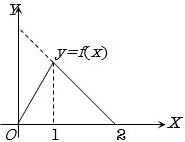
View full question & answer→MCQ 2391 Mark
$\mathop {\lim }\limits_{x \to 1} \frac{{\log x}}{{x - 1}} = $
Answera
(a) $\mathop {\lim }\limits_{x \to 1} \,\,\frac{{\log \,[(x - 1) + 1]}}{{x - 1}} = 1.$
Aliter : Apply $L-$ Hospital’s rule,
$\mathop {\lim }\limits_{x \to 1} \frac{{\log x}}{{x - 1}} = \mathop {\lim }\limits_{x \to 1} \frac{{\frac{1}{x}}}{1} = 1$
View full question & answer→MCQ 2401 Mark
If $\mathop {\lim }\limits_{x \to 2} \frac{{{x^n} - {2^n}}}{{x - 2}} = 80$, where $n$ is a positive integer, then $n = $
Answerb
(b) $\mathop {\lim }\limits_{x \to 2} \,\,\frac{{{x^n} - {2^n}}}{{x - 2}} = n\,.\,{2^{n - 1}}\,\, $
$\Rightarrow \,\,n.\,{2^{n - 1}} = 80\,\, \Rightarrow \,\,n = 5$.
View full question & answer→MCQ 2411 Mark
$\mathop {\lim }\limits_{x \to 0} \frac{{1 - \cos 2x}}{x} = $
Answera
(a)$\mathop {\lim }\limits_{x \to 0} \,\,\frac{{x\,.\,2\,{{\sin }^2}x}}{{{x^2}}} = 2.\mathop {\lim }\limits_{x \to 0} {\left( {\frac{{\sin x}}{x}} \right)^2} \cdot \mathop {\lim }\limits_{x \to 0} x = 0$.
View full question & answer→MCQ 2421 Mark
If $\mathop {\lim }\limits_{x \to 0} kx\,{\rm{cosec}}\,x = \mathop {\lim }\limits_{x \to 0} x\,{\rm{cosec}}\;kx$, then $k = $
- A
$1$
- B
$-1$
- ✓
$ \pm 1$
- D
$ \pm \,2$
AnswerCorrect option: C. $ \pm 1$
c
(c) $\mathop {\lim }\limits_{x \to 0} \,\,kx\cos ec\,x=\mathop {\lim }\limits_{x \to 0} \,\,x\cos ec\,\,kx$
$\Rightarrow \,\,k\,\,.\,\mathop {\lim }\limits_{x \to 0} \,\,\,\frac{x}{\sin x}=\frac{1}{k} \mathop {\lim }\limits_{x \to 0} \,\,\,\frac{kx}{\sin \,kx}$
$\Rightarrow \,\,k=\frac{1}{k}\,\,\Rightarrow \,\,k=\pm \,1$
View full question & answer→MCQ 2431 Mark
$\mathop {\lim }\limits_{x \to 0} \frac{{\log \cos x}}{x} = $
Answera
(a) $\mathop {\lim }\limits_{x \to 0} \,\,\frac{{\log \cos x}}{x} = \mathop {\lim }\limits_{x \to 0} \,\,\frac{{\log \,\left[ {1 - 2{{\sin }^2}\frac{x}{2}} \right]}}{x}$
$ = \mathop {\lim }\limits_{x \to 0} \,\,\frac{{ - \,\left[ {2\,{{\sin }^2}\frac{x}{2} + {{\left( {\frac{{2\,{{\sin }^2}\frac{x}{2}}}{2}} \right)}^2} + ......} \right]}}{x} = 0$
Aliter : Apply $L-$ Hospital’s rule,
$\mathop {\lim }\limits_{x \to 0} \,\frac{{\log \cos x}}{x} = \mathop {\lim }\limits_{x \to 0} \,\frac{{ - \tan x}}{1} = 0.$
View full question & answer→MCQ 2441 Mark
$\mathop {\lim }\limits_{x \to 0} \frac{{|x|}}{x} = $
Answerd
(d) Since $\mathop {\lim }\limits_{x \to 0 - } \,\,\frac{{|\,\,x\,\,|}}{x} = - 1$ and $\mathop {\lim }\limits_{x \to 0 + } \,\,\frac{{|\,\,x\,\,|}}{x} = 1,$
hence limit does not exist.
View full question & answer→MCQ 2451 Mark
$\mathop {\lim }\limits_{h \to 0} \frac{{\sqrt {x + h} - \sqrt x }}{h} = $
- ✓
$\frac{1}{{2\sqrt x }}$
- B
$\frac{1}{{\sqrt x }}$
- C
$2\sqrt x $
- D
$\sqrt x $
AnswerCorrect option: A. $\frac{1}{{2\sqrt x }}$
a
(a) $\mathop {\lim }\limits_{h \to 0} \,\,\frac{{\sqrt {x + h} - \sqrt x }}{h} = \mathop {\lim }\limits_{h \to 0} \,\,\frac{{{{(\sqrt {x + h} )}^2} - {{(\sqrt x )}^2}}}{{h\,(\sqrt {x + h} + \sqrt x )}} = \frac{1}{{2\sqrt x }}$.
Aliter : Apply $L-$ Hospital rule,
$\mathop {\lim }\limits_{h \to 0} \,\,\frac{{\sqrt {x + h} - \sqrt x }}{h} = \mathop {\lim }\limits_{h \to 0} \,\,\frac{1}{{2\sqrt {x + h} }} = \frac{1}{{2\sqrt x }}$.
View full question & answer→MCQ 2461 Mark
$\mathop {\lim }\limits_{x \to 0} \frac{{1 - \cos mx}}{{1 - \cos nx}} = $
AnswerCorrect option: C. $\frac{{{m^2}}}{{{n^2}}}$
c
(c) $\mathop {\lim }\limits_{x \to 0} \,\frac{{1 - \cos mx}}{{1 - \cos \,nx}} = \mathop {\lim }\limits_{x \to 0} \,\,\left\{ {\frac{{2\,{{\sin }^2}{\textstyle{{mx} \over 2}}}}{{2\,{{\sin }^2}{\textstyle{{nx} \over 2}}}}} \right\}$
$ = \mathop {\lim }\limits_{x \to 0} \,\left[ {{{\left\{ {\frac{{\sin {\textstyle{{mx} \over 2}}}}{{{\textstyle{{mx} \over 2}}}}} \right\}}^2}\,\,\,\frac{{{m^2}{x^2}}}{4}.\frac{1}{{{{\left\{ {\frac{{\sin {\textstyle{{nx} \over 2}}}}{{{\textstyle{{nx} \over 2}}}}} \right\}}^2}}}.\frac{4}{{{n^2}{x^2}}}} \right]$
$ = \frac{{{m^2}}}{{{n^2}}} \times 1 = \frac{{{m^2}}}{{{n^2}}}$.
Aliter : Apply $L$-Hospital’s rule,
$\mathop {\lim }\limits_{x \to 0} \frac{{1 - \cos mx}}{{1 - \cos nx}} = \mathop {\lim }\limits_{x \to 0} \frac{{m\sin mx}}{{n\sin nx}} $
$= \mathop {\lim }\limits_{x \to 0} \frac{{{m^2}\cos mx}}{{{n^2}\cos nx}} = \frac{{{m^2}}}{{{n^2}}}.$
View full question & answer→MCQ 2471 Mark
$\mathop {\lim }\limits_{x \to 0} \frac{{{e^{\sin x}} - 1}}{x} = $
Answera
(a) $\mathop {\lim }\limits_{x \to 0} \,\frac{{{e^{\sin x}} - 1}}{x} = \mathop {\lim }\limits_{x \to 0} \,\frac{{{e^{\sin x}} - 1}}{{\sin x}} \times \frac{{\sin x}}{x}$
$ = \mathop {\lim }\limits_{x \to 0} \,\frac{{{e^{\sin x}} - 1}}{{\sin x}} \times \mathop {\lim }\limits_{x \to 0} \,\frac{{\sin x}}{x} = 1 \times 1 = 1$.
Aliter : Apply $L-$ Hospital’s rule,
$\mathop {\lim }\limits_{x \to 0} \,\frac{{{e^{\sin x}} - 1}}{x} = \mathop {\lim }\limits_{x \to 0} \,\frac{{\cos x\,{e^{\sin x}}}}{1} = 1.\,{e^0} = 1.$
View full question & answer→MCQ 2481 Mark
$\mathop {\lim }\limits_{x \to \infty } \sqrt x (\sqrt {x + 5} - \sqrt x ) = $
Answerc
(c) $\mathop {\lim }\limits_{x \to \infty } \,\sqrt x \,(\sqrt {x + 5} - \sqrt x ) \times \frac{{(\sqrt {x + 5} + \sqrt x )}}{{(\sqrt {x + 5} + \sqrt x )}}$
$ = \mathop {\lim }\limits_{x \to \infty } \frac{{\sqrt x \,(5)}}{{\sqrt x \,\left( {\sqrt {1 + \frac{5}{x}} + 1} \right)}} = \frac{5}{2}$.
View full question & answer→MCQ 2491 Mark
$\mathop {\lim }\limits_{x \to 0} \frac{{\sqrt {1 + \sin x} - \sqrt {1 - \sin x} }}{x} = $
Answerb
(b) $\frac{\sqrt{1+\sin x}+\sqrt{1-\sin x}}{\sqrt{1+\sin x}+\sqrt{1-\sin x}}$
Apply $L-$ Hospital‘s rule,
$\mathop {\lim }\limits_{x \to 0} \frac{{\sqrt {1 + \sin x} - \sqrt {1 - \sin x} }}{x}$
$ = \mathop {\lim }\limits_{x \to 0} \,\,\frac{{\cos x}}{{2\sqrt {1 + \sin x} }} + \frac{{\cos x}}{{2\sqrt {1 - \sin x} }} = \frac{1}{2} + \frac{1}{2} = 1.$
View full question & answer→MCQ 2501 Mark
$\mathop {\lim }\limits_{x \to 0} \frac{{2{{\sin }^2}3x}}{{{x^2}}} = $
Answerc
(c)$\mathop {\lim }\limits_{x \to 0} \,\,\frac{{2 \times 9\,{{\sin }^2}3x}}{{{{(3x)}^2}}} = 18$
View full question & answer→MCQ 2511 Mark
$\mathop {\lim }\limits_{x \to \pi /2} \tan x\log \sin x = $
Answera
(a) $\mathop {\lim }\limits_{x \to \frac{\pi }{2}} \,\tan x\log \,\sin x = \mathop {\lim }\limits_{x \to \frac{\pi }{2}} \frac{{\log \sin x}}{{\cot x}}$
$ = \mathop {\lim }\limits_{x \to \frac{\pi }{2}} \frac{{\frac{1}{{\sin x}}\cos x}}{{ - {\rm{cose}}{{\rm{c}}^{\rm{2}}}x}} = 0$ (Applying $ L-$ Hospital’s rule)
View full question & answer→MCQ 2521 Mark
If $n$ is an integer, then $\mathop {\lim }\limits_{x \to n + 0} (x - [n]) = $
Answera
(a) $\mathop {\lim }\limits_{x \to n + 0} \,(x - [n]) = \mathop {\lim x}\limits_{x \to n + 0} \, - \mathop {\lim \,[n]}\limits_{x \to n + 0} \, = n - n = 0$.
View full question & answer→MCQ 2531 Mark
$\mathop {\lim }\limits_{x \to 0} \frac{x}{{|x| + {x^2}}} = $
Answerd
(d) $\mathop {\lim }\limits_{x \to 0 - } f(x) = \mathop {\lim }\limits_{h \to 0} \,\,\frac{{0 - h}}{{h + {h^2}}} = \mathop {\lim }\limits_{h \to 0} \,\frac{{ - 1}}{{1 + h}} = - 1$
and $\mathop {\lim }\limits_{x \to 0 + } f(x) = \mathop {\lim }\limits_{h \to 0} \,\,\frac{h}{{h + {h^2}}} = \mathop {\lim }\limits_{h \to 0} \,\frac{1}{{1 + h}} = 1$
Hence limit does not exist.
View full question & answer→MCQ 2541 Mark
$\mathop {\lim }\limits_{x \to 0} \frac{{\sin ax}}{{\sin bx}} = $
Answera
(a) $\mathop {\lim }\limits_{x \to 0} \,\,\frac{{\sin ax}}{{\sin bx}} = \mathop {\lim }\limits_{x \to 0} \,\,\frac{a}{b}\frac{{\sin ax}}{{ax}}\frac{{bx}}{{\sin bx}} = \frac{a}{b}$.
View full question & answer→MCQ 2551 Mark
$\mathop {\lim }\limits_{x \to a} \frac{{{{(x + 2)}^{5/3}} - {{(a + 2)}^{5/3}}}}{{x - a}} = $
AnswerCorrect option: A. $\frac{5}{3}{(a + 2)^{2/3}}$
a
(a) Apply the $L-$ Hospital‘s rule,
$\mathop {\lim }\limits_{x \to a} \frac{{f(x)}}{{g(x)}} = \mathop {\lim }\limits_{x \to a} \frac{{f'(x)}}{{g'(x)}}$.
View full question & answer→MCQ 2561 Mark
If $f(x) = \left\{ {\begin{array}{*{20}{c}}{\frac{2}{{5 - x}},}&{{\rm{when \,\,}}x < 3}\\{5 - x,}&{{\rm{when\,\, }}x > 3}\end{array}} \right.$, then
- A
$\mathop {\lim }\limits_{x \to 3 + } f(x) = 0$
- B
$\mathop {\lim }\limits_{x \to 3 - } f(x) = 0$
- ✓
$\mathop {\lim }\limits_{x \to 3 + } f(x) \ne \mathop {\lim }\limits_{x \to 3 - } f(x)$
- D
AnswerCorrect option: C. $\mathop {\lim }\limits_{x \to 3 + } f(x) \ne \mathop {\lim }\limits_{x \to 3 - } f(x)$
c
(c) $\mathop {\lim }\limits_{x \to 3 + } f(x) = 5 - 3 = 2,\,\mathop {\lim }\limits_{x \to 3 - } f(x) = \frac{2}{{5 - 3}} = 1.$
View full question & answer→MCQ 2571 Mark
$\mathop {\lim }\limits_{x \to 0} \frac{{\cos ax - \cos bx}}{{{x^2}}} = $
AnswerCorrect option: B. $\frac{{{b^2} - {a^2}}}{2}$
b
(b) $\mathop {\lim }\limits_{x \to 0} \frac{{\cos ax - \cos bx}}{{{x^2}}}$
$ = \mathop {\lim }\limits_{x \to 0} \,\frac{{2\,\sin \,\left( {\frac{{a + b}}{2}} \right)x\,.\,\sin \,\left( {\frac{{b - a}}{2}} \right)\,x}}{{\left( {\frac{{a + b}}{2}} \right)x\,.\frac{2}{{a + b}}.\frac{2}{{b - a}}.\left( {\frac{{b - a}}{2}} \right)x}} = \frac{{{b^2} - {a^2}}}{2}$
Aliter : Apply $ L$-Hospital’s rule,
$\mathop {\lim }\limits_{x \to 0} \,\frac{{\cos ax - \cos bx}}{{{x^2}}} = \mathop {\lim }\limits_{x \to 0} \,\,\frac{{ - \,a\sin ax + b\sin bx}}{{2x}}$
$ = \mathop {\lim }\limits_{x \to 0} \,\frac{{ - \,{a^2}\cos ax + {b^2}\cos bx}}{2} = \frac{{{b^2} - {a^2}}}{2}.$
View full question & answer→MCQ 2581 Mark
$\mathop {\lim }\limits_{x \to \pi /6} \frac{{{{\cot }^2}\theta - 3}}{{{\rm{cosec}}\theta - 2}} = $
Answerb
(b)$\mathop {\lim }\limits_{x \to \pi /6} \,\frac{{\cos e{c^2}\theta - 4}}{{\cos ec\,\theta - 2}} = \mathop {\lim }\limits_{x \to \pi /6} \,\cos ec\theta + 2 = 4.$
View full question & answer→MCQ 2591 Mark
$\mathop {\lim }\limits_{x \to 0} \frac{{{{(1 + x)}^5} - 1}}{{{{(1 + x)}^3} - 1}} = $
Answerc
(c) $\mathop {\lim }\limits_{x \to 0} \,\frac{{x\,{[^5}{C_1}{ + ^5}{C_2}x{ + ^5}{C_3}{x^2}{ + ^5}{C_4}{x^3}{ + ^5}{C_5}{x^4}]}}{{x\,{[^3}{C_1}{ + ^3}{C_2}x{ + ^3}{C_3}{x^2}]}}$ $ = \frac{5}{3}.$
Aliter : Apply $ L$-Hospital’s rule.
View full question & answer→MCQ 2601 Mark
If $\mathop {\lim }\limits_{x \to a} \frac{{{x^9} + {a^9}}}{{x + a}} = 9$, then $a = $
- ✓
${9^{1/8}}$
- B
$ \pm 2$
- C
$ \pm 3$
- D
AnswerCorrect option: A. ${9^{1/8}}$
a
$(a)$ $\mathop {\lim }\limits_{x \to a} \,\frac{{{x^9} + {a^9}}}{{x + a}} = 9\,\, $
$\Rightarrow \,\,\frac{{2{a^9}}}{{2a}} = 9\,\, \Rightarrow \,\,{a^8} = 9$
$ \Rightarrow \,\,\,\,a = {9^{1/8}}$
View full question & answer→MCQ 2611 Mark
$\mathop {\lim }\limits_{x \to 0 + } \frac{{x{e^{1/x}}}}{{1 + {e^{1/x}}}} = $
Answera
(a) $\mathop {\lim }\limits_{x \to 0 + } \frac{x}{{1 + {e^{ - 1/x}}}} = 0$
as ${e^{ - 1/x}} \to 0$ when $x \to {0^ + }$
View full question & answer→MCQ 2621 Mark
$\mathop {\lim }\limits_{x \to 0} \frac{{\sin 2x + \sin 6x}}{{\sin 5x - \sin 3x}} = $
Answerd
(d) $\mathop {\lim }\limits_{x \to 0} \,\,\frac{{2\sin 4x\cos 2x}}{{2\sin x\cos 4x}} = \mathop {\lim }\limits_{x \to 0} 4\left( {\frac{{\sin 4x}}{{4x}}} \right)\,\left( {\frac{x}{{\sin x}}} \right)\frac{{\cos 2x}}{{\cos 4x}} = 4$.
Aliter : $\mathop {\lim }\limits_{x \to 0} \,\,\frac{{\frac{{2\,\,\sin 2x}}{{2x}} + \frac{{6\,\,\sin 6x}}{{6x}}}}{{\frac{{5\,\,\sin 5x}}{{5x}} - \frac{{3\,\,\sin 3x}}{{3x}}}} = \frac{{2 + 6}}{{5 - 3}} = 4.$
View full question & answer→MCQ 2631 Mark
The value of $\mathop {\lim }\limits_{\theta \to 0} \left( {\frac{{\sin \frac{\theta }{4}}}{\theta }} \right)$ is
Answerb
(b)$\mathop {\lim }\limits_{\theta \to 0} \frac{{\sin \frac{\theta }{4}}}{\theta } = \mathop {\lim }\limits_{\theta \to 0} \frac{1}{4}.\frac{{\sin \frac{\theta }{4}}}{{(\theta /4)}} = \frac{1}{4}.$
View full question & answer→MCQ 2641 Mark
If $f(r) = \pi {r^2}$, then $\mathop {\lim }\limits_{h \to 0} \frac{{f(r + h) - f(r)}}{h} = $
- A
$\pi {r^2}$
- ✓
$2\pi r$
- C
$2\pi $
- D
$2\pi {r^2}$
AnswerCorrect option: B. $2\pi r$
b
(b)$\frac{d}{{dr}}f(r) = 2\pi r$.
View full question & answer→MCQ 2651 Mark
$\mathop {\lim }\limits_{x \to 0} x\log (\sin x) = $
AnswerCorrect option: B. ${\log _e}1$
b
(b)$\mathop {\lim }\limits_{x \to 0} x\log \sin x = \mathop {\lim }\limits_{x \to 0} \,\log \,{(\sin x)^x} = \log \,[\mathop {\lim }\limits_{x \to 0} \,\,{(\sin x)^x}]$
$ = \log \,\left[ {\mathop {\lim }\limits_{x \to 0} \,{{(1 + \sin x - 1)}^{\frac{{x(\sin x - 1)}}{{\sin x - 1}}}}} \right]$
$ = {\log _e}[{e^{\mathop {\lim }\limits_{x \to 0} \,x(\sin x - 1)}}] = {\log _e}1.$
View full question & answer→MCQ 2661 Mark
$\mathop {\lim }\limits_{x \to 0} \left( {\frac{{{a^x} - {b^x}}}{x}} \right) = $
AnswerCorrect option: B. $\log \left( {\frac{a}{b}} \right)$
b
(b)$\mathop {\lim }\limits_{x \to 0} \,\frac{{{a^x} - {b^x}}}{x} = \mathop {\lim }\limits_{x \to 0} \,\left( {\frac{{{a^x} - 1}}{x}} \right) - \mathop {\lim }\limits_{x \to 0} \,\left( {\frac{{{b^x} - 1}}{x}} \right)$
$ = \log \,\,a - \log \,\,b = \log \,(a/b)$.
View full question & answer→MCQ 2671 Mark
$\mathop {\lim }\limits_{x \to \infty } [x({a^{1/x}} - 1)]$,$(a > 1) = $
- A
$\log x$
- B
$1$
- C
$0$
- ✓
$ - \log \frac{1}{a}$
AnswerCorrect option: D. $ - \log \frac{1}{a}$
d
(d) $\mathop {\lim }\limits_{x \to \infty } x\,({a^{1/x}} - 1) = \mathop {\lim }\limits_{x \to \infty } \,\left[ {\frac{{{a^{1/x}} - 1}}{{1/x}}} \right]$
$ = \mathop {\lim }\limits_{x \to \infty } \frac{{[{e^{{{\log }_e}{a^{1/x}}}} - 1]}}{{1/x}} = {\log _e}a = - {\log _e}\frac{1}{a}.$
View full question & answer→MCQ 2681 Mark
$\mathop {\lim }\limits_{x \to \alpha } \frac{{\sin x - \sin \alpha }}{{x - \alpha }} = $
- A
$0$
- B
$1$
- C
$\sin \alpha $
- ✓
$\cos \alpha $
AnswerCorrect option: D. $\cos \alpha $
d
(d) $\mathop {\lim }\limits_{x \to \alpha } \,\,\frac{{\sin x - \sin \alpha }}{{x - \alpha }}$
$\mathop {\lim }\limits_{x \to \alpha } \,\,\frac{{\cos x}}{1} = \cos \alpha $, (Apply $L-$Hospital's rule)
View full question & answer→MCQ 2691 Mark
$\mathop {\lim }\limits_{x \to \infty } \frac{{\sqrt {{x^2} + {a^2}} - \sqrt {{x^2} + {b^2}} }}{{\sqrt {{x^2} + {c^2}} - \sqrt {{x^2} + {d^2}} }} = $
- ✓
$\frac{{{a^2} - {b^2}}}{{{c^2} - {d^2}}}$
- B
$\frac{{{a^2} + {b^2}}}{{{c^2} - {d^2}}}$
- C
$\frac{{{a^2} + {b^2}}}{{{c^2} + {d^2}}}$
- D
AnswerCorrect option: A. $\frac{{{a^2} - {b^2}}}{{{c^2} - {d^2}}}$
a
$(a)$ $\mathop {\lim }\limits_{x \to \infty } \,\frac{{({a^2} - {b^2})}}{{({c^2} - {d^2})}}\,\frac{{\left[ {\sqrt {1 + \frac{{{c^2}}}{{{x^2}}}} + \sqrt {1 + \frac{{{d^2}}}{{{x^2}}}} } \right]}}{{\left[ {\sqrt {1 + \frac{{{a^2}}}{{{x^2}}}} + \sqrt {1 + \frac{{{b^2}}}{{{x^2}}}} } \right]}} $
$= \frac{{{a^2} - {b^2}}}{{{c^2} - {d^2}}}.$
View full question & answer→MCQ 2701 Mark
$\mathop {\lim }\limits_{x \to 0} \frac{{\sin x - x}}{{{x^3}}} = $
- A
$\frac{1}{3}$
- B
$ - \frac{1}{3}$
- C
$\frac{1}{6}$
- ✓
$ - \frac{1}{6}$
AnswerCorrect option: D. $ - \frac{1}{6}$
d
(d) $\mathop {\lim }\limits_{x \to 0} \,\frac{{\sin x - x}}{{{x^3}}}$
Expand $sin\ x$, then
$ = \mathop {\lim }\limits_{x \to 0} \frac{{ - \frac{{{x^3}}}{{3\,!}} + \frac{{{x^5}}}{{5\,!}} - ...}}{{{x^3}}} = \mathop {\lim }\limits_{x \to 0} \left[ { - \frac{1}{{3\,!}} + \frac{{{x^2}}}{{5\,!}} - ...} \right] $
$= \frac{{ - 1}}{{3\,!}} = \frac{{ - 1}}{6}$.
Aliter : Apply $L-$ Hospital’s rule.
View full question & answer→MCQ 2711 Mark
$\mathop {\lim }\limits_{x \to 3} \left\{ {\frac{{x - 3}}{{\sqrt {x - 2} - \sqrt {4 - x} }}} \right\} = $
Answera
(a) $\mathop {\lim }\limits_{x \to 3} \,\left\{ {\frac{{x - 3}}{{\sqrt {x - 2} - \sqrt {4 - x} }}} \right\} = \mathop {\lim }\limits_{x \to 3} \,\frac{{(x - 3)\,\left\{ {\sqrt {x - 2} + \sqrt {4 - x} } \right\}}}{{2\,(x - 3)}} = 1$.
Aliter : Apply $ L-$ Hospital’s rule.
View full question & answer→MCQ 2721 Mark
$\mathop {\lim }\limits_{x \to 0} \frac{{x\cos x - \sin x}}{{{x^2}\sin x}} = $
- A
$\frac{1}{3}$
- ✓
$ - \frac{1}{3}$
- C
$1$
- D
AnswerCorrect option: B. $ - \frac{1}{3}$
b
(b) $\mathop {\lim }\limits_{x \to 0} \,\,\frac{{x\cos x - \sin x}}{{{x^2}\sin x}}$
$ = \mathop {\lim }\limits_{x \to 0} \,\,\frac{{ - \sin x}}{{2\sin x + x\cos x}}$
(By $L-$ Hospital’s rule)
$ = \mathop {\lim }\limits_{x \to 0} \,\,\frac{{ - \cos x}}{{3\cos x - x\sin x}} = - \frac{1}{3}$,
(Again by $L-$ Hospital’s rule)
$ = - \frac{1}{3}$
View full question & answer→MCQ 2731 Mark
$\mathop {\lim }\limits_{x \to \infty } \frac{{(x - 1)(2x + 3)}}{{{x^2}}} = $
Answerc
(c) $\mathop {\lim }\limits_{x \to \infty } \,\,\frac{{(x - 1)\,\,(2x + 3)}}{{{x^2}}} = \mathop {\lim }\limits_{x \to \infty } \,\,\frac{{2{x^2} + x - 3}}{{{x^2}}} = 2.$
View full question & answer→MCQ 2741 Mark
$\mathop {\lim }\limits_{x \to \infty } \left[ {\frac{{{1^3} + {2^3} + {3^3} + ....... + {n^3}}}{{{n^4}}}} \right] = $
- A
$\frac{1}{2}$
- B
$\frac{1}{3}$
- ✓
$\frac{1}{4}$
- D
AnswerCorrect option: C. $\frac{1}{4}$
c
(c) $\mathop {\lim }\limits_{n \to \infty } \frac{{{{\left( {1 + \frac{1}{n}} \right)}^2}}}{4} = \frac{1}{4}.$
View full question & answer→MCQ 2751 Mark
$\mathop {\lim }\limits_{x \to 0} \frac{{{y^2}}}{x} = ........$, where ${y^2} = ax + b{x^2} + c{x^3}$
Answerc
(c) $\mathop {\lim }\limits_{x \to 0} \,\frac{{ax + b{x^2} + c{x^3}}}{x} = \mathop {\lim }\limits_{x \to 0} \,\frac{{a + bx + c{x^2}}}{1} = a.$
View full question & answer→MCQ 2761 Mark
$\mathop {\lim }\limits_{x \to 0} \frac{{{{(1 + x)}^{1/2}} - {{(1 - x)}^{1/2}}}}{x} = $
Answerc
(c) Multiply function by $\frac{{{{(1 + x)}^{1/2}} + {{(1 - x)}^{1/2}}}}{{{{(1 + x)}^{1/2}} + {{(1 - x)}^{1/2}}}}$ and solve.
Aliter : Apply $ L-$ Hospital’s rule,
$\mathop {\lim }\limits_{x \to 0} \,\frac{{{{(1 + x)}^{1/2}} - {{(1 - x)}^{1/2}}}}{x} = \mathop {\lim }\limits_{x \to 0} \,\frac{1}{{2\sqrt {1 + x} }} + \frac{1}{{2\sqrt {1 - x} }} = 1$.
View full question & answer→MCQ 2771 Mark
$\mathop {\lim }\limits_{x \to 1} \frac{{{x^3} - 1}}{{{x^2} + 5x - 6}} = $
- A
$0$
- ✓
$\frac{3}{7}$
- C
$\frac{1}{2}$
- D
$ - \frac{1}{6}$
AnswerCorrect option: B. $\frac{3}{7}$
b
(b) $\mathop {\lim }\limits_{x \to 1} \,\frac{{(x - 1)\,\,({x^2} + x + 1)}}{{(x - 1)\,\,(x + 6)}} = \frac{3}{7}$.
View full question & answer→MCQ 2781 Mark
$\mathop {\lim }\limits_{x \to 1} \frac{{1 - {x^{ - 1/3}}}}{{1 - {x^{ - 2/3}}}} = $
- A
$\frac{1}{3}$
- ✓
$\frac{1}{2}$
- C
$\frac{2}{3}$
- D
$ - \frac{2}{3}$
AnswerCorrect option: B. $\frac{1}{2}$
b
(b) $\mathop {\lim }\limits_{x \to 1} \,\frac{{1 - {x^{ - 1/3}}}}{{(1 - {x^{ - 1/3}})\,\,(1 + {x^{ - 1/3}})}} = \frac{1}{2}.$
Aliter : Apply $L-$ Hospital’s rule.
View full question & answer→MCQ 2791 Mark
$\mathop {\lim }\limits_{x \to 0} \frac{{{{(1 + x)}^n} - 1}}{x} = $
Answera
(a) $\mathop {\lim }\limits_{x \to 0} \,\frac{{(1 + nx + {\,^n}{C_2}{x^2} + ...{\rm{higher powers of }}x{\rm{ to }}{x^n}) - 1}}{x} = n$.
Aliter : Apply $ L-$ Hospital’s rule.
View full question & answer→MCQ 2801 Mark
$\mathop {\lim }\limits_{x \to 0} \frac{{\sqrt {1 + x} - \sqrt {1 - x} }}{{{{\sin }^{ - 1}}x}} = $
Answerb
(b) Let ${\sin ^{ - 1}}x = y\,\, \Rightarrow x = \sin y$
So $\mathop {\lim }\limits_{y \to 0} \frac{{\sqrt {1 + \sin y} - \sqrt {1 - \sin y} }}{y}$
$(\because \,\,\,x \to 0 \Rightarrow y \to 0)$
$( $ Now multiply it by $\frac{\sqrt{1+\sin y}+\sqrt{1-\sin y}}{\sqrt{1+\sin y}+\sqrt{1-\sin y}}$ and solve $) $
$= 1$
Aliter : Apply $ L-$ Hospital’s rule.
View full question & answer→MCQ 2811 Mark
$\mathop {\lim }\limits_{\theta \to 0} \frac{{1 - \cos \theta }}{{{\theta ^2}}} = $
- A
$1$
- B
$2$
- ✓
$\frac{1}{2}$
- D
$\frac{1}{4}$
AnswerCorrect option: C. $\frac{1}{2}$
c
(c) $ \mathop {\lim }\limits_{\theta \to 0} \,\frac{{2\,{{\sin }^2}(\theta /2)}}{{{\theta ^2}}} = \frac{1}{2}.$
Aliter : Apply $ L-$ Hospital’s rule.
View full question & answer→MCQ 2821 Mark
$\mathop {\lim }\limits_{\theta \to 0} \frac{{\sin 3\theta - \sin \theta }}{{\sin \theta }} = $
Answerb
(b) $\mathop {\lim }\limits_{\theta \to 0} \,[3 - 4\,{\sin ^2}\theta ] - 1 = 2.$
Aliter : $\mathop {\lim }\limits_{\theta \to 0} \,\frac{{\sin 3\theta - \sin \theta }}{{\sin \theta }} $
$= \mathop {\lim }\limits_{\theta \to 0} \,\frac{{\sin 3\theta }}{{\sin \theta }} - \mathop {\lim }\limits_{\theta \to 0} \,\frac{{\sin \theta }}{{\sin \theta }}$
$ = \frac{3}{1} - 1 = 2.$
You may also apply $L-$ Hospital rule.
View full question & answer→MCQ 2831 Mark
$\mathop {\lim }\limits_{x \to 0} \frac{{1 - \cos x}}{x} = $
- ✓
$0$
- B
$\frac{1}{2}$
- C
$\frac{1}{3}$
- D
Answera
(a) $\mathop {\lim }\limits_{x \to 0} \,\frac{{2\,{{\sin }^2}(x/2)}}{x} = 0.$
Aliter : Apply $L-$ Hospital’s rule.
View full question & answer→MCQ 2841 Mark
$\mathop {\lim }\limits_{x \to 0} \frac{{{x^2} - \tan 2x}}{{\tan x}} = $
Answerb
(b) $\mathop {\lim }\limits_{x \to 0} \,\frac{{x\,\left( {x - \frac{{2\,\,\tan \,\,2x}}{{2x}}} \right)}}{{\tan x}} = - 2.$
View full question & answer→MCQ 2851 Mark
$\mathop {\lim }\limits_{\theta \to 0} \frac{{5\theta \cos \theta - 2\sin \theta }}{{3\theta + \tan \theta }} = $
- ✓
$\frac{3}{4}$
- B
$ - \frac{3}{4}$
- C
$0$
- D
AnswerCorrect option: A. $\frac{3}{4}$
a
$\mathop {\lim }\limits_{\theta \to 0} \,\frac{{\left( {5\cos \theta - \frac{{2\,\,\sin \theta }}{\theta }} \right)}}{{3 + \frac{{\tan \theta }}{\theta }}}$
$ = \frac{{5 - 2}}{{3 + 1}} = \frac{3}{4}$
View full question & answer→MCQ 2861 Mark
$\mathop {\lim }\limits_{x \to 0} \frac{{\sin (2 + x) - \sin (2 - x)}}{x} = $
- A
$\sin 2$
- B
$2\sin 2$
- ✓
$2\cos 2$
- D
$2$
AnswerCorrect option: C. $2\cos 2$
c
(c) Apply formula of $\sin C - \sin D$,
$i.e.,$ $\mathop {\lim }\limits_{x \to 0} \frac{{\sin (2 + x) - \sin (2 - x)}}{x} = \mathop {\lim }\limits_{x \to 0} \frac{{2\cos 2.\sin x}}{x}$
$ = 2\cos 2.\mathop {\lim }\limits_{x \to 0} \frac{{\sin x}}{x} = 2\cos 2$
You may also apply $L-$ Hospital rule.
View full question & answer→MCQ 2871 Mark
$\mathop {\lim }\limits_{x \to \infty } \frac{{2{x^2} - 3x + 1}}{{{x^2} - 1}} = $
Answerb
$(b)$ $\mathop {\lim }\limits_{x \to \infty } \,\frac{{2 - (3/x) + (1/{x^2})}}{{1 - (1/{x^2})}} = 2.$
View full question & answer→MCQ 2881 Mark
$\mathop {\lim }\limits_{x \to \infty } \frac{{3{x^2} + 2x - 1}}{{2{x^2} - 3x - 3}} = $
- A
$1$
- B
$3$
- ✓
$\frac{3}{2}$
- D
$ - \frac{3}{2}$
AnswerCorrect option: C. $\frac{3}{2}$
c
(c)$\mathop {\lim }\limits_{x \to \infty } \,\,\frac{{3 + (2/x) - (1/{x^2})}}{{2 - (3/x) - (3/{x^2})}} = \frac{3}{2}.$
View full question & answer→MCQ 2891 Mark
$\mathop {\lim }\limits_{x \to 2} \frac{{|x - 2|}}{{x - 2}} = $
Answerc
(c) $\mathop {\lim }\limits_{x \to 2 - } \,\,\frac{{|\,\,x - 2\,\,|}}{{x - 2}} = \mathop {\lim }\limits_{h \to 0} \,\frac{{|\,\,2 - h - 2\,\,|}}{{2 - h - 2}} = - 1$
and $\mathop {\lim }\limits_{x \to 2 + } \,\,\frac{{|\,\,x - 2\,\,|}}{{x - 2}} = \mathop {\lim }\limits_{h \to 0} \,\frac{{|\,\,2 + h - 2\,\,|}}{{2 + h - 2}} = 1$
Hence limit does not exist.
View full question & answer→MCQ 2901 Mark
$\mathop {\lim }\limits_{x \to a} \frac{{\cos x - \cos a}}{{\cos x - \cot a}} = $
AnswerCorrect option: C. ${\sin ^3}a$
c
(c) $\mathop {\lim }\limits_{x \to a} \,\frac{{\cos x - \cos a}}{{\cot x - \cot a}} = \mathop {\lim }\limits_{x \to a} \,\left( {\frac{{ - \sin x}}{{ - \cos e{c^2}x}}} \right) $
$= \mathop {\lim }\limits_{x \to a} {\sin ^3}x = {\sin ^3}a$.
View full question & answer→MCQ 2911 Mark
$\mathop {\lim }\limits_{h \to 0} \frac{{2\left[ {\sqrt 3 \sin \left( {\frac{\pi }{6} + h} \right) - \cos \left( {\frac{\pi }{6} + h} \right)} \right]}}{{\sqrt 3 h(\sqrt 3 \cos h - \sin h)}} = $
- A
$ - \frac{2}{3}$
- B
$ - \frac{3}{4}$
- C
$ - 2\sqrt 3 $
- ✓
$\frac{4}{3}$
AnswerCorrect option: D. $\frac{4}{3}$
d
(d) $\mathop {\lim }\limits_{h \to 0} \,\frac{{2\,\left[ {\sqrt 3 \sin \,\left( {\frac{\pi }{6} + h} \right) - \cos \,\left( {\frac{\pi }{6} + h} \right)} \right]}}{{\sqrt 3 \,h\,(\sqrt 3 \,\cos \,h - \sin \,h)}}$
$ = \mathop {\lim }\limits_{h \to 0} \,\frac{{\frac{4}{{\sqrt 3 }}\,\left[ {\frac{{\sqrt 3 }}{2}\sin \,\left( {\frac{\pi }{6} + h} \right) - \frac{1}{2}\cos \,\left( {\frac{\pi }{6} + h} \right)} \right]}}{{h\,(\sqrt 3 \cos \,h - \sin \,h)}}$
$ = \mathop {\lim }\limits_{h \to 0} \frac{4}{{\sqrt 3 }}.\frac{{\sin \,h}}{h}.\frac{1}{{(\sqrt 3 \,\cos \,h - \sin \,h)}} = \frac{4}{3}$.
View full question & answer→MCQ 2921 Mark
$\mathop {\lim }\limits_{x \to 0} {x^x} = $
Answerb
(b) Let $y = {x^x}\, \Rightarrow \,\,\,\log y = x\log x$
$\therefore \,\,\mathop {\lim }\limits_{y \to 0} \,\log y = \mathop {\lim }\limits_{x \to 0} x\log x$
$ = 0 = \log 1\,\, \Rightarrow \,\,\mathop {\lim }\limits_{x \to 0} {x^x} = 1$.
View full question & answer→MCQ 2931 Mark
$\mathop {\lim }\limits_{x \to 0} \frac{{1 - \cos x}}{{{{\sin }^2}x}} = $
- ✓
$\frac{1}{2}$
- B
$ - \frac{1}{2}$
- C
$2$
- D
AnswerCorrect option: A. $\frac{1}{2}$
a
(a) $\mathop {\lim }\limits_{x \to 0} \,\frac{{2\,{{\sin }^2}\frac{x}{2}.\,({x^2})}}{{4\,{{\sin }^2}x\,.\,\left( {\frac{{{x^2}}}{4}} \right)}} = \frac{1}{2}.$
Aliter : Apply $ L-$ Hospital’s rule two times.
View full question & answer→MCQ 2941 Mark
$\mathop {\lim }\limits_{x \to \pi /2} \frac{{1 + \cos 2x}}{{{{(\pi - 2x)}^2}}} = $
- A
$1$
- B
$2$
- C
$3$
- ✓
$\frac{1}{2}$
AnswerCorrect option: D. $\frac{1}{2}$
d
(d) $\pi - 2x = \theta \,\, \Rightarrow \,\,x = \frac{\pi }{2} - \frac{\theta }{2}$
and as $x \to \,(\pi /2),\,\,\theta \to 0$
Now solve yourself.
View full question & answer→MCQ 2951 Mark
$\mathop {\lim }\limits_{x \to 0} \frac{{1 - \cos 6x}}{x} = $
Answera
$(a)$ $\mathop {\lim }\limits_{x \to 0} \,\frac{{1 - \cos \,\,6x}}{x} = \mathop {\lim }\limits_{x \to 0} \,\frac{{2\,\,{{\sin }^2}3x}}{x} $
$= \mathop {\lim }\limits_{x \to 0} \,\frac{{x\,.\,2\,\,{{\sin }^2}3x}}{{{x^2}}} = 0$.
View full question & answer→MCQ 2961 Mark
$\mathop {\lim }\limits_{x \to 0} \frac{{3\sin x - \sin 3x}}{{{x^3}}} = $
Answera
(a) $\mathop {\lim }\limits_{x \to 0} \,\,\frac{{4\,{{\sin }^3}x}}{{{x^3}}} = 4.$
View full question & answer→MCQ 2971 Mark
$\mathop {\lim }\limits_{x \to 0} \frac{{{e^{{x^2}}} - \cos x}}{{{x^2}}} = $
- ✓
$\frac{3}{2}$
- B
$ - \frac{1}{2}$
- C
$1$
- D
AnswerCorrect option: A. $\frac{3}{2}$
a
(a) $\mathop {\lim }\limits_{x \to 0} \,\frac{{{e^{{x^2}}} + \cos x}}{{x^2}}$
Now expanding ${e^{{x^2}}}$ and $\cos x,$ we get
$\mathop {\lim }\limits_{x \to 0} \,\frac{{\frac{{3{x^2}}}{{2\,!}} + {x^4}\,\left( {\frac{1}{{2\,!}} - \frac{1}{{4\,!}}} \right) + .......}}{{{x^2}}} = \frac{3}{2}$
Aliter : Apply $L-$ Hospital’s rule,
$\mathop {\lim }\limits_{x \to 0} \,\frac{{2x{e^{{x^2}}} + \sin x}}{{2x}} = \mathop {\lim }\limits_{x \to 0} \,{e^{{x^2}}} + \mathop {\lim }\limits_{x \to 0} \,\frac{{\sin x}}{{2x}} $
$= 1 + \frac{1}{2} = \frac{3}{2}.$
View full question & answer→MCQ 2981 Mark
$\mathop {\lim }\limits_{x \to 0} \frac{{{e^{\alpha \;x}} - {e^{\beta \;x}}}}{x} = $
AnswerCorrect option: D. $\alpha - \beta $
d
(d) $\mathop {\lim }\limits_{x \to 0} \,\frac{{{e^{\alpha x}} - {e^{\beta x}}}}{x} = \mathop {\lim }\limits_{x \to 0} \,\frac{{{e^{\alpha x}} - 1 - {e^{\beta x}} + 1}}{x}$
$ = \mathop {\lim }\limits_{x \to 0} \,\frac{{{e^{\alpha x}} - 1}}{{x}} - \mathop {\lim }\limits_{x \to 0} \,\frac{{{e^{\beta x}} - 1}}{{ x}}$
$ = \alpha \mathop {\lim }\limits_{x \to 0} \,\frac{{{e^{\alpha x}} - 1}}{{\alpha x}} - \beta \mathop {\lim }\limits_{x \to 0} \,\frac{{{e^{\beta x}} - 1}}{{\beta x}}$
$ = \alpha .1 - \beta .1 = \alpha - \beta .$
View full question & answer→MCQ 2991 Mark
$\mathop {\lim }\limits_{x \to a} \frac{{({x^{ - 1}} - {a^{ - 1}})}}{{x - a}} = $
- A
$1/a$
- B
$\frac{{ - 1}}{a}$
- C
$\frac{1}{{{a^2}}}$
- ✓
$\frac{{ - 1}}{{{a^2}}}$
AnswerCorrect option: D. $\frac{{ - 1}}{{{a^2}}}$
d
(d) $\mathop {\lim }\limits_{x \to a} \,\frac{{(1/x) - (1/a)}}{{x - a}} = \mathop {\lim }\limits_{x \to a} \,\frac{{a - x}}{{ax\,(x - a)}} $
$= \mathop {\lim }\limits_{x \to a} \,\frac{{ - 1}}{{ax}} = \frac{{ - 1}}{{{a^2}}}$.
Or $\mathop {\lim }\limits_{x \to a} \,\,\frac{-1/{{x}^{2}}-0}{1-0}$
(By Appling $L-$ Hospital’s rule)
$-\frac{1}{{{a}^{2}}}$
View full question & answer→MCQ 3001 Mark
$\mathop {\lim }\limits_{x \to \infty } (\sqrt {{x^2} + 1} - x)$ is equal to
Answerc
(c) On rationalising, we get
$\mathop {\lim }\limits_{x \to \infty } \,\frac{{{x^2} + 1 - {x^2}}}{{\sqrt {{x^2} + 1} + x}} = \mathop {\lim }\limits_{x \to \infty } \,\frac{1}{{\sqrt {{x^2} + 1} + x}} = 0.$
View full question & answer→MCQ 3011 Mark
The value of $\mathop {\lim }\limits_{x \to \infty } \sqrt {{a^2}{x^2} + ax + 1} - \sqrt {{a^2}{x^2} + 1} $ is
AnswerCorrect option: A. $\frac{1}{2}$
a
(a) $\mathop {\lim }\limits_{x \to \infty } \,\sqrt {{a^2}{x^2} + ax + 1} - \sqrt {{a^2}{x^2} + 1} $
$ = \mathop {\lim }\limits_{x \to \infty } \,\frac{{ax}}{{\,\sqrt {{a^2}{x^2} + ax + 1} + \sqrt {{a^2}{x^2} + 1} }}$
$ = \mathop {\lim }\limits_{x \to \infty } \,\frac{a}{{\,\sqrt {{a^2} + \frac{a}{x} + \frac{1}{{{x^2}}}} + \sqrt {{a^2} + \frac{1}{{{x^2}}}} }} = \frac{a}{{2a}} = \frac{1}{2}$.
View full question & answer→MCQ 3021 Mark
$\mathop {\lim }\limits_{x \to 0} \frac{{{e^{\tan x}} - {e^x}}}{{\tan x - x}} = $
- ✓
$1$
- B
$e$
- C
${e^{ - 1}}$
- D
$0$
Answera
(a) $\mathop {\lim }\limits_{x \to 0} \,\,\frac{{{e^{\tan x}} - {e^x}}}{{\tan x - x}} = \mathop {\lim }\limits_{x \to 0} \,\,\frac{{{e^x}[{e^{\tan x - x}} - 1]}}{{\tan x - x}}$
$ = \mathop {\lim }\limits_{x \to 0} \,{e^x}\,.\mathop {\lim }\limits_{x \to 0} \,\frac{{{e^{\tan x - x}} - 1}}{{\tan x - x}} = {e^0} \times 1 = 1$.
View full question & answer→MCQ 3031 Mark
If $f(x) = \sqrt {\frac{{x - \sin x}}{{x + {{\cos }^2}x}}} $, then $\mathop {\lim }\limits_{x \to \infty } f(x)$is
Answerc
(c) $\mathop {\lim }\limits_{x \to \infty } \,\,f(x) = \,\mathop {\lim }\limits_{x \to \infty } \,\sqrt {\frac{{x - \sin x}}{{x + {{\cos }^2}x}}} $
$= \mathop {\lim }\limits_{x \to \infty } \,\,\sqrt {\frac{{1 - \frac{{\sin x}}{x}}}{{1 + \frac{{{{\cos }^2}x}}{x}}}} $
$ = \sqrt {\frac{{1 - 0}}{{1 + 0}}} = 1$,
$\left( {\because \,\,\,\frac{{\sin x}}{x} \to 0,\frac{{{{\cos }^2}x}}{x}\, \to 0\,\,{\text{as }}x \to \infty } \right)$.
View full question & answer→MCQ 3041 Mark
The value of $\mathop {\lim }\limits_{x \to a} \frac{{\log (x - a)}}{{\log ({e^x} - {e^a})}}$ is
Answera
(a) $\mathop {{\rm{lim}}}\limits_{{\rm{x}} \to a} \,\,\frac{{\log \,(x - a)}}{{\log \,({e^x} - {e^a})}} = \mathop {{\rm{lim}}}\limits_{{\rm{x}} \to a} \,\,\frac{{{e^x} - {e^a}}}{{(x - a)\,{e^x}}}$, $\left( {{\rm{Form}} \,\, \frac{0}{0}} \right)$
$ = \mathop {\lim }\limits_{x \to a} \,\,\frac{{{e^x}}}{{\left\{ {(x - a)\,{e^x} + {e^x}} \right\}}} = \frac{{{e^a}}}{{{e^a}}} = 1.$
View full question & answer→MCQ 3051 Mark
$\mathop {\lim }\limits_{x \to \pi /2} \left[ {x\tan x - \left( {\frac{\pi }{2}} \right)\sec x} \right] = $
Answerb
(b) $\mathop {\lim }\limits_{x \to \pi /2} \,\left[ {x\tan x - \left( {\frac{\pi }{2}} \right)\,\sec x} \right]$
$ = \mathop {\lim }\limits_{x \to \pi /2} \,\,\frac{{2x\,\,\sin x - \pi }}{{2\,\cos x}}$, $\left[ {{\rm{form}} \,\, \frac{0}{0}} \right]$
$ = \mathop {\lim }\limits_{x \to \pi /2} \,\,\frac{{[2\,\sin x + 2x\cos x]}}{{ - 2\,\sin x}} = - 1$, (By $L -$ Hospital’s rule).
View full question & answer→MCQ 3061 Mark
$\mathop {\lim }\limits_{x \to 0} \left[ {\frac{{\sin (x + a) + \sin (a - x) - 2\sin a}}{{x\sin x}}} \right] = $
- A
$\sin a$
- B
$\cos a$
- ✓
$ - \sin a$
- D
$\frac{1}{2}\cos a$
AnswerCorrect option: C. $ - \sin a$
c
(c) $\mathop {\lim }\limits_{x \to 0} \,\,2\,\sin \,a\,.\,\frac{{(\cos x - 1)}}{{x\sin x}}$
$ = - 2\,\sin a\,.\,\frac{{(1 - \cos x)}}{{{x^2}}}\,.\,\left( {\frac{x}{{\sin x}}} \right)$
$ = \mathop {\lim }\limits_{x \to 0} \,\, - 2\sin a\,.\,\frac{{2\,{{\sin }^2}(x/2)}}{{4\,{{\left( {\frac{x}{2}} \right)}^2}\,\left( {\frac{{\sin x}}{x}} \right)}} = - \sin a$.
View full question & answer→MCQ 3071 Mark
$\mathop {\lim }\limits_{x \to 0} \sin \left( {\frac{1}{x}} \right)$ is
Answerd
(d) $\mathop {\lim }\limits_{x \to {0^ - }} f(x) = \mathop {\lim }\limits_{h \to 0} f(0 - h)$
$ = \mathop {\lim }\limits_{h \to 0} \,\sin \,\left( {\frac{{ - 1}}{h}} \right) = \mathop {\lim }\limits_{h \to 0} \,\, - \sin \frac{1}{h}$
$=$ (finite number lies between $-1$ to $1$)
$\mathop {\lim }\limits_{x \to {0^ + }} f(x) = \mathop {\lim }\limits_{h \to 0} f(0 + h)$
$ = \mathop {\lim }\limits_{h \to 0} \,\,\sin \left( {\frac{1}{h}} \right)$
$=$ (finite number lies between $0$ to $1$)
$ \because \,\,\,\,\mathop {\lim }\limits_{x \to {0^ - }} f(x) \ne \mathop {\lim }\limits_{x \to {0^ + }} f(x)$
$\therefore$ $\mathop {\lim }\limits_{x \to 0} \sin \left( {\frac{1}{x}} \right)$ does not exist.
View full question & answer→MCQ 3081 Mark
$\mathop {\lim }\limits_{x \to 0} \frac{{{e^{\frac{1}{x}}}}}{{{e^{\left( {\frac{1}{x} + 1} \right)}}}} = $
Answerd
(d) $\mathop {{\rm{lim}}}\limits_{x \to 0} \frac{{{e^{1/x}}}}{{{e^{\left( {\frac{1}{x} + 1} \right)}}}} = \mathop {{\rm{lim}}}\limits_{x \to 0} \frac{{{e^{1/x}}}}{{{e^{\frac{1}{x}}}.e}}$
$ = \mathop {{\rm{lim}}}\limits_{x \to 0} \frac{1}{e} = {e^{ - 1}}$.
View full question & answer→MCQ 3091 Mark
The value of $\mathop {\lim }\limits_{x \to 0} \frac{{x\cos x - \log (1 + x)}}{{{x^2}}}$ is
Answera
(a) $\mathop {\lim }\limits_{x \to 0} \frac{{x\cos x - \log (1 + x)}}{{{x^2}}}$, $\left( {\frac{0}{0}{\rm{form}}} \right)$
Applying $ L-$ Hospital’s rule, we have
$\mathop {\lim }\limits_{x \to 0} \,\frac{{\cos x - x\sin x - \frac{1}{{x + 1}}}}{{2x}}$, $\left( {\frac{0}{0}{\rm{form}}} \right)$
$ = \mathop {\lim }\limits_{x \to 0} \,\frac{{ - \sin x - \sin x - x\cos x + \frac{1}{{{{(x + 1)}^2}}}}}{2} = \frac{1}{2}$.
View full question & answer→MCQ 3101 Mark
The value of $\mathop {\lim }\limits_{a \to 0} \frac{{\sin a - \tan a}}{{{{\sin }^3}a}}$ will be
- ✓
$ - \frac{1}{2}$
- B
$\frac{1}{2}$
- C
$1$
- D
$-1$
AnswerCorrect option: A. $ - \frac{1}{2}$
a
(a) $\mathop {\lim }\limits_{a \to 0} \frac{{\sin a - \tan a}}{{{{\sin }^3}a}} = \mathop {\lim }\limits_{a \to 0} \frac{{\cos a - 1}}{{{{\sin }^2}a\cos a}} $
$= \mathop {\lim }\limits_{a \to 0} \frac{{ - (1 - \cos a)}}{{(1 - {{\cos }^2}a)(\cos a)}}$
$ = \mathop {\lim }\limits_{a \to 0} \left[ { - \frac{1}{{(1 + \cos a)\cos a}}} \right] = - \frac{1}{{(1 + 1)1}} = \frac{{ - 1}}{2}$
View full question & answer→MCQ 3111 Mark
$\mathop {\lim }\limits_{n \to \infty } {\left( {\frac{n}{{n + y}}} \right)^n}$ equals
- A
$0$
- B
$1$
- C
$1/y$
- ✓
${e^{ - y}}$
AnswerCorrect option: D. ${e^{ - y}}$
d
(d) $\mathop {\lim }\limits_{n \to \infty } \,{\left( {\frac{n}{{n + y}}} \right)^n} = \mathop {\lim }\limits_{n \to \infty } \,{\left( {\frac{1}{{1 + \frac{y}{n}}}} \right)^n}$
$ = \mathop {\lim }\limits_{n \to \infty } \,{\left( {1 + \frac{y}{n}} \right)^{ - n}}$
$ = \mathop {\lim }\limits_{n \to \infty } \,{\left[ {{{\left( {1 + \frac{y}{n}} \right)}^n}} \right]^{ - 1}} = {e^{ - y}}$.
View full question & answer→MCQ 3121 Mark
If $f(x) = \left\{ \begin{array}{l}x\;:\;x < 0\\1\;:\;x = 0\\{x^2}\;:\;x > 0\end{array} \right.,$then $\mathop {\lim }\limits_{x \to 0} f(x) = $
Answerd
(d) $L.H.L. = 0$ and $R.H.L.$ cannot be found as the function is not defined for $x > 0.$
View full question & answer→MCQ 3131 Mark
If $f(x) = \left\{ \begin{array}{l}\sin x,x \ne n\pi ,n \in Z\\\,\,\,\,\,\,0,\,\,{\rm{otherwise}}\end{array} \right.$ and $g(x) = \left\{ \begin{array}{l}{x^2} + 1,x \ne 0,\,2\\\,\,\,\,\,\,\,\,4,x = 0\\\,\,\,\,\,\,\,\,\,5,x = 2\end{array} \right.$ then $\mathop {\lim }\limits_{x \to 0} g\{ f(x)\} = $
- ✓
$1$
- B
$0$
- C
$\frac{1}{2}$
- D
$\frac{1}{4}$
Answera
(a) $\mathop {{\rm{lim}}}\limits_{x \to 0} \,g(f(x)) = \mathop {{\rm{lim}}}\limits_{x \to 0} \,{[f(x)]^2} + 1 = \mathop {{\rm{lim}}}\limits_{x \to 0} \,({\sin ^2}x + 1) = 1$.
View full question & answer→MCQ 3141 Mark
$\mathop {\lim }\limits_{x \to 1} \frac{{1 + \log x - x}}{{1 - 2x + {x^2}}} = $
- A
$1$
- B
$-1$
- C
$0$
- ✓
$ - \frac{1}{2}$
AnswerCorrect option: D. $ - \frac{1}{2}$
d
(d) Applying $ L- $Hospital’s rule,
$\mathop {{\rm{lim}}}\limits_{x \to 1} \,\,\frac{{1 + \log x - x}}{{1 - 2x + {x^2}}} = \mathop {{\rm{lim}}}\limits_{x \to 1} \,\,\frac{{\frac{1}{x} - 1}}{{ - 2 + 2x}} = \mathop {{\rm{lim}}}\limits_{x \to 1} \,\,\frac{{1 - x}}{{2x(x - 1)}}$
Again applying $ L-$ Hospital’s rule,
$\mathop {{\rm{lim}}}\limits_{x \to 1} \frac{{ - 1}}{{4x - 2}} = - \frac{1}{2}$.
View full question & answer→MCQ 3151 Mark
$\mathop {\lim }\limits_{x \to 0} \frac{{{a^{\sin x}} - 1}}{{{b^{\sin x}} - 1}} = $
AnswerCorrect option: C. $\frac{{\log a}}{{\log b}}$
c
(c) $\mathop {{\rm{lim}}}\limits_{x \to 0} \frac{{{a^{\sin x}} - 1}}{{{b^{\sin x}} - 1}} = \mathop {{\rm{lim}}}\limits_{x \to 0} \frac{{{a^{\sin x}} - 1}}{{\sin x}} \times \frac{{\sin x}}{{{b^{\sin x}} - 1}}$
$ = {\log _e}a \times \frac{1}{{{{\log }_e}b}} = \frac{{\log a}}{{\log b}}$.
View full question & answer→MCQ 3161 Mark
The value of $\mathop {\lim }\limits_{x \to 2} \frac{{{3^{x/2}} - 3}}{{{3^x} - 9}}$ is
Answerc
(c) $\mathop {\lim }\limits_{x \to 2} \,\left( {\frac{{{3^{x/2}} - 3}}{{{3^x} - 9}}} \right)$ $ = \mathop {{\rm{lim}}}\limits_{x \to 2} \,\,\left( {\frac{{{3^{x/2}} - 3}}{{{{({3^{x/2}})}^2} - {3^2}}}} \right)$
$ = \mathop {{\rm{lim}}}\limits_{x \to 2} \,\frac{1}{{{3^{x/2}} + 3}} = \frac{1}{6}$.
View full question & answer→MCQ 3171 Mark
The value of $\mathop {\lim }\limits_{x \to 0} \,\frac{{(1 - \cos 2x)\sin 5x}}{{{x^2}\sin 3x}}$ is
- ✓
$10/3$
- B
$3/10$
- C
$6/5$
- D
$5/6$
AnswerCorrect option: A. $10/3$
a
(a) $\mathop {{\rm{lim}}}\limits_{x \to 0} \frac{{(1 - \cos 2x)\,\sin 5x}}{{{x^2}\sin 3x}}$
$ = \mathop {{\rm{lim}}}\limits_{x \to 0} \frac{{2{{\sin }^2}x\,\sin 5x}}{{{x^2}\sin 3x}}$
$ = \mathop {{\rm{lim}}}\limits_{x \to 0} \,\left( {\frac{{2{{\sin }^2}x}}{{{x^2}}}} \right)\frac{{\left( {\frac{{\sin 5x}}{x}} \right)}}{{\left( {\frac{{\sin 3x}}{x}} \right)}}$
$ = \mathop {{\rm{lim}}}\limits_{x \to 0} 2\,{\left( {\frac{{\sin x}}{x}} \right)^2} \times \frac{{5\mathop {{\rm{lim}}}\limits_{x \to 0} \left( {\frac{{\sin 5x}}{{5x}}} \right)}}{{3\mathop {{\rm{lim}}}\limits_{x \to 0} \left( {\frac{{\sin 3x}}{{3x}}} \right)}}$
$ = \frac{{2 \times 5}}{3} = \frac{{10}}{3}$.
View full question & answer→MCQ 3181 Mark
$\mathop {\lim }\limits_{x \to 0} \,\frac{{{\rm{ln}}\,(\cos x)}}{{{x^2}}}$ is equal to
- A
$0$
- B
$1$
- C
$\frac{1}{2}$
- ✓
$ - \frac{1}{2}$
AnswerCorrect option: D. $ - \frac{1}{2}$
d
(d) Applying $L-$ Hospital’s rule,
$\mathop {\lim }\limits_{x \to 0} \frac{{\ln (\cos x)}}{{{x^2}}}$$ = \mathop {\lim }\limits_{x \to 0} \frac{{ - \tan x}}{{2x}}$
$ = \mathop {\lim }\limits_{x \to 0} \frac{{ - {{\sec }^2}x}}{2} = \frac{{ - 1}}{2}$.
View full question & answer→MCQ 3191 Mark
The value of $\mathop {\lim }\limits_{x \to 0} \,\left( {\frac{{{e^x} - 1}}{x}} \right)$ is
Answerc
(c) $\mathop {{\rm{lim}}}\limits_{x \to 0} \frac{{{e^x} - 1}}{x} = \mathop {{\rm{lim}}}\limits_{x \to 0} \frac{{\left( {1 + \frac{x}{{1!}} + \frac{{{x^2}}}{{2!}} + ... - 1} \right)}}{x} = 1$.
View full question & answer→MCQ 3201 Mark
The value of $\mathop {\lim }\limits_{x \to 0} \,\left[ {\frac{{\sqrt {a + x} - \sqrt {a - x} }}{x}} \right]$ is
- A
$1$
- B
$0$
- C
$\sqrt a $
- ✓
$1/\sqrt a $
AnswerCorrect option: D. $1/\sqrt a $
d
(d) $\mathop {{\rm{lim}}}\limits_{x \to 0} \left[ {\frac{{\sqrt {a + x} - \sqrt {a - x} }}{x}} \right]$
$ = \mathop {{\rm{lim}}}\limits_{x \to 0} \,\left[ {\frac{{(\sqrt {a + x} - \sqrt {a - x} )(\sqrt {a + x} + \sqrt {a - x} )}}{{x(\sqrt {a + x} + \sqrt {a - x} )}}} \right]$
$ = \mathop {{\rm{lim}}}\limits_{x \to 0} \,\left[ {\frac{{2x}}{{x(\sqrt {a + x} + \sqrt {a - x} )}}} \right] = \frac{2}{{\sqrt a + \sqrt a }} = \frac{1}{{\sqrt a }}$.
View full question & answer→MCQ 3211 Mark
$\mathop {\lim }\limits_{\alpha \to \beta } \left[ {\frac{{{{\sin }^2}\alpha - {{\sin }^2}\beta }}{{{\alpha ^2} - {\beta ^2}}}} \right] = $
AnswerCorrect option: D. $\frac{{\sin 2\beta }}{{2\beta }}$
d
(d) $\mathop {\lim }\limits_{\alpha \to \beta } \frac{{{{\sin }^2}\alpha - {{\sin }^2}\beta }}{{{\alpha ^2} - {\beta ^2}}}$
Applying $ L-$ Hospital’s rule,
$\mathop {{\rm{lim}}}\limits_{\alpha \to \beta } \frac{{2\sin \,\alpha \,\,\cos \alpha }}{{2\alpha }} = \mathop {{\rm{lim}}}\limits_{\alpha \to \beta } \frac{{\sin \,\,2\alpha }}{{2\alpha }} = \frac{{\sin \,\,2\beta }}{{2\beta }}$.
View full question & answer→MCQ 3221 Mark
$\mathop {\lim }\limits_{x \to 1} \frac{{1 + \cos \pi \,x}}{{{{\tan }^2}\pi \,x}}$ is equal to
Answerb
(b) $\mathop {\lim }\limits_{x \to 1} \frac{{(1 + \cos \pi x)}}{{{{\tan }^2}\pi x}} = \mathop {\lim }\limits_{x \to 1} \frac{{ - \pi \sin \pi x}}{{2\pi \tan \pi x{{\sec }^2}\pi x}}$
[Using $ L-$ Hospital’s rule]
$ = \mathop {\lim }\limits_{x \to 1} \frac{{ - 1}}{2}{\cos ^3}\pi \,x$$ = \frac{1}{2}$.
View full question & answer→MCQ 3231 Mark
$\mathop {\lim }\limits_{x \to 3} \,[x] = $, (where $[.] =$ greatest integer function)
Answerc
(c) $\mathop {\lim }\limits_{h \to {0^ + }} \,[3 + h] = 3$ and $\mathop {\lim }\limits_{h \to {0^ - }} \,[3 - h] = 2$
$\therefore$ $\mathop {\lim }\limits_{x \to 3} \,\,[x]$ does not exist.
View full question & answer→MCQ 3241 Mark
$\mathop {\lim }\limits_{x \to 0} \,\,\frac{{{{\log }_e}(1 + x)}}{{{3^x} - 1}} = $
- A
${\log _e}3$
- B
$0$
- C
$1$
- ✓
${\log _3}e$
AnswerCorrect option: D. ${\log _3}e$
d
(d) $\mathop {\lim }\limits_{x \to 0} \frac{{{{\log }_e}(1 + x)}}{{{3^x} - 1}}$, $\left( {\frac{0}{0}\,{\rm{ form}}} \right)$
Using $ L-$ Hospital’s rule,
$\mathop {\lim }\limits_{x \to 0} \frac{{\frac{1}{{1 + x}}}}{{{3^x}{{\log }_e}3}} = \frac{1}{{{{\log }_e}3}} = {\log _3}e$.
View full question & answer→MCQ 3251 Mark
$\mathop {\lim }\limits_{x \to 0} \,\,\cos \frac{1}{x}$
Answerc
(c) $\mathop {\lim }\limits_{x \to 0} \,\cos \frac{1}{x}$ oscillates between $ - 1$ and $1.$
$\therefore$ Limit doesn’t exist.
View full question & answer→MCQ 3261 Mark
$\mathop {\lim }\limits_{x \to 0} \frac{{{4^x} - {9^x}}}{{x({4^x} + {9^x})}} = $
- ✓
$\log \left( {\frac{2}{3}} \right)$
- B
$\frac{1}{2}\log \left( {\frac{3}{2}} \right)$
- C
$\frac{1}{2}\log \left( {\frac{2}{3}} \right)$
- D
$\log \,\left( {\frac{3}{2}} \right)$
AnswerCorrect option: A. $\log \left( {\frac{2}{3}} \right)$
a
(a) $y = \mathop {\lim }\limits_{x \to 0} \frac{{{4^x} - {9^x}}}{{x({4^x} + {9^x})}}$,$\left( {\frac{0}{0}{\rm{form}}} \right)$
Using $L-$ Hospital’s rule,
$y = \mathop {\lim }\limits_{x \to 0} \frac{{{4^x}\log 4 - {9^x}\log 9}}{{({4^x} + {9^x}) + x({4^x}\log 4 + {9^x}\log 9)}}$
==> $y = \frac{{\log 4 - \log 9}}{2}$
==> $y = \frac{{\log {{\left( {\frac{2}{3}} \right)}^2}}}{2} = \log \frac{2}{3}$.
View full question & answer→MCQ 3271 Mark
$\mathop {\lim }\limits_{x \to 0} \frac{{{a^x} - {b^x}}}{{{e^x} - 1}} =$
AnswerCorrect option: A. $\log \left( {\frac{a}{b}} \right)$
a
(a) $\mathop {\lim }\limits_{x \to 0} \frac{{{a^x} - {b^x}}}{{{e^x} - 1}} = \mathop {\lim }\limits_{x \to 0} \frac{{{a^x} - {b^x}}}{x}.\frac{x}{{{e^x} - 1}}$
$ = \mathop {\lim }\limits_{x \to 0} \left[ {\frac{{{a^x} - 1}}{x} - \frac{{{b^x} - 1}}{x}} \right]\frac{x}{{{e^x} - 1}}$
$ = ({\log _e}a - {\log _e}b).\frac{1}{{{{\log }_e}e}}$$ = {\log _e}\left( {\frac{a}{b}} \right)$
Trick : Apply $ L-$ Hospital’s rule.
View full question & answer→MCQ 3281 Mark
$\mathop {\lim }\limits_{x \to 0} {(1 - ax)^{\frac{1}{x}}} = $
- A
$e$
- ✓
${e^{ - a}}$
- C
$1$
- D
${e^a}$
AnswerCorrect option: B. ${e^{ - a}}$
b
(b) $\mathop {\lim }\limits_{x \to 0} \,{[1 + ( - a)\,x]^{1/x}} = {e^{ - a}}$.
View full question & answer→MCQ 3291 Mark
The value of $\mathop {\lim }\limits_{x \to 7} \frac{{2 - \sqrt {x - 3} }}{{{x^2} - 49}}$ is
- A
$\frac{2}{9}$
- B
$ - \frac{2}{{49}}$
- C
$\frac{1}{{56}}$
- ✓
$ - \frac{1}{{56}}$
AnswerCorrect option: D. $ - \frac{1}{{56}}$
d
(d) Applying $L-$ Hospital’s rule,
$\mathop {\lim }\limits_{x \to 7} \frac{{2 - \sqrt {x - 3} }}{{{x^2} - 49}}$
$= \mathop {\lim }\limits_{x \to 7} \frac{{0 - \frac{1}{{2\sqrt {x - 3} }}}}{{2x}}$
$ = \mathop {\lim }\limits_{x \to 7} \frac{{ - 1}}{{4x\sqrt {x - 3} }} = \frac{{ - 1}}{{4.7\sqrt {7 - 3} }} = \frac{{ - 1}}{{56}}$.
View full question & answer→MCQ 3301 Mark
$\mathop {\lim }\limits_{x \to 0} \,\frac{{{e^x} - {e^{ - x}}}}{{\sin x}}$ is
Answerc
(c) $y = \mathop {\lim }\limits_{x \to 0} \frac{{{e^x} - {e^{ - x}}}}{{\sin x}}$
==> $y = \mathop {\lim }\limits_{x \to 0} \frac{{\left[ {1 + \frac{x}{{1!}} + \frac{{{x^2}}}{{2!}} + ....} \right] - \left[ {1 - \frac{x}{{1!}} + \frac{{{x^2}}}{{2!}} - ....} \right]}}{{\sin x}}$
==> $y = \mathop {\lim }\limits_{x \to 0} \frac{{2\,\left[ {\frac{x}{{1!}} + \frac{{{x^3}}}{{3!}} + \frac{{{x^5}}}{{5!}} + .............} \right]}}{{\sin x}}$
==> $y = \mathop {\lim }\limits_{x \to 0} \frac{{2\,\left[ {1 + \frac{{{x^2}}}{{3!}} + \frac{{{x^4}}}{{4!}} + ...........} \right]}}{{\frac{{\sin x}}{x}}}$
==> $y = \frac{{\mathop {\lim }\limits_{x \to 0} 2\,\left[ {1 + \frac{{{x^2}}}{{2!}} + .......} \right]}}{{\mathop {\lim }\limits_{x \to 0} \frac{{\sin x}}{x}}}$
==> $y = \frac{2}{1} = 2$
Trick : Applying $L-$ Hospital’s rule,
$\mathop {\lim }\limits_{x \to 0} \frac{{{e^x} - {e^{ - x}}}}{{\sin x}}$
$ = \mathop {\lim }\limits_{x \to 0} \frac{{{e^x} + {e^{ - x}}}}{{\cos x}} = \frac{{{e^0} + \frac{1}{{{e^0}}}}}{{\cos 0}} = \frac{{1 + 1}}{1} = 2$.
View full question & answer→MCQ 3311 Mark
$\mathop {\lim }\limits_{x \to \pi /6} \left[ {\frac{{3\sin x - \sqrt 3 \cos x}}{{6x - \pi }}} \right] = $
- A
$\sqrt 3 $
- ✓
$1/\sqrt 3 $
- C
$ - \sqrt 3 $
- D
$ - 1/\sqrt 3 $
AnswerCorrect option: B. $1/\sqrt 3 $
b
(b) Using $L-$ Hospital’s rule,
$\mathop {\lim }\limits_{x \to \pi /6} \frac{{3\cos x + \sqrt 3 \sin x}}{6} = \frac{{3.\frac{{\sqrt 3 }}{2} + \sqrt 3 .\frac{1}{2}}}{6} = \frac{1}{{\sqrt 3 }}$.
View full question & answer→MCQ 3321 Mark
$\mathop {\lim }\limits_{x \to 0} \frac{{\cos (\sin x) - 1}}{{{x^2}}} = $
AnswerCorrect option: D. $-1/2$
d
(d) $\mathop {{\rm{lim}}}\limits_{x \to 0} \frac{{\cos (\sin x) - 1}}{{{x^2}}}$
$= \mathop {{\rm{lim}}}\limits_{x \to 0} \frac{{ - 2{{\sin }^2}\left( {\frac{{\sin x}}{2}} \right)}}{{{x^2}}} = - 2.\frac{1}{4} = \frac{{ - 1}}{2}$.
View full question & answer→MCQ 3331 Mark
$\mathop {\lim }\limits_{\theta \to \frac{\pi }{2}} \frac{{\frac{\pi }{2} - \theta }}{{\cot \theta }} =$
Answerc
(c) Using $ L-$ Hospital's rule, $\mathop {\lim }\limits_{\theta \to \frac{\pi }{2}} \frac{{ - 1}}{{ - {\rm{cose}}{{\rm{c}}^{\rm{2}}}\theta }} = 1$.
View full question & answer→MCQ 3341 Mark
The value of $\mathop {\lim }\limits_{x \to - 1} \frac{{{x^2} + 3x + 2}}{{{x^2} + 4x + 3}}$ is equal to
Answerd
(d) $\mathop {\lim }\limits_{x \to 1} \frac{{{x^2} + 3x + 2}}{{{x^2} + 4x + 3}} = \mathop {\lim }\limits_{x \to - 1} \frac{{{x^2} + 2x + x + 2}}{{{x^2} + 3x + x + 3}}$
$ = \mathop {\lim }\limits_{x \to - 1} \frac{{(x + 1)(x + 2)}}{{(x + 1)(x + 3)}} = \mathop {\lim }\limits_{x \to - 1} \frac{{x + 2}}{{x + 3}} = \frac{1}{2}$.
View full question & answer→MCQ 3351 Mark
The value of $\mathop {\lim }\limits_{x \to 0} \frac{2}{x}\log (1 + x)$ is equal to
- A
$e$
- B
${e^2}$
- C
$\frac{1}{2}$
- ✓
$2$
Answerd
(d) $\mathop {\lim }\limits_{x \to 0} \frac{2}{x}\log (1 + x) = \mathop {\lim }\limits_{x \to 0} 2\log {(1 + x)^{\frac{1}{x}}}$
$ = \mathop {\lim }\limits_{x \to 0} 2{\log _e}e = 2$
$\left\{ { \because \mathop {\lim }\limits_{x \to 0} {{(1 + x)}^{\frac{1}{x}}} = {{\log }_e}e = 1} \right\}$
Trick : Using $L$ Hospital’s rule.
View full question & answer→MCQ 3361 Mark
The value of $\mathop {\lim }\limits_{x \to \infty } {\left( {\frac{{3x - 4}}{{3x + 2}}} \right)^{\frac{{x + 1}}{3}}}$ is equal to
- A
${e^{ - 1/3}}$
- ✓
${e^{ - 2/3}}$
- C
${e^{ - 1}}$
- D
${e^{ - 2}}$
AnswerCorrect option: B. ${e^{ - 2/3}}$
b
(b) $\mathop {\lim }\limits_{x \to \infty } {\left( {\frac{{3x - 4}}{{3x + 2}}} \right)^{\frac{{x + 1}}{3}}} = \mathop {\lim }\limits_{x \to \infty } {\left( {\frac{{3x + 2 - 6}}{{3x + 2}}} \right)^{\frac{{x + 1}}{3}}}$
$ = \mathop {\lim }\limits_{x \to \infty } {\left( {1 - \frac{6}{{3x + 2}}} \right)^{\frac{{x + 1}}{3}}} = \mathop {\lim }\limits_{x \to \infty } {\left[ {{{\left( {1 - \frac{6}{{3x + 2}}} \right)}^{\frac{{3x + 2}}{{ - 6}}}}} \right]^{\frac{{ - 6}}{{3x + 2}}.\frac{{x + 1}}{3}}}$
$ = \mathop {\lim }\limits_{x \to \infty } {e^{\frac{{ - 2(x + 1)}}{{3x + 2}}}} = {e^{ - 2/3}}$, $\left\{ \because \underset{x\to \infty }{\mathop{\lim }}\,\frac{-2(x+1)}{3x+2}=\frac{-2}{3} \right\}$
View full question & answer→MCQ 3371 Mark
The value of $\mathop {\lim }\limits_{x \to \infty } \frac{{(x + 1)(3x + 4)}}{{{x^2}(x - 8)}}$ is equal to
Answerd
(d) $\mathop {\lim }\limits_{x \to \infty } \frac{{(x + 1)(3x + 4)}}{{{x^2}(x - 8)}} = \mathop {\lim }\limits_{x \to \infty } \left[ {\frac{{x\left( {1 + \frac{1}{x}} \right)\,x\,\left( {3 + \frac{4}{x}} \right)}}{{{x^3}\left( {1 - \frac{8}{x}} \right)}}} \right]$
$ = \mathop {\lim }\limits_{x \to \infty } \left[ {\frac{1}{x}\frac{{\left( {1 + \frac{1}{x}} \right)\,\left( {3 + \frac{4}{x}} \right)}}{{\left( {1 - \frac{8}{x}} \right)}}} \right] = 0$.
View full question & answer→MCQ 3381 Mark
The value of $\mathop {\lim }\limits_{n \to \infty } \frac{{{x^n}}}{{{x^n} + 1}}$ where $x < - 1$ is
Answerc
(c)$\mathop {\lim }\limits_{n \to \infty } \frac{{{x^n}}}{{{x^n}\left( {1 + \frac{1}{{{x^n}}}} \right)}} = \mathop {\lim }\limits_{n \to \infty } \frac{1}{{\left( {1 + \frac{1}{{{x^n}}}} \right)}} = 1$.
View full question & answer→MCQ 3391 Mark
$\mathop {\lim }\limits_{n \to \infty } \frac{1}{2} + \frac{1}{{{2^2}}} + \frac{1}{{{2^3}}} + ... + \frac{1}{{{2^n}}}$ equals
Answerc
(c) $y = \mathop {\lim }\limits_{n \to \infty } \,\frac{1}{2} + \frac{1}{{{2^2}}} + \frac{1}{{{2^3}}} + ....... + \frac{1}{{{2^n}}} = \mathop {\lim }\limits_{n \to \infty } \,\,\frac{1}{2}\,\frac{{\left[ {1 - {{\left( {\frac{1}{2}} \right)}^n}} \right]}}{{\left( {1 - \frac{1}{2}} \right)}}$
$\mathop {\lim }\limits_{n \to \infty } \,\left[ {1 - \frac{1}{{{2^n}}}} \right] = 1 - 0 = 1$
View full question & answer→MCQ 3401 Mark
$\mathop {\lim }\limits_{n \to \infty } \left\{ {\frac{1}{{{n^2}}} + \frac{2}{{{n^2}}} + \frac{3}{{{n^2}}} + ...... + \frac{n}{{{n^2}}}} \right\}$ is
Answera
(a) $\mathop {\lim }\limits_{n \to \infty } \,\left( {\frac{1}{{{n^2}}} + \frac{2}{{{n^2}}} + \frac{3}{{{n^2}}} + ....... + \frac{n}{{{n^2}}}} \right)$
$ = \mathop {\lim }\limits_{n \to \infty } \,\,\left( {\frac{{1 + 2 + 3 + ...... + n}}{{{n^2}}}} \right) = \mathop {\lim }\limits_{n \to \infty } \,\frac{{\frac{n}{2}(n + 1)}}{{{n^2}}}$
$ = \frac{1}{2}\,\,\mathop {\lim }\limits_{n \to \infty } \,\,\frac{{n + 1}}{n} = \frac{1}{2}\,\,\mathop {\lim }\limits_{n \to \infty } \,\,1 + \frac{1}{n} = \frac{1}{2}$
View full question & answer→MCQ 3411 Mark
If ${x_n} = \frac{{1 - 2 + 3 - 4 + 5 - 6 + ..... - 2n}}{{\sqrt {{n^2} + 1} + \sqrt {4{n^2} - 1} }},$ then $\mathop {\lim }\limits_{n \to \infty } {x_n}$ is equal to
- A
$\frac{1}{3}$
- ✓
$ - \frac{2}{3}$
- C
$\frac{2}{3}$
- D
$1$
AnswerCorrect option: B. $ - \frac{2}{3}$
b
(b) $\mathop {\lim }\limits_{n \to \infty } \frac{{1 - 2 + 3 - 4 + 5 - 6 + ..... - 2n}}{{\sqrt {{n^2} + 1} + \sqrt {4{n^2} - 1} }}$
$ = \frac{{ - 2}}{{1 + 2}} = \frac{{ - 2}}{3}$.
View full question & answer→MCQ 3421 Mark
The derivative of function $f(x)$ is ${\tan ^4}x$. If $f(0) = 0$ then $\mathop {\lim }\limits_{x \to 0} {{f(x)} \over x}$ is equal to
Answerb
(b) $\mathop {\lim }\limits_{x \to 0} \frac{{f(x)}}{x} = \mathop {\lim }\limits_{x \to 0} \frac{{f(x) - 0}}{{x - 0}} = \mathop {\lim }\limits_{x \to 0} \frac{{f(x) - f(0)}}{{x - 0}}$
$ = {\left. {f'(x)} \right|_{x = 0}}$ $ = {\left. {{{\tan }^4}x} \right|_{x = 0}} = 0$
View full question & answer→MCQ 3431 Mark
$\mathop {\lim }\limits_{x \to 0} {\left( {\frac{{1 + \tan x}}{{1 + \sin x}}} \right)^{{\rm{cosec }}x}}$ is equal to
Answerc
(c) Given limit $ = \mathop {\lim }\limits_{x \to 0} [{(1 + \tan x)^{\cos ec\,x}} \times 1/{(1 + \sin x)^{\cos ec\,x}}]$
$ = \mathop {\lim }\limits_{x \to 0} \,{[{\{ 1 + \tan x)^{\cot \,x}}\} ^{sec\,x}} \times \{ 1/{(1 + \sin x)^{\cos ec\,x}}\} ]$
$ = {e^{\sec \,\,0}}.\frac{1}{e} = e\,.\,\frac{1}{e} = 1.$
View full question & answer→MCQ 3441 Mark
The value of $\mathop {\lim }\limits_{x \to \infty } \frac{{{x^2}\sin \frac{1}{x} - x}}{{1 - |x|}}$ is
Answera
(a) Putting $x = \frac{1}{t},$ the given limit
$ = \mathop {\lim }\limits_{t \to 0} \,\,\frac{{\frac{{\sin t}}{t} - 1}}{{t - 1}} = \frac{{1 - 1}}{{0 - 1}} = 0,$
which is given in $(a)$.
Aliter : $\mathop {\lim }\limits_{x \to \infty } \,\,\frac{{{x^2}\sin \frac{1}{x} - x}}{{1 - \,\,|x|}}$
$ = \mathop {\lim }\limits_{x \to \infty } \,\,\frac{{{x^2}\,\left( {\frac{1}{x} - \frac{1}{{3\,\,!}}\frac{1}{{{x^3}}} + ....} \right) - x}}{{1 - |x|}}$,
$ = \mathop {\lim }\limits_{x \to \infty } \,\,\frac{{\left( {x - \frac{1}{{6x}} + .... - x} \right)}}{{1 - |x|}}$
$ = \mathop {\lim }\limits_{x \to \infty } \,\frac{{\frac{1}{{6x}} - {\rm{terms \,containing \,powers\, of\, }}\frac{1}{x}}}{{|x| - 1}} = 0.$
View full question & answer→MCQ 3451 Mark
The value of $\mathop {\lim }\limits_{x \to 0} {\left( {\frac{{{a^x} + {b^x} + {c^x}}}{3}} \right)^{2/x}}$; $(a,\;b,\;c > 0)$ is
- A
${(abc)^3}$
- B
$abc$
- C
${(abc)^{1/3}}$
- ✓
Answerd
(d) Let $y = \mathop {\lim }\limits_{x \to 0} \,{\left( {\frac{{{a^x} + {b^x} + {c^x}}}{3}} \right)^{2/x}}$
$\Rightarrow$ $\log y = \mathop {\lim }\limits_{x \to 0} \, \frac{2}{x} \log \left( {\frac{{{a^x} + {b^x} + {c^x}}}{3}} \right)$
$ = 2\,\mathop {\lim }\limits_{x \to 0} \,\frac{{\log \,({a^x} + {b^x} + {c^x}) - \log 3}}{x}$
Now applying $L-$ Hospital’s rule, we have
$\log y = \log \,{(abc)^{2/3}}\, \Rightarrow \,\,y = {(abc)^{2/3}}$
View full question & answer→MCQ 3461 Mark
The value of $\mathop {\lim }\limits_{x \to {0^ + }} {x^m}{(\log x)^n},\;m,\;n \in N$ is
Answera
(a) $\mathop {\lim }\limits_{x \to 0 + } \,{x^m}\,{(\log x)^n} = \mathop {\lim }\limits_{x \to 0 + } \,\frac{{{{(\log x)}^n}}}{{{x^{ - m}}}}$ $\left( {{\rm{Form}} \,\,\frac{\infty }{\infty }} \right)$
$ = \mathop {\lim }\limits_{x \to 0 + } \,\frac{{n\,{{(\log x)}^{n - 1} \frac{1}{x}}}}{{ - m{x^{ - m-1}}}}\,$ (By $L-$ Hospital's rule)
$ = \mathop {\lim }\limits_{x \to 0 + } \,\frac{{n\,{{(\log x)}^{n - 1}}}}{{ - m{x^{ - m}}}}\,$ $\left( {{\rm{Form}} \,\, \frac{\infty }{\infty }} \right)$
$ = \mathop {\lim }\limits_{x \to 0 + } \,\frac{{n\,(n - 1)\,{{(\log x)}^{(n - 2)}}\frac{1}{x}}}{{{{( - m)}^2}{x^{ - m - 1}}}}$ (By $L-$ Hospital's rule)
$ = \mathop {\lim }\limits_{x \to 0 + } \,\frac{{n\,(n - 1)\,{{(\log x)}^{n - 2}}}}{{{m^2}{x^{ - m}}}}\,$ $\left( {{\rm{Form}} \,\, \frac{\infty }{\infty }} \right)$
.......................
......................
$ = \mathop {\lim }\limits_{x \to 0 + } \,\frac{{n\,\,!}}{{{{( - m)}^n}{x^{ - m}}}} = 0$
(Differentiating ${N^r}$ and ${D^r}$ $n$ times).
View full question & answer→MCQ 3471 Mark
The value of $\mathop {\lim }\limits_{x \to 0} \frac{{{{(1 + x)}^{1/x}} - e + \frac{1}{2}ex}}{{{x^2}}}$ is
- ✓
$\frac{{11e}}{{24}}$
- B
$\frac{{ - 11e}}{{24}}$
- C
$\frac{e}{{24}}$
- D
AnswerCorrect option: A. $\frac{{11e}}{{24}}$
a
(a) ${(1 + x)^{1/x}} = {e^{\frac{1}{x}\log \,(1 + x)}} = {e^{\frac{1}{x}\,\left( {x - \frac{{{x^2}}}{2} + \frac{{{x^3}}}{3}\, - .......} \right)}}$
$ = {e^{1 - \frac{x}{2} + \frac{{{x^2}}}{3}\, - ......}} = e\,{e^{ - \,\frac{x}{2} + \frac{{{x^2}}}{3}\, - \,.....}}$
$ = e\,\left[ {1 + \left( { - \frac{x}{2} + \frac{{{x^2}}}{3} - .....} \right) + \frac{1}{{2\,\,!}}\,{{\left( { - \frac{x}{2} + \frac{{{x^2}}}{3}\, - \,.....} \right)}^2} + ...} \right]$
$ = e\,\left[ {1 - \frac{x}{2} + \frac{{11}}{{24}}{x^2} - ....} \right]$
$\therefore \,\,\,\mathop {\lim }\limits_{x \to 0} \,\,\frac{{{{(1 + x)}^{1/x}} - e + \frac{{ex}}{2}}}{{{x^2}}} = \frac{{11e}}{{24}}$.
View full question & answer→MCQ 3481 Mark
$\mathop {\lim }\limits_{x \to 0} \,\frac{{{{(1 + x)}^{1/x}} - e}}{x}$ equals
- A
$\pi /2$
- B
$0$
- C
$2/e$
- ✓
-$e/2$
AnswerCorrect option: D. -$e/2$
d
(d) ${(1 + x)^{\frac{1}{x}}} = {e^{\frac{1}{x}\,[\log (1 + x)]}}$
$ = {e^{\frac{1}{x}\,\left( {x\, - \,\frac{{{x^2}}}{2}\, + \,\frac{{{x^3}}}{3}\, - \,\frac{{{x^4}}}{4}\, + ....} \right)}}$$ = {e^{\left( {1\, - \,\frac{x}{2}\, + \,\frac{{{x^2}}}{3}\, - \,\frac{{{x^3}}}{4}\, + \,....} \right)}}$
$ = e.{e^{\left( {\, - \,\frac{x}{2}\, + \,\frac{{{x^2}}}{3}\, - \,\frac{{{x^3}}}{4} + ....} \right)}}$
$ = e\left[ {\frac{{\left( { - \frac{x}{2} + \frac{{{x^2}}}{3} - \frac{{{x^3}}}{4} + ...} \right)}}{{1!}} + \frac{{{{\left( { - \frac{x}{2} + \frac{{{x^2}}}{3} - \frac{{{x^3}}}{4} + ...} \right)}^2}}}{{2!}} + ...} \right]$
$ = \left[ {e - \frac{{ex}}{2} + \frac{{11e}}{{24}}{x^2} + ... + ...} \right]$
$\therefore$ $\mathop {\lim }\limits_{x \to 0} \frac{{{{(1 + x)}^{1/x}} - e}}{x}$$ = \mathop {\lim }\limits_{x \to 0} \,\left[ {\frac{{e - \frac{{ex}}{2} - \frac{{11e}}{{24}}{x^2} + ...e}}{x}} \right]$
==> $\mathop {\lim }\limits_{x \to 0} \,\left( { - \frac{e}{2} - \frac{{11e}}{{24}}x + ...} \right)$$ = - \frac{e}{2}$.
View full question & answer→MCQ 3491 Mark
$\mathop {\lim }\limits_{m \to \infty } \,{\left( {\cos \frac{x}{m}} \right)^m} = $
Answerd
(d) $\mathop {\lim }\limits_{m \to \infty } {\left( {\cos \frac{x}{m}} \right)^m} = \mathop {\lim }\limits_{m \to \infty } {\left[ {1 + \left( {\cos \frac{x}{m} - 1} \right)} \right]^m}$
$ = \mathop {\lim }\limits_{m \to \infty } {\left[ {1 - \left( { - \cos \frac{x}{m} + 1} \right)} \right]^m}$
$ = \mathop {\lim }\limits_{m \to \infty } {\left[ {1 - 2{{\sin }^2}\frac{x}{{2m}}} \right]^m}$
$ = {e^{\mathop {\lim }\limits_{m \to \infty } - \left( {2{{\sin }^2}\frac{x}{{2m}}} \right)\,m}}$
$ = {e^{\mathop {\lim }\limits_{m \to \infty } - 2{{\left( {\frac{{\sin \frac{x}{{2m}}}}{{x/2m}}} \right)}^2}\left( {\frac{{{x^2}}}{{4{m^2}}}} \right)\,m}}$
$ = {e^{ - 2\mathop {\lim }\limits_{m \to \infty } \frac{{{x^2}}}{{4m}}}} = {e^0} = 1$.
View full question & answer→MCQ 3501 Mark
$\mathop {\lim }\limits_{\theta \to 0} \frac{{4\theta (\tan \theta - 2\theta \tan \theta )}}{{{{(1 - \cos 2\theta )}^2}}}$ is
- A
$1/\sqrt 2 $
- ✓
$1/2$
- C
$1$
- D
$2$
Answerb
(b) $\mathop {\lim }\limits_{\theta \to 0} \frac{{4\theta (\tan \theta - \sin \theta )}}{{{{(1 - \cos 2\theta )}^2}}} = \mathop {\lim }\limits_{\theta \to 0} \frac{{4\theta \sin \theta (1 - \cos \theta )}}{{4{{\sin }^4}\theta \cos \theta }}$
$ = \mathop {\lim }\limits_{\theta \to 0} \left( {\frac{\theta }{{\sin \theta }}} \right)\frac{{2{{\sin }^2}\theta /2}}{{{{\sin }^2}\theta \cos \theta }}$
$ = \mathop {\lim }\limits_{\theta \to 0} \frac{{2{{\sin }^2}\theta /2}}{{(2\sin (\theta /2)\cos {{(\theta /2)}^2})}}\frac{1}{{\cos \theta }}$
$ = \mathop {\lim }\limits_{\theta \to 0} \frac{1}{2}\frac{1}{{{{\cos }^2}(\theta /2).\cos \theta }} = \frac{1}{2}$.
View full question & answer→MCQ 3511 Mark
The value of the constant $\alpha $ and $\beta $ such that $\mathop {\lim }\limits_{x \to \infty } \left( {\frac{{{x^2} + 1}}{{x + 1}} - \alpha x - \beta } \right) = 0$ are respectively
- A
$(1, 1)$
- B
$(-1, 1)$
- ✓
$(1, -1)$
- D
$(0, 1)$
AnswerCorrect option: C. $(1, -1)$
c
(c) $\mathop {\lim }\limits_{x \to \infty } \left( {\frac{{{x^2} + 1}}{{x + 1}} - 2x - \beta } \right) = 0$
==> $\mathop {\lim }\limits_{x \to \infty } \frac{{{x^2}(1 - \alpha ) - x(\alpha + \beta ) + 1 - b}}{{x + 1}} = 0$
Since the limit of the given expression is zero, therefore degree of the polynomial in numerator must be less than denominator.
$\therefore$ $1 - \alpha = 0$ and $\alpha + \beta = 0$
==> $\alpha = 1$ and $\beta = - 1$.
View full question & answer→MCQ 3521 Mark
If ${S_n} = \sum\limits_{k = 1}^n {{a_k}} $ and $\mathop {\lim }\limits_{n \to \infty } {a_n} = a,$ then $\mathop {\lim }\limits_{n \to \infty } \frac{{{S_{n + 1}} - {S_n}}}{{\sqrt {\sum\limits_{k = 1}^n k } }}$ is equal to
- ✓
$0$
- B
$a$
- C
$\sqrt 2 a$
- D
$2a$
Answera
(a) We have $\mathop {\lim }\limits_{n \to \infty } \,\frac{{{S_{n + 1}} - {S_n}}}{{\sqrt {\sum\limits_{k = 1}^n k } }} = \mathop {\lim }\limits_{n \to \infty } \,\frac{{{a_{n + 1}}}}{{\sqrt {\frac{{n\,(n + 1)}}{2}} }} = 0$
(Since $n \to \infty ,\,{\rm{numerator }} \to a \,\, {\rm{ while}}\,\,{\rm{denominator }} \to \infty {\rm{)}}$
View full question & answer→MCQ 3531 Mark
If ${a_1} = 1$ and ${a_{n + 1}} = \frac{{4 + 3{a_n}}}{{3 + 2{a_n}}},\;n \ge 1$ and if $ \,\mathop {\lim }\limits_{n \to \infty } \,{a_{n}} = a$, then the value of $a$ is
- ✓
$\sqrt 2 $
- B
$ - \sqrt 2 $
- C
$2$
- D
AnswerCorrect option: A. $\sqrt 2 $
a
(a) We have ${a_{n + 1}} = \frac{{4 + 3{a_n}}}{{3 + 2{a_n}}}$
$ \Rightarrow \,\,\mathop {\lim }\limits_{n \to \infty } \,{a_{n + 1}} = \mathop {\lim }\limits_{n \to \infty } \,\frac{{4 + 3{a_n}}}{{3 + 2{a_n}}}$
$ \Rightarrow \,\,a = \frac{{4 + 3a}}{{3 + 2a}}\, \Rightarrow 2{a^2} = 4\,\, \Rightarrow \,\,a = \sqrt 2 $
$a \ne - \sqrt 2 $ because each ${a_n} > 0,$ therefore $\lim \,{a_n} = a > 0.$
View full question & answer→MCQ 3541 Mark
The value of $\mathop {\lim }\limits_{n \to \infty } \cos \left( {\frac{x}{2}} \right)\cos \left( {\frac{x}{4}} \right)\cos \left( {\frac{x}{8}} \right)...\cos \left( {\frac{x}{{{2^n}}}} \right)$ is
- A
$1$
- ✓
$\frac{{\sin x}}{x}$
- C
$\frac{x}{{\sin x}}$
- D
AnswerCorrect option: B. $\frac{{\sin x}}{x}$
b
(b) We know that
$\cos A\cos 2A\cos 4A....\cos {2^{n - 1}}A = \frac{{\sin {2^n}A}}{{{2^n}\sin A}}$
Taking $A = \frac{x}{{{2^n}}},$ we get
$\cos \,\left( {\frac{x}{{{2^n}}}} \right)\,\cos \,\left( {\frac{x}{{{2^{n - 1}}}}} \right)\,...\cos \left( {\frac{x}{4}} \right)\cos \,\left( {\frac{x}{2}} \right) = \frac{{\sin x}}{{{2^n}\sin \left( {\frac{x}{{{2^n}}}} \right)}}$
$\therefore \,\,\,\mathop {\lim }\limits_{n \to \infty } \,\,\cos \,\left( {\frac{x}{2}} \right)\cos \,\left( {\frac{x}{4}} \right)...\cos \,\left( {\frac{x}{{{2^{n - 1}}}}} \right)\,\cos \,\left( {\frac{x}{{{2^n}}}} \right)$
$ = \mathop {\lim }\limits_{n \to \infty } \,\frac{{\sin x}}{{{2^n}\sin \,\left( {\frac{x}{{{2^n}}}} \right)}} = \mathop {\lim }\limits_{n \to \infty } \,\frac{{\sin x}}{x}\frac{{(x/{2^n})}}{{\sin \,(x/{2^n})}} = \frac{{\sin x}}{x}$.
View full question & answer→MCQ 3551 Mark
$\mathop {\lim }\limits_{n \to \infty } \sin [\pi \sqrt {{n^2} + 1} ] = $
Answerb
(b) Given limit $ = \mathop {\lim }\limits_{n \to \infty } \,\,\sin \left\{ {n\pi {{\left( {1 + \frac{1}{{{n^2}}}} \right)}^{1/2}}} \right\}$
$ = \mathop {\lim }\limits_{n \to \infty } \,\,\sin \,\left\{ {n\pi \left( {1 + \frac{1}{{2{n^2}}} - \frac{1}{{8{n^4}}} + ...} \right)} \right\}$
$ = \mathop {\lim }\limits_{n \to \infty } \,\,\sin \,\left\{ {n\pi \left( {1 + \frac{1}{{2n}} - \frac{1}{{8{n^3}}} + ...} \right)} \right\}$
$ = \mathop {\lim }\limits_{n \to \infty } \,\,{( - 1)^n}\,\sin \pi \,\left( {\frac{1}{{2n}} - \frac{1}{{8{n^3}}} + ....} \right) = 0.$
View full question & answer→MCQ 3561 Mark
The values of $a$ and $b$ such that $\mathop {\lim }\limits_{x \to 0} \frac{{x(1 + a\cos x) - b\sin x}}{{{x^3}}} = 1$, are
- A
$\frac{5}{2},\;\frac{3}{2}$
- B
$\frac{5}{2},\; - \frac{3}{2}$
- ✓
$ - \frac{5}{2},\; - \frac{3}{2}$
- D
AnswerCorrect option: C. $ - \frac{5}{2},\; - \frac{3}{2}$
c
(c) $\mathop {\lim }\limits_{x \to 0} \,\,\frac{{x\,(1 + a\cos x) - b\,\sin x}}{{{x^3}}} = 1$
==> $\mathop {\lim }\limits_{x \to 0} \,\frac{{x\left\{ {1 + a\,\left( {1 - \frac{{{x^2}}}{{2\,\,!}} + \frac{{{x^4}}}{{4\,\,!}} - \frac{{{x^6}}}{{6\,\,!}} + ...} \right)} \right\} - b\,\left\{ {x - \frac{{{x^3}}}{{3\,\,!}} + \frac{{{x^5}}}{{5\,\,!}} - ...} \right\}}}{{{x^3}}} = 1$
==>$\mathop {\lim }\limits_{x \to 0} \,\frac{{(1 + a - b) + {x^2}\,\left( {\frac{b}{{3\,\,!}} - \frac{a}{{2\,\,!}}} \right) + {x^4}\left( {\frac{a}{{4\,\,!}} - \frac{b}{{5\,\,!}}} \right) + ...}}{{{x^2}}} = 1$ .....$(i)$
If $1 + a - b \ne 0,$ then $L.H.S.$ $ \to \infty $ as $x \to 0$ while $R.H.S. =1,$
therefore $1 + a - b = 0.$
Now from $(i),$ $\mathop {\lim }\limits_{x \to 0} \,\frac{{{x^2}\left( {\frac{b}{{3\,\,!}} - \frac{a}{{2\,\,!}}} \right) + {x^4}\,\left( {\frac{a}{{4\,\,!}} - \frac{b}{{5\,\,!}}} \right) + ...}}{{{x^2}}} = 1$
$ \Rightarrow \,\,\frac{b}{{3\,!}} - \frac{a}{{2\,\,!}} = 1\, \Rightarrow \,\,b - 3a = 6$.
Solving $1 + a - b = 0$ and $b - 3a = 6,$ we get $a = - 5/2,\,\,b = - 3/2$.
View full question & answer→MCQ 3571 Mark
If ${x_1} = 3$ and $x > 0$ then $\mathop {\lim }\limits_{n \to \infty } {x_n}$ is equal to
Answerb
(b) We have ${x_1} = 3,\,\,{x_{n + 1}} = \sqrt {2 + {x_n}} $
${x_2} = \sqrt {2 + {x_1}} = \sqrt {2 + 3} = \sqrt 5 $, $\,{x_3} = \sqrt {2 + {x_2}} = \sqrt {2 + \sqrt 5 } $
$\therefore \,\,\,{x_1} > {x_2} > {x_3}$
It can be easily shown by mathematical induction that the sequence ${x_1},\,\,{x_2},........{x_n},....$ is a monotonically decreasing sequence bounded below by $2$.
So it is convergent. Let $\lim {x_n} = x.$ Then
${x_{n + 1}} = \sqrt {2 + {x_n}} \, \Rightarrow \,\,\lim {x_{n + 1}} = \sqrt {2 + \lim {x_n}} $$ \Rightarrow \,x = \sqrt {2 + x} $
$ \Rightarrow \,\,{x^2} - x - 2 = 0\,\, \Rightarrow \,\,(x - 2)\,(x + 1) = 0\, \Rightarrow \,x = 2$
View full question & answer→MCQ 3581 Mark
The value of $\mathop {\lim }\limits_{x \to \frac{\pi }{2}} \frac{{\int_{\pi /2}^x {t\,dt} }}{{\sin (2x - \pi )}}$ is
- A
$\infty $
- B
$\frac{\pi }{2}$
- ✓
$\frac{\pi }{4}$
- D
$\frac{\pi }{8}$
AnswerCorrect option: C. $\frac{\pi }{4}$
c
(c) $y = \mathop {\lim }\limits_{x \to \pi /2} \,\,\frac{{\int_{\pi /2}^x {t\,.\,dt} }}{{\sin \,(2x - \pi )}}\,\,$
$\Rightarrow \,\,y = \mathop {\lim }\limits_{x \to \pi /2} \,\,\frac{{\left[ {\frac{{{t^2}}}{2}} \right]_{\pi /2}^x}}{{\sin \,(2x - \pi )}}$
$y = \mathop {\lim }\limits_{x \to \pi /2} \,\,\frac{{\left( {\frac{{{x^2}}}{2} - \frac{{{\pi ^2}}}{8}} \right)}}{{\sin \,(2x - \pi )}}\,\, $
$\Rightarrow \,\,y = \mathop {\lim }\limits_{x \to \pi /2} \,\,\frac{1}{8}\frac{{(4{x^2} - {\pi ^2})}}{{\sin \,(2x - \pi )}}\,\,$
$y = \mathop {\lim }\limits_{x \to \pi /2} \,\,\frac{1}{8}\frac{{(2x - \pi )\,\,(2x + \pi )}}{{\sin \,(2x - \pi )}}$
$y = \frac{1}{8}\,\,\frac{{\mathop {\lim }\limits_{x \to \pi /2} \,(2x + \pi )}}{{\mathop {\lim }\limits_{x \to \pi /2} \,\,\frac{{\sin \,(2x - \pi )}}{{\,(2x - \pi )}}}}$,
$\left( {\because \,\,\,\mathop {\lim }\limits_{\theta \to 0} \,\,\frac{\theta }{{\sin \theta }} = 1} \right)$
$y = \frac{1}{8} \times 2\pi = \frac{\pi }{4}$.
View full question & answer→MCQ 3591 Mark
The $\mathop {\lim }\limits_{x \to 0} {(\cos x)^{\cot x}}$ is
Answerc
(c) $y = \mathop {\lim }\limits_{x \to 0} {(\cos x)^{\cot x}}$
Taking $log$ on both sides,
==> $\log y = \mathop {\lim }\limits_{x \to 0} \,\,\cot x\log \cos x$
==> $\log y = \mathop {\lim }\limits_{x \to 0} \frac{{\log \cos x}}{{\tan x}}$,$\left( {\frac{0}{0} \,\, {\rm{form}}} \right)$
Applying $L-$ Hospital’s rule,
==> $\log y = \mathop {\lim }\limits_{x \to 0} \frac{{ - \tan x}}{{{{\sec }^2}x}}$= 0
==> $y = {e^0}$ ==> $y = 1$.
View full question & answer→MCQ 3601 Mark
If $f(x) = \left\{ \begin{array}{l}{x^2} - 3,\;2 < x < 3\\2x + 5,\;3 < x < 4\end{array} \right.$, the equation whose roots are $\mathop {\lim }\limits_{x \to {3^ - }} f(x)$ and $\mathop {\lim }\limits_{x \to {3^ + }} f(x)$ is
- A
${x^2} - 7x + 3 = 0$
- B
${x^2} - 20x + 66 = 0$
- ✓
${x^2} - 17x + 66 = 0$
- D
${x^2} - 18x + 60 = 0$
AnswerCorrect option: C. ${x^2} - 17x + 66 = 0$
c
(c) $f(x) = \left\{ \begin{array}{l}{x^2} - 3,\,\,2 < x < 3\\2x + 5,\,3 < x < 4\end{array} \right.$
$\mathop {\lim }\limits_{x \to {3^ - }} f(x) = \mathop {\lim }\limits_{x \to {3^ - }} ({x^2} - 3) = 6$
and $\mathop {\lim }\limits_{x \to {3^ + }} f(x) = \mathop {\lim }\limits_{x \to {3^ + }} (2x + 5) = 11$
Hence, the required equation will be
${x^2} - $ (sum of roots) $x + $ (Product of roots) = $0$
$i.e.,$ ${x^2} - 17x + 66 = 0$.
View full question & answer→MCQ 3611 Mark
If $\mathop {\lim }\limits_{x \to \infty } \left[ {\frac{{{x^3} + 1}}{{{x^2} + 1}} - (ax + b)} \right] = 2$, then
- A
$a = 1$ and $b = 1$
- B
$a = 1$ and $b = - 1$
- ✓
$a = 1$ and $b = - 2$
- D
$a = 1$ and $b = 2$
AnswerCorrect option: C. $a = 1$ and $b = - 2$
c
(c) $\mathop {{\rm{lim}}}\limits_{x \to \infty } \,\left( {\frac{{{x^3} + 1}}{{{x^2} + 1}} - (ax + b)} \right) = 2$
==> $\mathop {{\rm{lim}}}\limits_{x \to \infty } \,\left( {\frac{{{x^3}(1 - a) - b{x^2} - ax + (1 - b)}}{{{x^2} + 1}}} \right) = 2$
==> $\mathop {\lim }\limits_{x \to \infty } \,[{x^3}(1 - a) - b{x^2} - ax + (1 - b)] = 2\,({x^2} + 1)$.
Comparing the coefficients of both sides, $1 - a = 0$ and $ - b = 2$ or $a = 1,\,b = - 2$.
View full question & answer→MCQ 3621 Mark
If $f:R \to R$ be a differentiable function and $f(1) = 4,$ then the value of $\mathop {\lim }\limits_{x \to 1} \int_4^{f(x)} {\frac{{2t}}{{x - 1}}dt = } $
- ✓
$8f'(1)$
- B
$4f'(1)$
- C
$2f'(1)$
- D
$f'(1)$
AnswerCorrect option: A. $8f'(1)$
a
(a) $\mathop {\lim }\limits_{x \to 1} \,\frac{1}{{x - 1}}\,[{\{ f(x)\} ^2} - 16]$
$\mathop {\lim }\limits_{x \to 1} \,\frac{{[f(x) + 4]\,[f(x) - 4]}}{{x - 1}} = 8\,\left[ {\mathop {\lim }\limits_{x \to 1} \,\frac{{f(x) - f(1)}}{{x - 1}}} \right] = 8f'(1).$
View full question & answer→MCQ 3631 Mark
$\mathop {\lim }\limits_{x \to 0} \,\left( {\frac{{x - \sin \,x}}{x}} \right)\,\sin \,\left( {\frac{1}{x}} \right)$
- A
equals $1$
- ✓
equals $0$
- C
- D
equals $- 1$
AnswerCorrect option: B. equals $0$
b
Consider $\,\,\mathop {\lim }\limits_{x \to 0} \left( {\frac{{x - \sin x}}{x}} \right)\sin \left( {\frac{1}{x}} \right)$
$\, = \,\mathop {\lim }\limits_{x \to 0} \left[ {\frac{{x\left( {1 - \frac{{\sin x}}{x}} \right)}}{x}} \right] \times \mathop {\lim }\limits_{x \to 0} \sin \left( {\frac{1}{x}} \right)$
$ = \mathop {\lim }\limits_{x \to 0} \left[ {1 - \frac{{\sin x}}{x}} \right] \times \mathop {\lim }\limits_{x \to 0} \sin \left( {\frac{1}{x}} \right)$
$ = \left[ {1 - \mathop {\lim }\limits_{x \to 0} \frac{{\sin x}}{x}} \right] \times \mathop {\lim }\limits_{x \to 0} \sin \left( {\frac{1}{x}} \right)$
$ = 0 \times \mathop {\lim }\limits_{x \to 0} \sin \left( {\frac{1}{x}} \right) = 0$
View full question & answer→MCQ 3641 Mark
If $f(x) = 3x^{10} - 7x^8 + 5x^6 - 21x^3 +3x^2 - 7,$ then $\mathop {\lim }\limits_{\alpha \to 0} \frac{{f(1 - \alpha ) - f(1)}}{{{\alpha ^3} + 3\alpha }}$ is
- A
$-\frac {53}{3}$
- ✓
$\frac {53}{3}$
- C
$-\frac {55}{3}$
- D
$\frac {55}{3}$
AnswerCorrect option: B. $\frac {53}{3}$
b
Let $f'\left( x \right) = 3{x^{10}} - 7{x^8} + 5{x^6} - 21{x^3} + 3{x^2} - 7$
$f'\left( x \right) = 30{x^9} - 56{x^7} + 30{x^5} - 63{x^2} + 6x$
$f'\left( 1 \right) = 30 - 56 + 30 + 63 + 6$
$ = 66 - 63 - 56 = - 53$
Consider $\mathop {\lim }\limits_{\alpha \to 0} \frac{{f\left( {1 - \alpha } \right)-f\left( 1 \right)}}{{{\alpha ^3} + 3\alpha }}$
$\, = \,\mathop {\lim }\limits_{\alpha \to 0} \frac{{f'\left( {1 - \alpha } \right)\left( { - 1} \right) - 0}}{{3{\alpha ^3} + 3}}$ (By using $L'$ hosspital rule)
$ = \frac{{f'\left( {1 - 0} \right)\left( { - 1} \right) - 0}}{{3{{\left( 0 \right)}^3} + 3}} = \frac{{ - f'\left( 1 \right)}}{3} = \frac{{53}}{3}$
View full question & answer→MCQ 3651 Mark
$\mathop {\lim }\limits_{x \to 0} \frac{{\sin \,\left( {\pi {{\cos }^2}\,x} \right)}}{{{x^2}}}$ equals
AnswerCorrect option: D. $\pi $
d
Consider
$\,\,\mathop {\lim }\limits_{x \to 0} \frac{{\sin \left( {\pi {{\cos }^2}x} \right)}}{{{x^2}}}$
$\, = \,\mathop {\lim }\limits_{x \to 0} \frac{{\sin \left( {\pi - \pi {{\sin }^2}x} \right)}}{{{x^2}}}$
[$\because $ $\sin \left( {\pi - \theta } \right) = \sin \theta $]
$ = \mathop {\lim }\limits_{x \to 0} \frac{{\sin \left( {\pi {{\sin }^2}x} \right)}}{{\pi {{\sin }^2}x}} \times \frac{{\left( {\pi {{\sin }^2}x} \right)}}{{{x^2}}} = \pi $
View full question & answer→MCQ 3661 Mark
$\mathop {{\rm{lim}}}\limits_{x \to 2} \left( {\frac{{\sqrt {1 - {\rm{cos}}\left\{ {2\left( {x - 2} \right)} \right\}} }}{{x - 2}}} \right)=$
- A
$\sqrt 2 $
- B
-$\;\sqrt 2 $
- C
$\frac{1}{{\sqrt 2 }}$
- ✓
Answerd
$\mathop {\lim }\limits_{x \to 2} \frac{{\sqrt {1 - \cos \{ 2(x - 2)\} } }}{{x - 2}}$
$ = \mathop {\lim }\limits_{x \to 2} \frac{{\sqrt 2 |\sin (x - 2)|}}{{x - 2}}$
$R.H.L. = \mathop {\lim }\limits_{x \to {2^ - }} \frac{{\sqrt 2 \sin (x - 2)}}{{(x - 2)}} = - \sqrt 2 $
$R.H.L. = \mathop {\lim }\limits_{x \to {2^ + }} \frac{{\sqrt 2 \sin (x - 2)}}{{(x - 2)}} = - \sqrt 2 $
Thus $L . H . L . \neq R . H . L$
Hence, $\mathop {\lim }\limits_{x \to 2} \frac{{\sqrt {1 - \cos \{ 2(x - 2)\} } }}{{x - 2}}$ does not exist.
View full question & answer→MCQ 3671 Mark
If $f:R \to \left[ {0,\infty } \right)$ be such that $\mathop {{\rm{lim}}}\limits_{x \to 5} \;f\left( x \right)$ exists and $\mathop {{\rm{lim}}}\limits_{x \to 5} \frac{{{{\left( {f\left( x \right)} \right)}^2} - 9}}{{\sqrt {\left| {x - 5} \right|} }} = 0\;$,then $\mathop {{\rm{lim}}}\limits_{x \to 5} f\left( x \right)$ equals :
Answerd
$\mathop {\lim }\limits_{x \to 5} \frac{{{{(f(x))}^2} - 9}}{{\sqrt {|x - 5|} }} = 0$
$\mathop {\lim }\limits_{x \to 5} \left[ {{{(f(x))}^2} - 9} \right] = 0$
$ \Rightarrow \mathop {\lim }\limits_{x \to 5} (f) = 3$
View full question & answer→MCQ 3681 Mark
Let $f:R \to R$ be a positive increasing functioin with $\mathop {{\rm{lim}}}\limits_{x \to \infty } \frac{{f\left( {3x} \right)}}{{f\left( x \right)}} = 1$ then $\mathop {{\rm{lim}}}\limits_{x \to \infty } \frac{{f\left( {2x} \right)}}{{f\left( x \right)}} = $
- A
$\frac{2}{3}$
- B
$\frac{3}{2}$
- C
$3$
- ✓
$1$
Answerd
Since, $f(x)$ is a positive increasing function,
$\Rightarrow$ $0 < f\left( x \right) < f\left( {2x} \right) < f\left( {3x} \right)$
$\Rightarrow$ $0<1<\frac{f(2 x)}{f(x)}<\frac{f(3 x)}{f(x)}$
$\Rightarrow$ $\mathop {\lim }\limits_{x \to \infty } 1 \le \mathop {\lim }\limits_{x \to \infty } \frac{{f(2x)}}{{f(x)}} \le \mathop {\lim }\limits_{x \to \infty } \frac{{f(3x)}}{{f(x)}}$
By Sandwich theorem,
$\mathop {\lim }\limits_{x \to \infty } \frac{{f(2x)}}{{f(x)}} = 1$
View full question & answer→MCQ 3691 Mark
Let $f:R \to R$ be a differentiable function having $f(2) = 6,f'(2) = \left( {\frac{1}{{48}}} \right).$ Then $\mathop {\lim }\limits_{x \to 2} \int\limits_6^{f(x)} {\frac{{4{t^3}}}{{x - 2}}} dt$ equals
Answerb
(b) $\mathop {\lim }\limits_{x \to 2} \frac{{\int\limits_6^{f(x)} {4{t^3}dt} }}{{x - 2}}\,\,(0/0\,{\rm{\,\, form}}) = \mathop {\lim }\limits_{x \to 2} \frac{{4{{(f(x))}^3} \times f'(x)}}{1}$
$ = 4{(f(2))^3} \times f'(2) = 18$.
View full question & answer→MCQ 3701 Mark
Let $\alpha $ and $\beta $ be the roots of $a{x^2} + bx + c = 0$, then $\mathop {\lim }\limits_{x \to \alpha } \frac{{1 - \cos (a{x^2} + bx + c)}}{{{{(x - \alpha )}^2}}}$ is equal to
- A
$0$
- B
$\frac{1}{2}{(\alpha - \beta )^2}$
- ✓
$\frac{{{a^2}}}{2}{(\alpha - \beta )^2}$
- D
$ - \frac{{{a^2}}}{2}{(\alpha - \beta )^2}$
AnswerCorrect option: C. $\frac{{{a^2}}}{2}{(\alpha - \beta )^2}$
c
(c) $\mathop {\lim }\limits_{x \to \alpha } \,\frac{{1 - \cos \,(a{x^2} + bx + c)}}{{{{(x - \alpha )}^2}}} = 2\mathop {\lim }\limits_{x \to \alpha } \frac{{{{\sin }^2}\left( {\frac{{a{x^2} + bx + c}}{2}} \right)}}{{{{(x - \alpha )}^2}}}$
$ = 2\mathop {\lim }\limits_{x \to \alpha } \frac{{{{\sin }^2}\left\{ {\frac{{a\,(x - \alpha )\,(x - \beta }}{2}} \right\}}}{{{{(x - \alpha )}^2}}}$
$ = 2\,\mathop {\lim }\limits_{x \to \alpha } \,{\left[ {\frac{{\sin \,\left\{ {\frac{{a\,(x - \alpha )\,(x - \beta )}}{2}} \right\}}}{{\frac{{a\,(x - \alpha )\,(x - \beta )}}{2}}}} \right]^2}.\frac{{{a^2}}}{4}\,{(x - \beta )^2}$
$ = 2\,{(1)^2}\frac{{{a^2}}}{4}{(\alpha - \beta )^2} = \frac{{{a^2}}}{2}{(\alpha - \beta )^2}.$
View full question & answer→MCQ 3711 Mark
If $\mathop {\lim }\limits_{x \to \infty } {\left( {1 + \frac{a}{x} + \frac{b}{{{x^2}}}} \right)^{2x}} = {e^2},$ then the values of $a$ and $b$ are
- A
$a = 1,\;b = 2$
- ✓
$a = 1,\;b \in R$
- C
$a \in R,\;b = 2$
- D
$a \in R,\;b \in R$
AnswerCorrect option: B. $a = 1,\;b \in R$
b
(b) Since, $\mathop {\lim }\limits_{x \to \infty } \left( {1 + \frac{a}{x} + \frac{b}{{{x^2}}}} \right) = {e^2}$
$\therefore$ $\mathop {\lim }\limits_{x \to \infty } {\left[ {{{\left( {1 + \frac{{ax + b}}{{{x^2}}}} \right)}^{\frac{{{x^2}}}{{ax + b}}}}} \right]^{\frac{{2(ax + b)}}{x}}} = {e^2}$
==> $\mathop {\lim }\limits_{x \to \infty } {e^{\frac{{2(ax + b)}}{x}}} = {e^2} $
$\Rightarrow \mathop {\lim }\limits_{x \to \infty } \frac{{2(ax + b)}}{x} = 2$==> $2a = 2 \Rightarrow a = 1$
Thus $a = 1$ and $b \in R$.
View full question & answer→MCQ 3721 Mark
If $\mathop {\lim }\limits_{x \to 0} \frac{{\log (3 + x)\, - \log (3 - x)}}{x} = k,\,$ then the value of $k$ is
- A
$0$
- B
$ - \frac{1}{3}$
- ✓
$\frac{2}{3}$
- D
$ - \frac{2}{3}$
AnswerCorrect option: C. $\frac{2}{3}$
c
(c) $\mathop {\lim }\limits_{x \to 0} \frac{{\log (3 + x) - \log (3 - x)}}{x} = k$
By $ L-$ Hospital’s rule,
$\mathop {\lim }\limits_{x \to 0} \frac{{\frac{1}{{3 + x}} + \frac{1}{{3 - x}}}}{1} = k$
==> $\frac{2}{3} = k$.
View full question & answer→MCQ 3731 Mark
$\mathop {\lim }\limits_{x \to \frac{\pi }{2}} \frac{{\left[ {1 - \tan \left( {\frac{x}{2}} \right)} \right]\,[1 - \sin x]}}{{\left[ {1 + \tan \left( {\frac{x}{2}} \right)} \right]\,{{[\pi - 2x]}^3}}}$ is
- A
$\frac{1}{8}$
- B
$0$
- ✓
$\frac{1}{{32}}$
- D
$\infty $
AnswerCorrect option: C. $\frac{1}{{32}}$
c
(c) $\mathop {\lim }\limits_{x \to \frac{\pi }{2}} \frac{{\tan \left( {\frac{\pi }{4} - \frac{x}{2}} \right)\,(1 - \sin x)}}{{{{(\pi - 2x)}^3}}}$
Let $x = \frac{\pi }{2} + y:y \to 0$ ==> $\mathop {\lim }\limits_{y \to 0} \frac{{\tan \left( {\frac{{ - y}}{2}} \right)\,(1 - \cos y)}}{{{{( - 2y)}^3}}}$
= $\mathop {\lim }\limits_{y \to 0} \frac{{ - \tan \frac{y}{2}.2{{\sin }^2}\frac{y}{2}}}{{( - 8){y^3}}}$ $ = \mathop {\lim }\limits_{y \to 0} \frac{1}{{32}}\frac{{\tan \frac{y}{2}}}{{\left( {\frac{y}{2}} \right)}}.{\left[ {\frac{{\sin \frac{y}{2}}}{{\frac{y}{2}}}} \right]^2} = \frac{1}{{32}}$.
View full question & answer→MCQ 3741 Mark
Let $f(1) = g(1)\, = k\,$ and their ${n^{th}}$ derivatives ${f^n}(1)\,,\,{g^n}(1)$ exist and are not equal for some $n$. If $\lim _{x \rightarrow a} \frac{f(a) g(x)-f(a)-g(a) f(x)+g(a)}{g(x)-f(x)}=4$ then the value of $k$ is
Answera
We have, $\lim _{x \rightarrow a} \frac{f(a) g(x)-f(a)-g(a) f(x)+g(a)}{g(x)-f(x)}=4$
$\Rightarrow \lim _{x \rightarrow a} \frac{f(a) g^{\prime}(x)-0-g(a) f^{\prime}(x)+0}{g^{\prime}(x)-f^{\prime}(x)}=4$
$\Rightarrow \frac{f(a) g^{\prime}(a)-g(a) f^{\prime}(a)}{g^{\prime}(a)-f^{\prime}(a)}=4 \quad[\text { Using L'Hospital's Rule }]$
$\Rightarrow \frac{k\left\{g^{\prime}(a)-f^{\prime}(a)\right\}}{\left\{g^{\prime}(a)-f^{\prime}(a)\right\}}=4 \quad[\because f(a)=g(a)=k]$
$\Rightarrow k=4$
View full question & answer→MCQ 3751 Mark
The value of $\mathop {\lim }\limits_{x \to 0} \,\left( {\frac{{\int_0^{{x^2}} {{{\sec }^2}\,t\,dt} }}{{x\,\sin x}}} \right)\,$ is
Answerc
(c) $\mathop {\lim }\limits_{x \to 0} \frac{{\frac{d}{{dx}}\int_0^{{x^2}} {{{\sec }^2}t\,dt} }}{{\frac{d}{{dx}}(x\sin x)}} = \mathop {\lim }\limits_{x \to 0} \frac{{{{\sec }^2}{x^2}.2x}}{{\sin x + x\cos x}}$
By $L $ - Hospital’s rule, $\mathop {\lim }\limits_{x \to 0} \frac{{2{{\sec }^2}{x^2}}}{{\left( {\frac{{\sin x}}{x} + \cos x} \right)}} = \frac{{2 \times 1}}{{1 + 1}} = 1$.
View full question & answer→MCQ 3761 Mark
Let $f(x) = 4$ and $f'(x) = 4$, then $\mathop {\lim }\limits_{x \to 2} \,\frac{{xf(2) - 2f(x)}}{{x - 2}}$ equals
Answerc
(c) $y = \mathop {\lim }\limits_{x \to 2} \frac{{xf(2) - 2f(x)}}{{x - 2}}$
==> $y = \mathop {\lim }\limits_{x \to 2} \frac{{xf(2) - 2f(2) + 2f(2) - 2f(x)}}{{x - 2}}$
==> $y = \mathop {\lim }\limits_{x \to 2} \frac{{ - 2f(x) + 2f(2) + xf(2) - 2f(2)}}{{(x - 2)}}$
==> $y = \mathop {\lim }\limits_{x \to 2} - 2\frac{{[f(x) - f(2)]}}{{x - 2}} + \mathop {\lim }\limits_{x \to 2} \frac{{f(2).(x - 2)}}{{(x - 2)}}$
==> $y = - 2\mathop {\lim }\limits_{x \to 2} \frac{{f(x) - f(2)}}{{x - 2}} + f(2)$
==> $y = - 2\,\,\mathop {\lim }\limits_{x \to 2} f'(x) + f(2) = - \,8 + 4 = - \,4$.
View full question & answer→MCQ 3771 Mark
$\mathop {\lim }\limits_{x \to 0} \frac{{\sqrt {\frac{1}{2}(1 - \cos 2x)} }}{x} = $
Answerd
(d) $\mathop {\lim }\limits_{x \to 0} \,\frac{{\sqrt {{\textstyle{1 \over 2}}(1 - \cos 2x)} }}{x} = \mathop {\lim }\limits_{x \to 0} \,\frac{{|\,\,\sin x\,\,|}}{x}$
So, $\mathop {\lim }\limits_{x \to 0 + } \,\frac{{|\,\sin x\,|}}{x} = 1$ and $\mathop {\lim }\limits_{x \to 0 - } \,\frac{{|\,\sin x\,|}}{x} = - 1$
Hence limit does not exist.
View full question & answer→MCQ 3781 Mark
$\mathop {\lim }\limits_{x \to \infty } \frac{{\log {x^n} - [x]}}{{[x]}},\,n \in N,\,$$\,(\,[x]$ denotes greatest integer less than or equal to $x$)
- ✓
Has value $-1$
- B
Has value $0$
- C
Has value $1$
- D
AnswerCorrect option: A. Has value $-1$
a
(a)$\mathop {\lim }\limits_{x \to \infty } \frac{{\log {x^n} - [x]}}{{[x]}} = \mathop {\lim }\limits_{x \to \infty } \frac{{\log {x^n}}}{{[x]}} - \mathop {\lim }\limits_{x \to \infty } \frac{{[x]}}{{[x]}}$$ = 0 - 1 = - 1.$
View full question & answer→MCQ 3791 Mark
If $f(1)\, = 1,\,f'\,(1)\, = 2$, then $\mathop {\lim }\limits_{x \to 1} \frac{{\sqrt {f(x)} - 1}}{{\sqrt x - 1}}$ is
Answera
(a) $y = \mathop {\lim }\limits_{x \to 1} \frac{{\sqrt {f(x)} - 1}}{{\sqrt x - 1}}$
==> $y = \mathop {\lim }\limits_{x \to 1} \frac{{\left( {\sqrt {f(x)} - 1} \right)}}{{\left( {\sqrt x - 1} \right)}}.\frac{{\left( {\sqrt {f(x)} + 1} \right)}}{{\left( {\sqrt x + 1} \right)}}.\frac{{\left( {\sqrt x + 1} \right)}}{{\left( {\sqrt {f(x)} + 1} \right)}}$
==> $y = \mathop {\lim }\limits_{x \to 1} \frac{{f(x) - 1}}{{x - 1}}.\frac{{\sqrt x + 1}}{{\sqrt {f(x)} + 1}}$
==> $y = \mathop {\lim }\limits_{x \to 1} \frac{{f(x) - f(1)}}{{x - 1}}.\mathop {\lim }\limits_{x \to 1} \frac{{\sqrt x + 1}}{{\sqrt {f(x)} + 1}}$
==> $y = f'(1).\frac{2}{{\sqrt {f(1)} + 1}}$==> $y = 2.\frac{2}{2} = 2$
Trick : Applying $ L-$ Hospital’s rule,
$\mathop {\lim }\limits_{x \to 1} \frac{{\frac{1}{2}{{\left\{ {f(x)} \right\}}^{ - 1/2}}f'(x)}}{{\frac{1}{2}{x^{ - 1/2}}}} = \mathop {\lim }\limits_{x \to 1} \frac{{f'(x)\sqrt x }}{{\sqrt {f(x)} }} = \frac{{f'(1).\sqrt 1 }}{{\sqrt {f(1)} }} = 2.$
View full question & answer→MCQ 3801 Mark
$\mathop {\lim }\limits_{x \to \infty } \,{\left( {\frac{{{x^2} + 5x + 3}}{{{x^2} + x + 3}}} \right)^x}$=
- ✓
${e^4}$
- B
${e^2}$
- C
${e^3}$
- D
$e$
AnswerCorrect option: A. ${e^4}$
a
(a) $\frac{{{x^2} + 5x + 3}}{{{x^2} + x + 3}} = 1 + \frac{{4x}}{{{x^2} + x + 3}} = 1 + y$ (say)
where $y = \frac{{4x}}{{{x^2} + x + 3}} = \frac{{\frac{4}{x}}}{{1 + \frac{1}{x} + \frac{3}{{{x^2}}}}} = 0$ as $x \to \infty $
Also, $xy = \frac{{4{x^2}}}{{{x^2} + x + 3}} = \frac{4}{{1 + \frac{1}{x} + \frac{3}{{{x^2}}}}} = 4$ as $x \to \infty $
$\therefore$ limit $ = \mathop {\lim }\limits_{y \to 0} {(1 + y)^x}$ $ = \mathop {\lim }\limits_{y \to 0} {[{(1 + y)^{1/y}}]^{\,xy}} = {e^{xy}} = {e^4}$.
View full question & answer→MCQ 3811 Mark
$\mathop {Lim}\limits_{x \to 0} \,\, \frac{{{{\log }_{{{\sin }^2}x}}\cos x}}{{{{\log }_{{{\sin }^2}\frac{x}{2}}}\cos \frac{x}{2}}}$ has the value equal to
Answerc
Use base changing theorem and then use $L'$ Hospital's rule
View full question & answer→MCQ 3821 Mark
$\mathop {Limit}\limits_{x\, \to \,{0^ + }}\frac{1}{{x\,\sqrt x }}\left( {a\,\,\tan^{-1} \,\frac{{\sqrt x }}{a}\,\,\, - \,\,\,b\,\,\,\tan^{-1} \,\frac{{\sqrt x }}{b}} \right)$ has the value equal to
- A
$\frac{{a - b}}{3}$
- B
$0$
- C
$\frac{{({a^2} - {b^2})}}{{6{a^2}{b^2}}}$
- ✓
$\frac{{{a^2}\,\, - \,\,{b^2}}}{{3\,{a^2}\,{b^2}}}$
AnswerCorrect option: D. $\frac{{{a^2}\,\, - \,\,{b^2}}}{{3\,{a^2}\,{b^2}}}$
d
Using Lopital rule $\mathop {\,Limit}\limits_{x \to 0} \,\,\left( {\,\frac{{a\,{{\tan }^{ - 1}}\frac{{\sqrt x }}{a}\, - \,b{{\tan }^{ - 1}}\frac{{\sqrt x }}{a}}}{{x\sqrt x }}\,} \right) =\mathop {Lim}\limits_{x \to 0}\frac{{\frac{a}{{\left( {1 + \frac{x}{{{a^2}}}} \right)}}\,.\,\frac{1}{a}\,.\,\frac{1}{{2\sqrt x }}\,\,\, - \,\,\,\frac{b}{{\left( {1 + \frac{x}{{{b^2}}}} \right)}}\,.\,\frac{1}{b}\,.\,\frac{1}{{2\sqrt x }}}}{{\frac{3}{2}\,.\,\sqrt x }}\,$ $=\mathop {Lim}\limits_{x \to 0} \,\left[ {\frac{{{a^2}}}{{({a^2} + x)\,x}}\,\, - \,\frac{{{b^2}}}{{({b^2} + x)}}\,\frac{1}{x}} \right]\,.\,\frac{1}{3}\,$ $=\frac{{{a^2}\,\, - \,\,{b^2}}}{{3\,{a^2}\,{b^2}}}$
View full question & answer→MCQ 3831 Mark
If $\mathop {Lim}\limits_{x\, \to \,0} \, (x^{-3} sin 3x + ax^{-2} + b)$ exists and is equal to zero then :
AnswerCorrect option: A. $a = - 3\, \& \,b = 9/2$
a
$\mathop {Lim}\limits_{x \to 0} \,\,\frac{{\sin 3x}}{{{x^3}}} + \frac{a}{{{x^2}}} + b$
$=\mathop {Lim}\limits_{x\, \to \,0} $ $\frac{{\sin 3x\, + ax + b{x^3}}}{{{x^3}}}\,$
$= \mathop {Lim}\limits_{x\, \to \,0} $ $\frac{{3\,\frac{{\sin 3x}}{{3x}}\,\, + \,\,a\,\, + \,\,b{x^2}}}{{{x^2}}}\,$
for existence of limit $3 + a = 0 \Rightarrow a = - 3 $
$\therefore l =$$\mathop {Lim}\limits_{x\, \to \,0} $$\frac{{\sin 3x\, - 3x\, + b{x^3}}}{{{x^3}}}\,$$= 27\,.\,\frac{{\sin t - t}}{{{t^3}}}\, + \,b\,=0$ $ (3x = t)$
$= - \,\frac{{27}}{6}\,\, + \,\,b\,\, = 0 \Rightarrow b = \frac{9}{2}\,$
[ $OR$ use $L$’ Hospital’s rule ]
View full question & answer→MCQ 3841 Mark
The value of $\mathop {Limit}\limits_{x \to \infty } \,\frac{{{{\left( {{2^{{x^n}}}} \right)}^{\frac{1}{{{e^x}}}}}\,\, - \,\,{{\left( {{3^{{x^n}}}} \right)}^{\frac{1}{{{e^x}}}}}}}{{{x^n}}}\,$ (where $n \in N$) is
- A
ln $\left( {\frac{2}{3}} \right)$
- ✓
$0$
- C
$n\,ln \,\left( {\frac{2}{3}} \right)$
- D
Answerb
$l =\mathop {Limit}\limits_{x \to \infty } \,\frac{{{2^{\frac{{{x^n}}}{{{e^x}}}\,}}\, - \,\,{3^{\frac{{{x^n}}}{{{e^x}}}}}}}{{{x^n}}}\,$
but $\mathop {Limit}\limits_{x \to \infty } \,\frac{{{x^n}}}{{{e^x}}}\,\, = \,0$ $\Rightarrow l = 0$
View full question & answer→MCQ 3851 Mark
For a certain value of $c,$$\mathop {Lim}\limits_{x \to - \infty } $ $[(x^5 + 7x^4 + 2)^C - x]$ is finite & non zero. The value of $c$ and the value of the limit is
- ✓
$1/5, 7/5$
- B
$0, 1$
- C
$1, 7/5$
- D
AnswerCorrect option: A. $1/5, 7/5$
a
$\mathop {Lim}\limits_{x \to - \,\,\infty } $$\left( {{x^{5c}}{{\left( {1 + \frac{7}{x}\,\, + \frac{2}{{{x^5}}}} \right)}^c}\,\, - \,\,x} \right) =$
$\mathop {Lim}\limits_{x \to - \,\,\infty } $$x\,\,\left( {{x^{5c - 1}}{{\left( {1 + \frac{7}{x}\,\, + \frac{2}{{{x^5}}}} \right)}^c}\,\, - \,\,1} \right)$
This will be of the form $\infty \times 0$ only if
$5c - 1 = 0 \Rightarrow c = 1/ 5 $ substituting $c = 1/5 , \,l$ becomes
Hence $l =\mathop {Lim}\limits_{x \to - \,\,\infty } $$x\left[ {{{\left( {1 + X} \right)}^{1/5}}\,\,\, - \,\,1} \right]$ where $X\,\, = \,\,\frac{7}{x}\,\, + \,\frac{2}{{{x^5}}}$
=$\mathop {Lim}\limits_{x \to - \,\,\infty } $$x\left[ {{{\left( {1 + X} \right)}^{1/5}}\,\,\, - \,\,1} \right] $
$= \mathop {Lim}\limits_{x \to - \,\,\infty } $$x\,\left( {\frac{7}{x}\,\, + \,\frac{2}{{{x^5}}}} \right)\,\,.\,\,\frac{1}{5} =$$\frac{7}{5}$
Hence $c =\frac{1}{5}$ and $l =\frac{7}{5}$
View full question & answer→MCQ 3861 Mark
Which one of the following best represents the graph of the function $f(x) =\mathop {Lim}\limits_{n \to \infty } \,\,\frac{2}{\pi }\,{\tan ^{ - 1}}\left( {nx} \right)$
Answera
Total 50 517.3
If $x>0$ then $n x$ tends to infinite and $\tan ^{-1} \infty=\pi / 2$
So lim tends to $1 .$
If $x=0$ then $n x$ becomes 0 and $\tan ^{-1} 0=0$
so, lim becomes 0.
If $x<0$ then $n x$ tends to negative infinite and $\tan ^{-1}-\infty=-\pi / 2$
So lim tends to -1 .
View full question & answer→MCQ 3871 Mark
$\mathop {lim}\limits_{x\,\, \to \,\,1} $ $\left[ {{{\left[ {\frac{4}{{{x^2}\,\, - \,\,{x^{ - 1}}}}\,\, - \,\,\frac{{1\,\, - \,\,3x\,\, + \,\,{x^2}}}{{1\,\, - \,\,{x^3}}}} \right]}^{ - 1}}\,\, + \,\,\frac{{3\,\,.\,\,\left( {{x^4}\,\, - \,\,1} \right)}}{{{x^3}\,\, - \,\,{x^{ - 1}}}}} \right]$ =
- A
$\frac{1}{3}$
- ✓
$3$
- C
$\frac{1}{2}$
- D
View full question & answer→MCQ 3881 Mark
$ABC$ is an isosceles triangle inscribed in a circle of radius $r$ . If $AB = AC $ $\& h$ is the altitude from $A$ to $BC$ and $P$ be the perimeter of $ABC$ then $\mathop {lim}\limits_{h \to 0} $ $\frac{\Delta }{{{P^3}}}$ equals (where $\Delta$ is the area of the triangle)
- A
$\frac{1}{{32r}}$
- B
$\frac{1}{{64r}}$
- ✓
$\frac{1}{{128r}}$
- D
AnswerCorrect option: C. $\frac{1}{{128r}}$
c
$AB =$ $\sqrt {{{\not h}^2}\, + 2rh - {{\not h}^2}} \,$ = $\,\sqrt {2rh} \,$
$P =$ $2\,\sqrt {2rh} \,$ + $2\,\sqrt {2rh\,\, - \,\,{h^2}} \,\,$
$P =$ $2\,\left[ {\sqrt {2rh} \,\, + \,\,\,\sqrt {2rh\,\, - \,\,{h^2}} \,\,} \right]$
$\Delta =$ $\frac{{\not 2\,\sqrt {2rh\,\, - \,\,{h^2}} \,\,.\,h}}{{\not 2}}\,$ =$h\,\,\sqrt {2rh\,\, - \,\,{h^2}} $
$\therefore \,\mathop {Limit}\limits_{h \to 0} \,\,\frac{\Delta }{{{p^3}}}\,$
= $\mathop {Limit}\limits_{h \to 0} \,\,\frac{{h\sqrt {2rh - {h^2}} }}{{8{{\left[ {\sqrt {2rh} \,\, - \,\,\sqrt {2rh - {h^2}} } \right]}^3}}}$
= $\,\mathop {Limit}\limits_{h \to 0} \,\,\frac{{{h^{3/2}}\sqrt {2r - h} }}{{8\,{h^{3/2}}{{\left[ {\sqrt {2r} \,\, - \,\,\sqrt {2r - h} } \right]}^3}}}$
=$\frac{{\sqrt {2r} }}{{8\,.\,8\,(2r)\,{{(2r)}^{1/2}}}}\,\, = \,\,\frac{1}{{128r}}\,\,$
Alternative: Note that as $h \Rightarrow 0$ , $b =\,\frac{a}{2}\,$ or $2b = a$
Hence $\frac{\Delta }{{{p^3}}}\,$ =$\frac{{ab\,(b)}}{{4R.\,{{(a\, + \,2b)}^3}}}\,$ (using $R$ =$\frac{{abc}}{{4\Delta }}\,$ )
=$\frac{{2{b^3}}}{{4R\,\,64\,{b^3}}}\,$ =$\frac{1}{{128\,\,R}}$ $ \Rightarrow \,\,\,\,(C)$
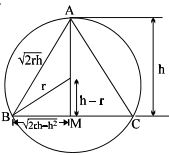
View full question & answer→MCQ 3891 Mark
If $[x] $ denotes the greatest integer $\le x$ , then
$\mathop {Limit}\limits_{n\,\, \to \,\,\infty } $$\frac{1}{{{n^4}}}$ $\left( {\left[ {{1^3}\,x} \right]\,\, + \,\,\left[ {{2^3}\,x} \right]\,\, + \,\,......\,\, + \,\,\left[ {{n^3}\,x} \right]} \right)$ equals
View full question & answer→MCQ 3901 Mark
The value of the limit $\prod\limits_{n = 2}^\infty {\,\left( {1 - \frac{1}{{{n^2}}}} \right)} $ is
- A
$1$
- B
$\frac{1}{4}$
- C
$\frac{1}{3}$
- ✓
$\frac{1}{2}$
AnswerCorrect option: D. $\frac{1}{2}$
d
$\prod\limits_{n = 2}^\infty {\,\left( {\frac{{{n^2} - 1}}{{{n^2}}}} \right)} $=$\prod\limits_{n = 2}^\infty {\,\left( {\frac{{n - 1}}{n}} \right)} \,\,\prod\limits_{n = 2}^\infty {\,\left( {\frac{{n + 1}}{n}} \right)} $
=$\frac{{1\,\cdot\,2\,\cdot\,3........(n - 1)}}{{2\,\cdot\,3\,\cdot\,4......(n - 1)\,\cdot\,n}}$ =$\frac{1}{n}\,\cdot\,\frac{{n + 1}}{2}$ =$\mathop {Lim}\limits_{n \to \infty } \,\,\frac{{1 + \frac{1}{n}}}{2}$ =$\frac{1}{2}$
View full question & answer→MCQ 3911 Mark
$\mathop {Limit}\limits_{x \to \frac{\pi }{2}} \,\frac{{\sin x}}{{{{\cos }^{ - 1}}\left[ {\frac{1}{4}\,(3\sin x\, - \,\sin 3x)} \right]}}\,$ where [ ] denotes greatest integer function , is
- ✓
$\frac{2}{\pi }\,$
- B
$1$
- C
$\frac{4}{\pi }\,$
- D
AnswerCorrect option: A. $\frac{2}{\pi }\,$
a
$\mathop {Limit}\limits_{x \to \frac{\pi }{2}} \,\frac{{\sin x}}{{{{\cos }^{ - 1}}[{{\sin }^3}x]}}\,$
at $x \to \pi /2 , [sin^3x] \to 0$ and $sinx \to 1$
$\therefore \,\,l =$ $\frac{2}{\pi }\,$
View full question & answer→MCQ 3921 Mark
If $\mathop {Lim}\limits_{x \to \,0} \,$ $\frac{{\ln (3 + x) - \ln (3 - x)}}{x}$ $= k$ , the value of $k$ is
- ✓
$\frac{2}{3}\,$
- B
$-\frac{1}{3}\,$
- C
$-\frac{2}{3}\,$
- D
$0$
AnswerCorrect option: A. $\frac{2}{3}\,$
a
$\mathop {Limit}\limits_{x \to \,0} \,$ $\frac{{\ln (3 + x) - \ln (3 - x)}}{x}$
=$\mathop {Limit}\limits_{x \to \,0} \,$$\frac{{\ln 3\, + \ln \left( {1 + \frac{x}{3}} \right)\, - \ln 3\, - \,\ln \left( {1 - \frac{x}{3}} \right)}}{x}$
=$\mathop {Limit}\limits_{x \to \,0} \,$$\ln \,{\left( {1 + \frac{x}{3}} \right)^{1/x}}\, - \,\,\ln {\left( {1 - \frac{x}{3}} \right)^{1/x}}$
=$\frac{1}{x}\,\,.\,\,\frac{x}{3}\,\,\, - \,\,\frac{1}{x}\,\left( { - \frac{x}{3}} \right)\,$
=$\frac{1}{3}\, + \,\frac{1}{3}\,\, = \,\,\frac{2}{3}\,$
View full question & answer→MCQ 3931 Mark
The function $f (x) =$ $\mathop {Lim}\limits_{n \to \infty } \,\,\frac{{{x^{2n}} - 1}}{{{x^{2n}} + 1}}$ is identical with the function
- A
$g (x) = sgn(x - 1)$
- B
$h (x) = sgn (tan^{-1}x)$
- ✓
$u (x) = sgn( | x | - 1)$
- D
$v (x) = sgn (cot^{-1}x)$
AnswerCorrect option: C. $u (x) = sgn( | x | - 1)$
c
$f (x) =$$\left[ \begin{gathered} \hfill \\ \hfill \\ \hfill \\ \hfill \\ \end{gathered} \right.$ $\begin{gathered} - 1\,\,\,\,\,\,if\,\, - 1 < x < 1 \hfill \\ \hfill \\ \,\,\,0\,\,\,\,\,\,if\,\,x = 1\,\,or\,\, - 1 \hfill \\ \hfill \\ \,\,\,1\,\,\,\,\,\,if\,\,|x| > 1 \hfill \\ \end{gathered} $ and $g (x) = sgn(|x| - 1)$ is same
View full question & answer→MCQ 3941 Mark
If $f(3) = 6 \& f ‘ (3) = 2$, then $\mathop {Limit}\limits_{x\,\, \to \,\,3} $ $\frac{{x\,f(3)\,\, - \,\,3\,f\,(x)}}{{x\,\, - \,\,3}}$ is given by :
Answerc
$f (3) = 6 ; f ‘ (3)= 2$,
$\mathop {Limit}\limits_{x\,\, \to \,\,3} $ $ \frac{{x\,f(3)\,\, - \,\,3\,f\,(x)}}{{x\,\, - \,\,3}}$ put $x = 3 + h$
=$\mathop {Limit}\limits_{h \to \,0} \,\frac{{(3 + h)\,\cdot\,f(3) - \,3f(3 + h)}}{h}\,$ =$\mathop {Limit}\limits_{h \to \,0} \,\,\frac{{ - 3\,[\,f(3 + h)\, - \,f(3)\,]}}{h}\, + \,\,f(3)\,$
= $- 3f ‘ (3) + f (3) = - 6 + 6 = 0$ Ans
View full question & answer→MCQ 3951 Mark
The limiting value of the function $f(x) =$ $\frac{{2\sqrt 2 - {{(\cos x + \sin x)}^3}}}{{1 - \sin 2x}}$ when $x \to \frac{\pi }{4} $ is
- A
$\sqrt 2 $
- B
$\frac{1}{{\sqrt 2 }}$
- C
$3\sqrt 2 $
- ✓
$\frac{3}{{\sqrt 2 }}$
AnswerCorrect option: D. $\frac{3}{{\sqrt 2 }}$
d
put $x =$ $\frac{\pi }{4}$ $+ h $ or use $L$ ’Hospital’s rule
View full question & answer→MCQ 3961 Mark
For $\mathop {Lim}\limits_{x \to 8} \,\,\frac{{\sin \{ x - 10\} }}{{\{ 10 - x\} }}$ (where { } denotes fractional part function)
- A
$LHL$ exist but $RHL$ does not exist
- ✓
$RHL$ exist but $LHL$ does not exist.
- C
neither $LHL$ nor $RHL$ does not exist
- D
both $RHL$ and $LHL$ exist and equals to $1$
AnswerCorrect option: B. $RHL$ exist but $LHL$ does not exist.
b
$\mathop {Lim}\limits_{x \to {8^ + }} \,\,\frac{{\sin \{ x\} }}{{\{ - x\} }}$ $= 0$ as ${I + x } = {x}$ ; as $\mathop {Lim}\limits_{x \to {I^ + }} \,\,\{ x\} \, \to 0$ and$\mathop {Lim}\limits_{x \to {I^ - }} \,\,\{ - x\} \, \to 1$
$\mathop {Lim}\limits_{x \to {8^ - }} \,\,\frac{{\sin \{ x\} }}{{\{ - x\} }}$ $\to \,\, \infty $ as $sin\{x\} \to \,\, sin(1)$ and $ \{-x\} \to \,0 $
View full question & answer→MCQ 3971 Mark
$\mathop {Lim}\limits_{n\,\, \to \,\,\infty } $ $\frac{{{1^2}\,\,n\,\, + \,\,{2^2}\,\,(n\, - \,1)\,\, + \,\,{3^2}\,\,(n\, - \,2)\,\, + \,\,.....\,\, + \,\,{n^2}\,.\,\,1}}{{{1^3}\,\, + \,\,{2^3}\,\, + \,\,{3^3}\,\, + \,\,......\,\, + \,\,{n^3}}}$ is equal to :
- ✓
$\frac{1}{3}$
- B
$\frac{2}{3}$
- C
$\frac{1}{2}$
- D
$\frac{1}{6}$
AnswerCorrect option: A. $\frac{1}{3}$
a
$\frac{{Lim}}{{n \to \infty }}\frac{{\begin{array}{*{20}{c}}
{{1^2}}&{n + {2^2}}&{\left( {n - 2} \right) + {3^2}}&{\begin{array}{*{20}{c}}
{\left( {n - 2} \right) + ............ + {n^2}}&{\left( {n - \left( {n - 1} \right)} \right)}&{}
\end{array}}
\end{array}}}{{\sum\limits_{}^{} {{n^3}} }}$
${N^r} = n\left( {{1^2} + {2^2}..... + {n^2}} \right) - \left( {{{1.2}^2} + {{2.3}^2} + {{3.4}^2} + ..... + \left( {n - 1} \right){n^2}} \right)$
$=\begin{array}{*{20}{c}} n&{\sum {{n^2}} }&{\begin{array}{*{20}{c}} { - \sum\limits_{r - 2}^n {\left( {r - 1} \right)} }&{.{r^2}}&{} \end{array}} \end{array}$
$= \begin{array}{*{20}{c}} n&{\sum {{n^2}} }&{\begin{array}{*{20}{c}} { - \sum\limits_{r - 2}^n {\left( {{r^3} - {1^2}} \right)} }&{}&{} \end{array}} \end{array}$
$= \begin{array}{*{20}{c}} n&{\sum {{n^2}} }&{ - \left[ {\begin{array}{*{20}{c}} {\sum {{n^3}} }&{ - \sum {{n^2}} } \end{array}} \right]} \end{array}$
$=\begin{array}{*{20}{c}} {\left( {n + 1} \right)\sum {{n^2}} }&{ - \sum {{n^3}} } \end{array}$
$ l = \frac{{Lim}}{{n \to \infty }}$ $\frac{{\begin{array}{*{20}{c}} {\left( {n + 1} \right)\sum {{n^2}} }&{ - \sum {{n^3}} } \end{array}}}{{\sum {{n^3}} }}$
$\frac{{Lim}}{{n \to \infty }}$ $\frac{{\left( {n + 1} \right)n\left( {n + 1} \right)\left( {2n + 1} \right)}}{{6n\left( {n + 1} \right)n\left( {n + 1} \right)}}$ $-1$
$\begin{array}{*{20}{c}} {\frac{4}{3}}&{ - 1} \end{array}$ $=\frac{1}{3}$
Alternatively:
$l =\underbrace {\frac{{{1^2}n + {2^2}(n - 1) + ...... + {n^2}\cdot1}}{{{1^3} + {2^3} + {3^2}...... + {n^3}}} + 1}_{}$ $- 1 $
$=\frac{{{1^2}(n + 1) + {2^2}(n + 1) + ...... + {n^2}(n + 1)}}{{\sum {{n^3}} }} - 1$
$l = \frac{{(n + 1)\sum {{n^2}} }}{{\sum {{n^3}} }}- 1$
View full question & answer→MCQ 3981 Mark
The value of $\mathop {_{Limit}}\limits_{x \to \,\infty } \,\frac{{{{\cot }^{ - 1}}\left( {{x^{ - a}}\,\,{{\log }_a}x} \right)}}{{{{\sec }^{ - 1}}\left( {{a^x}\,\,{{\log }_x}a} \right)}}$ $(a > 1)$ is equal to
Answera
$\mathop {Limit}\limits_{x \to \infty } \,\frac{{{{\cot }^{ - 1}}\left( {\frac{{{{\log }_a}x}}{{{x^a}}}} \right)}}{{{{\sec }^{ - 1}}\left( {\frac{{{a^x}}}{{{{\log }_a}x}}} \right)}}\,$ ;
$\mathop {as}\limits_{x \to \infty } \,\left( {\frac{{{{\log }_a}x}}{{{x^a}}}} \right)\,\, \to \,\,0$ and $\,\left( {\frac{{{a^x}}}{{{{\log }_a}x}}} \right)\, \to \,\,\infty \,$ (using L’opital rule)
$\therefore l =$$\frac{{\pi /2}}{{\pi /2}}$ $= 1 $
View full question & answer→MCQ 3991 Mark
Let $f : (1, 2 ) \to R$ satisfies the inequality $\frac{{\cos (2x - 4)\, - 33}}{2}\,\, < \,\,f(x)\,\, < \,\frac{{{x^2}\,|4x - 8|}}{{x - 2}}$ ,$\forall \,\,x\,\, \in \,(1,2)$ . Then $\mathop {Lim}\limits_{x \to {2^ - }} \,\,f(x)$ is equal to
- A
$16$
- ✓
$-16$
- C
cannot be determined from the given information
- D
Answerb
$\mathop {Lim}\limits_{x \to {2^ - }} \,\,f(x)$$\frac{{\cos (2x - 4)\, - \,33}}{2}\,\, = \,\, - 16$ ;
$\mathop {Lim}\limits_{x \to {2^ - }} \,\,f(x)$$\frac{{{x^2}\,.\,4|x - 2|}}{{x - 2}}\,\, = \, - 4(4)\,\, = \,\,\, - 16$
By sandwich theorem $\mathop {Lim}\limits_{x \to {2^ - }} \,\,f(x)$ $= -16 $
View full question & answer→MCQ 4001 Mark
Let $a = min\,\, [x^2 + 2x + 3, x \in R]$ and $b =$ $\mathop {Lim}\limits_{x \to 0} \,\,\frac{{\sin x\cos x}}{{{e^x} - {e^{ - x}}}}$ . Then the value of $\sum\limits_{r = 0}^n {{a^r}{b^{n - r}}} $ is
- A
$\frac{{{2^{n + 1}} + 1}}{{3\,\cdot\,{2^n}}}$
- B
$\frac{{{2^{n + 1}} - 1}}{{3\,\cdot\,{2^n}}}$
- C
$\frac{{{2^n} - 1}}{{3\,\cdot\,{2^n}}}$
- ✓
$\frac{{{4^{n + 1}} - 1}}{{3\,\cdot\,{2^n}}}$
AnswerCorrect option: D. $\frac{{{4^{n + 1}} - 1}}{{3\,\cdot\,{2^n}}}$
d
$a = (x + 1)^2 + 2 \Rightarrow a = 2$
$b =$ $\mathop {Lim}\limits_{x \to 0} \,\,\frac{{\sin 2x}}{{\frac{{2({e^{2x}} - 1).2x}}{{2x}}}}$ = $\frac{1}{2}$
now $\sum\limits_{r = 0}^n {{a^r}{b^{n - r}}} $ = $\sum {{2^r}{{\left( {\frac{1}{2}} \right)}^{n - r}}} $ = $\frac{1}{{{2^n}}}\sum\limits_{4 = 0}^n {{2^{2r}}} $
=$\frac{1}{{{2^n}}}$ $[1 + 2^2 + 2^4 + ... + 2^{2n} ]$
=$\frac{1}{{{2^n}}}$$\left[ {\frac{{{{({2^2})}^{n + 1}} - 1}}{{{2^2} - 1}}} \right]$ =$\frac{1}{{{2^n}}}$$\left[ {\frac{{{4^{n + 1}} - 1}}{3}} \right]$ =$\frac{{{4^{n + 1}} - 1}}{{{{3.2}^n}}}$
View full question & answer→MCQ 4011 Mark
$\frac{{Lim}}{{x \to 1/\sqrt 2 }}$ $\frac{{x - \cos \left( {\begin{array}{*{20}{c}} {{{\sin }^{ - 1}}}&x \end{array}} \right)}}{{1 - \tan \left( {\begin{array}{*{20}{c}} {{{\sin }^{ - 1}}}&x \end{array}} \right)}}$ is
- A
$\frac{1}{{\sqrt 2 }}$
- ✓
$-\frac{1}{{\sqrt 2 }}$
- C
$\sqrt 2 $
- D
$-\sqrt 2 $
AnswerCorrect option: B. $-\frac{1}{{\sqrt 2 }}$
b
put $sin^{-1}x = \theta$
$\frac{{Lim}}{{\theta \to \pi /4}}$$\frac{{\sin \theta - \cos \theta }}{{1 - \tan \theta }}$
$=\frac{{Lim}}{{\theta \to \pi /4}}-cos\theta$
$=-\frac{1}{\sqrt 2 }$
View full question & answer→MCQ 4021 Mark
If $f(x) = cos x, x =n \pi , n = 0, 1, 2, 3, ..... = 3$, otherwise and $\phi (x) =\left[ {\begin{array}{*{20}{c}} {{x^2}\,\, + \,\,1}&{when\,\,\,\,x\, \ne \,3\,,\,\,x\, \ne \,0} \\ 3&{when\,\,\,\,x\, = \,0\,\,\,\,\,\,\,\,\,\,\,\,\,} \\ 5&{when\,\,\,\,x\, = \,3\,\,\,\,\,\,\,\,\,\,\,\,\,} \end{array}} \right.$ then $\mathop {Limit}\limits_{x\,\, \to \,\,0} f(\phi (x)) =$
View full question & answer→MCQ 4031 Mark
Let $\mathop {Lim}\limits_{x \to 0} $ $sec^{-1}$ $\left( {\frac{x}{{\sin x}}} \right)$ $= l$ and $\mathop {Lim}\limits_{x \to 0} $ $sec^{-1}$ $\left( {\frac{x}{{\tan x}}} \right)$ $= m$, then
- ✓
$l$ exists but $m$ does not
- B
$m$ exists but $l$ does not
- C
$l$ and $m$ both exist
- D
neither $l$ nor $m$ exists
AnswerCorrect option: A. $l$ exists but $m$ does not
View full question & answer→MCQ 4041 Mark
Range of the function $f (x) =$ $\left[ {\frac{1}{{\ln ({x^2} + e)}}} \right]\,\, + \,\,\frac{1}{{\sqrt {1 + {x^2}} }}\,$ is , where $[*]$ denotes the greatest integer function and $e =$ $\mathop {Limit}\limits_{\alpha \to 0} {(1 + \alpha )^{1/\alpha }}\,$
AnswerCorrect option: D. $(0, 1) \cup \{2\}$
d
$\left[ {\frac{1}{{\ln ({x^2} + e)}}} \right]\, - \left[ \begin{gathered} 0\,\,\,\,x\, \ne \,0 \hfill \\ 1\,\,\,\,\,x\, = \,0 \hfill \\ \end{gathered} \right.$
$f(x) - \left[ \begin{gathered} 2\,\,\,\,\,\,\,\,\,\,\,\,\,\,\,\,\,\,x\, = \,0 \hfill \\ \frac{1}{{\sqrt {1 + {x^2}} }}\,\,\,\,x \ne 0 \hfill \\ \end{gathered} \right.$
Hence range of $f (x)$ is $(0, 1) \cup {2}$
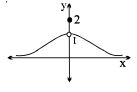
View full question & answer→MCQ 4051 Mark
$\mathop {Lim}\limits_{x \to {0^ - }} \,{\sin ^{ - 1}}[\tan x]\,$ $= l$ then $\{ l \}$ is equal to
where [ ] and { } denotes greatest integer and fractional part function.
- A
$0$
- B
$1 - \,\frac{\pi }{2}\,$
- C
$\frac{\pi }{2}\,\, - \,1$
- ✓
$2\,\, - \,\,\frac{\pi }{2}\,$
AnswerCorrect option: D. $2\,\, - \,\,\frac{\pi }{2}\,$
d
$\mathop {Lim}\limits_{x \to {0^ - }} \,\,{\sin ^{ - 1}}[\tan x] = - \frac{\pi }{2}$ ;
hence $\left\{ { - \frac{\pi }{2}} \right\}$ = $\left\{ {2 - \frac{\pi }{2} - 2} \right\}$ $= 2 -\frac{\pi }{2}$
View full question & answer→MCQ 4061 Mark
$\mathop {Limit}\limits_{x \to \infty } \,\frac{{{{\cot }^{ - 1}}\left( {\sqrt {x + 1} \,\, - \,\sqrt x } \right)}}{{{{\sec }^{ - 1}}\left\{ {{{\left( {\frac{{2x + 1}}{{x - 1}}} \right)}^x}} \right\}}}$ is equal to
Answera
$\mathop {Limit}\limits_{x \to \infty } \,\sqrt {x + 1} \, - \sqrt x \,$ $= 0$ $\Rightarrow cot^{-1}(0) = \pi /2$
$\mathop {Limit}\limits_{x \to \infty } \,{\left( {\frac{{2x + 1}}{{x - 1}}} \right)^x}\,\, = \,\,\infty \,$ $\Rightarrow\,\,\, sec^{-1} (\infty ) = \pi /2$
$\therefore\,\, l = 1$ Ans
View full question & answer→MCQ 4071 Mark
Let $f(x) =$ $\frac{{\ln ({x^2} + {e^x})}}{{\ln ({x^4} + {e^{2x}})}}$ . If $f(x) = l$ and $\mathop {Limit}\limits_{x\,\, \to \,\, - \,\infty } f(x) = m$ then :
- ✓
$l = m$
- B
$l = 2m$
- C
$2 l = m$
- D
$l + m = 0$
AnswerCorrect option: A. $l = m$
a
$\mathop {Lim}\limits_{x \to \infty } $ $\frac{{\ln ({x^2} + {e^x})}}{{\ln ({x^4} + {e^{2x}})}}$
= $\mathop {Lim}\limits_{x \to \infty } \,$ $\frac{{\ln \,\,{e^x}\,\left( {1 + \frac{{{x^2}}}{{{e^x}}}} \right)}}{{\ln \,\,{e^{2x}}\,\left( {1 + \frac{{{x^4}}}{{{e^{2x}}}}} \right)}}$
=$\mathop {Lim}\limits_{x \to \infty } \,$ $\frac{{x\, + \,\ln \,\,\left( {1 + \frac{{{x^2}}}{{{e^x}}}} \right)}}{{2x\, + \,\ln \,\,\,\left( {1 + \frac{{{x^4}}}{{{e^{2x}}}}} \right)}}$
= $\frac{{1\, + \,\ln \,\,{{\left( {1 + \frac{{{x^2}}}{{{e^x}}}} \right)}^{1/x}}}}{{2\, + \,\ln \,\,\,{{\left( {1 + \frac{{{x^4}}}{{{e^{2x}}}}} \right)}^{1/x}}}}$
note that $\mathop {as}\limits_{x \to \,\infty } \,$ $\,\frac{{{x^2}}}{{{e^x}}}\,\, \to \,\,0$ and $\mathop {as}\limits_{x \to \,\infty } \,$ $\,\frac{{{x^2}}}{{{e^{2x}}}}\,\, \to \,\,0$
=$\mathop {Lim}\limits_{x \to \infty } \,$ $\frac{{1 + \frac{1}{x}\left( {1 + \frac{{{x^2}}}{{{e^x}}}\, - \,1} \right)}}{{2 + \frac{1}{x}\left( {1 + \frac{{{x^4}}}{{{e^{2x}}}}\, - \,1} \right)}}$
= $\mathop {Lim}\limits_{x \to \infty } \,$ $\frac{{1 + \frac{x}{{{e^x}}}}}{{2 + \frac{{{x^3}}}{{{e^{2x}}}}}}$
|||$^{ly}$ $\mathop {Limit}\limits_{x \to \, - \,\infty } \,\, = \,\,\frac{1}{2}\,$
View full question & answer→MCQ 4081 Mark
$\mathop {Lim}\limits_{n\,\, \to \,\,\infty } $ $cos$ $\left( {\,\pi \sqrt {{n^2} + n} \,} \right)$ when $n$ is an integer :
- A
is equal to $1$
- B
is equal to $- 1$
- ✓
- D
Answerc
$\pi n$ ${\left( {1\,\, + \,\,\frac{1}{n}} \right)^{1/2}}$
$= n \pi $ $\left( {1\,\, + \,\,\frac{1}{{2\,n}}\,\, + \,\,\frac{1}{2}\,\left( {\frac{1}{2}\,\, - \,\,1} \right)\,\,\frac{1}{{2\,\,!}}\,\,\frac{1}{{{n^2}}}\,\, + \,\,......} \right)$
$= \pi \left[ {n\,\, + \,\,\frac{1}{2}\,\, + \,\,\frac{1}{2}\,\left( {\frac{1}{2}\,\, - \,\,1} \right)\,\,\frac{1}{{2\,\,!}}\,\,\frac{1}{n}\,\, + \,\,......} \right)$
as $n \Rightarrow \infty$ ;
$\frac{\pi }{2}$. $\left( {2\,n\,\, + \,\,1\,\, + \,\,\left( {\frac{1}{2}\,\, - \,\,1} \right)\,\,\frac{1}{{2\,\,!}}\,\,\frac{1}{n}\,\, + \,\,.......} \right)$
$= (2n + 1)$ $\frac{\pi }{2}$
Alternatively $(1)$ :
Take $A = (2n +1)$ $\frac{\pi }{2}\,$ and $B = $ $\frac{\pi }{2}\,$$\left[ {\left( {\frac{1}{2}\, - \,1} \right)\,\frac{1}{{2!}}\,\,\frac{1}{n}\,\, + \,\,....} \right]$
now $cos (A + B) = cosA cosB - sinA sinB $
$= 0 - (1)$$\mathop {Limit}\limits_{n\,\, \to \,\,\infty } $ $sin$ $\left( {\frac{\pi }{2}\,\left( {\frac{1}{2}\, - \,1} \right)\frac{1}{{2!}}\,\frac{1}{n}\, + \,...} \right)$
$= 0 $
Alternatively $(2)$
Best $l =$ $\mathop {Limit}\limits_{n \to \infty } \,\, \pm \,\,\cos \left( {n\pi \, - \,\pi \sqrt {{n^2} + n} \,} \right)$
$\Rightarrow$ $=\mathop {Limit}\limits_{n \to \infty } \,\, \pm \,\,\cos \left( {\,\pi \,\,\left( {n\, - \,\sqrt {{n^2} + n} } \right)\,} \right)$
$=\mathop {Limit}\limits_{n \to \infty } \,\,\,\cos \,\left( {\frac{{\left( {\pi \,( + n)} \right)}}{{n + \sqrt {{n^2} + n} }}} \right)\,\,$
= $\mathop {Limit}\limits_{n \to \infty } \,\,\,\cos \,\left( {\frac{{n\,\pi }}{{n + n\,\sqrt {1 + \frac{1}{n}} }}} \right)\,\,$
= $\mathop {Limit}\limits_{n \to \infty } \,\,\,\cos \,\left( {\frac{{\,\pi }}{{1 + \,\sqrt {1 + \frac{1}{n}} }}} \right)\,\,$
$= cos$ $\frac{\pi }{2}\,$ $\to 0 $
View full question & answer→MCQ 4091 Mark
$\lim \limits _{x \to 0} \frac{{{{(\sin x - \tan x)}^2} - {{(1 - \cos 2x)}^4} + {x^5}}}{{7\cdot{{({{\tan }^{ - 1}}x)}^7}\, + {{({{\sin }^{ - 1}}x)}^6}+ 3{{\sin }^5}x}}$ is equal to
- A
$0$
- B
$\frac{1}{7}$
- ✓
$\frac{1}{3}$
- D
$1$
AnswerCorrect option: C. $\frac{1}{3}$
c
Hint:Divide Nr. and Dr. by $x^5$ and evaluate limit
View full question & answer→MCQ 4101 Mark
Let $\mathop {Limit}\limits_{x\,\, \to \,\,0} $ $\frac{{[\,{x^2}]}}{{{x^2}}}$ $= l \&$ $\mathop {Limit}\limits_{x\,\, \to \,\,0} $ $\frac{{[\,{x^2}]}}{{{x^2}}}$ $= m $,
where $[ ]$ denotes greatest integer , then:
- A
$l$ exists but $m$ does not
- ✓
$m$ exists but $l$ does not
- C
$l \&\,\, m$ both exist
- D
neither $l$ nor $m$ exists .
AnswerCorrect option: B. $m$ exists but $l$ does not
b
$\frac{{{{[\,x\,]}^2}}}{{{x^2}}}$ = $\left[ {\begin{array}{*{20}{c}} 0&{if\,\,\,\,0\,\, < \,\,x\,\, < \,\,1\,\,\,\,} \\ {\tfrac{1}{{{x^2}}}}&{if\,\,\,\,\, - \,1\,\, < \,\,x\,\, < \,\,0} \end{array}} \right.$ $\Rightarrow $ $l$ does not exist .
$\frac{{{{[\,x\,]}^2}}}{{{x^2}}}$ = $\left[ {\begin{array}{*{20}{c}} 0&{if\,\,\,\,0\,\, < \,\,x\,\, < \,\,1\,\,\,\,} \\ {\tfrac{1}{{{x^2}}}}&{if\,\,\,\,\, - \,1\,\, < \,\,x\,\, < \,\,0} \end{array}} \right.$ $\Rightarrow$ $m$ exists and is equal to zero.
View full question & answer→MCQ 4111 Mark
The value of $\mathop {Limit}\limits_{x\,\, \to \,\,0} $ $\frac{{\left( {\,\tan \,\,\left( {\,\{ \,x\,\} \,\, - \,\,1\,} \right)\,} \right)\,\,\,\,\sin \,\,\{ \,x\,\} }}{{\{ \,x\,\} \,\,\,\left( {\,\{ \,x\,\} \,\, - \,\,1\,} \right)}}$
where $\{ x \}$ denotes the fractional part function:
- A
is $1$
- B
is $tan 1$
- C
is $sin 1$
- ✓
Answerd
$\mathop {Limit}\limits_{x\,\, \to \,\,0} $ $\frac{{\left( {\,\tan \,\,\left( {\,\{ \,x\,\} \,\, - \,\,1\,} \right)\,} \right)\,\,\,\,\sin \,\,\{ \,x\,\} }}{{\{ \,x\,\} \,\,\,\left( {\,\{ \,x\,\} \,\, - \,\,1\,} \right)}}$
= $\mathop {Limit}\limits_{x \to \,{0^ + }} \,$ $f (x)$
= $\mathop {\,Limit}\limits_{h \to {0^ + }} \frac{{\tan (h - 1)\,.\,\sinh }}{{h\,(h - 1)}}$
= $\frac{{\tan ( - 1)}}{{ - 1}}\,\,$
$ = \,\,\tan 1\,$
$\mathop {Limit}\limits_{x \to \,{0^ - }} \frac{{\tan ((1 - h)\, - \,1)\,\,\sin (1 - h)}}{{(1 - h)\,\,(1 - h - 1)}}\,\, = \,\,\frac{{\sin 1}}{1}\,$ $= sin 1$
Hence limit $x \to 0 f (x)$ does not exist
View full question & answer→MCQ 4121 Mark
$\mathop {Lim}\limits_{x\,\, \to \,\,\infty } $ $\frac{{2 + 2x + \sin 2x}}{{(2x + \sin 2x){e^{\sin x}}}}$ is :
- A
- B
equal to $1$
- C
equal to $- 1$
- ✓
Answerd
$\mathop {Limit}\limits_{x\,\, \to \,\,\infty } $$\frac{{\frac{2}{x}\, + \,2\, + \frac{{\sin 2x}}{x}}}{{\left( {2 + \frac{{\sin 2x}}{x}} \right)\,{e^{\sin x}}}}\,$
as $x \Rightarrow \,\,\infty$
$l = \mathop {Limit}\limits_{x\,\, \to \,\,\infty } $ $\frac{2}{{2\,.\,{e^{\sin x}}}}\,$ = oscillatory between $\frac{1}{e}\,$ to $\frac{1}{{{e^{ - 1}}}}\,$ $\Rightarrow$ non existent
View full question & answer→MCQ 4131 Mark
The value of $_{x \to \,0}^{\lim }\,\,\left( {\cos \,\,ax} \right){}^{\cos ec{}^2bx}$ is
- A
${}_e{}^{\left( { - \,\frac{{8b{}^2}}{{a{}^2}}} \right)}$
- B
${}_e{}^{\left( { - \,\frac{{8a{}^2}}{{b{}^2}}} \right)}$
- ✓
${}_e{}^{\left( { - \,\frac{{a{}^2}}{{2b{}^2}}} \right)}$
- D
${}_e{}^{\left( { - \,\frac{{b{}^2}}{{2a{}^2}}} \right)}$
AnswerCorrect option: C. ${}_e{}^{\left( { - \,\frac{{a{}^2}}{{2b{}^2}}} \right)}$
c
$ln\,\,l =$ $ {e^{\mathop {_{Limit}}\limits_{x \to \,0} \cos e{c^2}bx\,(\cos ax\, - \,1)}}$
now $ln \,\,l=- \mathop {Limit}\limits_{x \to \,0} \,\frac{{1 - \cos ax}}{{{{\sin }^2}bx}}\,$
= $-\mathop {Limit}\limits_{x \to \,0} \,\frac{{{{\sin }^2}ax}}{{{{\sin }^2}bx}}\,.\,\,\frac{1}{{1 + \cos ax}}\,$ = $-\frac{{{a^2}}}{{2{b^2}}}\,$
$l = {\,_e}^{ - \frac{{{a^2}}}{{2{b^2}}}}$
View full question & answer→MCQ 4141 Mark
$\mathop {Lim}\limits_{x \to c} $ $f(x)$ does not exist when :
where $[x]$ denotes step up function $\& \{x\}$ fractional part function.
- A
$f(x) = [[x]] - [2x - 1], c = 3$
- B
$f(x) = [x] - x, c = 1$
- C
$f(x) = \{x\}^2 - \{-x\}^2, c = 0$
- ✓
$(B)$ or $(C)$ both
AnswerCorrect option: D. $(B)$ or $(C)$ both
d
Option $A: f(x)=[[x]]-[2 x-1],$ at $c=3$
Let's check right hand limit at $c=3$
$x=3+h$
$\lim _{h \rightarrow 0} f(3+h)=\lim _{h \rightarrow 0}[[3+h]]-[2(3+h)-1]=4-6=-2$
Let's check Left hand limit at $c=3$
$x=3-h$
$\lim _{h \rightarrow 0} f(3-h)=\lim _{h \rightarrow 0}[[3-h]]-[2(3-h)-1]=3-5=-2$
$\lim _{x \rightarrow 3} f(x)$ does exist.
Option $B : f(x)=[x]-x$ at $c=1$
Let's check right hand limit at $c=1$
$x=1+h$
$\lim _{h \rightarrow 0} f(1+h)=\lim _{h \rightarrow 0}[1+h]-(1+h)=1-1=0$
Let's check Left hand limit at $c=1$
$x=1-h$
$\lim _{h \rightarrow 0} f(1-h)=\lim _{h \rightarrow 0}[1-h]-(1-h)=0-1=-1$
$\lim _{x \rightarrow 1} f(x)$ does not exist.
Option $C : f( x )=\left( x ^{2}\right)-(- x )^{2},$ at $c =0$
Let's check right hand limit at $c=0$ $x=0+h$
$\lim _{h \rightarrow 0} f(0+h)=\lim _{h \rightarrow 0}(h)^{2}--h^{2}=0-1=-1$
Let's check Left hand limit at $c=0$
$x=0-h$
$\lim _{h \rightarrow 0} f(0-h)=\lim _{h \rightarrow 0}(-h)^{2}-h^{2}=0-0=0$
$\lim _{x \rightarrow 0} f(x)$ does exist.
Hence, Option $B$ and $C$.
View full question & answer→MCQ 4151 Mark
Let $f (x) = \left[ {\begin{array}{*{20}{c}} {\tfrac{{{{\tan }^2}\,\,\{ \,x\,\} }}{{{x^2}\,\, - \,\,{{[\,x\,]}^2}}}\,\,\,\,} \\ {1\,\,\,\,\,\,\,\,\,\,\,\,\,\,\,\,\,\,\,\,\,\,\,\,\,\,} \\ {\sqrt {\{ \,x\,\} \,\,\,\cot \,\,\{ \,x\,\} } } \end{array}} \right.\,\,\,\,\,\begin{array}{*{20}{c}} {for\,\,\,\,\,x\,\, > \,\,0} \\ {for\,\,\,\,\,x\,\, = \,\,0} \\ {for\,\,\,\,\,x\,\, < \,\,0} \end{array}$ where $[ x ]$ is the step up function and $\{ x \}$ is the fractional part function of $x$ , then :
- A
$\mathop {Limit}\limits_{x\,\, \to \,\,{0^ + }} f (x) = 1$
- B
$\mathop {Limit}\limits_{x\,\, \to \,\,{0^ - }} f (x) = 1$
- C
$cot ^{-1} {\left( {\mathop {Limit}\limits_{x\,\, \to \,\,{0^ - }} \,\,\,f\,(x)} \right)^2}= 1$
- ✓
both $(A)$ and $(C)$
AnswerCorrect option: D. both $(A)$ and $(C)$
d
$\lim _{x \rightarrow 0^{+}} f(x)=\lim _{x \rightarrow 0^{+}} \frac{\tan ^{2} x}{x^{2}-[x]^{2}}$
$\lim _{x \rightarrow 0^{+}} \frac{\tan ^{2} x}{x^{2}\left(1-\frac{[x]^{2}}{x^{2}}\right)}$
$\operatorname{since,\operatorname{lim}_{x\rightarrow0}\frac{\operatorname{tan}x}{x}=1\text{and}\operatorname{lim}_{x\rightarrow0^{+}}[x]=0}$
$\operatorname{Hence,} \lim _{x \rightarrow 0^{+}} f(x)=1$
$\lim _{x \rightarrow 0^{-}} f(x)=\lim _{x \rightarrow 0^{-}} \sqrt{\{x\} \cot \{x\}}$
$=\lim _{x \rightarrow 0^{-}} \sqrt{(x-[x]) \cot (x-[x])}$
$=\lim _{x \rightarrow 0} \sqrt{(x+1) \cot (x+1)}$
$=\sqrt{\cot 1}$
$\left(\lim _{x \rightarrow 0^{-}} f(x)\right)^{2}=\cot 1$
$\Rightarrow \cot ^{-1}\left(\lim _{x \rightarrow 0^{-}} f(x)\right)^{2}=1$
View full question & answer→MCQ 4161 Mark
Let $f(x) = \frac{{x\,\,.\,\,{2^x}\,\, - \,\,x}}{{1\,\, - \,\,\cos \,x}} \& g(x) = 2^x sin \left( {\frac{{\ell n\,2}}{{{2^x}}}} \right)$ then :
- A
$\mathop {Limit}\limits_{x\,\, \to \,\,0} f(x) = ln 2$
- B
$\mathop {Limit}\limits_{x\,\, \to \,\,\infty } g(x) = ln 2$
- C
$\mathop {Limit}\limits_{x\,\, \to \,\,0} f(x) = ln 4$
- ✓
$(B)$ or $(C)$ both
AnswerCorrect option: D. $(B)$ or $(C)$ both
d
$f(x)=\frac{\frac{2^{x}-1}{2 \sin ^{2} \frac{x}{2}}}{x}$
$=\frac{2^{x}-1}{\frac{x}{4} \cdot \frac{2 \sin ^{2} \frac{x}{2}}{\frac{x^{2}}{4}}}$
$=\frac{2^{x}-1}{\frac{x}{2} \cdot \frac{\sin ^{2} \frac{x}{2}}{\frac{x^{2}}{4}}}$
As $x \rightarrow 0$
$f(x)=2 \ln (2)$
$=\ln (4)$
$\lim _{x \rightarrow 0} f(x)=\ln 4$
Now $g(x)=\frac{\sin \left(\frac{\ln (2)}{2^{x}}\right)}{\frac{\ln (2)}{2^{x}}} \cdot \ln (2)$
As $x \rightarrow 0$
$g(x)=\ln (2)$
$\lim _{x \rightarrow 0} g(x)=\ln 2$
View full question & answer→MCQ 4171 Mark
Which of the following limits vanish ?
where [ ] denotes greatest integer function
- A
$\mathop {Limit}\limits_{x\,\, \to \,\,\infty } {x^{\tfrac{1}{4}}} sin \frac{1}{{\sqrt x }}$
- B
$\mathop {Limit}\limits_{x\,\, \to \,\,\pi /2} (1 - sin x) . tan x$
- C
$\mathop {Limit}\limits_{x\,\, \to \,\,{3^ + }} $ $\frac{{{{[x]}^2}\,\, - \,\,9}}{{{x^2}\,\, - \,\,9}}$
- ✓
Answerd
a) $\lim _{x \rightarrow \infty} x \overline{4} \sin \frac{1}{\sqrt{x}}(0 \times \infty$ form $)$
Rearranging the above expression and using L'Hospital Rule in $\lim _{x \rightarrow \infty}\left(\begin{array}{c}\sin \frac{1}{\sqrt{x}} \\ \frac{-1}{x}\end{array}\right) \Rightarrow \lim _{x \rightarrow \infty}\left(\frac{\cos \frac{1}{\sqrt{x}}\left(\frac{-1}{2}\right) x^{\frac{-3}{2}}}{\left(\frac{-1}{4} x^{\frac{-5}{4}}\right)}=0\right.$
b) $\lim _{x \rightarrow \frac{\pi}{2}}(1-\sin x) \tan x(0 \times \infty$ form $)$
Rearranging and applying L'Hospital Rule $\lim _{x \rightarrow \frac{\pi}{2}} \frac{1-\sin x}{\cot x}=\lim _{x \rightarrow \frac{\pi}{2}} \frac{-\cos x}{-\csc ^{2} x}=\lim _{x \rightarrow \frac{\pi}{2}} \cos x \sin ^{2} x=0$
c) $\lim _{x \rightarrow 3^{+}} \frac{[x]^{2}-9}{x^{2}-9}$
Applying L'Hospital Rule $\left(\frac{0}{0}\right)$ form
The derivative of $[x]$ at $x \rightarrow 3^{+}$ will be 0
Thus, $\lim _{x \rightarrow 3^{+}} \frac{0}{2 x}=0$
View full question & answer→MCQ 4181 Mark
If $x$ is a real number in $[0, 1]$ then the value of $\mathop {Limit}\limits_{m\,\, \to \,\,\infty } $ $\mathop {Limit}\limits_{n\,\, \to \,\,\infty } $ $[1 + cos^{2m} (n ! \pi x)]$ is given by
AnswerCorrect option: D. $(B)$ or $(C)$ both
d
$\mathop {Limit}\limits_{m\,\, \to \,\,\infty } $ $\mathop {Limit}\limits_{n\,\, \to \,\,\infty } $ $1 + cos^{2m}(n ! \pi n)$
Let $x\, \in \,[0,\,1]\,$ is a rational
then $n!. x$ if $n \to \,\infty$ becomes integral
$\therefore cos^2 (n ! x) \pi = 1$
$\therefore \mathop {Limit}\limits_{m \to \infty } \, ( cos^2 n ! x \pi )^m = 1$
$\therefore l = 1 + 1 = 2$ if $x$ is rational
if $x$ is irrational , then $n ! x$ is not an integer
$\therefore cos^2( n! x) \pi$ is less than $1$
$cos^2 ( ( n! x) \pi )^m \to\,\, 0 $
$\therefore l = 1 + 0 = 1$ $\Rightarrow$ the result
View full question & answer→MCQ 4191 Mark
A weight hangs by a spring $\&$ is caused to vibrate by a sinusoidal force .
Its displacement s$(t)$ at time $t$ is given by an equation of the form, $s(t) =$ $\frac{A}{{{c^2}\, - \,\,{k^2}}}$ $(sin\, kt - sin \,ct) $
where $A, c \& k $ are positive constants with $c \ne k,$ then the limiting value of the displacement as $c \to k$ is
- A
$\frac{{ - \,At\,\,\,\sin \,kt}}{{2k}}$
- B
$\frac{{ \,At\,\,\,\sin \,kt}}{{2k}}$
- C
$\frac{{ \,At\,\,\,\cos \,kt}}{{2k}}$
- ✓
$\frac{{ - \,At\,\,\,\cos \,kt}}{{2k}}$
AnswerCorrect option: D. $\frac{{ - \,At\,\,\,\cos \,kt}}{{2k}}$
View full question & answer→MCQ 4201 Mark
$\mathop {Limit}\limits_{x\,\, \to \,\,4} $ $\frac{{{{(\cos \,\alpha )}^x}\, - \,\,{{(\sin \,\alpha )}^x}\, - \,\,\cos \,2\alpha }}{{x\,\, - \,\,4}}=$
where $0 < \alpha <$ $\frac{\pi }{2}$
- A
$cos^4\, \alpha\, ln \,cos\, \alpha\,+ \,sin^4\, \alpha\, ln sin\, \alpha$
- B
$-\,cos^4\, \alpha\, ln \,cos\, \alpha - sin^4\, \alpha\, ln sin\, \alpha$
- C
$-\,cos^4\, \alpha\, ln \,cos\, \alpha - \,sin^4\, \alpha\, ln sin\, \alpha$
- ✓
$cos^4\, \alpha\, ln \,cos\, \alpha - sin^4\, \alpha\, ln sin\, \alpha$
AnswerCorrect option: D. $cos^4\, \alpha\, ln \,cos\, \alpha - sin^4\, \alpha\, ln sin\, \alpha$
d
$\operatorname{Cos}^{4} 2-\sin ^{4} \alpha-\cos 2 x$
$\left(\cos ^{2} \alpha-\sin ^{2}\right)\left(\cos ^{2} \alpha+\sin ^{2} \alpha\right)-\cos 2 \alpha$
$\cos 2 \alpha-\cos 2 \alpha \rightarrow 0$
L'hoshpital rule
$\lim _{x \rightarrow 4} \frac{\cos ^{2} \ln (\cos \alpha)-\sin ^{x} \ln \sin \alpha-0}{1}$
$\cos ^{4} 2 \ln (\cos \alpha)-\sin ^{4} \ln \sin \alpha$
View full question & answer→MCQ 4211 Mark
$\mathop {Limit}\limits_{x\,\, \to \,\,0} $ ${\left( {\cos \,2x} \right)^{3\,/\,{x^2}}}$ has the value equal to ______ .
- A
$e^{-3}$
- B
$e^{-4}$
- C
$e^{-5}$
- ✓
$e^{-6}$
AnswerCorrect option: D. $e^{-6}$
d
The limit should be $\frac{1}{e^{6}}$ $\lim _{x \rightarrow 0} \cos \frac{3}{x^{2}}(2 x)=$
But:
$\cos ^{\frac{3}{x^{2}}}(2 x)=e^{\frac{3}{x^{2}} \ln |\cos (2 x)|}$ (have a look at the properties of logarithms)
and:
$\lim _{x \rightarrow 0} e^{\frac{3}{x^{2}} \ln [\cos (2 x) \mid}=e^{-6}$
The exponent $\frac{3}{x^{2}} \ln [\cos (2 x)]$ tends to -6
View full question & answer→MCQ 4221 Mark
If $f(x)=\left\{\begin{array}{ll}\sin x, & x \neq n \pi, \quad n \in I \\ 2, & \text { otherwise }\end{array}\right.$ and $g(x)=\left\{\begin{array}{ll}x^{2}+1, & x \neq 0,2 \\ 2, & x=0 \\ 4, & x=2\end{array}\right.$ then $\lim _{x \rightarrow 0}$$g[f(x)]$ is
Answerd
$g[f(x)]=\left\{\begin{array}{cc}{[f(x)} & f^{2}+1 \\ 4 & \text { if } f(x) \neq 0,2 \\ 5 & \text { if } f(x)=0\end{array}\right.$
if $f((x))=2$ $g_{0 f(n)}=\left\{\begin{array}{ccc}\sin ^{2} x+1 & \text { if } & x \neq n \pi \\ 5 & \text { if } & x=n \pi\end{array}\right.$
$\lim _{n \rightarrow 0} g_{0} f=\lim _{n \rightarrow 0} \sin ^{2} n+1=$ $1$
View full question & answer→MCQ 4231 Mark
If $L=\overset{lim}{x^2\rightarrow a} \frac{b-cos(x^2-a)}{(x^2-a)sin(cx^2-a)}$ is non-zero finite $(a > 0),$ then-
- A
$L = 2, b = 1, c = 1$
- ✓
$L =\frac{1}{2} ,b= 1,c= 1$
- C
$L = 4,b =-1,c =-1$
- D
$L =\frac{1}{4},b=-1,c =-1$
AnswerCorrect option: B. $L =\frac{1}{2} ,b= 1,c= 1$
b
$\mathop {\lim }\limits_{{x^2} \to a} \frac{{b - \cos \left( {{x^2} - a} \right)}}{{\left( {{x^2} - a} \right)\sin \left( {{x^2} - a} \right)}}$
Let ${x^2} - a = t$
$\mathop {\lim }\limits_{t \to 0} \frac{{b - \cos t}}{{t\sin \left( {c\left( {t + a} \right) - a} \right)}}$
$ \Rightarrow \frac{{b - 1}}{0}\,\,\,\,\, \Rightarrow b = 1$
$\mathop {\lim }\limits_{t \to 0} \frac{{1 - \cos t}}{{t\sin \left( {ct + a\left( {c - 1} \right)} \right)}} = \mathop {\lim }\limits_{t \to 0} \frac{{2{{\sin }^2}\frac{t}{2}}}{{t\sin \left( {ct + a\left( {c - 1} \right)} \right)}}$
$\mathop {\lim }\limits_{t \to 0} \frac{{\sin \frac{t}{2}}}{{\sin \left( {ct + a\left( {c - 1} \right)} \right)}} = \frac{0}{{\sin a\left( {c - 1} \right)}}$
$ \Rightarrow c = 1$
$\mathop {\lim }\limits_{t \to 0} \frac{{\sin \frac{t}{2}}}{{\sin t}} = \frac{1}{2}$
$ \Rightarrow L = \frac{1}{2}$
View full question & answer→MCQ 4241 Mark
$\mathop {\lim }\limits_{x \to 0} \,x^2(1+2+3+...+[\frac{1}{|x|}])$ is equal to
(where [.] denotes greatest integer function)
AnswerCorrect option: B. $\frac{1}{2}$
b
Put $x=\frac{1}{t}$
$\therefore $ Given limit $ = \mathop {\lim }\limits_{t \to \infty } \frac{{1 + 2 + 3 + .... + \left[ {\left| t \right|} \right]}}{{{t^2}}}$
$ = \mathop {\lim }\limits_{t \to \infty } \frac{{[|t|]([|t|] + 1)}}{{2{t^2}}} = \frac{1}{2}$
View full question & answer→MCQ 4251 Mark
$\mathop {\lim }\limits_{n \to \infty } {\left[ {\frac{{\sin \left( n \right)}}{{{n^2}}} + \log \left( {\frac{{en + 1}}{{n + e}}} \right)} \right]^n}$ is equal to
- A
$e - \frac{1}{e}$
- B
${e^{e - \frac{1}{e}}}$
- ✓
${e^{\frac{1}{e} - e}}$
- D
$\frac{1}{e} - e$
AnswerCorrect option: C. ${e^{\frac{1}{e} - e}}$
c
The given form is ${\left( 1 \right)^\infty }$ form
$L = \mathop {\lim }\limits_{n \to \infty } n.\left[ {\frac{{\sin n}}{{{n^2}}} + \log \left( {\frac{{en + 1}}{{n + e}}} \right) - 1} \right]$
$ = \mathop {\lim }\limits_{n \to \infty } \frac{{\sin n}}{n} + n\log \left( {\frac{{ne - 1}}{{ne + {e^2}}}} \right)$
$ = \mathop {\lim }\limits_{n \to \infty } \left[ {\frac{{\sin n}}{n} + \frac{{\log \left( {1 + \frac{{ne - 1}}{{ne + {e^2}}} - 1} \right)}}{{\left( {\frac{{ne - 1}}{{ne + {e^2}}} - 1} \right)}} \times n \times \left( {\frac{{ne - 1}}{{ne + {e^2}}} - 1} \right)} \right]$
$ \Rightarrow \frac{{1 - {e^2}}}{e}$
View full question & answer→MCQ 4261 Mark
$\mathop {\lim }\limits_{x \to 1} \frac{{{x^2} - 1}}{{{{\sin }^2}\,x + \cos \,x\cos \,(x + 2) - {{\cos }^2}\,(x + 1)}}$ is
- A
$0$
- B
$\frac{1}{{\cos \,1}}$
- ✓
$\frac{2}{{\sin \,2}}$
- D
$\frac{1}{{2\ cos \,1}}$
AnswerCorrect option: C. $\frac{2}{{\sin \,2}}$
c
$\mathop {\lim }\limits_{x \to 1} \frac{{\left( {x - 1} \right)\left( {x + 1} \right)}}{{{{\sin }^2}x - {{\sin }^2}1}}$
$\mathop {\lim }\limits_{x \to 1} \frac{{\left( {x - 1} \right)\left( {x + 1} \right)}}{{\sin \left( {x - 1} \right) - \sin \left( {x + 1} \right)}}$
$\frac{2}{{\sin 2}}$
View full question & answer→MCQ 4271 Mark
The value of the limit $\mathop {\lim }\limits_{x \to 0} \frac{{{e^x} - {e^{ - x}} - 2x}}{{x - \sin \,x}}$ is
- A
$4$
- B
$1$
- ✓
$2$
- D
$\frac {1}{2}$
Answerc
$\mathop {\lim }\limits_{x \to 0} \frac{{{e^x} - {e^{ - x}} - 2x}}{{x - \sin x}}$
Using $L'$ hospital rule
$ = \mathop {\lim }\limits_{x \to 0} \frac{{{e^x} + {e^{ - x}} - 2}}{{1 - \cos x}} = \mathop {\lim }\limits_{x \to 0} \frac{{{e^x} - {e^{ - x}}}}{{\sin x}}$
$ = \mathop {\lim }\limits_{x \to 0} \frac{{{e^x} + {e^{ - x}}}}{{\cos x}} = 2$
View full question & answer→MCQ 4281 Mark
If $f(x)$ $=\int\limits_{9{x^2}}^{{x^4}} {{5^{\sqrt t }}} dt$ , then $\mathop {\lim }\limits_{h \to 0} $ $\frac{{f(3 + h) - f(3 - h)}}{h}$ is equal to
- A
$0$
- ✓
$108(5^9)$
- C
$5^5$
- D
$54(5^8)$
AnswerCorrect option: B. $108(5^9)$
b
$f'(x) = 4x^35x^2 -18x 5^{3x}$ value of limit is $=$ $ 2f'(3)$
$2(54.5^9) = 108(5^9)$
View full question & answer→MCQ 4291 Mark
If $\mathop {\lim }\limits_{x \to \infty } $ $\frac{{({e^{\mu x}} + 5)}}{{({e^{100x}} + 7)}}$ exists, then sum of all possible positive integral values of $\mu $ is -
- A
$5051$
- B
$50$
- C
$4950$
- ✓
$5050$
AnswerCorrect option: D. $5050$
d
$\mu \leq 100$
$\mu=1,2,3, \ldots, 100$
$\mathrm{Sum}=1+2+3+\ldots \ldots+100$
$=\frac{100(100+1)}{2}=5050$
View full question & answer→MCQ 4301 Mark
$\mathop {\lim }\limits_{x \to 0} $ $\frac{{\int\limits_0^x ( {\text{ta}}{{\text{n}}^{ - 1}}{\text{ t }}{{\text{)}}^2}{\text{dt}}}}{{({\text{sinx - x}})}}$ is-
- A
$0$
- ✓
$-2$
- C
$2$
- D
$\frac{1}{2}$
View full question & answer→MCQ 4311 Mark
The value of $\mathop {\lim }\limits_{x \to \frac{\pi }{2}} \frac{{\int_{\frac{\pi }{2}}^x t \,dt}}{{\sin (2x - \pi )}}$ is
- A
$\infty$
- B
$\frac{\pi}{2}$
- ✓
$\frac{\pi}{4}$
- D
$\frac{\pi}{8}$
AnswerCorrect option: C. $\frac{\pi}{4}$
c
$y = \mathop {\lim }\limits_{x \to \pi /2} \frac{{\int_{\pi /2}^x {t.dt} }}{{\sin \left( {2x - \pi } \right)}}$
$ \Rightarrow y = \mathop {\lim }\limits_{x \to \pi /2} \frac{{\left[ {\frac{{{t^2}}}{2}} \right]_{\pi /2}^x}}{{\sin \left( {2x - \pi } \right)}}$
$y = \mathop {\lim }\limits_{x \to \pi /2} \frac{{\left( {\frac{{{x^2}}}{2} - \frac{{{\pi ^2}}}{8}} \right)}}{{\sin \left( {2x - \pi } \right)}}$
$ \Rightarrow y = \mathop {\lim }\limits_{x \to \pi /2} \frac{1}{8}\frac{{\left( {4{x^2} - {\pi ^2}} \right)}}{{\sin \left( {2x - \pi } \right)}}$
$y = \mathop {\lim }\limits_{x \to \pi /2} \frac{1}{8}\frac{{\left( {2x - \pi } \right)\left( {2x + \pi } \right)}}{{\sin \left( {2x - \pi } \right)}}$
$ \Rightarrow y = \frac{1}{8}\frac{{\mathop {\lim }\limits_{x \to \pi /2} \left( {2x + \pi } \right)}}{{\mathop {\lim }\limits_{x \to \pi /2} \frac{{\sin \left( {2x - \pi } \right)}}{{\left( {2x - \pi } \right)}}}}$ ($\because $ $\mathop {\lim }\limits_{\theta \to 0} \frac{\theta }{{\sin \theta }} = 1$)
$y = \frac{1}{8} \times 2\pi = \frac{\pi }{4}$
View full question & answer→MCQ 4321 Mark
$\mathop {\lim }\limits_{x \to \infty } \frac{{{{\cot }^{ - 1}}\left( {\sqrt {x + 1} - \sqrt x } \right)}}{{{{\sec }^{ - 1}}\left\{ {{{\left( {\frac{{2x + 1}}{{x - 1}}} \right)}^x}} \right\}}}$ is equal to-
Answera
$\lim _{x \rightarrow \infty} \frac{\cot ^{-1}(\sqrt{x+1}-\sqrt{x})}{\sec ^{-1}\left\{\left(\frac{2 x+1}{x-1}\right)^{x}\right\}}$
$=\lim _{x \rightarrow \infty} \frac{\cot ^{-1}\left[(\sqrt{x+1}-\sqrt{x}) \cdot \frac{\sqrt{x+1}+\sqrt{x}}{\sqrt{x+1}+\sqrt{x}}\right]}{\sec ^{-1}\left\{\left(\frac{2 x+1}{x-1}\right)^{x}\right\}}$
$ =\lim _{x \rightarrow \infty} \frac{\cot ^{-1}\left[\frac{1}{\sqrt{x+1}+\sqrt{x}}\right]}{\sec ^{-1}\left\{\left(\frac{2 x+1}{x-1}\right)^{x}\right\}}$
$= \lim _{x \rightarrow \infty} \frac{\tan ^{-1}[\sqrt{x+1}+\sqrt{x}]}{\cos ^{-1}\left\{\left(\frac{x-1}{2 x+1}\right)^{x}\right\}}=\frac{\tan ^{-1}(\infty)}{\cos ^{-1}(0)}=\frac{\pi / 2}{\pi / 2}=1 $
View full question & answer→MCQ 4331 Mark
The value of $\mathop {\lim }\limits_{x \to 0} {(\cos ax)^{cosec{^2}\ bx}}$ is-
- A
${e^{\left( {\frac{{ - 8{b^2}}}{{{a^2}}}} \right)}}$
- B
${e^{\left( {\frac{{ - 8{a^2}}}{{{b^2}}}} \right)}}$
- ✓
${e^{\left( {\frac{{ - {a^2}}}{{2{b^2}}}} \right)}}$
- D
${e^{\left( {\frac{{ - {b^2}}}{{2{a^2}}}} \right)}}$
AnswerCorrect option: C. ${e^{\left( {\frac{{ - {a^2}}}{{2{b^2}}}} \right)}}$
c
$\mathop {\lim }\limits_{x \to 0} {\left( {\cos ax} \right)^{\cos e{c^2}bx}}\left( {{1^\infty }form} \right)$
$ = {e^{\mathop {\lim }\limits_{x \to 0} }}\left( {\cos ax - 1} \right) \times \frac{1}{{{{\sin }^2}bx}}$
$ = {e^{\mathop {\lim }\limits_{x \to 0} }} - \frac{{1 - \cos ax}}{{{{\left( {ax} \right)}^2}}} \times \frac{{{{\left( {ax} \right)}^2}}}{{{{\left( {\frac{{\sin bx}}{{bx}} \times bx} \right)}^2}}}$
$ = {e^{ - \frac{1}{2}\frac{{{a^2}}}{{{b^2}}}}}$
View full question & answer→MCQ 4341 Mark
Let $\tan (2\pi \left| {\sin \,\theta } \right|) = \cot (2\pi \left| {\cos \,\theta } \right|),$ where $\theta \in R$ and $f(x) = (\left| {\sin \,\theta } \right| + \left| {\cos \,\theta } \right|).$ The value of $\mathop {\lim }\limits_{x \to \infty } \left[ {\frac{2}{{f(x)}}} \right]$ equals (Here $[\,]$ represents greatest integer function)
View full question & answer→MCQ 4351 Mark
$\mathop {\lim }\limits_{n \to \infty } \frac{{[{1^2}x + {1^2}] + [{2^2}x + {2^2}] + [{3^2}x + {3^2}] + ....... + [{n^2}x + {n^2}]}}{{{n^3}}}$
is equal to :- (where $[.]$ greatest integer function)
AnswerCorrect option: C. $\frac{x}{3} + \frac{1}{3}$
c
$\mathop {\lim }\limits_{n \to \infty } \frac{{\left[ {{1^2}x} \right] + \left[ {{2^2}x} \right] + \ldots + \left[ {{n^2}x} \right]}}{{{n^3}}} + \frac{{\left( {{1^2} + {2^2} + \ldots + {n^2}} \right)}}{{{n^3}}}$
$\quad=\frac{x}{3}+\frac{1}{3}$
View full question & answer→MCQ 4361 Mark
$\mathop {\lim }\limits_{n \to \infty } {\left\{ {\left( {1 + \frac{1}{{{n^2}}}} \right)\left( {1 + \frac{{{2^2}}}{{{n^2}}}} \right)\left( {1 + \frac{{{3^2}}}{{{n^2}}}} \right)......\left( {1 + \frac{{{{(n - 1)}^2}}}{{{n^2}}}} \right)} \right\}^{1/n}}$ Equals to:-
- A
${e^{(4 - \pi )/2}}$
- B
${e^{(\pi - 4)/2}}$
- ✓
$2{e^{(\pi - 4)/2}}$
- D
AnswerCorrect option: C. $2{e^{(\pi - 4)/2}}$
View full question & answer→MCQ 4371 Mark
If $f(x) = \frac{{\sin \frac{{\pi x}}{4}}}{{x + 1}} ,$ then $\mathop {\lim }\limits_{h \to 0} \frac{{f(1 + h) - f(1)}}{{{h^2} + 2h}}$ is -
- A
$\frac{{\pi - 4}}{{2\sqrt 2 }}$
- B
$\frac{{\pi }}{{16\sqrt 2 }}$
- C
$\frac{{\pi - 2}}{{8\sqrt 2 }}$
- ✓
$\frac{{\pi - 2}}{{16\sqrt 2 }}$
AnswerCorrect option: D. $\frac{{\pi - 2}}{{16\sqrt 2 }}$
d
limit $=\frac{f^{\prime}(1)}{2}=\frac{\pi-4}{16 \sqrt{2}}$
View full question & answer→MCQ 4381 Mark
If $f(0) = 2,$ then $\mathop {\lim }\limits_{x \to 0} \frac{{\int\limits_0^x {\left( {tf(x) + xf(t)} \right)dt} }}{{{x^2}}}$ is equal to -
Answerc
$\mathop {\lim }\limits_{x \to 0} \frac{{f\left( x \right).\frac{{{x^2}}}{2} + x\int\limits_0^x {f\left( t \right)dt} }}{{{x^2}}}$
$ = \frac{{f\left( 0 \right)}}{2} + \mathop {\lim }\limits_{x \to 0} \frac{{\int\limits_0^x {f\left( t \right)dt} }}{x}$
$ = 1 + f\left( 0 \right) = 3$
View full question & answer→MCQ 4391 Mark
The value of $\mathop {\lim }\limits_{x \to \infty } \left( {\left| {{x^2}} \right| + x} \right)\log \left( {x{{\cot }^{ - 1}}x} \right)$ is
- A
$\frac{1}{3}$
- ✓
$ - \frac{1}{3}$
- C
$\frac{2}{3}$
- D
$ - \frac{2}{3}$
AnswerCorrect option: B. $ - \frac{1}{3}$
b
$x = \frac{1}{h}$
$\mathop {\lim }\limits_{h \to 0} \frac{{h + 1}}{{{h^2}}}.\log \frac{{{{\tan }^{ - 1}}h}}{h}$
$ = \log {\left( {\frac{{{{\tan }^{ - 1}}h}}{h}} \right)^{\frac{{h + 1}}{{{h^2}}}}}$
$ \Rightarrow \log {\left( {1 + \left( {\frac{{{{\tan }^{ - 1}}h}}{h}} \right)} \right)^{\frac{{h + 1}}{{{h^2}}}}}$
$ \Rightarrow \left( {\frac{{{{\tan }^{ - 1}}h}}{h} - 1} \right)\frac{{h + 1}}{{{h^2}}}$
$ = \frac{{\left( {{{\tan }^{ - 1}}h - h} \right)}}{h} \times \frac{{h + 1}}{{{h^2}}}$
Applying series of ${\tan ^{ - 1}}x$
$\mathop {\lim }\limits_{h \to 0} \left[ { - \frac{1}{3} + \frac{{{h^2}}}{5}.....} \right]\left[ {h + 1} \right] = - \frac{1}{3}$
View full question & answer→MCQ 4401 Mark
The value of $\mathop {\lim }\limits_{x \to 0} \,\left( {\left[ {\frac{{100x}}{{\sin \,x}}} \right] + \left[ {\frac{{99\,\sin \,x}}{x}} \right]} \right)$ , where $[.]$ denotes the greatest integer function, is
Answerb
$\frac{x}{\sin x}>1$ and $\frac{\sin x}{x}<1$
$\therefore\left[\frac{100 x}{\sin x}\right]=100$ and $\left[\frac{99 \sin x}{x}\right]=98$
$\therefore$ Ans is $198.$
View full question & answer→MCQ 4411 Mark
$\mathop {\lim }\limits_{x \to 1} \frac{{x + {x^2} + ...... + {x^n} - n}}{{x - 1}}$ is equal to
AnswerCorrect option: C. $\frac{{n\left( {n + 1} \right)}}{2}$
c
$\mathop {\lim }\limits_{x \to 1} \left\{ {\frac{{x - 1}}{{x - 1}} + \frac{{{x^2} - 1}}{{x - 1}} + \ldots \ldots + \frac{{{x^n} - 1}}{{x - 1}}} \right\}$
$ = 1 + 2 + ....n = \frac{{n\left( {n + 1} \right)}}{2}$
View full question & answer→MCQ 4421 Mark
If $a > 0$ , $b < 0$ , then $\mathop {\lim }\limits_{x \to {0^ + }} \frac{{\sqrt {\left( {1 - \cos 2ax} \right)} }}{{\sin \,bx}}$ is equal to
AnswerCorrect option: A. $\frac{{a\sqrt 2 }}{b}$
a
$\mathop {\lim }\limits_{x \to {0^ + }} \frac{{\sqrt 2 \left| {\sin ax} \right|}}{{\sin bx}}$
$ = \mathop {\lim }\limits_{h \to 0} \sqrt 2 \frac{{\sin \,ah\,bh}}{{\sin \,bh\,ah}} \times \frac{a}{b} = \frac{a}{b}\sqrt 2 $
View full question & answer→MCQ 4431 Mark
The value of the limit $\mathop {\lim }\limits_{x \to 0} \,{\left\{ {{1^{\frac{1}{{{{\sin }^2}x}}}} + {2^{\frac{1}{{{{\sin }^2}x}}}} + ....... + {n^{\frac{1}{{{{\sin }^2}x}}}}} \right\}^{{{\sin }^2}x}}$ is
Answerd
For any $n$ numbers $a_{1}, \ldots, a_{n}>0,$ we have
$\lim _{p \rightarrow+\infty}\left(a_{1}^{p}+a_{2}^{p}+\ldots+a_{n}^{p}\right)^{1 / p} =\max \left\{a_{1}, \ldots, a_{n}\right\}$
$\lim _{p \rightarrow \infty}\left(a_{1}^{p}+a_{2}^{p}+\ldots+a_{n}^{p}\right)^{1 / p} =\min \left\{a_{1}, \ldots, a_{n}\right\}$
I will only justify $(* 1 a)$. Relabeling the numbers if necessary, we only need to study the case $00,$ we have
$a_{n}=\left(a_{n}^{p}\right)^{1 / p} \leq\left(a_{1}^{p}+\ldots+a_{n}^{p}\right)^{1 / p} \leq\left(a_{n}^{p}+\ldots+a_{n}^{p}\right)^{1 / p}=n^{1 / p} a_{n}$
since $\lim _{p \rightarrow+\infty} n^{1 / p}=1,$ by squeezing, $(* 1 a)$ follows.
Apply this to the case $\left(a_{1}, \ldots, a_{n}\right)=(1, \ldots, n)$ and notice as $x \rightarrow 0, \frac{1}{\sin ^{2} x} \rightarrow+\infty,$ we get
$\lim _{x \rightarrow \infty}\left(1^{1 / \sin ^{2} x}+\ldots+n^{1 / \sin ^{2} x}\right)^{\sin ^{2} x}=\max \{1, \ldots, n\}=n$
View full question & answer→MCQ 4441 Mark
Value of $\mathop {\lim }\limits_{x \to 0} \frac{{1 - \cos (1 - \cos x)}}{{x\tan x - {x^2}}}$ IS
- A
$- \frac{8}{3}$
- B
$- \frac{3}{8}$
- ✓
$\frac{3}{8}$
- D
$\frac{8}{3}$
AnswerCorrect option: C. $\frac{3}{8}$
c
$\mathop {\lim }\limits_{x \to 0} \frac{{1 - \cos (1 - \cos x)}}{{{{(1 - \cos x)}^2}}}.\frac{{{{(1 - \cos x)}^2}}}{{{x^4}}}.\frac{{{x^4}}}{{x(\tan x - x)}} = \frac{1}{2}.{\left( {\frac{1}{2}} \right)^2}.\frac{1}{{\frac{1}{3}}} = \frac{3}{8}$
View full question & answer→MCQ 4451 Mark
$\mathop {\lim }\limits_{x \to {2^ + }} \frac{{1 - \cos \{ {x^2} + 2x\} }}{{\ln {{(x - 1)}^{(x - 2)}}}}$ is equal to
(where $\{.\}$ denotes fractional part function)
Answerb
$\mathop {\lim }\limits_{x \to {2^ + }} \frac{{1 - \cos \left\{ {{x^2} + 2x} \right\}}}{{{{\left\{ {{x^2} + 2x} \right\}}^2}}}\frac{{{{\left( {{x^2} + 2x - 8} \right)}^2}}}{{{{\left( {x - 2} \right)}^2}}}\frac{{x - 2}}{{\ln \left( {1 + \left( {x - 2} \right)} \right)}}$
($\because $ ${x^2} + 2x \in \left( {8,9} \right)$)
$ = \frac{1}{2}\mathop {\lim }\limits_{x \to {2^ + }} \frac{{{{\left( {x + 4} \right)}^2}{{\left( {x - 2} \right)}^2}}}{{{{\left( {x - 2} \right)}^2}}} = 18$
View full question & answer→MCQ 4461 Mark
Let $f$ :$ (0, \infty ) \rightarrow R$ & $g$ : $(0,\infty ) \rightarrow R$ be two functions where $g(x) = x + \frac{1}{x}$ . If $1 < f(x).g(x) < 10\,\, \forall x > 0$, then $\mathop {\lim }\limits_{x\, \to \,\infty } f(x)$ is
Answerc
$1 < f\left( x \right).\frac{{\left( {{x^2} + 1} \right)}}{x} < 10$
$\frac{x}{{{x^2} + 1}} < f(x) < \frac{{10x}}{{{x^2} + 1}}$
$ \Rightarrow \mathop {\lim }\limits_{x \to \infty } f(x) = 0$
(Sandwich Th.)
View full question & answer→MCQ 4471 Mark
$\mathop {\lim }\limits_{x \to {1^ + }} \frac{{{{\left( {1 + \left\{ x \right\}} \right)}^{\frac{1}{{\left\{ x \right\}}}}} - \frac{e}{{\sqrt {{e^{\left\{ x \right\}}}} }}}}{{1 - \cos \left\{ x \right\}}}$ (where {.} denotes fractional part function)
- A
$0$
- ✓
$\frac{{2e}}{3}$
- C
$\frac{{3e}}{2}$
- D
AnswerCorrect option: B. $\frac{{2e}}{3}$
b
$\mathop {\lim }\limits_{x \to {1^ + }} \frac{{{e^{\frac{1}{{\left\{ x \right\}}}\ln \left( {1 + \left\{ x \right\}} \right)}} - {e^{1 - \frac{{\left\{ x \right\}}}{2}}}}}{{1 - \cos \left\{ x \right\}}}$
$ = 2\mathop {\lim }\limits_{x \to {1^ + }} \frac{{{e^{1 - \frac{{\left\{ x \right\}}}{2} + \frac{{{{\left\{ x \right\}}^2}}}{3}}} - {e^{1 - \frac{{\left\{ x \right\}}}{2}}}}}{{{{\left\{ x \right\}}^2}}}$
$ = 2e\mathop {\lim }\limits_{x \to {1^ + }} \frac{{{e^{\frac{{{{\left\{ x \right\}}^2}}}{3}}} - 1}}{{{{\left\{ x \right\}}^2}}} = \frac{{2e}}{3}$
View full question & answer→MCQ 4481 Mark
If $\mathop {\lim }\limits_{n \to \infty } \frac{1}{{10 + {{\left( {2\cos x} \right)}^{2n}}}} = 0$ , then complete set of all possible values of $|sin\ x|$ is
- ✓
$\left[ {0,\frac{{\sqrt 3 }}{2}} \right)$
- B
$\left[ {\frac{{\sqrt 3 }}{2},1} \right]$
- C
$\left[ {\frac{1}{2},1} \right]$
- D
$\left[ {\frac{1}{2},\frac{{\sqrt 3 }}{2}} \right]$
AnswerCorrect option: A. $\left[ {0,\frac{{\sqrt 3 }}{2}} \right)$
a
$\mathop {\lim }\limits_{n \to \infty } \frac{1}{{10 + {{\left( {2\cos x} \right)}^n}}} = 0$
$ \Rightarrow \left| {\cos x} \right| > \frac{1}{2}$
$\therefore \left| {\sin x} \right| < \frac{{\sqrt 3 }}{2}$
View full question & answer→MCQ 4491 Mark
Let $L(m)$ be the $x-$ coordinate of the left end point of the intersection of the graphs of $y = x^2 - 6$ and $y = m$ , where $-6 < m < 6$ . The value of $\mathop {\lim }\limits_{m \to 0} \left( {\frac{{L\left( { - m} \right) - L\left( m \right)}}{m}} \right)$ equals
- A
$0$
- ✓
$\tfrac{1}{{\sqrt 6 }}$
- C
$\tfrac{2}{{\sqrt 6 }}$
- D
$1$
AnswerCorrect option: B. $\tfrac{1}{{\sqrt 6 }}$
b
$y=x^{2}-6 $ and $ y=m$
intersect at $x=\pm \sqrt{m+6}$
$\Rightarrow \mathrm{L}(\mathrm{m})=-\sqrt{\mathrm{m}+6}$
Required limit $ = \mathop {\lim }\limits_{m \to 0} \left( {\frac{{ - \sqrt {6 - m} + \sqrt {m + 6} }}{m}} \right) = \frac{1}{{\sqrt 6 }}$
View full question & answer→MCQ 4501 Mark
Let $f$ be a differentiable function and equation of normal to the graph of $y = f(x)$ at $x = 3$ is $3y = x + 18$ . If $L\, = \,\mathop {Lim}\limits_{x \to 1} \frac{{f\left( {3 + {{\left( {4{{\tan }^{ - 1}}x - \pi } \right)}^2}} \right) - f\left( {3 + {{\left( {f\left( 3 \right) - x - 6} \right)}^2}} \right)}}{{{{\sin }^2}\left( {x - 1} \right)}}$ then
- A
$L = f(-f'(3))$
- B
$L = 0$
- ✓
$L - f'(3) = -6$
- D
$f(f'(3) + 6) = 9$
AnswerCorrect option: C. $L - f'(3) = -6$
c
$f(3)=7, f^{\prime}(3)=-3$
$L = \mathop {\lim }\limits_{x \to 1} \frac{{{\rm{f}}\left( {3 + {{\left( {4{{\tan }^{ - 1}}{\rm{x}} - \pi } \right)}^2}} \right) - {\rm{f}}\left( {3 + {{(1 - {\rm{x}})}^2}} \right)}}{{{{\sin }^2}({\rm{x}} - 1)}}$
$ = \mathop {\lim }\limits_{x \to 1} \frac{{f\left( {3 + {A^2}} \right) - f\left( {3 + {B^2}} \right)}}{{{{\sin }^2}B}},$ where
$A=4 \tan ^{-1} x-\pi $ and $ B=1-x$
$ = \mathop {\lim }\limits_{x \to 1} \left( {\frac{{f\left( {3 + {A^2}} \right) - f(3)}}{{{A^2}}}} \right)\frac{{{A^2}}}{{{B^2}}} - \frac{{f\left( {3 + {B^2}} \right) - f(3)}}{{{B^2}}}$
$ = {f^\prime }(3)\mathop {\lim }\limits_{x \to 1} \frac{{{{\left( {4{{\tan }^{ - 1}}x - \pi } \right)}^2}}}{{{{(1 - x)}^2}}} - {f^\prime }(3)$
$=3 f^{\prime}(3)=-9$
View full question & answer→MCQ 4511 Mark
If $\mathop {\lim }\limits_{x \to 1} {\sin ^{ - 1}}\left( {\frac{k}{{\ln x}} - \frac{k}{{x - 1}}} \right)$ exist, then the number of integers in the range of $k$ , is
Answerc
$L = \mathop {\lim }\limits_{x \to 1} k\left( {\frac{{x - 1 - \ln x}}{{\left( {x - 1} \right)\ln x}}} \right)$
$x=1+h$
$L = k\mathop {\lim }\limits_{h \to 0} \left( {\frac{{h - \ln \left( {1 + h} \right)}}{{{h^2}}}} \right) = \frac{k}{2}$
$\therefore $ For ${\sin ^{ - 1}}\left( {\frac{k}{2}} \right)$ to exist
$ - 1 \le \frac{k}{2} \le 1 \Rightarrow k \in \left[ { - 2,2} \right]$
Number of integers is $5$
View full question & answer→MCQ 4521 Mark
If $\left| x \right| < 1$, then $\mathop {\lim }\limits_{n \to \infty } \left\{ {\left( {1 + x} \right)\left( {1 + {x^2}} \right)\left( {1 + {x^4}} \right).....\left( {1 + {x^{2n}}} \right)} \right\}$ is equal to
- A
$\frac{1}{{x - 1}}$
- ✓
$\frac{1}{{1 - x}}$
- C
$1$
- D
$x-1$
AnswerCorrect option: B. $\frac{1}{{1 - x}}$
b
$\mathop {\lim }\limits_{n \to \infty } \left( {1 + x} \right)\left( {1 + {x^2}} \right)...\left( {1 + {x^{2n}}} \right)$
$ = \mathop {\lim }\limits_{n \to \infty } \frac{{\left( {1 - {x^{4n}}} \right)}}{{\left( {1 - x} \right)}} = \frac{{1 - 0}}{{1 - x}} = \frac{1}{{1 - x}}$
View full question & answer→MCQ 4531 Mark
If $a$ is minimum value of ${\sin ^2}\theta - \sin \theta + \frac{1}{2}$ and $b = \mathop {\lim }\limits_{x \to \infty } \left( {\sqrt {\left( {x + 1} \right)\left( {x + 2} \right)} - x} \right)$ then $\left| {2a + b} \right| = $
Answerd
${a_{\sin }} = {\sin ^2}\theta - \sin \theta + \frac{1}{2}$
$=\left(\sin \theta-\frac{1}{2}\right)^{2}+\frac{1}{4}$
$a_{1}=\frac{1}{4}$
$b = \mathop {\lim }\limits_{x \to \infty } \left( {\sqrt {(x + 1)(x + 2)} - x} \right)$
$ = \mathop {\lim }\limits_{x \to \infty } \frac{{3X + 2}}{{\sqrt {(x + 1)(x + 2)} + x}} = \frac{3}{2}$
So, $|2 a+b|=\left|\frac{1}{2}+\frac{3}{2}\right|=2$
View full question & answer→MCQ 4541 Mark
If $\mathop {\lim }\limits_{x \to 0} \frac{{\ln \left( {1 + x} \right) - ax}}{{{x^2}}} = l$, then the value of $(a + l)$ is equal to (where $l$ is a finite number)
- ✓
$\frac{1}{2}$
- B
$-\frac{1}{2}$
- C
$1$
- D
$2$
AnswerCorrect option: A. $\frac{1}{2}$
a
$\mathop {\lim }\limits_{x \to 0} \frac{{\left( {x - \frac{{{x^2}}}{2} + \frac{{{x^3}}}{3}....} \right) - ax}}{{{x^2}}}$
$ = \mathop {\lim }\limits_{x \to 0} \frac{{\left( {1 - a} \right)x - \frac{1}{2}{x^2} + \frac{{{x^2}}}{3} + ....}}{{{x^2}}}$
$\because $ limit is finite $ \Rightarrow 1 - a = 0 \Rightarrow a = 1$ and $l = - \frac{1}{2}$
$\therefore a + l = \frac{1}{2}$
View full question & answer→MCQ 4551 Mark
If $\mathop {\lim }\limits_{x \to \infty } \left\{ {\ln \left( {{x^2} + 5x} \right) - 2\ln \left( {cx + 1} \right)} \right\} = - 2$ then
- ✓
$c = e$
- B
$c = e^{-1}$
- C
$c=-e$
- D
AnswerCorrect option: A. $c = e$
a
$\mathop {\lim }\limits_{x \to \infty } \left\{ {\ln \left( {{x^2} + 5x} \right) - 2\ln \left( {cx + 1} \right)} \right\}$
$=\ln \left\{\frac{\left(x^{2}+5 x\right)}{(c x+1)^{2}}\right\}=-2$
$\frac{x^{2}+5 x}{c^{2} x^{2}+2 c x+1}=e^{-2}$
$\frac{1}{c^{2}}=\frac{1}{e^{2}} \Rightarrow c=e$
View full question & answer→MCQ 4561 Mark
$\mathop {\lim }\limits_{x \to 0} \frac{{5\sin x + x\cos x}}{{2\tan x - {x^2}}}$ is
Answerb
$\mathop {\lim }\limits_{x \to 0} \frac{{5\sin x + x\cos x}}{{2\tan x - {x^2}}}$
$\mathop {\lim }\limits_{x \to 0} \frac{{5\frac{{\sin x}}{x} + \cos x}}{{\frac{{2\tan x}}{x} - x}} = \frac{{5 + 1}}{{2 - 0}} = 3$
View full question & answer→MCQ 4571 Mark
If $f(x)$ be a function satisfying the condition that $f(x) = \frac{1}{3}\left[ {f(x + 6) + \frac{6}{{f(x + 7)}}} \right]$ and $f(x) \geq 0$ for all $x \in R$ .If $\mathop {\lim }\limits_{x \to \infty } f(x) = \sqrt m $ then value of $m$ is
Answera
$f(x)=\frac{f(x+6)}{3}=\frac{2}{f(x+7)}$
$\mathop {\lim }\limits_{x \to \infty } f(x) = \sqrt m = \frac{{\sqrt {3m} }}{3} + \frac{2}{{\sqrt 3 }}$
$m = \frac{m}{3} + 2$
So, $m = 3$
View full question & answer→MCQ 4581 Mark
Value of $\mathop {\lim }\limits_{x \to 1 } \frac{{\left( {\log \left( {1 + x} \right) - \log \,2} \right)\left( {{{3.4}^{x - 1}} - 3x} \right)}}{{\left( {{{\left( {7 + x} \right)}^{1/3}} - {{\left( {1 + 3x} \right)}^{1/2}}} \right)\sin \,\pi x}}$
- A
$\frac{9}{\pi }\left( {2\,\log \,2 - 1} \right)$
- ✓
$\frac{9}{{4\pi }}\left( {\,\log \,4 - 1} \right)$
- C
$\frac{9}{{2\pi }}\left( {\,\log \,4 - \frac{1}{2}} \right)$
- D
$\frac{2}{{3\pi }}\left( {2\,\log \,2 - 1} \right)$
AnswerCorrect option: B. $\frac{9}{{4\pi }}\left( {\,\log \,4 - 1} \right)$
b
$\mathop {\lim }\limits_{h \to 0} \frac{{\left( {\log \left( {2 + h} \right) - \log 2} \right)3.\left( {{4^h} - 1 - h} \right)}}{{\left( {{{\left( {8 + h} \right)}^{1/3}} - {{\left( {4 + 3h} \right)}^{1/2}}} \right).\sin \pi \left( {1 + h} \right)}}$
$\mathop {\lim }\limits_{h \to 0} \frac{{3.\log \left( {1 - \frac{h}{2}} \right).\left( {{4^h} - 1 - h} \right)}}{{2\left[ {{{\left( {1 - \frac{h}{8}} \right)}^{1/3}} - {{\left( {1 - \frac{{3h}}{4}} \right)}^{1/2}}} \right]\left( { - \sin \pi h} \right)}}$
$\mathop {\lim }\limits_{h \to 0} \frac{{3.\left( {\log \frac{{\left( {1 + \frac{h}{2}} \right)}}{{\frac{h}{2}}}.\frac{h}{2}} \right).\left( {{4^h} - 1 - h} \right)}}{{2\left[ {\left( {1 + \frac{h}{{24}} + ....} \right) - \left( {1 - \frac{{3h}}{8}} \right)} \right]\left( {\frac{{ - \sin \pi h}}{{\pi h}}} \right)\pi h}}$
Using standard limit
$\mathop {\lim }\limits_{h \to 0} \frac{{\left( {\frac{{3h}}{2}} \right)\left( {{4^h} - 1 - h} \right)}}{{2\left( {\frac{h}{3}} \right)\left( {\pi h} \right)}}$
$ = \mathop {\lim }\limits_{h \to 0} \frac{9}{{4\pi }}\left( {\frac{{{4^h} - 1 - h}}{h}} \right)$
Using $LH$ rule
$\mathop {\lim }\limits_{h \to 0} \left( {\frac{9}{{4\pi }}} \right)\left( {\frac{{{4^h}\log 4 - 1}}{1}} \right)$
Taking limit $\left( {\frac{9}{{4\pi }}} \right)\left( {\log 4 - 1} \right)$
View full question & answer→MCQ 4591 Mark
$\mathop {\lim }\limits_{\theta \to {0^ + }} \,{\left( {\sin \theta } \right)^{\left( {\sin \theta - {{\sin }^2}\theta } \right)}}$ is
- ✓
$1$
- B
$e^{-1}$
- C
${e^{ - 1/2}}$
- D
$0$
Answera
It is $0^{\circ}$ form
Let $\mathrm{y}=(\sin \theta)^{\left(\sin \theta-\sin ^{2} \theta\right)}$
$\ln y = (1 - \sin \theta )\left( {\sin \theta \ln \sin \theta } \right)$
$\ln y = \mathop {\lim }\limits_{\theta \to \infty } \frac{{\ln \sin \theta }}{{\cos {\mathop{\rm ec}\nolimits} \theta }}$ (Use $L'$ pital and solve)
View full question & answer→MCQ 4601 Mark
$\mathop {\lim }\limits_{n \to \infty } \,\frac{{\sum\limits_{r = 0}^n {{{\tan }^{ - 1}}\left( {1 + r + {r^2}} \right)} }}{n}$ is equal to
- A
$1$
- B
$2$
- C
$\frac {\pi}{4}$
- ✓
$\frac {\pi}{2}$
AnswerCorrect option: D. $\frac {\pi}{2}$
d
$\sum\limits_{r = 0}^n {{{\tan }^{ - 1}}} \left( {1 + r + {r^2}} \right)$
$ = \sum\limits_{r = 0}^n {\frac{\pi }{2} - {{\tan }^{ - 1}}} \frac{1}{{1 + r + {r^2}}}$
$ = \frac{{n\pi }}{2} - \sum\limits_{r = 0}^n {{{\tan }^{ - 1}}} \frac{{\left( {r + 1} \right) - r}}{{1 + r\left( {r + 1} \right)}}$
$ = \frac{{n\pi }}{2} - \sum\limits_{r = 0}^n {\left( {{{\tan }^{ - 1}}\left( {r + 1} \right) - {{\tan }^{ - 1}}r} \right)} $
View full question & answer→MCQ 4611 Mark
The value of $\mathop {\lim }\limits_{x \to \infty } {x^{\frac{1}{3}}}\left( {{{\left( {x + 1} \right)}^{\frac{2}{3}}} - {{\left( {x - 1} \right)}^{\frac{2}{3}}}} \right)$ is
- ✓
$\frac {4}{3}$
- B
$\frac {-1}{3}$
- C
$\frac {1}{3}$
- D
$\frac {-2}{3}$
AnswerCorrect option: A. $\frac {4}{3}$
a
$L = \mathop {\lim }\limits_{x \to \infty } \frac{{{x^{\frac{1}{3}}}\left( {\left( {x + 1} \right) - \left( {x - 1} \right)} \right)\left( {{{\left( {x + 1} \right)}^{\frac{1}{3}}} + {{\left( {x - 1} \right)}^{\frac{1}{3}}}} \right)}}{{{{\left( {x + 1} \right)}^{\frac{2}{3}}} + {{\left( {{x^2} - 1} \right)}^{\frac{1}{3}}} + {{\left( {x - 1} \right)}^{\frac{2}{3}}}}}$
$ = \mathop {\lim }\limits_{x \to \infty } \frac{{2\left( {{{\left( {{x^2} + x} \right)}^{\frac{1}{3}}} + {{\left( {{x^2} + x} \right)}^{\frac{1}{3}}}} \right)}}{{{{\left( {x + 1} \right)}^{\frac{2}{3}}} + {{\left( {{x^2} - 1} \right)}^{\frac{1}{3}}} + {{\left( {x - 1} \right)}^{\frac{2}{3}}}}}$
$ = \frac{{2\left( 2 \right)}}{3} = \frac{4}{3}$
View full question & answer→MCQ 4621 Mark
The value of $\mathop {\lim }\limits_{x \to 0} \,\frac{{{e^x} - x - 1}}{{{x^2}}}$ is
Answera
$\lim _{x \rightarrow 0} \frac{e^{x}-1-x}{x^{2}}=\frac{e^{0}-1-0}{0}=\frac{1-1}{0}=\frac{0}{0}$
This is an indeterminate type so use I'Hopital's Rule. That is, take the derivative of the top and the bottom and then find the limit of its quotient.
$\lim _{x \rightarrow 0} \frac{e^{x}-1}{2 x}=\frac{e^{0}-1}{0}=\frac{1-1}{0}=\frac{0}{0}$ This is still an indeterminate form so let's
use I'Hopital's Rule again.
$\lim _{x \rightarrow 0} \frac{e^{x}}{2}=\frac{e^{0}}{2}=\frac{1}{2}$
View full question & answer→MCQ 4631 Mark
If $\alpha $ is the interior angle of a regular octagon, then $\mathop {\lim }\limits_{\theta \to {\alpha ^ + }} \frac{{\tan \theta - 1}}{{\left[ {\sin \theta + \cos \theta } \right]}}$ is equal to (Note : $[k]$ denotes greatest integer less than or equal to $k$ )
Answerd
$\alpha=135^{\circ}$
$\mathop {\lim }\limits_{\theta \to \frac{{3\pi }}{4}} \frac{{\tan \theta - 1}}{{[\sin \theta + \cos \theta ]}} = \frac{{ - 2}}{{ - 1}} = 2$
View full question & answer→MCQ 4641 Mark
Let $H(x) = \int\limits_{{x^2}}^{{x^3}} {\left( {x + 1} \right)\sin {t^3}dt} $ , then $\mathop {\lim }\limits_{x \to 1} \frac{{H(x)}}{{x - 1}}$ equal to
- A
$sin 1$
- B
$-sin1$
- ✓
$2sin1$
- D
$0$
AnswerCorrect option: C. $2sin1$
c
Using $L'$ Hopitals rule
$\mathop {\lim }\limits_{x \to 1} \frac{{H'\left( x \right)}}{1} = H'\left( 1 \right) = \left( {\left( {x + 1} \right)\int\limits_{{{\rm{x}}^2}}^{{{\rm{x}}^3}} {\sin {{\rm{t}}^3}dt} } \right)$
$H'\left( x \right) = \int\limits_{{{\rm{x}}^2}}^x {\sin {t^3}dt} + \left( {x + 1} \right)\left[ {3{x^2}\sin {x^9} - 2x\sin {x^6}} \right]$
at $x=1 \quad H^{\prime}(1)=2 \sin 1$
View full question & answer→MCQ 4651 Mark
If $\mathop {\lim }\limits_{x \to 2} \frac{{a{x^2} + bx + c}}{{{{(2x - 1)}^2}}} = \frac{1}{2}$ then $\mathop {\lim }\limits_{x \to 2} \frac{{(x - a)(x - b)(x - c)}}{{x - 2}}$ is
- A
$0$
- B
$\frac{1}{2}$
- C
$2$
- ✓
$6$
Answerd
$\mathop {\lim }\limits_{x \to \frac{1}{2}} \frac{{a{x^2} + bx + c}}{{{{\left( {2x - 1} \right)}^2}}} = \frac{1}{2}$
$\Rightarrow a x^{2}+b x+c=\frac{1}{2}(2 x-1)^{2}$
$\Rightarrow a x^{2}+b x+c=2 x^{2}-2 x+\frac{1}{2}$
$\therefore a=2, b=-2, c=\frac{1}{2}$
$\therefore \mathop {\lim }\limits_{x \to 2} \frac{{\left( {x - 2} \right)\left( {x + 2} \right)\left( {x - \frac{1}{2}} \right)}}{{x - 2}}$
$ = 4 \times \frac{3}{2} = 6$
View full question & answer→MCQ 4661 Mark
$\mathop {\lim }\limits_{n \to \infty } \left( {\frac{{n + 1}}{{{n^2} + {1^2}}} + \frac{{n + 2}}{{{n^2} + {2^2}}} + \frac{{n + 3}}{{{n^2} + {3^2}}} + ....... + \frac{1}{n}} \right) = $
AnswerCorrect option: C. $\frac{\pi }{4} + \frac{1}{2}\ln 2$
c
$\mathop {\lim }\limits_{n \to \infty } \sum\limits_{r = 1}^{r = n} {\frac{{n + r}}{{{n^2} + {r^2}}}} $
$ = \mathop {\lim }\limits_{n \to \infty } \sum {\frac{{1 + \frac{r}{n}}}{{1 + {{\left( {\frac{r}{n}} \right)}^2}}} \times \frac{1}{n}} $
$ = \int\limits_0^1 {\frac{{1 + x}}{{1 + {x^2}}}dx = \pi /4} + \frac{1}{2}\ln 2$
View full question & answer→MCQ 4671 Mark
$\mathop {\lim }\limits_{x \to \infty } \frac{{\sqrt {{x^2} - \sqrt {{x^2} - \sqrt {{x^2} - .....} } } }}{x}$ is equal to-
- A
$0$
- B
$\frac{1}{2}$
- ✓
$1$
- D
$\frac{1}{4}$
Answerc
Let $f(x)=\sqrt{x^{2}-\sqrt{x^{2}-\sqrt{x^{2}} \ldots .}}$
$\Rightarrow f^{2}(\mathrm{x})+f(\mathrm{x})=\mathrm{x}^{2}$
$\Rightarrow\left(f(x)+\frac{1}{2}\right)^{2}=x^{2}+\frac{1}{4}$
clearly
$x < f\left( x \right) + \frac{1}{2} < x + \frac{1}{2}$
$ \Rightarrow x - \frac{1}{2} < f\left( x \right) < x$
$\Rightarrow 1-\frac{1}{2 x}<\frac{f(x)}{x}<1$
$\Rightarrow$ by sandwith theorem $\mathop {\lim }\limits_{x \to \infty } \frac{{f(x)}}{x} = 1.$
View full question & answer→MCQ 4681 Mark
If $\mathop {\lim }\limits_{x \to 2} \frac{{\tan (x - 2)({x^2} + (a - 2)x - 2a)}}{{({x^2} - 4x + 4)}} = 7$,then $'a'$ is -
Answerb
$\mathop {\lim }\limits_{x \to 2} \frac{{\tan (x - 2)({x^2} + (a - 2)x - 2a)}}{{{{(x - 2)}^2}}} = 7$
$\Rightarrow a+2=7 \Rightarrow a=5$
View full question & answer→MCQ 4691 Mark
$\mathop {\lim }\limits_{x \to 1} {\left( {\frac{4}{\pi }{{\tan }^{ - 1}}x} \right)^{\frac{1}{{({x^2} - 1)}}}}$ is equal to -
- A
$-\frac{1}{\pi}$
- B
$\frac{1}{\pi}$
- C
$e^{-\frac{1}{\pi}}$
- ✓
$e^{\frac{1}{\pi}}$
AnswerCorrect option: D. $e^{\frac{1}{\pi}}$
d
$\mathop {\lim }\limits_{x \to 1} {\left( {\frac{4}{\pi }{{\tan }^{ - 1}}x} \right)^{\frac{1}{{\left( {{x^2} - 1} \right)}}}} = {e^{\mathop {\lim }\limits_{x \to 1} \frac{1}{{{x^2} - 1}}\left( {\frac{4}{\pi }{{\tan }^{ - 1}}x - 1} \right)}}$
${e^{\mathop {\lim }\limits_{x \to 1} \frac{4}{\pi }\frac{{\left( {{{\tan }^{ - 1}}x - {{\tan }^{ - 1}}1} \right)}}{{\left( {{x^2} - 1} \right)}}}} = {e^{\mathop {\lim }\limits_{x \to 1} \frac{4}{\pi }\frac{{{{\tan }^{ - 1}}\left( {\frac{{x - 1}}{{1 + x}}} \right)}}{{\left( {{x^2} - 1} \right)}}}} = {e^{\frac{1}{\pi }}}$
View full question & answer→MCQ 4701 Mark
If $\mathop {\lim }\limits_{x \to 0} \left( {\frac{{3\sin x - 3x + \frac{{{x^3}}}{2}}}{{2{x^n}}}} \right)$ is a finite number, then greatest value of $n \in N$, is -
Answerb
$\mathop {\lim }\limits_{x \to 0} \frac{{3\left( {x - \frac{{{x^3}}}{{3!}} + \frac{{{x^5}}}{{5!}} \ldots .} \right) - 3x + \frac{{{x^3}}}{2}}}{{2{x^n}}}$
greatest value of $n$ is $5 .$
View full question & answer→MCQ 4711 Mark
$\mathop {\lim }\limits_{x \to {0^ + }} {\left( {\sec \sqrt x } \right)^{\frac{{10}}{x}}}$ is equal to
- A
$e^{-5}$
- ✓
$e^{5}$
- C
$e^{10}$
- D
$e^{1/5}$
AnswerCorrect option: B. $e^{5}$
View full question & answer→MCQ 4721 Mark
The value of $\mathop {\lim }\limits_{x \to {0^ + }} {\left( {e.{a^2}.{e^3}.{a^4}........{e^{n - 1}}.{a^n}} \right)^{\frac{1}{{\left( {{n^2} + 1} \right)}}}}$ is equal to
- A
$ae$
- B
$(ae)^{1/2}$
- C
$(ea)^4$
- ✓
$(ae)^{1/4}$
AnswerCorrect option: D. $(ae)^{1/4}$
View full question & answer→MCQ 4731 Mark
$\mathop {\lim }\limits_{x \to {0^ + }} \left\{ {{{\left( {1 + x} \right)}^{\frac{2}{x}}}} \right\}$ is equal to (where $\{.\}$ denotes the fractional part of $x$)
- ✓
$e^2 -7$
- B
$e^2 -8$
- C
$e^2 -6$
- D
$7$
AnswerCorrect option: A. $e^2 -7$
a
As $\left\{(1+x)^{\frac{2}{x}}\right\}=(1+x)^{\frac{2}{x}}-\left[(1+x)^{\frac{2}{x}}\right]$
And $\lim _{x \rightarrow 0}(1+x)^{\frac{2}{x}}=\exp \lim _{x \rightarrow 0}\left(\frac{2}{x} \log (1+x)\right)=\exp \lim _{x \rightarrow 0}\left(\frac{2 \frac{1}{1+x}}{1}\right)=e^{2}$
since$\left[\lim _{x \rightarrow \infty} f(x)^{g(x)}=e^{\left(\lim _{x \rightarrow \infty} g(x) \cdot \ln f(x)\right)}\right]$
$\therefore \lim _{x \rightarrow 0}\left\{(1+x)^{\frac{2}{x}}\right\}=e^{2}-\left[e^{2}\right]=e^{2}-7$
View full question & answer→MCQ 4741 Mark
$\mathop {\lim }\limits_{x \to 0} \,\frac{{x\sqrt {{y^2} - {{(y - x)}^2}} }}{{{{(\sqrt {8xy - 4{x^2}} + \sqrt {8xy} )}^3}}}$ is equal to
- A
$\frac{1}{4}$
- B
$\frac{1}{2}$
- C
$\frac{1}{{2\sqrt 2 }}$
- ✓
$\frac{1}{{128y}}$
AnswerCorrect option: D. $\frac{1}{{128y}}$
d
$\mathop {\lim }\limits_{x \to 0} \frac{{x\sqrt {{y^2} - {{\left( {y - x} \right)}^2}} }}{{{{\left( {\sqrt {8xy - 4{x^2}} + \sqrt {8xy} } \right)}^3}}}$
$\mathop {\lim }\limits_{x \to 0} \frac{{x\sqrt {2xy + {x^2}} }}{{{x^{3/2}}{{\left( {\sqrt {8y - 4x} + \sqrt {8y} } \right)}^3}}}$
$\mathop {\lim }\limits_{x \to 0} \frac{{x.{x^{1/2}}\sqrt {2y + x} }}{{{x^{3/2}}{{\left( {\sqrt {8y - 4x} + \sqrt {8y} } \right)}^3}}}$
$\frac{{\sqrt {2y} }}{{{{\left( {2\sqrt {8y} } \right)}^3}}}$
$\frac{{\sqrt 2 {y^{1/2}}}}{{8.8\sqrt 8 {y^{3/2}}}} = \frac{1}{{128y}}$
View full question & answer→MCQ 4751 Mark
$\mathop {\lim }\limits_{x \to 0} \,{(\cos mx)^{n/{x^2}}}$ equals
AnswerCorrect option: B. ${e^{\frac{{{-m^2}n}}{2}}}$
b
$\mathop {\lim }\limits_{x \to 0} {\left( {\cos mx} \right)^{n/{x^ - }}}\left( {{1^\infty }form} \right)$
${e^{\mathop {\lim }\limits_{x \to 0} \left( {\cos mx - 1} \right) \times \frac{n}{{{x^2}}}}}$
${e^{\mathop {\lim }\limits_{x \to 0} \frac{{ - \left( {1 - \cos mx} \right)n}}{{{x^2}}}}}$
${e^{ - \frac{{{m^2}}}{2} \times n}}$
View full question & answer→MCQ 4761 Mark
If $f(x + y) = f(x) + f(y)$ for all $x, y \in R$ and $f(1) = 1$, then value of $\mathop {\lim }\limits_{x \to 0} \frac{{{2^{f(\tan x)}} - {2^{f(\sin x)}}}}{{f(\tan x) - f(\sin x)}}$
- ✓
$\log_e2$
- B
$\log_2e$
- C
$\frac{1}{2} \log_e2$
- D
$\frac{1}{2} \log_2e$
AnswerCorrect option: A. $\log_e2$
View full question & answer→MCQ 4771 Mark
$\mathop {\lim }\limits_{x \to \frac{{{\pi ^ + }}}{2}} {e^{\left[ {cotx} \right]}}$ is equal to :-
(where $[.]$ is greatest integer function)
- A
$e$
- B
$1$
- C
$0$
- ✓
$\frac{1}{e}$
AnswerCorrect option: D. $\frac{1}{e}$
View full question & answer→MCQ 4781 Mark
$\mathop {\lim }\limits_{x \to {a^ + }} \frac{{|x{|^3}}}{a} - {\left[ {\frac{x}{a}} \right]^3}\,(a\, > \,0);$ is equal to :- (where $[x]$ is greatest integer function and $|x|$ is modulus function)
- A
$a^2 -3$
- ✓
$a^2 -1$
- C
$a^2$
- D
AnswerCorrect option: B. $a^2 -1$
View full question & answer→MCQ 4791 Mark
$\mathop {\lim }\limits_{x \to 0} \frac{{\sin ({x^{\frac{1}{3}}})\,\ln (1 + 3x)}}{{{{({{\tan }^{ - 1}}\sqrt x )}^2}\left( {{e^{5{x^{\frac{1}{3}}}}} - 1} \right)}} = $
- ✓
$\frac{3}{5}$
- B
$\frac{1}{5}$
- C
$\frac{2}{5}$
- D
$\frac{5}{3}$
AnswerCorrect option: A. $\frac{3}{5}$
View full question & answer→MCQ 4801 Mark
If $\mathop {\lim }\limits_{x \to 0} \phi (x) = {a^3},(a \ne 0)$; then $\mathop {\lim }\limits_{x \to 0} \phi \left( {\frac{x}{a}} \right)$ is equal to :-
- A
$\frac{1}{a^3}$
- ✓
$a^3$
- C
$a^2$
- D
$\frac{1}{a^2}$
Answerb
$\lim _{x \rightarrow 0} \phi\left(\frac{x}{a}\right)=\lim _{a t \rightarrow 0}\left(\frac{a t}{a}\right)$
$=\lim _{t \rightarrow 0} \phi(t)=\lim _{x \rightarrow 0} \phi(x)=a^{3}$
View full question & answer→MCQ 4811 Mark
If $f(x) = Sgn(Sgn(Sgn(x)))$, then $\mathop {\lim }\limits_{x \to 0} f(x)$ is equal to :-
View full question & answer→MCQ 4821 Mark
If $\mathop {\lim }\limits_{x \to \infty } {\left( {\frac{{{a^{1/x}} + b}}{c}} \right)^x} = d$ (non zero finite), then $(b + 1)log_a\,d$ is
Answera
$\mathop {\lim }\limits_{x \to \infty } {\left( {\frac{{{a^{1/x}} + b}}{c}} \right)^x} = \left\{ {\begin{array}{*{20}{c}}
0&{c > b + 1}\\
{{a^{1/c}}}&{c = b + 1}\\
\infty &{c < b + 1}
\end{array}} \right.$
$ \Rightarrow \left( {b + 1} \right){\log _a}d = 1$
View full question & answer→MCQ 4831 Mark
$\mathop {\lim }\limits_{x \to 1} f(x)$ is equal to, where
$f(x) = \left\{ {\begin{array}{*{20}{c}}
{\frac{{{e^{\frac{1}{{x - 1}}}} - 2}}{{{e^{\frac{1}{{x - 1}}}} + 2}}}&{x \ne 1}\\
{1\,\,\,\,\,\,\,\,\,\,\,\,\,}&{x = 1}
\end{array}} \right.$
Answerd
$L.H.L$ $ = \mathop {\lim }\limits_{x \to {1^ - }} \frac{{{e^{\frac{1}{{x - 1}}}} - 2}}{{{e^{\frac{1}{{x - 1}}}} + 2}} = \mathop {\lim }\limits_{h \to {0^ - }} \frac{{{e^{ - \frac{1}{h}}} - 2}}{{{e^{ - \frac{1}{h}}} + 2}} = - 1$
$R.H.L$ $ = \mathop {\lim }\limits_{x \to {1^ - }} \frac{{{e^{\frac{1}{{x - 1}}}} - 2}}{{{e^{\frac{1}{{x - 1}}}} + 2}} = \mathop {\lim }\limits_{h \to {0^ + }} \frac{{{e^{\frac{1}{h}}} - 2}}{{{e^{\frac{1}{h}}} + 2}}$
$ = \mathop {\lim }\limits_{h \to {0^ + }} \frac{{1 - 2{e^{\frac{1}{h}}}}}{{1 + 2{e^{ - \frac{1}{h}}}}} = 1$
as $\mathrm{L} . \mathrm{H} . \mathrm{L} \neq \mathrm{R} . \mathrm{H} . \mathrm{L}.$
limit does not exist.
View full question & answer→MCQ 4841 Mark
$\mathop {lim}\limits_{n \to \infty } \cos \left( {\pi \sqrt {{n^2} + n} } \right)$ , where $n \in I$ , is
Answerc
$\mathop {\lim }\limits_{n \to \infty } \pm \cos \left( {n\pi - \pi \sqrt {{n^2} + n} } \right)$
$\mathop {\lim }\limits_{n \to \infty } \pm \cos \pi \left[ {\frac{{{n^2} - \left( {{n^2} + n} \right)}}{{n + \sqrt {{n^2} + n} }}} \right]$
$\mathop {\lim }\limits_{n \to \infty } \pm \cos \left( {\pi \times \frac{{ - n}}{{n + \sqrt {{n^2} + n} }}} \right)$
$ \pm \cos \left( {\pi \times \frac{{ - 1}}{2}} \right) = 0$
View full question & answer→