Question
Maximize $Z = x + y$
Subject to
$-2\text{x}+\text{y}\leq1$
$\text{x}\leq2$
$\text{x}+\text{y}\leq3$
$\text{x},\text{y}\geq0$
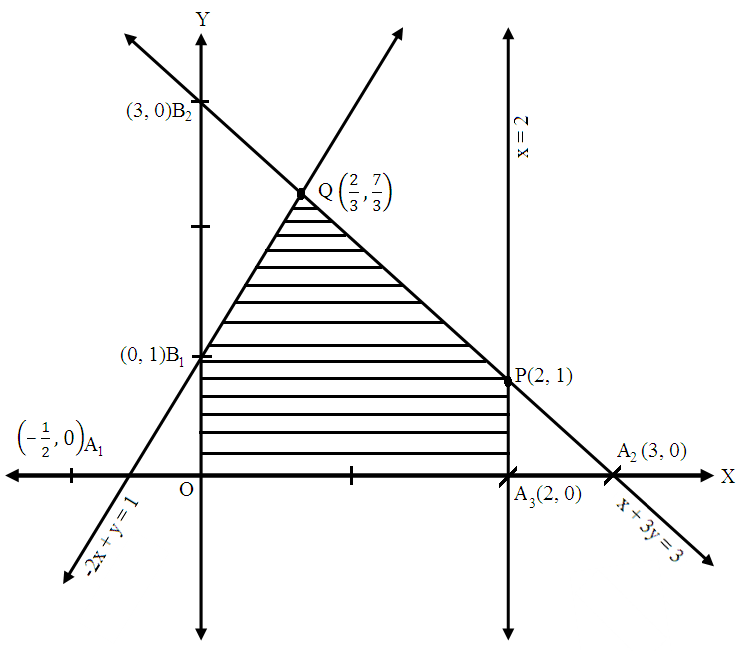
Answer

Converting the given inequations into equation,
$-2x + y = 1, x = 2, x + y = 3, x= y = 0$


Region represented by - $2x + y = 1:$
Line - $2x + y = 1$ meets coordinate axes at $\text{A}_1\Big(\frac{-1}{2},0\Big)$ and B1(0, 1), clearly, (0, 0) satisfies $-2\text{x}+\text{y}\leq1$, so region containing origin represents $-2\text{x}+\text{y}\leq1$ in xy-plane.
Region represented by $\text{x}\leq2$:
Linex - 2 is parallel to y-axis and meets x-axis at $A_3(2, 0).$
Clearly, (0, 0) satisfies $\text{x}\leq2$, so region containing origin represents $\text{x}\leq2$ in xy-plane.
Region represented by $\text{x}+\text{y}\leq3$:
Line x + y - 3 meets coordinate axes at $A_2(3, 0)$ and$ B_2(0, 3).$
Clearly, (0, 0) satisfies $\text{x}+\text{y}\leq3$, so region containing origin represents $\text{x}+\text{y}\leq3$ in xy-plane.
Region represented $\text{x},\text{y}\geq0$:
It represents first quadrant in xy-plane.
So, shaded region $OA_3PQ8$, represents the feasible region.
Coordinates of P(2, 1) is obtained by solving x + y = 3 and x = 2, $\text{Q}\Big(\frac{2}{3},\frac{7}{3}\Big)$ by solving -2x + y = 1 and x + y = 3.
The value of Z = x + y at
$\text{O}(0, 0) = 0 + 0 = 0$
$\text{A}_3(2, 0) = 2 + 0 = 2$
$\text{P}(2, 1) = 2 +1 = 2$
$\text{Q}\Big(\frac{2}{3},\frac{7}{3}\Big)=\frac{2}{3}+\frac{7}{3}=3$
$\text{B}_1(0, 1) = 0 + 1 = 1$
So, maximum Z = 3 is at every point on the line joining PQ.
Hence, maximum z = 3 at x = 2 and y = 1 Or $\text{x}=\frac{2}{3}$ and $\text{y}=\frac{7}{3}.$

Need a full question paper?

Generate a complete, print-ready paper with questions like this in minutes — across 16+ boards, with answer keys.

Start Generating Free

Similar questions

Draw a rough sketch of the curve $\text{y}=\frac{x}{\pi}+2\sin^2\text{x}$ and find the area between x-axis, the curve and the ordinates $\text{x}=0\text{ and }\text{x}=\pi.$
Evaluate the following integrals:$\int\frac{\text{x}-1}{3\text{x}^2-4\text{x}+3}\text{dx}$
Evaluate the following integrals:
$\int\sqrt{2\text{x}-\text{x}^2}\text{dx}$
The vertices A, B, C of triangle ABC have respectively position vector $\vec{\text{a}},\ \vec{\text{b}},\ \vec{\text{c}}$ with respect to given origin O. Show that the point D where the bisector of $\angle{\text{A}}$ meets BC has position Vector $\vec{\text{d}}=\frac{\beta\vec{\text{b}}+\gamma\vec{\text{c}}}{\beta+\gamma}$, where $\beta=\big|\vec{\text{c}}-\vec{\text{a}}\big|$ and, $\gamma=\big|\vec{\text{a}}-\vec{\text{b}}\big|$.
Find $\frac{\text{dy}}{\text{dx}},$ when
$\text{x}=\text{a}(\cos\theta+\theta\sin\theta)$ and $\text{y}=\text{a}(\sin\theta-\theta\sin\theta-\theta\cos\theta)$
Evaluate the following integrals:
$\int\text{e}^{2\text{x}}\Big(\frac{1-\sin2\text{x}}{1-\cos2\text{x}}\Big)\text{dx}$
If $\text{u}=\sin^{-1}\Big(\frac{2\text{x}}{1+\text{x}^2}\Big)$ and $\text{v}=\tan^{-1}\Big(\frac{2\text{x}}{1-\text{x}^2}\Big),$ where -1 < x < 1 then write the value of $\frac{\text{dy}}{\text{dx}}.$
A company has two plants to manufacture bicycles. The first plant manufactures $60 \%$ of the bicycles and the second plant $40 \%$. Out of the $80 \%$ of the bicycles are rated of standard quality at the first plant and $90 \%$ of standard quality at the second plant. A bicycle is picked up at random and found to be standard quality. Find the probability that it comes from the second plant.
Find the intervals in which the following functions are increasing or decreasing.
$f(x) = x^3- 12x^2 + 36x + 17$
Solve the following initial value problems:
$\text{x}\frac{\text{dy}}{\text{dx}}+\text{y}=\text{x}\cos\text{x}+\sin\text{x},\text{ y}\Big(\frac{\pi}{2}\Big)=1$