MCQ
Maximum threat to the world is from :
  • A
    Global warming.
  • Ozone hole.
  • C
    Water pollution.
  • D
    Soil erosion.

Answer

Correct option: B.
Ozone hole.
Maximum threat to the world is from ozone layer which is found in the stratosphere. This layer acts as a shield absorbing $\text{UV}$ radiations from the sun. For the ozone layer to be intact there has to be a balance between the production and degradation which has been disturbed by the $\text{CFCs}$ used in refrigerators. The $\text{F}$ and $\text{Cl,}$ which are released by these compounds results in the thinning out of the ozone layer also known as the ozone hole. It causes threat to life and environment as it leads to skin aging and cancers, snow blindness, cataract, melting of polar ice caps, global warming etc.

Need a full question paper?

Generate a complete, print-ready paper with questions like this in minutes — across 16+ boards, with answer keys.
Start Generating Free

Similar questions

Assign $A, B, C, D$ from given type of reaction. ${K_2}Mn{O_4} + {H^ + } \longrightarrow KMn{O_4} + Mn{O_2} \downarrow $
Benzene burns according to the following equation at $300\, K$ $(R = 8.314\, J\, mole^{-1}K^{-1}), 2C_6H_6(l) + 15 O_2 (g) \to  12 CO_2 (g) + 6H_2O(l)$, $\Delta H^o = -6542\, kJ/mol$ What is the $\Delta E^o$ for the combustion of $1.5\, mol$ of benzene.....$kJ$
The bond angle between ${H - O -H}$ in ice is closest to
Some pairs of ions are given below. In which pair, first ion is more stable than second?
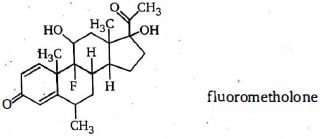
The following molecule is fluorometholone a steroidal anti-inflammatory agent.  How many stereogenic centers does it contain ?
Which of the following is not a biological function of calcium?
The pressure exerted by the gaseous molecules is due to :
For the given reaction, choose the correct expression of $\mathrm{K}_{\mathrm{C}}$ from the following :-$\mathrm{Fe}_{(\mathrm{aq})}^{3+}+\mathrm{SCN}_{(\mathrm{aq})}^{-} \rightleftharpoons(\mathrm{FeSCN})_{(\mathrm{aq})}^{2+}$
Which of the following reactions are disproportionation reactions?

(A) $\mathrm{Cu}^{+} \rightarrow \mathrm{Cu}^{2+}+\mathrm{Cu}$

(B) $3 \mathrm{MnO}_4^{2-}+4 \mathrm{H}^{+} \rightarrow 2 \mathrm{MnO}_4^{-}+\mathrm{MnO}_2+2 \mathrm{H}_2 \mathrm{O}$

(C) $2 \mathrm{KMnO}_4 \rightarrow \mathrm{K}_2 \mathrm{MnO}_4+\mathrm{MnO}_2+\mathrm{O}_2$

(D) $2 \mathrm{MnO}_4^{-}+3 \mathrm{Mn}^{2+}+2 \mathrm{H}_2 \mathrm{O} \rightarrow 5 \mathrm{MnO}_2+4 \mathrm{H}^{+}$

Choose the correct answer from the options given below:

Some inert gas is added at constant volume to the following reaction at equilibrium

$N{H_4}HS(s) \rightleftharpoons N{H_3}(g) + H_2S(g)$

Predict the effect of adding the inert gas