Mechanical waves on the surface of a liquid are
Easy
Download our app for free and get started
The mechanical waves on the surface of a liquid are both the transverse as well as the longitudinal waves.

Download our appand get started for free
Experience the future of education. Simply download our apps or reach out to us for more information. Let's shape the future of learning together!No signup needed.*
Similar Questions
- 1If two waves having amplitudes $2A$ and $A$ and same frequency and velocity, propagate in the same direction in the same phase, the resulting amplitude will beView Solution
- 2Two tuning forks, $A$ and $B$, give $4$ beats per second when sounded together. The frequency of $A$ is $320 Hz.$ When some wax is added to $B$ and it is sounded with $A, 4$ beats per second are again heard. The frequency of $B$ is .... $Hz$View Solution
- 3View Solutionstationary source is emitting sound at a fixed frequency $f_0$, which is reflected by two cars approaching the source. The difference between the frequencies of sound reflected from the cars is $1.2\%$ of $f_0$. What is the difference in the speeds of the cars (in $km$ per hour) to the nearest integer ..... $km/hr$ ? The cars are moving at constant speeds much smaller than the speed of sound which is $330$ $ms^{-1}$.
- 4A sound source is moving towards a stationary observer with $(1/10)$ of the speed of sound. The ratio of apparent to real frequency is .........View Solution
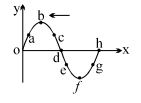
- 5The figure represents the instantaneous picture of a transverse harmonic wave traveling along the negative $x$-axis. Choose the correct alternative $(s)$ related to the movement of the nine points shown in the figure. The points moving upward is/areView Solution
- 6Two superimposing waves are represented by equation $y_1=2 \sin 2 \pi(10 t-0.4 x)$ and $y_2=4 \sin 2 \pi(20 t-0.8 x)$. The ratio of $I_{\max }$ to $I_{\min }$ is ........View Solution
- 7On sounding tuning fork $A$ with another tuning fork $B$ of frequency $384 Hz, 6$ beats are produced per second. After loading the prongs of $A$ with some wax and then sounding it again with $B, 4$ beats are produced per second. What is the frequency of the tuning fork $A$ .... $Hz$View Solution
- 8View SolutionThe type of waves that can be propagated through solid is
- 9A wire having a linear mass density $9.0 \times 10^{-4} \;{kg} / {m}$ is stretched between two rigid supports with a tension of $900\; {N}$. The wire resonates at a frequency of $500\;{Hz}$. The next higher frequency at which the same wire resonates is $550\; {Hz}$. The length of the wire is $...... {m}$View Solution
- 10Assume that the displacement$(s)$ of air is proportional to the pressure difference $(\Delta p)$ created by a sound wave. Displacement$(s)$ further depends on the speed of sound $(v),$ density of air $(\rho)$ and the frequency $(f)$ If $\Delta p \approx 10\, Pa , v \approx 300\, m / s , p \approx 1\, kg / m ^{3}$ and $f \approx 1000 \,Hz$, then $s$ will be the order ofView Solution
(take multiplicative constant to be $1$ )