A sound source is moving towards a stationary observer with $(1/10)$ of the speed of sound. The ratio of apparent to real frequency is .........
Easy


Download our appand get started for free
Experience the future of education. Simply download our apps or reach out to us for more information. Let's shape the future of learning together!No signup needed.*
Similar Questions
- 1In a closed organ pipe, the frequency of fundamental note is $30 \mathrm{~Hz}$. A certain amount of water is now poured in the organ pipe so that the fundamental frequency is increased to $110 \mathrm{~Hz}$. If the organ pipe has a cross-sectional area of $2 \mathrm{~cm}^2$, the amount of water poured in the organ tube is _____________$g.$ (Take speed of sound in air is $330 \mathrm{~m} / \mathrm{s}$ )View Solution
- 2A closed organ pipe has a frequency $'n'$. If its length is doubled and radius is halved, its frequency nearly becomes-View Solution
- 3View SolutionThe following phenomenon cannot be observed for sound waves
- 4Two waves having equationsView Solution
${x_1} = a\sin (\omega \,t + {\phi _1})$, ${x_2} = a\sin \,(\omega \,t + {\phi _2})$
If in the resultant wave the frequency and amplitude remain equal to those of superimposing waves. Then phase difference between them is
- 5A sonometer wire of length $114\, cm$ is fixed at both the ends. Where should the two bridges be placed so as to divide the wire into three segments whose fundamental frequencies are in the ratio $1 : 3 : 4$ ?View Solution
- 6Tuning fork ${F_1}$ has a frequency of $256 Hz$ and it is observed to produce $6$ beats/second with another tuning fork ${F_2}$. When ${F_2}$ is loaded with wax, it still produces $6$ beats/second with ${F_1}$. The frequency of ${F_2}$ before loading was ..... $Hz$View Solution
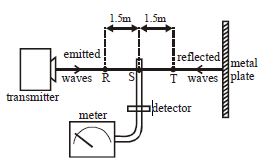
- 7The given diagram shows a detector placed between a transmitter of sound waves and a metal plate. At three adjacent points, $ R, S$ and $T$ , the meter shows zero intensity. Which of the following is the frequency of the emitted wave ... $Hz$ ? (Take the velocity of sound as $ = 300\ m/s$ )View Solution
- 8View SolutionStanding waves can be produced
- 9The equation of a transverse wave is given by $y = 100\,\sin \pi (0.04z - 2t)$ where $y$ and $z$ are in $cm$ and $t$ is in seconds. The frequency of the wave in $Hz$ isView Solution
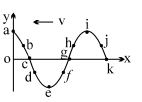
- 10The figure represents the instantaneous picture of a longitudinal harmonic wave travelling along the negative $x$-axis. Identify the correct statement $(s)$ related to the movement of the points shown in the figure. The points of maximum compression areView Solution