Question
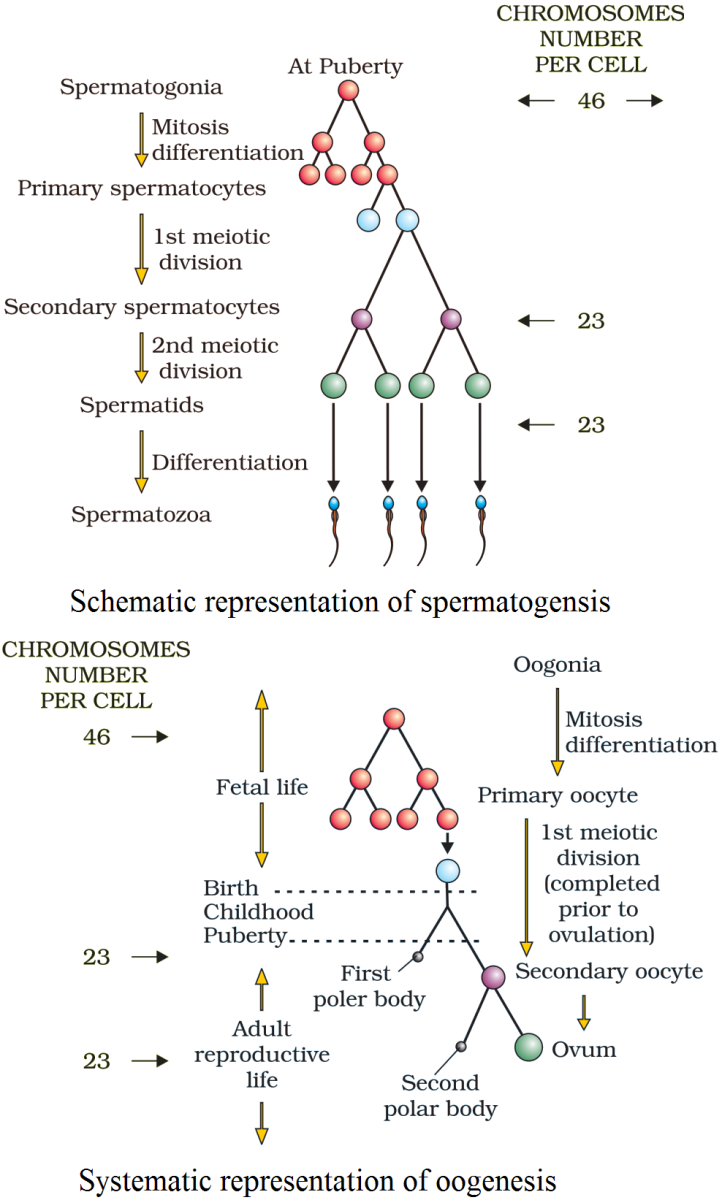
Meiotic division during oogenesis is different from that in spermatogenesis. Explain how and why?
Answer

Unequal cytoplasmic division of the oocyte is to ensure the retention of bulk of cytoplasm in one cell called secondary oocyte instead of sharing it with two. It has to provide nourishment for the developing embryo during early stages, so it is essential to retain as much cytoplasmic materials it could in a single daughter cell.


Need a full question paper?

Generate a complete, print-ready paper with questions like this in minutes — across 16+ boards, with answer keys.

Start Generating Free

Similar questions

(a) Explain the process of DNA replication in prokaryotes.
(b) Name the phase in the cell cycle in which DNA replication takes place in the cell. What if after DNA replication there is no cell division in a cell?
Pragyan takes fruits, vegetables, bread and egg curry in a day's menu. While his teacher was giving a lecture on trophic level, he got fascinated and asked following questions from his teacher.
  1. How many trophic levels does he occupy in different food chains?
  2. Represent atleast three food chains.
  3. Which among them gives him the maximum amount of energy? Give reason.
  4. What values are shown by Pragyan?
For the selection of recombinants, insertional inactivation of the antibiotic marker has been superseded by insertional inactivation of a marker gene coding for a chromogenic substrate. Give reasons.
It has often been seen that phenotype of F1 offspring resembles to both the parents. Justify your by taking the example of inheritance of ABO blood group in human being.
State the laws of inheritance that can be derived from such a cross.
With a suitable diagram, describe the organisation of mammary gland.
Read the following and answer any four questions from (i) to (v) given below:

Crown gall is a neoplastic disease of most dicotyledonous plants and is caused by the soil bacterium Agrobacterium tumefaciens. A large extra chromosomal plasmid in these bacteria was found to be responsible for this disease. The plasmid is known as Ti plasmid. Bacteria free crown gall cells can be cultured in the absence of phytohormones. Ti plasmid is widely used in genetic engineering to deliver the desirable genes. The part of Ti plasmid transferred into plant cell DNA is called T-DNA. T-DNA with desired DNA segment is inserted into the chromosome of the host plant where it produces copies of itself.

  1. Which of the following is the full full of T-DNA?
  1. Transfer DNA.
  2. Tumour inducing DNA.
  3. Transgenic DNA.
  4. None of these.
  1. Ti plasmid cannot infect and develop crown gall in,
  1. Tomato.
  2. Maize.
  3. Soybean.
  4. sunflower.
  1. While making transgenic plant, T-DNA is inserted into the host cell, it is then:
  1. Integrated into the target host genome.
  2. Lie independent of the host genome.
  3. Rupture the host cell wall.
  4. Produce oncogenic factors in the host.
  1. Agrobacterium mediated gene transfer in plants:
  1. Allows relatively large segment of DNA.
  2. Transfer of DNA with defined ends and minimal rearrangement.
  3. High quality and fertility in transgenic plants.
  4. All of these.
  1. Assertion: In Agrobacterium mediated gene transfer in plants, transgenic plants do not develop tumors.

Reason: In T-DNA tumor producing genes are deleted during the process of gene transfer.

  1. Both assertion and reason are true and reason is the correct explanation of assertion.
  2. Both assertion and reason are true but reason is not the correct explanation of assertion.
  3. Assertion is true but reason is false.
  4. Both assertion and reason are false.
Avinash went to his village during his summer vacations. One day, he decided to visit the nearby forest and asked his grandfather to accompany him. His grandfather told him about the recent cutting of forest and the new factory which had been established. Hearing this Avinash became curious and explained his grandfather about the ecosystem services.
  1. What are the benefits of healthy forest ecosystem?
  2. Explain the contribution of Robert Constanza in ecosystem services.
  3. What factors account for cost of various ecosystem services?
  4. What values are shown by Avinash?
Name any two chromosomal aberration associated disorders.
State the Mendel’s law of inheritance that is universally acceptable.