Question
Mention different safety measures and precautions while using electricity and electrical appliances.

Answer

Electricity is very useful to us. It has made our life comfortable, easy and luxurious. On the other hand, it is dangerous also. It may cause great mishappenings, injuries and sometimes even death. So we must adopt some safety measures and take precautions discussed below:
$1.$ Never touch electrical switches or gadgets when your body is wet.
$2.$ If you need to operate or repair any electrical appliances, wear rubber hand gloves and stand on a dry wooden or plastic base. $3.$ Never play with electric sockets or wires.
$4.$ In case of short circuit or a spark in a switch, put the main switch off immediately with the help of a plastic or wooden stick.
$5.$ In case of fire in electric wires, never use water to extinguish it. First switch off the mains, then use dry sand to extinguish the fire.

Need a full question paper?

Generate a complete, print-ready paper with questions like this in minutes — across 16+ boards, with answer keys.

Start Generating Free

Similar questions

A torch is not functioning, though contact points in the torch are in working condition. What can be the possible reasons for this? Mention any three.
Match the objects given in Column $I$ with the materials given in Column $II.$
 
$COLUMN\ I$
 
$COLUMN\ II$
$a$
Surgical Instruments
$i$
Plastic
$b$
Newspaper
$ii$
Animal product
$c$
Electrical switches
$iii$
Steel
$d$
Wool
$iv$
Plant product
Suggest an arrangement to store a $U$ shaped magnet. How is this different from storing a pair of bar magnets?
Match the following items given in Column $A$ with that in Column $B$:
S.No.
Column $A$
S.No.
Column $B$
$(a)$
Handpicking
$(i)$
Conversion of water vapours into liquids.
$(b)$
Threshing
$(ii)$
Separating bran from flour.
$(c)$
Winnowing
$(iii)$
Separating larger size impurities.
$(d)$
Sieving
$(iv)$
Separating butter from milk.
$(e)$
Sedimentation
$(v)$
Conversion of water into Us vapours.
$(f)$
Evaporation
$(vi)$
Separating grains from its stalks.
$(g)$
Condensation
$(vii)$
Settling of heavier components at bottom.
$(h)$
Churning
$(viii)$
Separation by wind or by blowing air.
Identify the wrong statements and correct them:
  1. Anther is a part of the pistil.
  2. The visible parts of a bud are the petals.
  3. Lateral roots are present in a tap root.
  4. Leaves perform the function of transpiration only.
Match the following items given in Column $A$ with that in Column $B$:
S.No.
Column $A$
S.No.
Column $B$
$(a)$
Cell
$(i)$
Allows electricity to pass through it.
$(b)$
Battery
$(ii)$
Either breaks or completes a circuit.
$(c)$
Conductor
$(iii)$
Converts electricity into light.
$(d)$
Insulator
$(iv)$
Glows when electricity passes in it.
$(e)$
Switch
$(v)$
A device which produces electricity.
$(f)$
Bulb
$(vi)$
Is a path of electricity.
$(g)$
Filament
$(vii)$
Does not allow electricity to pass.
$(h)$
Circuit
$(viii)$
A combination of cells.
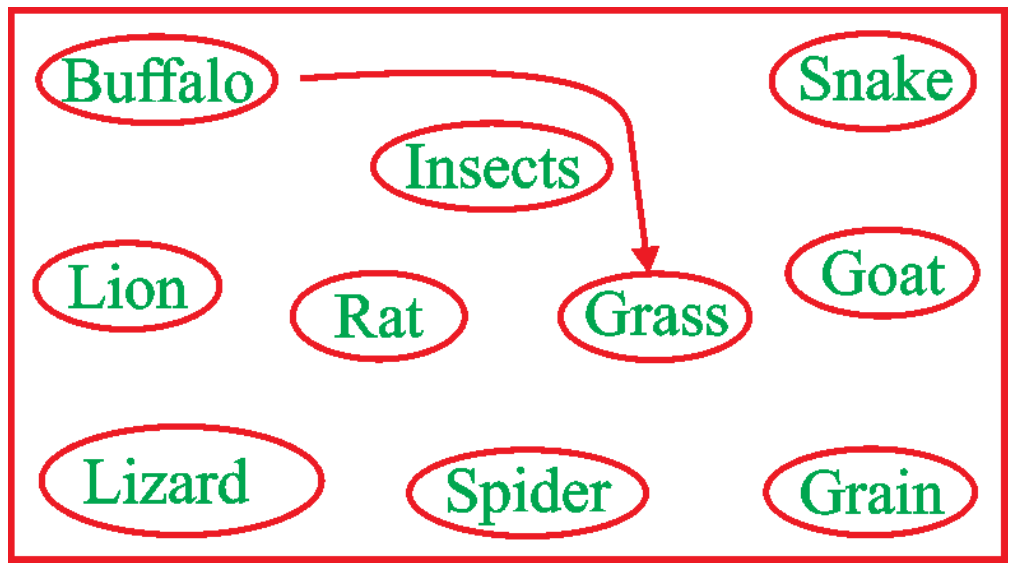
Connect the animal with the food it eats by an arrow using different colours in the figure given below. One is done for you.
Both Sarika and Mohan were asked to make salt solution. Sarika was given a teaspoonful of salt and half a glass of water, whereas Mohan was given twenty teaspoons full of salt and half a glass of water.
  1. How would they make salt solutions?
  2. Who would be able to prepare saturated solution?
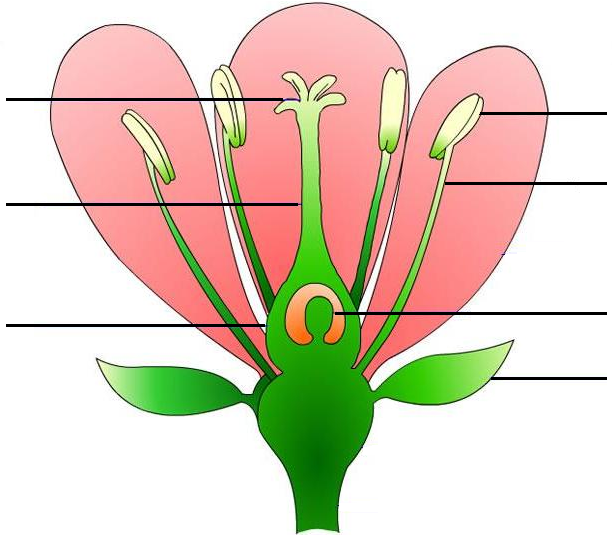
Given below is a diagram of a flower. Study it carefully and label the parts as indicated.
Ishika was asked by her teacher to measure the length of the line drawn on the blackboard. She immediately took out her scale to measure the line. But she noticed that the end of her scale is broken. She felt very sad and said to the teacher that she would not be able to measure the length of the line. Teacher consoled her and taught her a new method of measuring line using the same scale.
$(a)$ What is a scale?
$(b)$ Name devices that can be used to measure length.
$(c)$ What new method of measuring line by using a broken scale was taught by Ishika's teacher?
$(d)$ What values of Ishika is shown here?