Question
Mention important results regarding electrostatics of conductors.

Answer

Important results regarding electrostatics of conductors are as follows :
(1) Inside a conductor, electric field is zero.
(2) At the surface of a charged conductor, electrostatic field must be normal to the surface at every point.
(3) The interior of a conductor can have no excess charge in the static situation.
(4) Electrostatic potential is constant throughout the volume of the conductor and has the same value inside as on its surface.
(5) Electric field at the surface of a charged conductor
$\overrightarrow{ E }=\frac{\sigma}{\varepsilon_0} \hat{n}$
Where, $\sigma$ is the surface charge density and
$\hat{n}$ is a unit vector normal to the surface in the outward direction.
(6) When a conductor with a cavity is placed in external electric field the cavity in the conductor remains shielded from the outside electric influence. (The field inside cavity is always zero. This is known as electrostatic shielding.)

Need a full question paper?

Generate a complete, print-ready paper with questions like this in minutes — across 16+ boards, with answer keys.
Start Generating Free

Similar questions

In some old texts it is mentioned that $4\pi$ lines of force originate from each unit positive charge. Comment on the statement in view of the fact that $4\pi$ is not an integer.
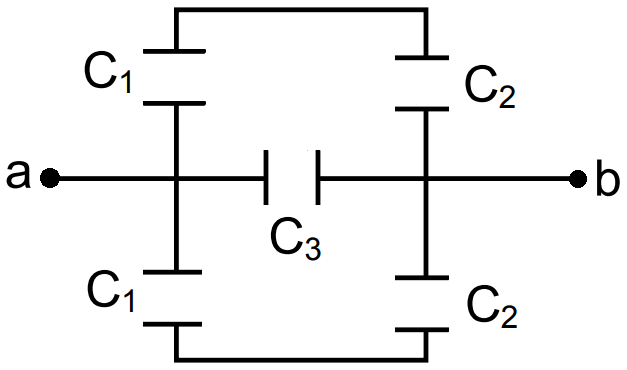
Find the equivalent capacitance of the syatem shown in figure between the points $a$ and $b.$
Calculate the potential energy of a single charge in an external field.
In half-wave rectification, what is the output frequency if the input frequency is 50 Hz. What is the output frequency of a full-wave rectifier for the same input frequency?
The angle made by the string of a simple pendulum with the vertical depends on time as $\theta=\frac{\pi}{90}\sin[(\pi\text{s}^{-1})\text{t}].$ Find the length of the pendulum if $\text{g}=\pi^2\text{m/s}^2.$
Answer the following question:
Every metal has a definite work function. Why do all photoelectrons not come out with the same energy if incident radiation is monochromatic? Why is there an energy distribution of photoelectrons?
Using the formula $\overrightarrow{\text{F}}=\text{q}\overrightarrow{\text{v}}\times\overrightarrow{\text{B}}$ and $\text{B}=\frac{\mu_0\text{i}}{2\pi\text{r}},$ show that the $SI$ units of the magnetic field $B$ and the permeability constant $\mu_0$ may be written as $N/A-m$ and $NA^2$ respectively.
A filter transmits only the radiation of wavelength greater than $440\ nm.$ Radiation from a hydrogen$-$discharge tube goes through such a filter and is incident on a metal of work function $2.0eV.$ Find the stopping potential which can stop the photoelectrons.
The separation between a node and the next antinode in a vibrating air column is 25cm. If the speed of sound in air is 340m/s, find the frequency of vibration of the air column.
What is the width of the depletion layer of a P-N junction when it is (i) forward biased (ii) reverse biased?