Question
Mention the changes occurring in the geomagnetic components.

Answer

Changes in the geomagnetic components : Magnitudes of geomagnetic components are not only different at different places on the earth and there are usual and unusual changes in their magnitudes at same place also. These changes are as follows:
(1) Long term changes: According to Kelvin, changes in magnitudes of geomagnetic components occur very slowly with time and after one thousand years, they again come back to their original value. According to him, the cause of this change is the spinning of magnetic poles around the geographic poles.
(2) Annual changes: These changes complete their cycle in one year. These changes are maximum in a particular month and minimum in another particular month and their characteristics is of opposite types in both hemispheres. For example, in the month of February, angle of dip is maximum in northern hemisphere and minimum in southern hemisphere. In contract to this, in the month of August, it is minimum in northern hemisphere and maximum in southern hemisphere.
(3) Daily changes : In magnitude of geomagnetic elements, there are daily changes. These changes are maximum at a particular time of the day and minimum at another particular time of the day. This time is different for three components.
(4) Non-periodic changes : Sometimes there are sudden changes in geomagnetic components which are known as magnetic disturbance. Whenever black spot in the sun is towards earth, then there is sudden change in geomagnetic elements.

Need a full question paper?

Generate a complete, print-ready paper with questions like this in minutes — across 16+ boards, with answer keys.

Start Generating Free

Similar questions

Deduce the expression for the torque $\overrightarrow{\tau}$  acting on a planar loop of area $\overrightarrow{\text{A}}$ and carrying current I placed in a uniform magnetic field $\overrightarrow{\text{B}}.$ 
If the loop is free to rotate, what would be its orientation in stable equilibrium?
Radio waves are produced by the accelerated motion of charges in conducting wires. Microwaves are produced by special vacuum tubes. Infrared waves are produced by hot bodies and molecules also known as heat waves. UV rays are produced by special lamps and very hot bodies like Sun. 
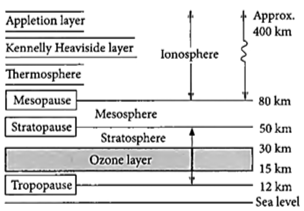
Image
(i) Solar radiation is
i. transverse electromagnetic wave
ii. longitudinal electromagnetic waves
iii. both longitudinal and transverse electromagnetic waves
iv. none of these.
(a) Option (i)  (b) Option (iv)  (c) Option (iii)  (d) Option (ii)

(ii) What is the cause of greenhouse effect?
(a) Ultraviolet rays (b) X-rays (c) Infrared rays (d) Radiowaves

(iii) Biological importance of ozone layer is
(a) it stops ultraviolet rays
(b) none of these.
(c) it reflects radiowaves
(d) It layer reduces greenhouse effect

OR

Earth's atmosphere is richest in
(a) ultraviolet (b) infrared (c) X-rays (d) microwaves

(iv) Ozone is found in
(a) troposphere (b) mesosphere (c) ionosphere (d) stratosphere
A fat person is standing on a light plank floating on a calm lake. The person walks from one end to the other on the plank. His friend sitting on the shore watches him and finds that the person hardly moves any distance because the plank moves backward about the same distance as the person moves on the plank. Explain.
A container contains water upto a height of 20cm and there is a point source at the centre of the bottom of the container. A rubber ring of radius r floats centrally on the water. The ceiling of the room is 2.0m above the water surface.
  1. Find the radius of the shadow of the ring formed on the ceiling if r = 15cm.
  2. Find the maximum value of r for which the shadow of the ring is formed on the ceiling. Refractive index of water $\frac{4}{3}.$
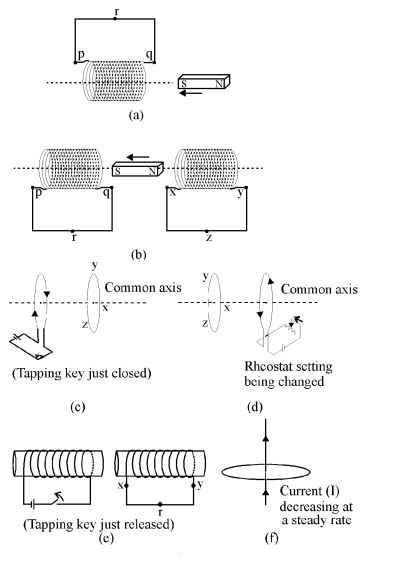
Predict the direction of induced current in the situations described by the following figures (a) to (f).
Image
A child has near point at 10cm. What is the maximum angular magnification the child can have with a convex lens of focal length 10cm?
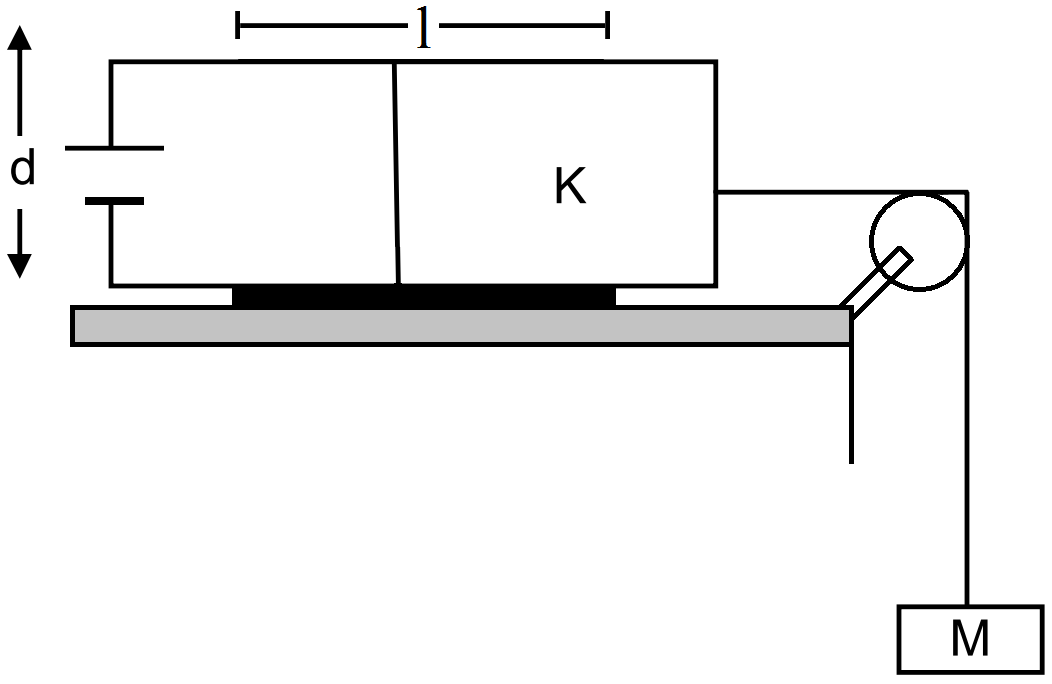
Consider the situation shown in figure. The width of each plate is b. The capacitor plates are rigidly clamped in the laboratory and connected to a battery of emf $\in.$ All surfaces are frictionless. Calculate the value of M for which the dielectric slab will stay in equilibrium.

Draw the graph of deviation angle $(\delta)$ versus incidence angle (i) and derive the formula for refractive index $n_{21}=\frac{\sin \left(\frac{A+D_m}{2}\right)}{\sin \left(\frac{A}{2}\right)}$ for the material of prism.
Two friends A and B are standing a distance x apart in an open field and wind is blowing from A to B. A beats a drum and B hears the sound t1 time after he sees the event. A and B interchange their positions and the experiment is repeated. This time B hears the drum t2 time after he sees the event. Calculate the velocity of sound in still air v and the velocity of wind u. Neglect the time light takes in travelling between the friends.
Complete the following table:
Car Model
Driver X
Reaction time 0.20s
Driver Y
Reaction time 0.30s
A (deceleration on hard braking = 6.0m/s2)
Speed = 54km/h
Braking distance
a = ...
Total stopping distance
b = ...
Speed = 72km/h
Braking distance
c = ...
Total stopping distance
d = ...
B (deceleration on hard braking = 7.5m/s2)
Speed = 54km/h
Breaking distance
e = ...
Total stopping distance
f = ...
Speed 72km/h
Braking distance
g = ...
Total stopping distance
h = ...