Question
Mention the major events during photosynthesis.

Answer

1. Photolysis: With the help of light energy, oxygen evolving Z-complex splits up water into its components- protons $\left( H ^{+}\right)$, electrons $\left( e ^{-}\right)$and oxygen.
$2 H_2 O \xrightarrow[Mn, Ca, Cl]{OEC} O_2+4 H^{+}+4 e^{-}$
2. Absorption of Light Energy: Chlorophyll absorbs light energy.
3. Primary Reaction: Chlorophyll converts the absorbed light energy into chemical energy. It is called primary reaction of photosynthesis. It builds up ATP with the help of excited electrons.
4. Formation of Reducing Power: Coenzyme NADP ${ }^{+}$is changed to reduced form of NADPH.
$NADP^{+}+H^{+}+2 e^{-} \rightarrow NADPH$
5. Reduction of $C O _2$ : Carbon dioxide is reduced enzymatically with the help of NADPH and ATP to form carbohydrates.
$6 CO_2+12 NADPH+18 ATP \rightarrow C_6 H_{12} O_6+12 NADP^{+}+18 ADP+18 Pi$

Need a full question paper?

Generate a complete, print-ready paper with questions like this in minutes — across 16+ boards, with answer keys.

Start Generating Free

Similar questions

The organisms A, B and C can obtain their food in three different ways. Organism A derives its food from the body of another living organism which is called its D, without killing it. The organism B takes in the solid food by the process of ingestion, digests a part of this food and throws out undigested food in the process called E. The organism C obtains its food from dead and decaying plants.
  1. What is the mode of nutrition of (i) organism A (ii) organism B, and (iii) organism C?
  2. What is the organism like D called?
  3. Name the process E.
  4. Give one example each of organisms like A, B and C.
  5. What is the general name of three modes of nutrition exhibited by organisms A, B and C?
A $10 cm$ long pencil is placed $5 cm$ in front of a concave mirror having a radius of curvature of $40 cm$.
(i) Determine the position of the image formed by this mirror.
(ii) What is the size of the image?
(iii) Draw a ray diagram to show the formation of the image as mentioned in the part (i).
What are fossils? How are they formed? List two methods of determining the age of fossils. Explain in brief the importance of fossils in deciding the evolutionary relatrionships.
Compounds such as alcohol and glucose also contain hydrogen but are not categorised as acids. Describe an activity to prove it.
Differentiate between an autotroph and a heterotroph.
The image below shows a developing fetus in the mother's womb. The developing fetus is connected to the placenta by means of umbilical cord. The Umbilical vein and artery run inside the umbilical cord.
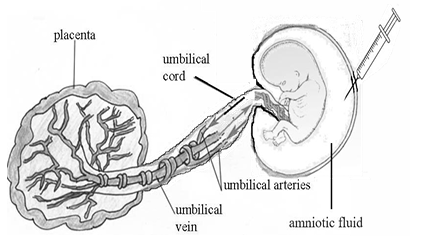
Image

(i) Name two substance that moves through the blood vessels. (1)
(ii) If the placenta has less villi how will it affect the baby's growth? (1)
(iii) Name the region where the embryo develops inside the female body. Explain how this region is adapted for nourishing the baby. (1)
(iv) Some of the fetal cells fall off into the amniotic fluid and can be collected by careful procedure. The cells were screened and found to contain XY chromosome. (2)
(a) What is the sex of the foetus?
(b) How is this prenatal sex determination misused?
What is the difference between direct current generator and alternating current generator?
Plants do not have any nervous or muscle tissue, still, they have the ability to sense touch. How?
A compound C (molecular formula, $C _2 H _4 O _2$) reacts with Na - metal to form a compound R and evolves a gas that burns with a pop sound. Compound C on treatment with an alcohol A in presence of an acid forms a sweetsmelling compound S (molecular formula, $C _3 H _6 O _2$). On the addition of NaOH to C, it also gives R and water. S on treatment with NaOH solution gives back R and A.
Identify C, R, A, S, and write down the reactions involved.
Evolution has exhibited a greater stability of molecular structure when compared with morphological structures. Comment on the statement and justify your opinion.