Question
Mercury has an angle of contact equal to $140^{\circ}$ with soda-lime glass. A narrow tube of radius 1.00 mm made of this glass is dipped in a trough containing mercury. By what amount does the mercury dip down in the tube relative to the liquid surface outside? Surface tension of mercury at the temperature of the experiment is 0.465 N $m ^{-1}$. Density of mercury $=13.6 \times 10^3 kgm ^{-3}$. .
Need a full question paper?

Generate a complete, print-ready paper with questions like this in minutes — across 16+ boards, with answer keys.

Start Generating Free

Similar questions

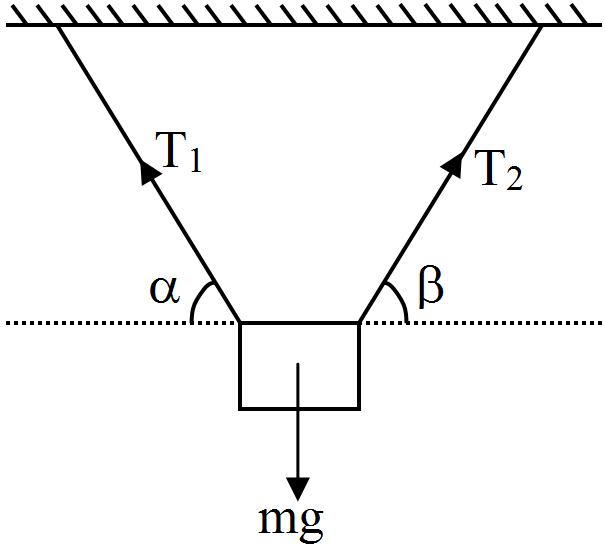
A body of mass m is suspended by two strings making angles $\alpha$ and $\beta$ with the horizonal as shown in Fig. Calculate the tensions in the two strings.
A cube of wood floating in water supports a $200g$ mass resting at the centre of its top face. When the mass is removed, the cube rises $2cm$. Find the volume of the cube.
A football is kicked into the air vertically upwards. What is its
  1. acceleration, and
  2. velocity at the highest point?
A disc of radius $10\ cm$ is rotating about its axis at an angular speed of $20\ \text{rad/s.}$ Find the linear speed of:
  1. A point on the rim.
  2. The middle point of a radius.
Define period of revolution. Derive an expression of period of revolution or time period of satellite.
ls it always true that for two sources of equal intensity, the number of photons emitted in a given time are equal?
Can kinetic energy of a system be increased without applying any external force on the system?
Find the temperature at which the average thermal kinetic energy is equal to the energy needed to take a hydrogen atom from its ground state to n = 3 state. Hydrogen can now emit red light of wavelength 653.1nm. Because of Maxwellian distribution of speeds, a hydrogen sample emits red light at temperatures much lower than that obtained from this problem. Assume that hydrogen molecules dissociate into atoms.
A flywheel of moment of inertia $5.0\ kg-m^2$ is rotated at a speed of $60\ \text{rad/s.}$ Because of the friction at the axle, it comes to rest in $5.0$ minutes. Find:
  1. The average torque of the friction.
  2. The total work done by the friction.
  3. The angular momentum of the wheel $1$ minute before it stops rotating.
Two stars each of one solar mass ($= 2 \times 10^{30}kg$) are approaching each other for a head on collision. When they are a distance $10^9km$, their speeds are negligible. What is the speed with which they collide? The radius of each star is $10^4km.$ Assume the stars to remain undistorted until they collide. (Use the known value of G).