Question
Can kinetic energy of a system be increased without applying any external force on the system?

Answer

Yes. Let us consider an isolated system of two particles falling towards each other under their mutual gravitational force of attraction. Here, the net force on the system is zero, but the velocities of the particles keep on increasing. Also, the kinetic energy of the system is increased without applying any external force on it.

Need a full question paper?

Generate a complete, print-ready paper with questions like this in minutes — across 16+ boards, with answer keys.
Start Generating Free

Similar questions

Satellite $A$ is in a certain circular orbit about a planet, while satellite $B$ is in a larger circular orbit. Which satellite has $(i)$ the longer period and $(ii)$ the greater speed?
The mass of a spaceship is $1000kg$. It is to be launched from the earth's surface out into free space. The value of g and R (radius of earth) are $10m/ s^2$ and $6400km$, respectively. What is the required energy for this work done?
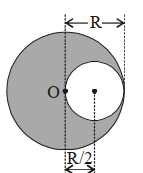
A sphere of radius $R$ has been cut out of $\left(\frac{R}{2}\right)$ solid sphere of radius $R$ as shown in the figure. Find the position of the center of mass of the remaining sphere.
Image
A particle is projected with a velocity of $40m s^{-1}$. After 2s it just crosses a vertical pole of height $20m$. Calculate the angle of projection and the horizontal range.
Find the magnitude and direction of the resultant of two forces $\vec{\text{P}}$ and $\vec{\text{Q}}$ in terms of their magnitudes and angle $\theta$ between them.
A steam engine delivers $5.4 \times 10^8 \mathrm{~J}$ of work per minute and services $3.6 \times 10^9 \mathrm{~J}$ of heat per minute from its boiler. What is the efficiency of the engine? How much heat is wasted per minute?
Show that when a particle is moving in S.H.M. its velocity at a distance $\frac{\sqrt{3}}{2}$ of its amplitude from the central position is half its velocity in central position.
Plot the corresponding reference circle for each of the following simple harmonic motions. Indicate the initial (t = 0) position of the particle, the radius of the circle, and the angular speed of the rotating particle. For simplicity, the sense of rotation may be fixed to be anticlockwise in every case: (x is in cm and t is in s).
$\text{x}=2\cos\pi\text{t}$
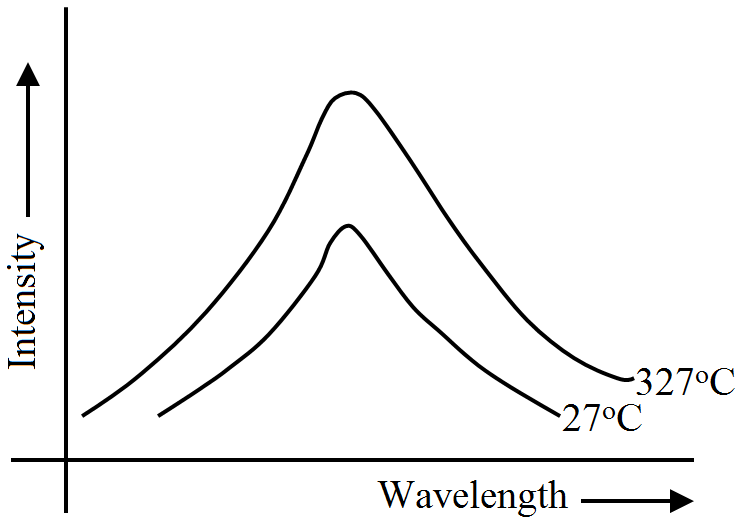
The spectrum of a black body at two temperatures $27 {}^\circ C$ and $327 {}^\circ C$ is shown in the figure. Let $A_1$ and  $A_2$ be the respective areas under the two curves. Estimate the ratio $\frac{A_2}{A_1}.$
How many time constants will elapse before the power delivered by a battery drops to half of its maximum value in an RC circuit?