MCQ
Mercury has an angle of contact equal to $140^{\circ}$ with soda lime glass. A narrow tube of radius $1.00 \;mm$ made of this glass is dipped in a trough containing mercury. By what amount does the mercury dip down (in $mm$) in the tube relative to the liquid surface outside? Surface tension of mercury at the temperature of the experiment is $0.465\; N m ^{-1} .$ Density of mercury $=13.6 \times 10^{3} \;kg m ^{-3}$
  • A
    $11.96$
  • B
    $2.34$
  • C
    $8.24$
  • $5.34$

Answer

Correct option: D.
$5.34$
d
Angle of contact between mercury and soda lime glass, $\theta=140^{\circ}$

Radius of the narrow tube, $r=1 mm =1 \times 10^{-3} m$

Surface tension of mercury at the given temperature, $s=0.465 N m ^{-1}$

Density of mercury, $\rho=13.6 \times 10^{3} kg / m ^{3}$

Dip in the height of mercury $=h$

Acceleration due to gravity, $g=9.8 m / s ^{2}$

Surface tension is related with the angle of contact and the dip in the height as

$s=\frac{h \rho g r}{2 \cos \theta}$

$\therefore h=\frac{2 s \cos \theta}{r \rho g}$

$=\frac{2 \times 0.465 \times \cos 140}{1 \times 10^{-3} \times 13.6 \times 10^{3} \times 9.8}$

$=-0.00534 m$

$=-5.34 mm$

Here, the negative sign shows the decreasing level of mercury. Hence, the mercury level dips by $5.34\; mm$

Need a full question paper?

Generate a complete, print-ready paper with questions like this in minutes — across 16+ boards, with answer keys.

Start Generating Free

Similar questions

Three particles of masses $10\;g, 20\;g$ and $40\;g$ are moving with velocities $10\widehat i,10\widehat j$ and  $10\widehat k\;m/s$ respectively. If due to some mutual interaction, the first particle comes to  rest and the velocity of second particle becomes $\left( {3\widehat i + 4\widehat j\,\,} \right)\, m/s$, then the velocity of third particle is
What is the velocity of a metallic ball of radius $r$ falling in a tank of liquid at the instant when its acceleration is one half that of a freely falling body? $($The densities of metal and of liquid are $\rho$ and $\sigma$ respectively and of viscosity of liquid is $\eta)$
A horizontal heavy uniform bar of weight $W$ is supported at its ends by two men. At the instant, one of the men lets go off his end of the rod, the other feels the force on his hand changed to
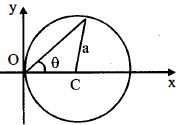
A particle is moving in a circular path of radius $a,$ with a constant velocity $v$ as shown in the figure.The centre of circle is marked by $'C'$. The angular momentum from the origin $O$ can be written as
A body of length 1m having cross sectional area $0.75\;m^2$ has heat flow through it at the rate of $ 6000\; Joule/sec$ . Then find the temperature difference if $K = 200\;J{m^{ - 1}}{K^{ - 1}}$ ...... $^oC$
At $0 \;K$ which of the following properties of a gas will be zero
A symmetric double convex lens is cut in two equal parts by a plane containing the principal axis. If the power of the original lens was 4D, the power of a divided lens will be:
A particle moving with uniform speed in a circular path maintains:
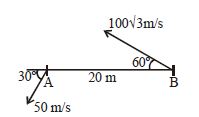
Velocity of two particles $A$ and $B$ separated by distance $20\ m$ apart is as shown in figure then ........ $rad/s$ will be the angular velocity of $B$ with respect to $A$
A refrigerator converts $500\,g$ of water at $25\,^oC$ into ice at $-10\,^oC$ in $3\,hours\,40\,minutes$ . The quantity of heat removed per minute is  ........ $cal/\min$

(Sp. heat of water $1\,cal/gm$, Specific heat of ice $= 0.5\,cal/g\,^oC$ , letent heat of fusion $= 80\,cal/g$ )