Mercury is filled in a tube of radius $2 \mathrm{~cm}$ up to a height of $30 \mathrm{~cm}$. The force exerted by mercury on the bottom of the tube is. . . . . . $\mathrm{N}$.
(Given, atmospheric pressure $=10^5 \mathrm{Nm}^{-2}$, density of mercury $=1.36 \times 10^4 \mathrm{~kg} \mathrm{~m}^3, \mathrm{~g}=10 \mathrm{~ms}^2$, $\left.\pi=\frac{22}{7}\right)$
JEE MAIN 2024, Diffcult


Download our appand get started for free
Experience the future of education. Simply download our apps or reach out to us for more information. Let's shape the future of learning together!No signup needed.*
Similar Questions
- 1A leak proof cylinder of length $1 \;\mathrm{m},$ made of a metal which has very low coefficient of expansion is floating vertically in water at $0^{\circ} \mathrm{C}$ such that its height above the water surface is $20\; \mathrm{cm} .$ When the temperature of water is increased to $4^{\circ} \mathrm{C},$ the height of the cylinder above the water surface becomes $21 \;\mathrm{cm} .$ The density of water at $\mathrm{T}=4^{\circ} \mathrm{C},$ relative to the density at $\mathrm{T}=0^{\circ} \mathrm{C}$ is close toView Solution
- 2View SolutionIn the case of a fluid, Bernoulli's theorem expresses the application of the principle of conservation of :
- 3Three liquids of densities $d,\,2d$ and $3d$ are mixed in equal proportions of weights. The relative density of the mixture isView Solution
- 4Alaminar stream is flowing vertically down from a tap of cross-section area $1$ $cm^2$. At a distance $10 $ $cm$ below the tap, the cross-section area of the stream has reduced to $1/2$ $cm^2$. The volumetric flow rate of water from the tap must be about ........ $litre/\min$View Solution
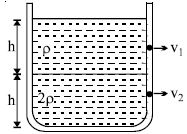
- 5Equal volumes of two immiscible liquids of densities $\rho$ and $2\rho$ are filled in a vessel as shown in figure. Two small holes are punched at depth $h/ 2$ and $3h/2$ from the surface of lighter liquid. If $v_1 $ and $v_2 $ are the velocities of a flux at these two holes, then $v_1/v_2 $ is :View Solution
- 6A sample of metal weighs $210 gm$ in air, $180 gm$ in water and $120 gm$ in liquid. Then relative density $(RD) $ ofView Solution
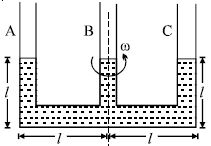
- 7Figure shows a three arm tube in which a liquid is filled upto levels of height $l$. It is now rotated at an angular frequency $\omega$ about an axis passing through arm $B$. The angular frequency $\omega$ at which level of liquid in arm $B$ becomes zero.View Solution
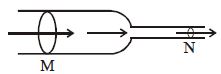
- 8Horizontal tube of non-uniform cross-section has radii of $0.1\,m$ and $0.05\,m$ respectively at $M$ and $N.$ For a stream-line flow of liquid the rate of liquid flow isView Solution
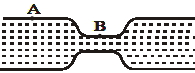
- 9Water flows in a horizontal tube (see figure). The pressure of water changes by $700\; \mathrm{Nm}^{-2}$ between $\mathrm{A}$ and $\mathrm{B}$ where the area of cross section are $40\; \mathrm{cm}^{2}$ and $20\; \mathrm{cm}^{2},$ respectively. Find the rate of flow of water through the tube. ........ $\mathrm{cm}^{3} / \mathrm{s}$View Solution
(density of water $=1000\; \mathrm{kgm}^{-3}$ )
- 10At what speed, the velocity head of water is equal to pressure head of $40 \,cm$ of mercury is ........ $m / s$View Solution