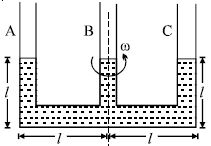
Figure shows a three arm tube in which a liquid is filled upto levels of height $l$. It is now rotated at an angular frequency $\omega$ about an axis passing through arm $B$. The angular frequency $\omega$ at which level of liquid in arm $B$ becomes zero.
Diffcult
Download our app for free and get started
$P=P_{0}+\rho g\left(\frac{3 l}{2}\right)=P_{0}+\frac{3 \rho g l}{2}$
$\left(\mathrm{P}-\mathrm{P}_{0}\right) \mathrm{S}=(\rho \mathrm{S} l) \frac{l}{2} \omega^{2}$
$\frac{3 \rho g l S}{2}=\frac{\rho S l^{2}}{2} \omega^{2}$
$\frac{3}{2} g=\frac{l \omega^{2}}{2}$
$\omega^{2}=\frac{3 g}{l}$
$\omega=\sqrt{\frac{3 g}{l}}$

Download our appand get started for free
Experience the future of education. Simply download our apps or reach out to us for more information. Let's shape the future of learning together!No signup needed.*
Similar Questions
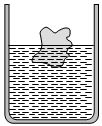
- 1View SolutionA body floats in a liquid contained in a beaker. If the whole system as shown in figure falls freely under gravity, then the upthrust on the body due to liquid is
- 2Water flows in a streamlined manner through a capillary tube of radius $a$, the pressure difference being $P$ and the rate of flow $Q$. If the radius is reduced to $a/2$ and the pressure increased to $ 2P, $ the rate of flow becomesView Solution
- 3A hollow sphere has inner volume half the outer volume. Its $4/5\,th$ part is submerged when placed in water. The density of material isView Solution
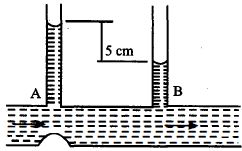
- 4In the diagram shown, the difference in the two tubes of the manometer is $5\, \ cm$, the cross section of the tube at $A$ and $B$ is $6\, mm^2$ and $10\, mm^2$ respectively. The rate at which water flows through the tube is $........ cc/s$View Solution
$(g\, = 10\, ms^{-2})$
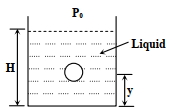
- 5A small spherical monoatomic ideal gas bubble $\left(\gamma=\frac{5}{3}\right)$ is trapped inside a liquid of density $\rho_{\ell}$ (see figure). Assume that the bubble does not exchange any heat with the liquid. The bubble contains n moles of gas. The temperature of the gas when the bubble is at the bottom is $\mathrm{T}_0$, the height of the liquid is $\mathrm{H}$ and the atmospheric pressure is $\mathrm{P}_0$ (Neglect surface tension).View Solution
Figure: $Image$
$1.$ As the bubble moves upwards, besides the buoyancy force the following forces are acting on it
$(A)$ Only the force of gravity
$(B)$ The force due to gravity and the force due to the pressure of the liquid
$(C)$ The force due to gravity, the force due to the pressure of the liquid and the force due to viscosity of the liquid
$(D)$ The force due to gravity and the force due to viscosity of the liquid
$2.$ When the gas bubble is at a height $\mathrm{y}$ from the bottom, its temperature is
$(A)$ $\mathrm{T}_0\left(\frac{\mathrm{P}_0+\rho_0 \mathrm{gH}}{\mathrm{P}_0+\rho_t \mathrm{gy}}\right)^{2 / 5}$
$(B)$ $T_0\left(\frac{P_0+\rho_t g(H-y)}{P_0+\rho_t g H}\right)^{2 / 5}$
$(C)$ $\mathrm{T}_0\left(\frac{\mathrm{P}_0+\rho_t \mathrm{gH}}{\mathrm{P}_0+\rho_t \mathrm{gy}}\right)^{3 / 5}$
$(D)$ $T_0\left(\frac{P_0+\rho_t g(H-y)}{P_0+\rho_t g H}\right)^{3 / 5}$
$3.$ The buoyancy force acting on the gas bubble is (Assume $R$ is the universal gas constant)
$(A)$ $\rho_t \mathrm{nRgT}_0 \frac{\left(\mathrm{P}_0+\rho_t \mathrm{gH}\right)^{2 / 5}}{\left(\mathrm{P}_0+\rho_t \mathrm{gy}\right)^{7 / 5}}$
$(B)$ $\frac{\rho_{\ell} \mathrm{nRgT}_0}{\left(\mathrm{P}_0+\rho_{\ell} \mathrm{gH}\right)^{2 / 5}\left[\mathrm{P}_0+\rho_{\ell} \mathrm{g}(\mathrm{H}-\mathrm{y})\right]^{3 / 5}}$
$(C)$ $\rho_t \mathrm{nRgT} \frac{\left(\mathrm{P}_0+\rho_t g \mathrm{H}\right)^{3 / 5}}{\left(\mathrm{P}_0+\rho_t g \mathrm{~g}\right)^{8 / 5}}$
$(D)$ $\frac{\rho_{\ell} \mathrm{nRgT}_0}{\left(\mathrm{P}_0+\rho_{\ell} \mathrm{gH}\right)^{3 / 5}\left[\mathrm{P}_0+\rho_t \mathrm{~g}(\mathrm{H}-\mathrm{y})\right]^{2 / 5}}$
Give the answer question $1,2,$ and $3.$
- 6An object is located at $2\, km$ beneath the surface of the water. If the fractional compression $\frac{\Delta V }{ V }$ is $1.36\, \%,$ the ratio of hydraulic stress to the corresponding hydraulic strain will be ......... . [Given : density of water is $1000\, kg m ^{-3}$ and $\left. g =9.8 \,ms ^{-2} .\right]$View Solution
- 7View SolutionA body is just floating on the surface of a liquid. The density of the body is same as that of the liquid. The body is slightly pushed down. What will happen to the body
- 8A jet of water with cross section of $6$ $cm^2$ strikes a wall at an angle of $60^o $ to the normal and rebounds elastically from the wall without losing energy. If the velocity of the water in the jet is $12$ $m/s$, the force acting on the wall is ....... $N$View Solution
- 9A fire hydrant delivers water of density $\rho $ at a volume rate $L$. The water travels vertically upward through the hydrant and then does $90^o$ turn to emerge horizontally at speed $V$. The pipe and nozzle have uniform cross-section throughout. The force exerted by the water on the corner of the hydrant isView Solution
- 10View SolutionThe height to which a cylindrical vessel be filled with a homogeneous liquid, to make the average force with which the liquid presses the side of the vessel equal to the force exerted by the liquid on the bottom of the vessel, is equal to