Question
Microbes can be used to decrease the use of chemical fertilizers and pesticides. Explain how this can be accomplished.###How biofertilizers increase fertility of soil?

Answer

→ Due to our present day life styles, environmental pollution is a major cause of concern.
→ The use of chemical fertilizers to meet the ever-increasing demand of agricultural produce has contributed significantly to this pollution.
→ There are problems associated with the overuse of chemical fertilizers and there is a large pressure to switch to organic farming the use of biofertilizers.
→ Biofertilizers are organisms that enrich the nutrient quality of the soil.
→ The main sources of biofertilizers are bacteria, fungi and cyanobacteria.
→ The nodules on the roots of leguminous plants are formed by the symbiotic association of Rhizobium.
→ These bacteria fix atmospheric nitrogen into organic forms, which is used by the plant as nutrient.
→ Other bacteria can fix atmospheric nitrogen while free-living in the soil Azospirillum and Azotobacter, enriching the nitrogen content of the soil.
→ Fungi are also known to form symbiotic associations with plants(mycorrhiza).
→ Many members of the genus Glomus form mycorrhiza.
→ The fungal symbiont in these associations absorbs phosphorus from soil and passes it to the plant.
→ In paddy fields, cyanobacteria serve as an important biofertilizer.
→ Currently, in our country, a number of biofertilizers are available commercially in the market and farmers use these regularly in their fields to replenish soil nutrients and to reduce dependence on chemical fertilizers.
→ In agriculture, there is a method of controlling pests that relies on natural predation rather than introduced chemicals.
→ The use of biocontrol measures will greatly reduce our dependence on toxic chemicals and pesticides.
→ A biological control being developed for use in the treatment of plant disease is the fungus Trichoderma. Trichoderma species are free-living fungi.
→ Trichoderma is a biocontrol agent of several plant pathogens.
Need a full question paper?

Generate a complete, print-ready paper with questions like this in minutes — across 16+ boards, with answer keys.

Start Generating Free

Similar questions

Read the following and answer any four questions from (i) to (v) given below:
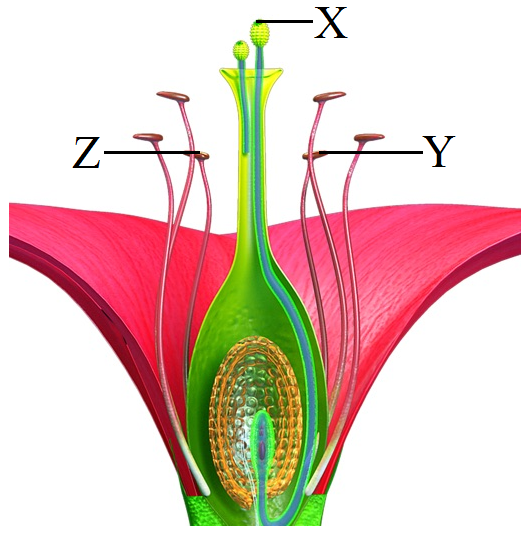
Cross pollination is the transfer of pollen grains from the anther of a one flower to the stigma of a genetically different flower. It is performed with the help of an external agency which may be abiotic (e.g., wind, water) or biotic (e.g., insects, birds, bats, snails). The diagram shows the carpel of an insect pollinated flower.

  1. What is the most likely reason for non germination of pollen grain Z?
  1. Pollen grains X and Y were brought to the stigma earlier, therefore, their germination inhibited the germination of pollen grain Z.
  2. Pollen grain Z was brought to the flower by wind, while pollen grains X and Y were brought to the flower by insect.
  3. Pollen grain Z lacks protrusions that allow it to adhere properly onto the stigma surface.
  4. Pollen grain Z comes from a flower of an incompatible species.
  1. Which of the following best describes the function of the pollen tube?
  1. It acts as a conduit to transport male gametes from the anther to the ovule.
  2. It acts as a conduit to transport male gametes from the stigma to the ovule.
  3. It contains key nutrients that serve to nourish the newly-formed zygote.
  4. It digests the tissues of the stigma, style, and ovary.
  1. Pollination of a flower in which the pollen is carried by an insect is called:
  1. Anemophily.
  2. Ornithophily.
  3. Entomophily.
  4. Malacophil.
  1. Refer to the given characteristics of some flowers.
  1. The stamens hang out of the flower, exposing the anthers to the wind.
  2. The pollen grains are tiny and light.
  3. The flower has a sweet scent.
  4. The flower petals are brightly colored.
  1. Pollenkitt is generally found in:
  1. Anemophilous flowers.
  2. Entomophilous flowers.
  3. Ornithophilous flowers.
  4. Malacophilous flowers.
How interesingly Gene is amplified by using PCR? Explain with diagram.
Explain different types of RNA along with process of transcription.
Read the following and answer any four questions from (i) to (v) given below:

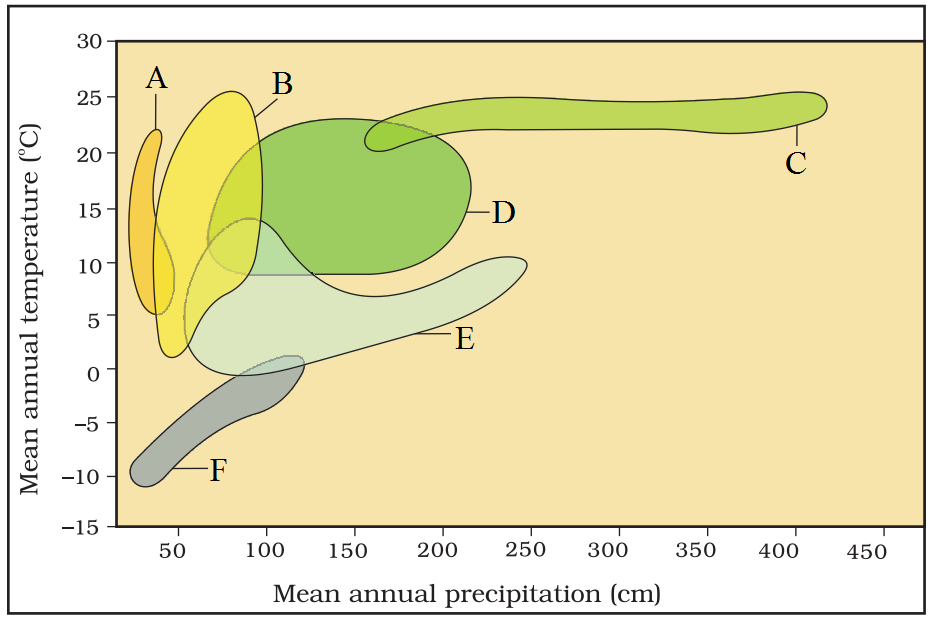
Organism P has thick lips and tongue so that it can easily feed on the commonly available spiny plants. Organism Q has thick layer of insulating fat under the skin. It was strong hooves to walk steadily on steep surfaces and lives in burrows during winters. Organism R has bright colours and sticky pads on its fingers and toes. It lives on trees.

  1. Which of the following is correct habitat for organisms P regarding its adaptation?
  1. Grassland biome.
  2. Desert biome.
  3. Tropical rainforest.
  4. Tropical deciduous forest.
  1. Which of the following is correct match regarding organism Q and its habitat?
  1. Tundra - Polar bear.
  2. Tropical rain forest - Deer.
  3. Grassland - Bighorn sheep.
  4. Desert - Camel.
  1. Which of the following is incorrect regarding organisms R's habitat?
  1. The vegetation shows stratification.
  2. Epiphytic growth is rich.
  3. Standing crop is highest.
  4. Deep rooted shrubs are common due to abundant sunlight.
  1. The dominant plants in habitat where P lives could be:
  1. Opuntia
  2. Nymphaea
  3. Deodar
  4. both (a) and (c).
  1. Organisms P, Q and R respectively most likely occur in:

  1. F, B and A.
  2. C, A, E.
  3. A, F and C.
  4. B, D and A.
Read the following and answer any four questions from (i) to (v) given below:

Unlike animals, plants cannot runaway for their defence, therefore, they have evolved an astonishing variety of morphological and chemical defences against herbivores. Thorns are the most common morphological means of defence. Many plants produce and store chemicals that make the herbivore sick when they are eaten, inhibit feeding or digestion, disrupt its reproduction or even kill it. Some plants produce highly poisonous chemicals and that is why no cattle or goats browse on those plants. A wide variety of chemical substances that we extract from plants on a conunercial scale are produced by them actually as defence against grazers and browsers.

  1. Why you never see cattle or goats browsing on weed Calotropisl?
  1. It produces highly poisonous tannins.
  2. It produces quinine which is bitter in taste.
  3. It produces poisonous cardiac glycosides.
  4. It bears prickles.


  1. What could be the possible reason for invasive growth of the prickly pear cactus introduced in Australia?
  1. Absence of predators.
  2. New mycorrhizal association.
  3. Abundant water availability.
  4. All of these.
  1. Which of the following is most likely to sick by consuming chemicals produced by plants?
  1. Frog
  2. Goat
  3. Human
  4. Pigeon
  1. Plant evolve variety of morphological and chemical defences against.
  1. Prey
  2. Predator
  3. Commenal
  4. Mutualist
  1. Assertion: Some plant functions as predator in nature.

Reason: Phytoph ago us insects feed on plant sap.

  1. Both assertion and reason are true and reason is the correct explanation of assertion.
  2. Both assertion and reason are true but reason is not the correct explanation of assertion.
  3. Assertion is true but reason is false.
  4. Both assertion and reason are false.
Nematode specific genes were introduced into the tobacco host plant using a vector:
  1. pBR 322.
  2. Plasmid.
  3. Bacteriophage.
  4. Agrobacterium.
Read the following and answer any four questions from (i) to (v) given below:

The endosperm makes the main source of food for the embryo. Generally the endosperm nucleus divides after the division of the oospore, but in several cases the endosperm is formed to a great extent even before the first division of the oospore. There are three general types of endosperm formation: (a) nuclear type, (b) cellular type and (c) helobial type. The endosperm is usually triploid, but haploid endosperm is also found. Endosperm may either be completely consumed by the developing embryo before seed maturation, or it may persist in the mature seed.

  1. Haploid endosperm is found in:
  1. Pin us.
  2. Cauliflower.
  3. Sunflower.
  4. Pea.
  1. Persistent endosperm is found in:

P. Pea Q. Castor R. Bean S. Coconut T. Groundnut.

  1. Q and S.
  2. P and T.
  3. R, S and T.
  4. P, S and T.
  1. Milk of tender coconut represents (A) and the surrounding white coconut meal represents (B).
S. No
A
B
(a)
Cellular endosperm
Free- nuclear endosperm
(b)
Free-nuclear endosperm
Cellular endosperm
(c)
Helobial endosperm
Cellular endosperm
(d)
Free-nuclear endosperm
Helobial endosperm
  1. If an endosperm cell of a gymnosperm contains 12 chromosomes, the number of chromosomes in each cell of the root will be:
  1. 4
  2. 24
  3. 16
  4. 6
  1. In angiosperms, normally after fertilization:
  1. The zygote divides earlier than the primary endosperm nucleus.
  2. The primary endosperm nucleus divides earlier than the zygote.
  3. Both the zygote and primary endosperm nucleus divide simultaneously.
  4. Both the zygote and primary endosperm nucleus undergo a resting period.
Explain incomplete dominance in dog flower (snapdragon or Antirrhinum sp.) with the help of a chart.###During monohybrid experiment, in F 2 generation, the ratio of phenotype & genotype remains same - explain by giving suitable example (chart is necessary).
Write a short note on endosperm development.
Describe different outbreeding devices in detail.###Describe different devices to discourage self pollination.###Describe different devices to encourage cross pollination.