MCQ
Microscope is an optical instrument which
  • A
    Enlarges the object
  • Increases the visual angle formed by the object at the eye
  • C
    Decreases the visual angle formed by the object at the eye
  • D
    Brings the object nearer

Answer

Correct option: B.
Increases the visual angle formed by the object at the eye
In microscope final image formed is enlarged which in turn increases the visual angle.

Need a full question paper?

Generate a complete, print-ready paper with questions like this in minutes — across 16+ boards, with answer keys.
Start Generating Free

Similar questions

Which of the following statements indicates that light waves are transverse
A man does a given amount of work in $10 \mathrm{sec}$. Another man does the same amount of work in $20 \mathrm{sec}$. The ratio of the output power of first man to the second man is
Two wires of the same material have lengths in the ratio $1: 2$ and their radii are in the ratio $1: \sqrt{2}$. If they are stretched by applying equal forces, the increase in their lengths will be in the ratio
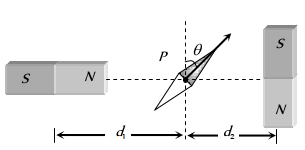
Two magnets $A$ and $B$ are identical and these are arranged as shown in the figure. Their length is negligible in comparison to the separation between them. A magnetic needle is placed between the magnets at point $P$ which gets deflected through an angle $\theta$ under the influence of magnets. The ratio of distance $d_1$ and $d_2$ will beImage
A particle is tied to $20 cm$ long string. It performs circular motion in vertical plane. What is the angular velocity of string when the tension in the string at the top is zero
Two electric lamps of $40$ watt each are connected in parallel. The power consumed by the combination will be
A transverse wave is represented by the equation $y=y_0 \sin \frac{2 \pi}{\lambda}(v t-x)$
For what value of $\lambda$, the maximum particle velocity equal to two times the wave velocity
If wavelength of a wave is $\lambda=6000 \mathring A$. Then wave number will be
In a sinusoidal wave, the time required for a particular point to move from maximum displacement to zero displacement is $0.170$ second. The frequency of the wave is
A particle moving with a uniform acceleration travels $24 m$ and 64 $m$ in the first two consecutive intervals of $4 sec$ each. Its initial velocity is